DD
MM
YYYY

PAGES

DD
MM
YYYY

spot_img

PAGES

Home Blog Page 5981

Does Agriculture Really Mean Peace in Nigeria?

0
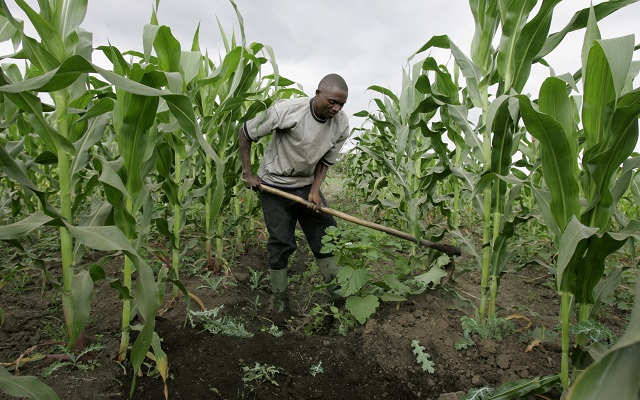
A farmer prepares water channels in his maize field in Ngiresi near the Tanzanian town of Arusha on Tuesday, July 17, 2007. Millions of farmers around the world will be affected by a growing movement to change one of the biggest forces shaping the complex global food market: subsidies. Many experts agree farmers need help to grow food year in and year out, but Western farmers may get too much and African farmers too little. (AP Photo/Karel Prinsloo)

In any country, agriculture is the father of all industries. From developed to developing countries, other industries and sectors including markets within the duo cannot survive without receiving inputs in forms of finished or semi-finished products from the agriculture industry. In spite of the significant place of agriculture in human and organisational survival, in developing countries such as Nigeria the industry is suffering due to a number of factors.

Poor spending on agriculture and citizens’ interest in the industry remain low despite the availability of arable lands for production and possible jobs. Between 2001 and 2005, less than 2% of total federal expenditure was allotted to agriculture. From 2006 to 2020, the spending on the industry by the federal and state governments is not quite different. The poor spending has raised many issues among the public analysts and investors who believe that agriculture requires more attention if truly the governments want to achieve economy diversification agenda, from oil dominated to multi-economy.

Since agriculture provides what people eat and industries use, Nigeria has continued to have a low human development index occasioned by the poor attention to the industry. Over the years, our checks reveal that the Nigerian government at state and federal levels have had varied policies towards the industry development. The outcomes remain mixed. It is not clear whether the country is making significant progress or not.

This, according to our analyst, is largely due to the failure of the governments to address insecurity, irregular inflation rate growth, drought, earthquake, floods and systemic corruption among the agencies saddled with the responsibility of delivering policy goals and objectives. In the North-Eastern Nigeria, the Boko Haram insurgency has led to heightened levels of displacement, leading to non-availability of food and restricting individuals’ ability to access it.

In the last five years (2016-2020), analysis shows that the level of consuming meat product of beef, pig, poultry and sheep had positive and negative connections. The more Nigerians [including industrial use] consumed beef meat the more they devoured pig meat. According to our analysis, one unit of beef meat consumption increased consumption of pig meat by 45%, while it reduced consumption of poultry and sheep by 88.3% and 90.4% respectively. In our analysis, we only found positive linkage between poultry and sheep consumption in the last 5 years. One unit of consuming poultry meat in metric tons led to more than 99% of consuming sheep meat. On average, over 1.6 million metric tons of beef, more than 1 million of metric tons of pig meat, over 912,000 metric tons of poultry meat and over 2.3 million metric tons of sheep meat were consumed during the period.

In the next 5 years, our analysis suggests that the consumption of one unit of beef meat would lead to 15.6% increase in consuming pig meat, while it would be a 45.1% increase in devouring poultry meat. However, the level of consuming sheep is expected to be reduced by 96.2%, while the consumption of sheep meat would be increased by the same percent. By 2025, our analysis indicates that pig and poultry meat consumption would connect negatively, signifying that the more people and industries consume pig meat, the less they would consume poultry meat [-70.7%].

The negativity would be less for sheep meat consumption. We found a 38.4% reduction in consuming sheep meat, while it was positive for pig meat consumption. Sheep meat consumption would also have the same outcome. One unit of consuming poultry meat would reduce consumption of sheep meat by 20.3%. On average, over 1.5 million metric tons of beef meat more than 1 million metric tons of pig meat, over 912,000 metric tons of poultry meat and over 2.3 million metric tons of sheep meat would be consumed by 2025.

Exhibit 1: Meat Consumption in Million Metric Tons
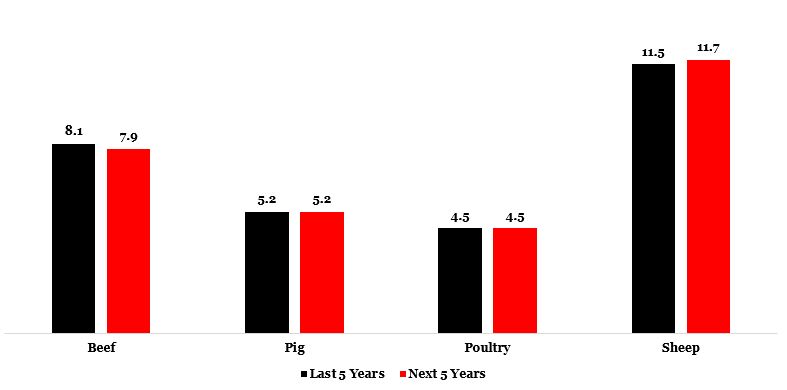
Source: FAO Statistics, 2020; US Department of Agriculture 2020; Infoprations Analysis, 2020

What Do We Need?

Looking at our current analysis, insights and those in the public domain, it is clear that federal and state governments should do more to enhance agriculture industry, especially building sustainable security architecture for farmers and distributors. When farmers and distributors are at peace, final consumers would not be starved. When farmers and distributors are protected, inflation driven food prices and unemployment rates would be reduced. These have been discovered by academic and industrial researchers many years ago.
Why Central Bank of Nigeria Must Not Listen To Money Transfer Operators On USD Remittance Payments

18
The Central Bank of Nigeria made a very great call a few weeks ago, by mandating banks to pay diaspora remittance in US dollars in Nigeria, discarding an old practice where people whose family members had sent dollars were paid in Naira, using the official exchange rate. I noted that the decision by the apex bank was a great one, as that decision would improve supply of dollars in the nation, with the resulting impact of reducing the pressure on naira against US dollars. But some industry players are not happy with this new policy.
In a report by Nairametrics, the Association of Licensed Mobile Payments Operators (ALMPO)  is asking the apex bank to reverse the payment in dollars of these remittance transactions. Largely, they want to continue to receive the US dollars and pay people in Naira, making money on the exchange rate differential.  The new CBN policy has forced them to rely entirely on transaction commissions.

“The CBN’s decision to restrict international remittances to USD payouts only is the overarching concern of everyone. It certainly limits the number of Nigerian citizens that can conveniently access funds sent from the diaspora. I sincerely hope that CBN reconsiders its position on this, and re-allow Naira payments in cash or into accounts or wallets,” Jay Alabrabra, Chairman of ALMPO, Mr. Jay Alabrabra.

These payment operators are not fair on this request; they are looking out for themselves and not the citizens. Nothing stops any receiver from asking a bank to pay in Naira, and that payment will likely be at a better exchange rate since the bank will know the person can ask for the dollars, and walk out, and change them in bureau de change. Technically, there is no way this new policy is limiting the “number of Nigerian citizens that can conveniently access funds sent from the diaspora”.

What is happening here is clear: CBN asked banks to close the  Naira accounts of these operators, and that simply meant they have been disintermediated in the system. As I noted, if the money was sent in US dollars and would be paid in US dollars, the phase in the chain where they operate in Nigeria has been eliminated. By the appeal, they are asking the government to make them relevant again.

But from my understanding, this is what CBN is doing here: in the past, when you wired USD, Euro or any foreign currency from abroad to Nigeria, you were paid in Naira, determined by the CBN official exchange rate. The IMTOs maintained a special purpose naira account to work on that reconciliation between the USD, etc they had received, say in the US and UK. and the naira they have settled in Nigeria.

But under the new CBN policy, where the USD or Euro is paid in the same currency in Nigeria to the recipient, there is practically no need for IMTOs to run a naira account. In other words, they have been disintermediated in the system locally. What happens is this: it is now between CBN and IMTOs offshore offices, and CBN and local banks since one currency is involved. The IMTOs local naira accounts are now redundant and of no value.  (They can of course run the usual current and saving accounts).

The apex bank should not listen to them: they can pivot to other sectors in the economy, and not just depend on the arbitration on exchange rate to make a living in Nigeria. Indeed, there are some sectors which Nigeria must be bold to phase out if we expect the economy to be transformed.

Why Central Bank of Nigeria Asked Banks To Close Naira Accounts of Money Transfer Operators

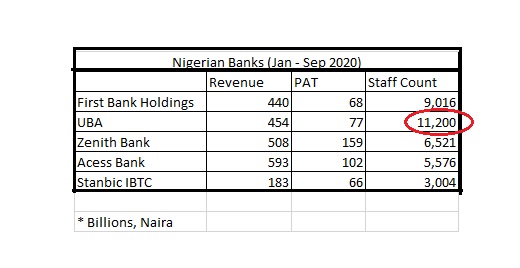
The Productivity in Nigerian Banking (One Table)

1

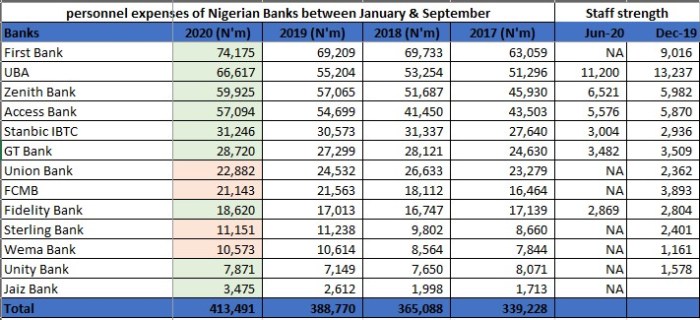
On staff count, UBA seems to be using many more workers in its business. First Bank Holdings includes both the bank and other subsidiaries. And yet, even with that, UBA has more staff than First Bank Holdings. Though not included in the table, GTBank employs about 3,500 people with a revenue number that tracks Zenith Banks and profit of N142 billion within the 9 month under examination. Indeed, UBA has to improve its productivity as the numbers seem extremely out of phase with peers.

GTBank remains the most capitalized bank in Nigeria at N965 billion, followed by Zenith Bank at N769 billion.

Source: Nairametric, Bank Annual Reports

Meanwhile, the fintech startups are coming after these profits. OPay plans to hit a transaction volume of $2 billion by the end of 2021. That would make it one of the most important financial institutions in Africa. OPay, according to the company, currently processes about 80% of transfers among mobile money operators in Nigeria and 20% of non-merchant point of sales transactions. If that trajectory continues, OPay could be at the center of Nigeria’s consumer sector.

OPay, a Nigerian fintech startup founded by Opera, plans to expand its payments service operations to North Africa early next year after Covid-19 restrictions led to a spike in transactions on its platform.

The volume of monthly settlements on the OPay platform grew almost fourfold to $1.4 billion in November from $363 million in January, as people sought alternative payments services during coronavirus-induced lockdowns, the company’s managing director, Iniabasi Akpan, said in an interview from Lagos.

[…]

We plan to reach transactions value of about $2 billion by the end of this year. The company will leverage its network of 300,000 offline agents to deepen the adoption of its payments service. The company is now planning an entry into the north African market after its success in Africa’s most populous country. The process has begun and we will see how the first quarter turns out.”


Bank personnel (source: nairametric)


The UK Finally Secures A Brexit Deal

0

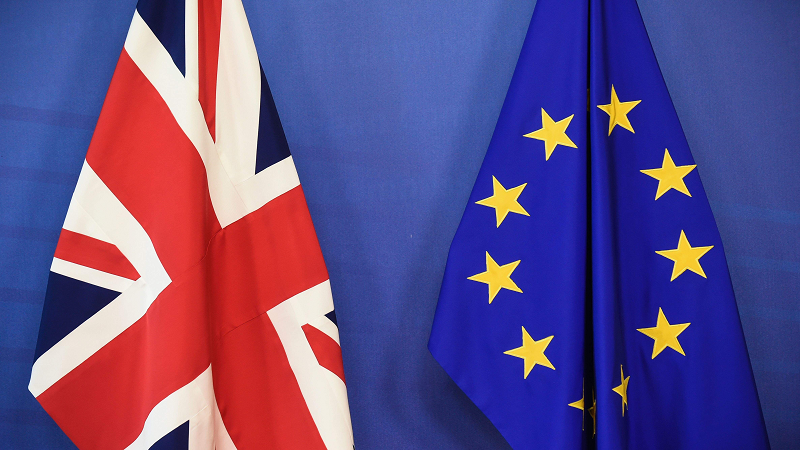
The UK finally made a Brexit and security deal with the EU, averting a “no deal” exit from the bloc eight days before the December 31 deadline.

The prolonged negotiation placed both the EU and Britain on a difficult path, as both sides are still battling the COVID-19 pandemic. The deal which upholds the existing zero-tariff zero-quota agreement on imports and exports valued at £668bn ($771bn) has set a new record in the history of the former partners.

While British Prime Minister Boris Johnson still has a battle of approval to face at home, many Britons think it was a great deal.

“Deal is done. Everything that the British public was promised during the 2016 referendum and in the general election last year is delivered by this deal.

“We have taken back control of our money, borders, laws, trade and our fishing waters.

“The deal is fantastic news for families and businesses in every part of the UK. We have signed the first free trade agreement based on zero tariffs zero quotas that has ever been achieved with the EU,” a UK source said.

As the deadline for the deal drew near, talks between both sides were dragging along fishing right on British waters, with British Health Minister Matt Hancock accusing the European Union of making unreasonable demands to hinder a deal.

The final push for the deal which hung on giving EU ships access to British fishing waters and a “level playing field” on standards and state aid, was settled in the eleventh hour and documented in 2,000-page legal text to end the over four years negotiation.

What the deal means for both sides.

The UK source said the deal would end free movement and allow the introduction of a points-based immigration system. It will also end the seamless trade with the bloc that UK is currently enjoying in the single market, and introduce new border checks on UK goods.

Also, bureaucracy bottlenecks created by the new deal means that traders will fill an estimated 200 million customs declarations a year, a development an official said would cost the UK 4% of GDP in the long term compared to staying in the bloc.

However, the deal will require ratification by EU leaders who are expected to give provisional approval for the deal so that it can come into effect this year.

Independent reported that the ratification will pave way for a treaty governing trade between the former partners on the basis of zero tariffs and zero quotas, as well as future co-operation in areas such as security and law and order.

But if the EU leaders fail to ratify the deal, a short period of no-deal could still happen in early January.

In the UK, MPs and peers are expected to reconvene in Westminster on 30 December to rush the agreement into law in a single day.

But that is not certain as division along party lines is posing a challenge that may jeopardize the deal. Independent reported that hardline Brexiteers on the backbench Tory European Research Group have signaled that they are not prepared to act as a rubber-stamp. Consequently, they are reconvening their Star Chamber of legal experts led by Sir Bill Cash to examine the documents to see if any part of it undermines UK’s sovereignty.

Who wins?

The Brexit deal comes at a time when the UK is struggling to keep its economy battered by the pandemic afloat. Experts believe the deal should give a short-term boost to the economy, but the trade agreement will still leave the country poorer as it battles with its worst recession in 300 years.

The UK enjoyed trade rights and benefits that it is no longer entitled to due to the deal, and will have to reel through the consequences amidst economic chaos.

“The United Kingdom has chosen to leave the European Union and the single market, to renounce the benefits and advantages held by member states. Our agreement does not reproduce these rights and benefits, and therefore despite this agreement there will be real changes in a few days from now,” said EU chief negotiator Michael Barnier.

The UK’s win is based mainly on avoiding a “no deal” Brexit. CNN noted that the deal seems to mostly cover trade in goods, where the United Kingdom has a deficit with its EU neighbors, and excludes key service industries like finance, where it currently enjoys a surplus.

“The good news is that a disruptive and acrimonious ‘no deal’ has been avoided. The bad news for the UK in our view, is that the EU appears to have secured a deal which allows it to retain nearly all of the advantages it derives from its trading relationship with the UK, while giving it the ability to use regulatory structures to cherry pick among the sectors where the UK had previously enjoyed advantages in the trading relationship,” JPMorgan’s Malcolm Barr wrote in a research note.

Central Bank of Nigeria Revokes Licenses of 7 PSPS and 1 SSP

0

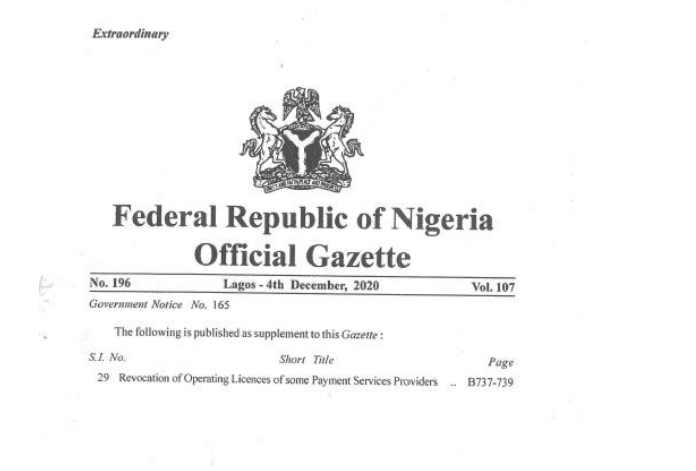
The Central Bank of Nigeria (CBN) has revoked the operating licenses of 7 payment service providers and one switch service provider. These entities have failed to meet their statutory obligations, according to a  Federal Republic of Nigeria Gazette.

The 7 payment service providers are:

  • Easifuel Limited
  • Transaction Processing System (TPS)
  • Grand Towers Limited
  • Paymaster Limited
  • E-Revenue Gateway Limited
  • Eartholeum Network Limited
  • Globasure Limited.

The affected switch service provider is 3Line Card Management Limited.