Topic: The 2021 Outlook in Nigeria, Africa & Global: Growth After A Redesign
Date: Saturday, Dec 12, 2020
Time: 4pm – 5.30 pm WAT
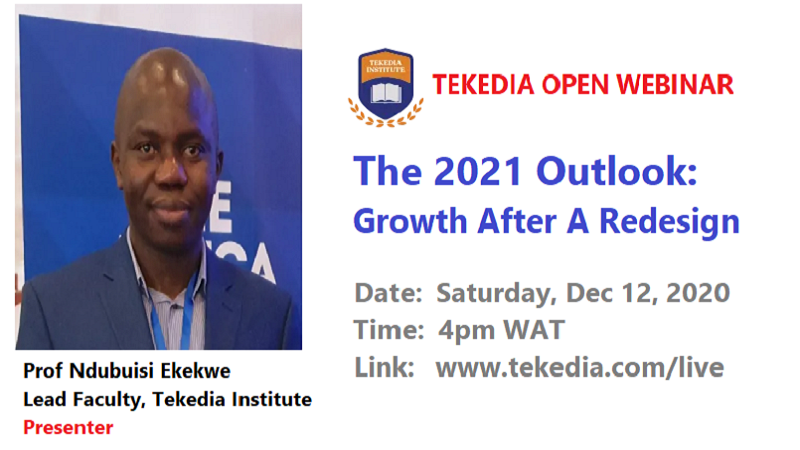
Presenter: Prof Ndubuisi Ekekwe, Lead Faculty, Tekedia Institute
Zoom Link: {completed]
About Tekedia Institute
Tekedia Institute offers an innovation management 12-week program, optimized for business execution and growth, with digital operational overlay. It runs 100% online. The theme is Innovation, Growth & Digital Execution – Techniques for Building Category-King Companies. All contents are self-paced, recorded and archived which means participants do not have to be at any scheduled time to consume contents.
It is a sector- and firm-agnostic management program comprising videos, flash cases, challenge assignments, labs, written materials, webinars, etc by a global faculty coordinated by Prof Ndubuisi Ekekwe.
Greetings. Thanks for joining us at Tekedia Institute for the webinar on “The 2021 Outlook – Growth After A Redesign”. The video is now available.
As noted, here are elements we need to consider as we build for 2021:
Hybridized Supply Chain: Flexible, adaptive, global and local, at the same time.
Remote Everything: The web will run the world across sectors.
Digitization and Cloud Migration: The pace will accelerate.
Semi-automation: Disintermediation of humans will accelerate.
If you are selling or offering services, find how to deliver services in or around these elements because they will drive business, in the next coming years in Nigeria, and Africa, in general.
Tekedia Institute is a United States/Nigeria-based institution with focus on business management and leadership development. It runs a popular training program called Tekedia Mini-MBA which has been attended by professionals from at least 30 countries.
The oil market heaved a sigh of relief on Thursday in London following the commencement of COVID-19 vaccine inoculation. Global benchmark futures surged 2.8% to climb above $50 per barrel, reaching a nine-month high.
The gain marks a significant market rebound since the oil industry came under the heavy weight of coronavirus.
Moderna andPfizer announced the success of their respective vaccines trials, boosting the chance of global economy rebound and accelerating the pace of oil market recovery. The weakened U.S. dollar is also a factor in the oil price increase. Bloomberg said it raised the appeal for commodities priced in this currency and helped thrust Brent past $50.
Though it is expected that vaccine rollouts would spur the oil market recovery, analysts are surprised it is coming this fast.
“I am a bit surprised that it happened now. I have been advocating $50+ Brent, but I thought that would happen after we see inventories and demand look better,” Bart Melek, the head of global commodity strategy at TD Securities.
Bloomberg reported that key technical indicators are signaling that benchmarks are overbought and U.S. inventories recently are piling higher, which suggest the possibility of the market getting ahead of itself.
Data from Energy Information Administration said U.S. inventories expanded a whopping 15.2 million barrels last week in the biggest build in government data going back to 1982, with the exception of one week in April. At the same time, domestic gasoline demand is the lowest it has been for this time of year since 1997.
The report noted that supply and demand dynamics have drastically improved from just a few months ago. Inventories are drawing down globally, and there are signs the market is handling increased output better than anticipated. But, it will be months before the vaccine is distributed widely enough to fully reopen the economy.
“The distinct FOMO-type shift in financial market sentiment is supported by a global physical market that is absorbing barrels at a more robust-than-consensus pace,” RBC analysts including Helima Croft and Micheal Tran said in a report. “Asia refinery runs remain firm, global floating storage levels are being dismantled at a vigorous pace and European mobility is accelerating amid loosening regional lockdowns.”
Some measures by oil exporters which include keeping a tight rein on output, contributed to the astonishing surge, and there are indicators that it will be sustained in the long term.
The Bloomberg report noted that the swift reshaping along oil’s forward curve underscores the confidence in a long-term recovery. The curve is now trading in a structure known as backwardation that makes it profitable to roll contracts from one month to the next, which is also attracting a rush of new flows to the market.
The signals are notable across continents even amidst the economic pressure stemming from the second wave of COVID-19.
There are glimmers of a recovery in Europe in addition to Asia’s full-throttle return. The U.K., which emerged from a second lockdown this month, saw road fuel sales jump by almost 10% last week. Fuel use in Brazil has surpassed pre-virus levels. Still, it’s a less certain picture in the U.S., where gasoline consumption has dropped to the lowest since May, the report said.
Good and bad news for Nigeria.
Africa’s largest oil producer Nigeria has a tough future to reckon with as the price surges. The largest economy in Africa removed fuel subsidy earlier in the year as she gears toward full deregulation, which means, the Nigerian oil market now sells at international market price.
While the rising oil price will put more money into Nigeria’s government purse and help stabilize naira, the country’s currency, against dollar, it will spark industrial action as the cost will gradually become unaffordable.
In September, Nigerian labor unions were close to embarking onindefinite nationwide strike following an increase in the price of fuel. It was aborted when the negotiations between government and labor unions yielded adeal that includes the exclusion of minimum wage earners from income tax.
Pump price in Nigeria has been moving up and down since the removal of the fuel subsidy. Each time it goes up, uproar follows, signaling that there would be a showdown between Nigerian government and its people when the global economy fully recovers and the oil market bounces back.
Nigeria is facing its worst recession in decades, degenerating its revenue woes, and thus cannot afford to subsidize fuel for now. On the other hand, the larger number of Nigerians living on N30,000 ($80) monthly minimum wage or less, cannot afford to buy fuel at international price.
Against this backdrop, the rising oil price is to Nigeria, a test of economic dichotomy.
After 162 exclusive webinars, anchored by industry leaders, across sectors and geographies, Tekedia Institute will close the year with an open and public one, titled ” The 2021 Outlook in Nigeria, Africa & Global: Growth After A Redesign”. We invite you to join us today at 4pm WAT. Prof Ndubuisi Ekekwe, the Lead Faculty of the Institute, will handle the session. It will run in the format of Tekedia Mini-MBA Live Zoom session.
Topic: The 2021 Outlook in Nigeria, Africa & Global: Growth After A Redesign
Date : Saturday, Dec 12, 2020 (i.e. today)
Time: 4pm – 5.30 pm WAT
Presenter: Prof Ndubuisi Ekekwe, Lead Faculty, Tekedia Institute
Tekedia Institute is a United States/Nigeria-based institution with focus on business management and leadership development. It runs a popular training program called Tekedia Mini-MBA which has been attended by professionals from at least 30 countries.
Far from other continents in the world, African businesses and creative people have been denied the full benefits of their ideas or innovations. From Nairobi to Lagos and Johannesburg to Cairo, pirated copies of creative works are everywhere. This has largely been linked to the poorer institutional and legal framework for intellectual rights protection on the continent.
What African Entrepreneurs Need to Know About Filling and Protecting PIP
Patent in Africa is not an easy task and not protecting one’s invention is never an option. Patent aims to give patent holder time to capitalize on their investment and promote investment. Protection of intellectual property is significant as it sets one’s business apart from competitors. It can be sold or licensed which provides an important revenue stream. It also forms an essential part of marketing or brand.
All business has intellectual property worth protecting regardless of the size and sector. Intellectual property could be brand, investment, design or any kind of creation. Intellectual property is more democratic in the sense that you do not need large capital or goods to generate more capital but brain, intellect and creativity.
From the north to the east and south to the west of Africa, businesses and creative people need to know that protecting their works is very imperative. It has numerous benefits. Over the years, those in advanced economies have been capturing value from their patents and trademarks. In our experience, we have learnt that patent and trademarks are part of strategic capital that businesses and people convert into value [monetary].
When one intends to file a patent or trademark, there are a number of national, regional and global bodies for it. The World Intellectual Property Organisation is the largest body, which has more than 45 million records from some 55 national and international collections. A click on the body’s official website gives clues of what is required to understand availability or the otherwise of a patent or trademark globally.
Our check shows that a total of 2,680,900 patent applications were received by the body in 2014. Africa had 180,300 resident applications and 880, 600 non-resident applications. This is not quite different from what the continent had between 1995 and 2010. Between 2015 and 2018, South Africa filed resident patents than Nigeria and Ghana, analysis reveals. In a recent research, it also emerged that the majority of patent filings in Africa are from Europe, the United States, and other high income countries. Yet, in South Africa, between 15% and 20% of patent filings are by residents of South Africa, and 3% are from other developing and emerging economies. Only a small share of inventions globally are made in sub?Saharan Africa, but for those inventions that do arise in Africa, foreign filings are made widely outside of Africa. Trademark seems the most active IPRs in sub-Sahara Africa most especially in Kenya, Ghana, Gambia, Nigeria, and South Africa. This is the area of IPRs which had witnessed numerous applications from nationals of the region.
The Struggle to Protect PIP
In Africa, due to the poor legal system, protecting a patent is not advisable and can be immaterial and this is majorly as a result of a flawed legal system. Archaic old laws are another serious problem that must be faced in tackling one of out of many challenges we have as regards patent in Africa. Lack of enforceability is an aggravation of archaic laws. Lack of expertise in court to deal with intellectual property matters is also an issue. Basically, there are laws regulating intellectual property, but these laws are neither enforced nor effective. It is safe to say new legislations at this point are not remedies, but enforcement of the already laid down legislations.
Registering patent can be time consuming and lengthy process. Typically, 3-4 years and market may change or technology may overtake invention by the time an inventor gets patent. It is costly, whether the patent holder or business holder is rich or not due to the application and search for existing patents. It is however important to note that the potential for making profit should outweigh the time, money and effort it takes to maintain a patent because not every patent has financial value. This implies that the whole patent, registering must be worth the whole stress and profitable in a way that it outweighs the amount being spent.
Despite the fact that a business, regardless of the size ought to be patented, it is not a smart move to patent when it is not beneficial. In Nigeria, even the due to the active nature and awareness surround IP protection and the development of a number of institutions responsible for protecting it, they still lack the explicit policy and legislative backing.
To Increase Innovation Ecosystem, African Leaders Need to Ensure Sustainable PIP Protection
To increase innovation ecosystem, our analyst notes that African leaders need to ensure sustainable patent and intellectual property protection. This is highly imperative in Nigeria, Kenya, Tanzania, Uganda and other countries where failure to file patent and trademark is reducing innovation output.
In our analysis, we found no significant difference between the innovation output of Nigeria and South Africa in 3 years [2017 to 2019]. However, we discovered the difference between Kenya and Uganda’s innovation output during the period. There was a significant difference between Nigeria and South Africa intellectual property protection during the period. South Africa has better intellectual property protection environment than Nigeria.
During the years, our analysis reveals that Nigeria, Ghana, Tanzania, Kenya, Uganda and South Africa intellectual property protection and innovation output related negatively. We found -76.6% connection. This indicates that the higher the poor intellectual property protection the less businesses and people innovated in the countries between 2017 and 2019. The intellectual property protection capability of the governments of select countries only contributed 58.7% to the innovation outputs.
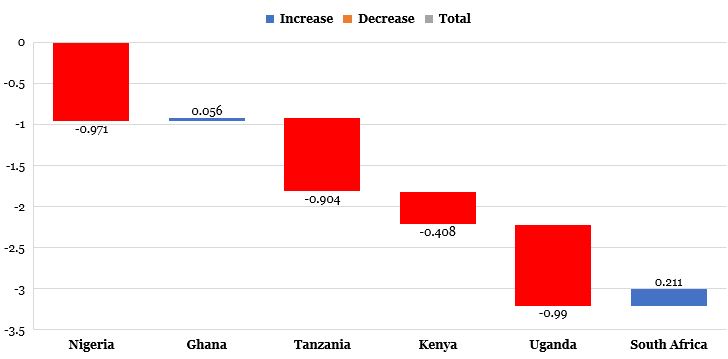
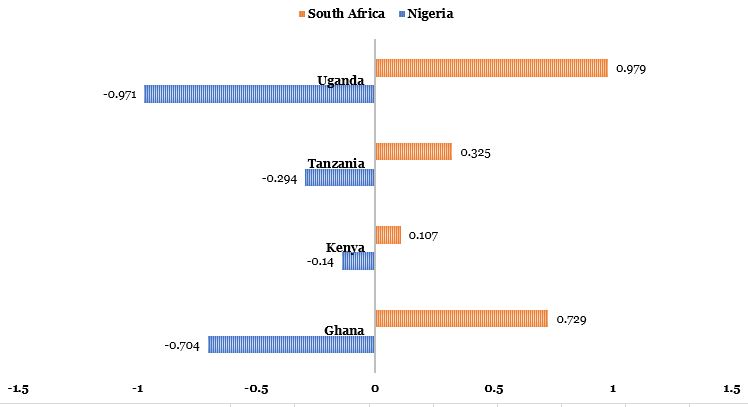
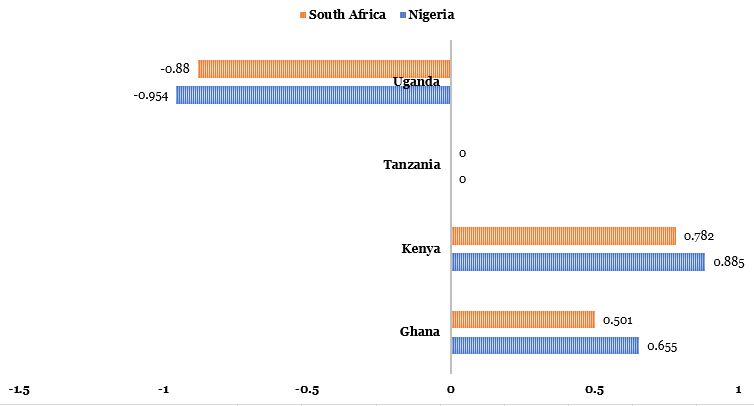
Shielding, Nigeria and South Africa for proper understanding of submitting patent and trademark applications in relation to other countries, analysis shows that the higher Nigeria filed patent, the less other countries did. This is differed from what we found for South Africa [see Exhibit 2]. For the trademark applications, we found mixed results [see Exhibit 3].
Exhibit 1: Link Between Intellectual Property Protection and Innovation Output (2017-2019)
Source: Global Competitiveness Index, 2020; Global Innovation Index, 2020; Infoprations Analysis, 2020
Exhibit 2: Patent Applications
Source: World Intellectual Property Organisation, 2020; Infoprations Analysis, 2020
Exhibit 3: Trademark Applications
Source: World Intellectual Property Organisation, 2020; Infoprations Analysis, 2020
Strategic Options
Laws. There are initiatives that the continent should tap into like ensuring basic and enabling laws are up to date and in line with global trends.
Policy. Articulating national innovation policy goals and objectives, milestones and a clearly identifiable plan of action which advance effective policy goals by setting up a specific commission or agency charged with the responsibility for addressing challenges in each sector. A good example is the Nigerian Copyright Commission (NCC) which has accomplished several milestones in the Copyright sector.
Empowerment. Empowering agencies with the requisite tools and funding to enable them to achieve their industrialisation, innovation and development aspirations. A need to design a systematic process for teaching, training and supporting our creators and innovators. Part of these initiatives involve the training of law students, lawyers and judges on the fundamentals of IP law and enforcement, and on the drafting of statutes in the IP sector.
Collaboration. The collaboration of the various agencies of government with a bearing on innovation and development is vital in achieving national goals in the long run. Much like the importance of regional is strength and weaknesses of member nations to advance our common economic goals.
It is important that the government take note of the factors hindering the growth and effectiveness of patent and intellectual property as a whole and take active measures to face these factors or challenges for rapid growth.