DD
MM
YYYY

PAGES

DD
MM
YYYY

spot_img

PAGES

Home Blog Page 6

Volkswagen Targets 20% Cost Reduction by 2028 Amid 35,000 Job Cuts Plan, China Market Slowdown and U.S. Tariffs

0

Volkswagen plans to cut costs by 20% across all brands by the end of 2028, according to Manager Magazin.

The move comes as Europe’s largest carmaker seeks to reinforce its balance sheet against rising expenses, intensifying competition in China, and U.S. tariff pressures.

Chief Executive Oliver Blume and finance chief Arno Antlitz presented what the publication described as a “massive” savings plan during a closed-door meeting with top executives in Berlin in mid-January.

A company spokesperson said Volkswagen began a group-wide cost programme three years ago and has already achieved savings in the double-digit billion-euro range, helping to offset geopolitical headwinds such as U.S. tariffs. Further details on where additional reductions will be implemented were not disclosed.

China, Tariffs, and Technology Costs

Volkswagen’s push comes amid mounting structural challenges across its core markets.

In China, once the company’s most profitable region, German automakers are contending with an aggressive price war led by domestic electric vehicle manufacturers. Local brands have combined competitive pricing with advanced software features and shorter development cycles, eroding the traditional advantages of European incumbents.

At the same time, the group faces elevated development costs tied to parallel investment in combustion engines and electric drivetrains. According to Manager Magazin, expenditures on software and dual powertrain development remain significant, straining margins during a period of slower global demand growth.

While Volkswagen operates production facilities in North America, transatlantic trade tensions and shifting industrial policy, marked by U.S. tariffs, continue to complicate supply chains and cost structures.

Speculation that plant closures could form part of the savings drive has drawn attention from labor representatives. Daniela Cavallo, head of Volkswagen’s works council, acknowledged the report but referenced an agreement reached with Volkswagen AG at the end of 2024.

“With this agreement, we have expressly ruled out plant closures and layoffs for operational reasons,” Cavallo said in a statement.

Volkswagen is already undertaking a major workforce restructuring. The company is cutting 35,000 jobs in Germany by 2030 as part of its competitiveness programme. In January, the core Volkswagen brand said it would reduce management positions and consolidate its production platform, targeting €1 billion in savings over the same period.

The balance Volkswagen must strike is delicate: delivering structural cost reductions while maintaining labor peace in Germany, where worker representation on supervisory boards carries significant influence.

Industry-Wide Cost Discipline

The tightening environment is not limited to Volkswagen. Mercedes-Benz said last week that profit margins at its automotive division could decline further this year and pledged “relentless cost discipline.”

Across Europe’s auto sector, manufacturers are grappling with:

  • Slowing electric vehicle demand growth in some markets.
  • High capital expenditure is tied to electrification and digitalization.
  • Competitive pricing pressure from Chinese entrants.
  • Regulatory requirements are pushing low-emission vehicle development.

Volkswagen, headquartered in Wolfsburg, said on Friday it remains committed to its long-term transition toward more efficient and low-emission vehicles, signaling that cost-cutting will not reverse its electrification trajectory.

Platform Consolidation and Brand Synergies

A 20% cost reduction across all brands implies deeper integration within Volkswagen Group’s multi-brand structure, which includes mass-market, premium, and performance marques. Analysts expect further consolidation of vehicle platforms, shared software architectures, and streamlined procurement to deliver scale efficiencies.

Improving inter-brand cooperation — long a challenge within the group’s decentralized structure — may become a key lever. Shared development of battery systems, software stacks, and manufacturing modules could reduce duplication and accelerate time-to-market.

The emphasis on software spending also reflects Volkswagen’s ongoing efforts to strengthen in-house digital capabilities after earlier setbacks in its software division. Containing those costs while remaining competitive in vehicle intelligence and connectivity will be central to margin stabilization.

Blume is expected to provide further details at Volkswagen’s annual results press conference on March 10.

The 20% target underscores the scale of the adjustment facing Europe’s automotive champions. With China no longer delivering easy growth, U.S. trade policy adding volatility, and technology investments compressing returns, German carmakers are entering a phase defined by capital discipline and structural reform.

Vitalik Warns Prediction Markets Face Collapse Without Fix on Directions

0

Ethereum co-founder Vitalik Buterin recently expressed serious concerns about the current state of decentralized prediction markets, warning that without a major shift in direction, they risk long-term unsustainability or collapse.

In a detailed post on X, Buterin acknowledged the successes of platforms like Polymarket—high trading volumes, the ability to support full-time traders, and their role as a news supplement.

However, he argued they are “over-converging” on an unhealthy product-market fit: focusing heavily on short-term cryptocurrency price bets, sports wagering, and other high-dopamine activities that provide momentary excitement but little long-term societal value or informational utility.

He described this as a slide toward “corposlop” (corporate slop), driven by platforms chasing revenue in tough markets by catering to “naive traders”—uninformed participants who consistently lose money, effectively subsidizing “smart traders” who profit from better information.

Buterin outlined three main types of participants who absorb losses in prediction markets: Naive traders (current dominant model): People betting on bad ideas, which he sees as morally neutral in isolation but “cursed” when over-relied upon, as it incentivizes platforms to encourage poor decision-making and exploitative communities.

Info buyers; decision markets where organizations pay for information: Limited by public goods problems, as info benefits everyone for free. Hedgers (his proposed solution): Users who accept expected losses (-EV linearly) for risk reduction, like insurance.

He advocated pivoting strongly toward generalized hedging as a more sustainable path. Examples include: Betting against politically unfavorable outcomes to offset portfolio risks like holding biotech stocks while hedging election risks.

A radical vision: Replacing fiat/stablecoins entirely with personalized baskets of prediction market shares tied to individual future expenses such as housing, food, regional goods/services. AI/LLMs could customize these baskets, providing true stability without relying on centralized currencies.

For this to work, markets would need to be denominated in desirable assets; interest-bearing ones, ETH, or wrapped stocks to avoid high opportunity costs. Emphasizing the risk of collapse if platforms continue depending on speculative gambling during bear markets, rather than evolving into robust hedging tools.

His core warning is that the sector’s current trajectory—dominated by short-term, high-dopamine speculation on crypto prices, sports, and similar events—creates an unsustainable model reliant on “naive traders” who consistently lose money.

Without a pivot, he argues, these markets risk collapsing or stagnating, especially in bear markets when speculative volumes dry up.

Here are the key implications of his critique and proposed shift toward generalized hedging: Current reliance on naive (uninformed) participants incentivizes platforms to prioritize addictive, low-value bets to maximize revenue and liquidity.

This creates a feedback loop: platforms build communities and features around “dumb opinions” to attract more losers, subsidizing smart traders. In prolonged downturns or reduced retail enthusiasm as seen in recent crypto cycles, volumes could plummet, leading to liquidity crises, platform failures, or regulatory backlash.

Buterin contrasts naive traders with hedgers: users who accept small expected losses for risk reduction, similar to buying insurance. This could elevate prediction markets from gambling/entertainment to core financial infrastructure, attracting sophisticated institutional capital, long-term users, and higher-quality liquidity.

It aligns with ideals from Robin Hanson but addresses public goods issues in info-buying models. Markets must be denominated in desirable, interest-bearing, or appreciating assets like ETH, wrapped stocks to minimize opportunity costs—non-yielding fiat would undermine hedging value.

Integration with AI for personalized baskets and onchain indices for goods/services prices would be essential. This requires major infrastructure builds like better oracles, LLM-driven customization, cross-asset denomination. If achieved, it could decentralize money itself, reducing reliance on USD-backed stablecoins and enhancing crypto’s antifragility.

Failure to adapt might leave markets niche or entertainment-only. Prediction markets have gained prominence but face scrutiny. A hedging pivot could position them as legitimate risk-management tools, potentially easing regulatory pressure by emphasizing utility over gambling.

Success here might inspire hybrid systems (prediction markets + governance/DAOs) and influence stablecoin designs. Failure risks the sector being dismissed as “casino crypto,” limiting mainstream adoption and innovation. It echoes ongoing crypto debates about speculation vs. utility.

This could spur developer focus on hedging prototypes, AI integrations, or new platforms. It also pressures existing ones like Polymarket to evolve or risk losing mindshare. Buterin’s intervention is a call to action: prediction markets have proven technical viability but face a moral and economic fork in the road.

Pivoting to hedging could unlock profound innovation—potentially redefining money and risk management in a decentralized world—while sticking with the status quo risks turning them into another unsustainable hype cycle.

Buterin concluded: “Build the next generation of finance, not corposlop.” This comes amid prediction markets’ growing prominence, but also regulatory pressures and debates over their role beyond entertainment/speculation. His view aligns with long-standing ideas in the space while pushing for practical, AI-enhanced evolution.

Rosebank Industries in Advanced Talks to Acquire Two U.S. PE-Backed Firms for $3.05bn, Plans £1.9bn Equity Raise

0

British investment firm Rosebank Industries announced on Monday that it is in advanced negotiations to acquire two U.S.-based businesses owned by private equity firm American Securities for a combined enterprise value of $3.05 billion.

The proposed deals would mark Rosebank’s most significant transaction since its 2024 public listing and reinforce its strategy of acquiring, improving, and eventually exiting industrial and manufacturing assets. Sky News first reported that Rosebank is negotiating to purchase CPM (a leading global supplier of processing equipment for food, animal feed, oilseed, and biomass industries) and MW Industries (a precision components manufacturer specializing in fasteners, springs, and related engineered products).

To fund the acquisitions, Rosebank plans to raise approximately £1.9 billion ($2.59 billion) through an equity issuance, supplemented by debt financing. The company has not yet disclosed the exact structure of the equity raise—whether a rights issue, placing, or open offer—but such transactions typically involve institutional investors and existing shareholders.

The proposed deals follow Rosebank’s first major post-IPO acquisition in August 2025, when it purchased U.S.-based wire-harness producer Electrical Components International for just under $1.9 billion. That transaction established Rosebank’s foothold in the U.S. industrial sector and demonstrated its ability to execute sizable leveraged buyouts. Rosebank also confirmed its intention to move from London’s Alternative Investment Market (AIM) to the London Stock Exchange’s Main Market in the second quarter of 2026, regardless of whether the U.S. acquisitions are completed.

The uplisting would improve liquidity, visibility, and access to institutional capital, aligning with Rosebank’s long-term growth ambitions.

Rosebank’s focus on industrial and manufacturing assets positions it to capitalize on several macro trends:

  • Reshoring and supply-chain resilience — U.S. and European companies continue to prioritize nearshoring and “friend-shoring” of critical manufacturing capacity, creating opportunities for value-accretive acquisitions in the U.S.
  • Private equity exits — Many PE firms that acquired assets during the low-rate environment of 2020–2022 now face pressure to return capital to investors ahead of new fundraising, leading to increased availability of quality businesses at potentially attractive valuations.
  • Industrial digitization and automation — CPM and MW Industries operate in sectors increasingly adopting automation, IoT, and advanced manufacturing techniques—areas where strategic buyers can drive operational improvements and margin expansion.

The deals, if completed, would significantly expand Rosebank’s U.S. footprint and diversify its portfolio beyond wire harnesses into food/agriculture processing equipment (CPM) and precision-engineered components (MW Industries). Both targets serve stable, essential end-markets with recurring aftermarket and service revenue streams.

Financial and Shareholder Considerations

The £1.9 billion equity raise represents a substantial dilution event for existing shareholders, though Rosebank’s strong post-IPO track record and clear acquisition strategy may mitigate concerns. The combination of equity and debt financing suggests a leveraged buyout structure, consistent with Rosebank’s model of enhancing acquired businesses through operational improvements before eventual exits.

The proposed acquisitions are subject to customary due diligence, regulatory approvals (including antitrust review in the U.S.), and final negotiation of terms. No binding agreements have been signed, and there can be no certainty that the transactions will be completed.

Rosebank’s move comes amid a recovering global M&A environment in 2026, with financial sponsors under pressure to return capital to investors ahead of new fundraising. Goldman Sachs CEO David Solomon noted at the UBS Financial Services Conference earlier this month that sponsor activity is accelerating, with valuation sensitivity diminishing as firms prioritize distributions.

The deals also reflect continued interest in U.S. industrial assets, particularly those with strong fundamentals and exposure to secular growth themes (automation, food security, electrification). Rosebank’s intention to uplist to the LSE Main Market in Q2 2026 is expected to improve liquidity and institutional access, potentially supporting further capital raises and acquisitions.

The success of the proposed deals—and the planned equity raise—will likely be key drivers of share performance in the coming months. Analysts believe the company’s ability to integrate CPM and MW Industries, realize synergies, and drive operational improvements will ultimately determine whether this transaction creates meaningful long-term value.

Enterprise AI video generation platforms compared: what $99 really buys you

0

Call it the $99 puzzle. Vendors claim that, for the cost of one software seat, you get a full virtual studio—security, avatars, instant translation. Yet fine-print blurs the promise: minutes vs. credits, surprise add-ons, compliance gaps.

We ran the numbers. With AI video now board-level spend—Synthesia serves 60 000 companies and recently hit a $2.1 billion valuation (TechCrunch, January 14 2025)—what does $99 truly deliver?

This guide compares leading platforms at that price, shows where the dollars stretch or stall, and hands you a checklist to turn the subscription into measurable ROI.

Why enterprises are racing toward AI video

Speed

That single benefit tops every learning and development manager’s list. A script that once crawled through storyboards, studio bookings, and post-production can now become a finished video before lunch. Turnaround falls from weeks to hours, and projects that stalled in review queues finally launch.

Scale

With an avatar on call, producing fifty regional versions of an onboarding video is routine. Swap a language, adjust a price, regenerate. Teams that struggled with localization breathe easier.

Cost

Traditional corporate footage can exceed $1 000 per finished minute after talent, lighting, and editing. A ninety-nine-dollar subscription flips that math. One L&D director cut six figures in annual spend by replacing on-site shoots with AI presenters. She trimmed travel days and invoice bloat without sacrificing quality.

Personalization

Marketing teams generate ten micro-pitches, each greeting the viewer by name or industry. Sales emails that once felt mass-produced now read as bespoke, raising reply rates and pipeline velocity.

Reach

Voice cloning and instant translation let global HR groups deploy safety training in a hundred languages without flying crews across time zones. Employees hear guidance in accents they recognize, which lifts comprehension and compliance.

AI will not replace every camera. Brand campaigns that need cinematic storytelling still rely on human performers. For the steady rhythm of explainers, walkthroughs, and policy refreshers, though, AI studios offer the faster lane.

The question is no longer whether to adopt AI video; it is how quickly teams can weave it into daily workflows before competitors collect the same savings and attention.

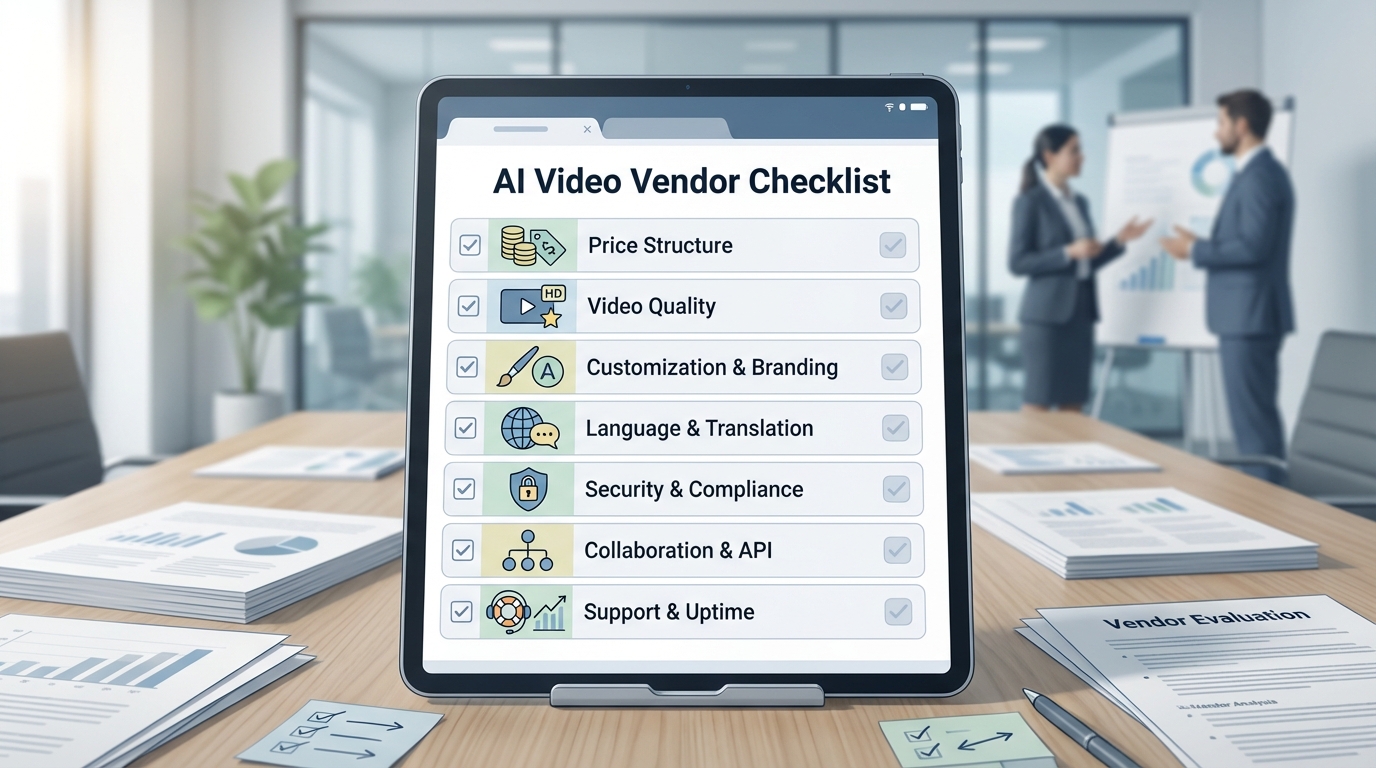
The checklist smart buyers use

Before teams fall for slick demos, they need a yardstick. Vendors highlight avatars and single-click workflows, but an enterprise deal lives or dies on deeper, often hidden details.

Price sits first, but not the headline price. What matters is what the fee unlocks. Does the plan grant thirty video minutes, a credit wallet, or true unlimited generation? Clarity here prevents upgrade surprises two months in.

Leonardo’s Maestro Unlimited tier, powered by an AI video generator for animating images, includes 60 000 fast tokens each month; once those are used, generation shifts to an unlimited but lower-priority “Relaxed” queue that can stretch processing times when demand spikes.

Leonardo’s pricing guide also notes that relaxed mode runs only one concurrent job, so teams requiring rapid turnarounds should track their token balance or budget for top-up packs.

Quality stands beside cost. Full-HD output is basic. The real divider is how natural the avatar looks and sounds. Subtle eye movement, clean lip sync, and a voice free of robotic cadence decide whether learners lean in or tune out. Ask for raw samples, not the curated highlight reel.

Customisation follows. Brand colours, fonts, and, if policy permits, a likeness of a real employee all push adoption higher. Without these touches, videos feel generic and engagement drops.

Language support turns a good platform into a global one. Check how many languages are available and whether translation minutes are capped. “Unlimited” can shrink in the fine print.

Security and compliance never sit last. Request SOC 2 evidence, GDPR alignment, and an explicit statement that your footage will not train someone else’s model. If legal raises an eyebrow, momentum stops.

Collaboration rounds out the list. A single seat is fine for a pilot, but real programmes involve reviewers, approvers, and subject-matter experts. Look for shared workspaces, role permissions, and ideally an API that posts content straight into your LMS or CMS.

Support is the insurance policy. Quick chat responses and published uptime matter when a quarterly compliance video must ship today, not tomorrow.

Walk each contender through this checklist; the exercise spots weak points early and keeps the contract aligned with the pace, scale, and risk profile your organisation needs.

What $99 really buys: platform by platform

Synthesia: polished performance at $89

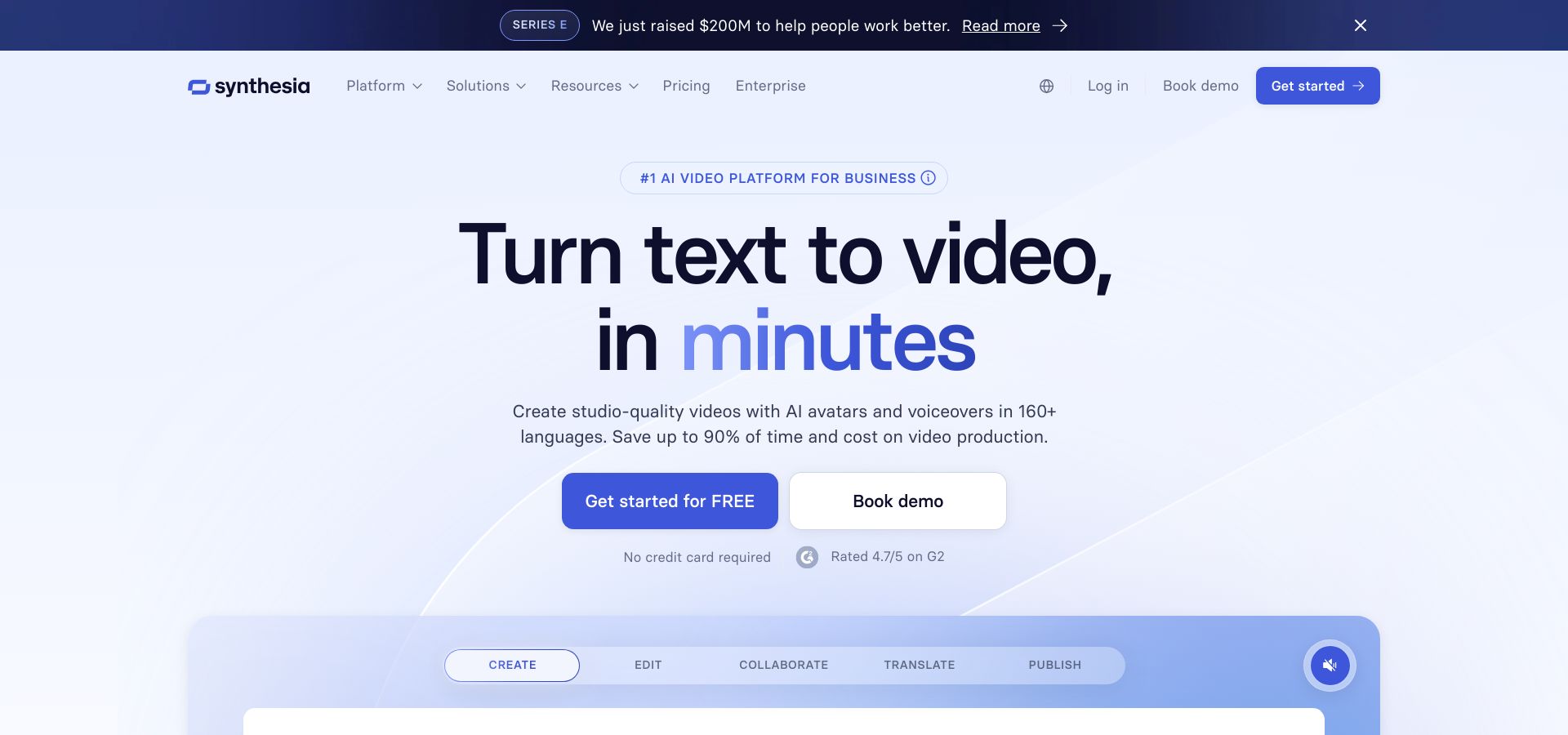
Synthesia AI video platform homepage screenshot

Synthesia is the brand most executives recognise, and the platform leans on that reputation. At the Creator tier, eighty-nine dollars secures thirty full-HD minutes each month, access to more than 180 stock avatars, and a studio interface a new marketer can master in an hour.

Quality leads the story. Avatars deliver crisp lip sync, natural eye blinks, and consistent lighting across scenes. Viewers question the realism less often, which keeps engagement high and brand risk low.

Customisation ranks above entry-level rivals. Teams can upload fonts and colours, import PowerPoint slides, and film up to five personal avatars (turning the CEO into pixels requires a separate four-figure capture fee). For many companies that is still cheaper than one location shoot.

API access sweetens the deal. Want to generate training clips whenever a policy changes? The hooks exist. Collaboration is intentionally limited at this tier: one editor plus five read-only reviewers. Larger departments will feel that ceiling quickly and may face an enterprise upsell.

Volume is the main trade-off. Thirty minutes disappear fast once you translate or iterate. If your roadmap includes dozens of multilingual videos each month, Synthesia offers polish but nudges you toward a pricier unlimited plan. Treat the Creator tier as a pilot or a steady trickle, not a fire hose.

HeyGen: flexible credits at $149 (often split to near-$99)

HeyGen AI video generator business plan screenshot

HeyGen grew up as the challenger and still moves like one. Instead of fixed minutes, it provides a credit wallet. Basic avatars cost fewer credits; premium “Avatar IV” realism costs more. The Business plan ships with a thousand credits monthly—about fifty minutes of top-tier footage—which many teams divide between two seats, landing at roughly ninety-nine dollars per user.

The credit model is both blessing and puzzle. Use lightweight scenes and content flows all quarter; ignore the meter and credits vanish by day ten. The upside is predictable cost control: when the wallet is empty, production pauses.

Quality keeps pace with leaders. The platform offers 4 K exports, 175 languages, and voice cloning at no extra fee, making it attractive for marketers chasing personalisation at scale. Collaboration feels built-in with shared workspaces, threaded comments, and a twenty-dollar add-on for each extra creator.

Process depth is where HeyGen stumbles. It lacks the strict approval flows and granular roles regulated industries expect. If legal must sign off on every script, Synthesia still wins. For growth companies that value volume, creative freedom, and vertical-video formats, HeyGen often delivers more minutes per dollar.

DeepBrain AI: unlimited minutes at a modest price

DeepBrain AI Studios unlimited minutes plan screenshot

DeepBrain AI keeps a lower profile in Western media, yet its Pro tier sits near one-hundred-and-twenty dollars and promises the word enterprises love most: unlimited. No minute caps, no credit math, just a fair-use policy and permission to produce content until reviewers ask for a break.

Avatar quality surprises newcomers. Real actors are filmed under controlled lighting, so facial texture and micro-expressions feel authentic. Add 4 K exports and the footage is conference-screen ready.

The editor targets power users. A timeline lets you fine-tune transitions, layer graphics, and add music without leaving the browser, pleasing designers who find slide-based tools restrictive.

Governance deserves a close look. DeepBrain lists GDPR alignment and firm data-ownership terms, but a SOC 2 audit is still pending. Support replies quickly through chat, though time-zone gaps can slow escalations.

If volume is the key metric—think e-learning vendors or franchise systems updating regional modules—DeepBrain’s unlimited model offers the lowest cost per finished minute in this roundup. The trade-off is running a slightly leaner vendor-risk review yourself.

Colossyan: the flat-fee workhorse

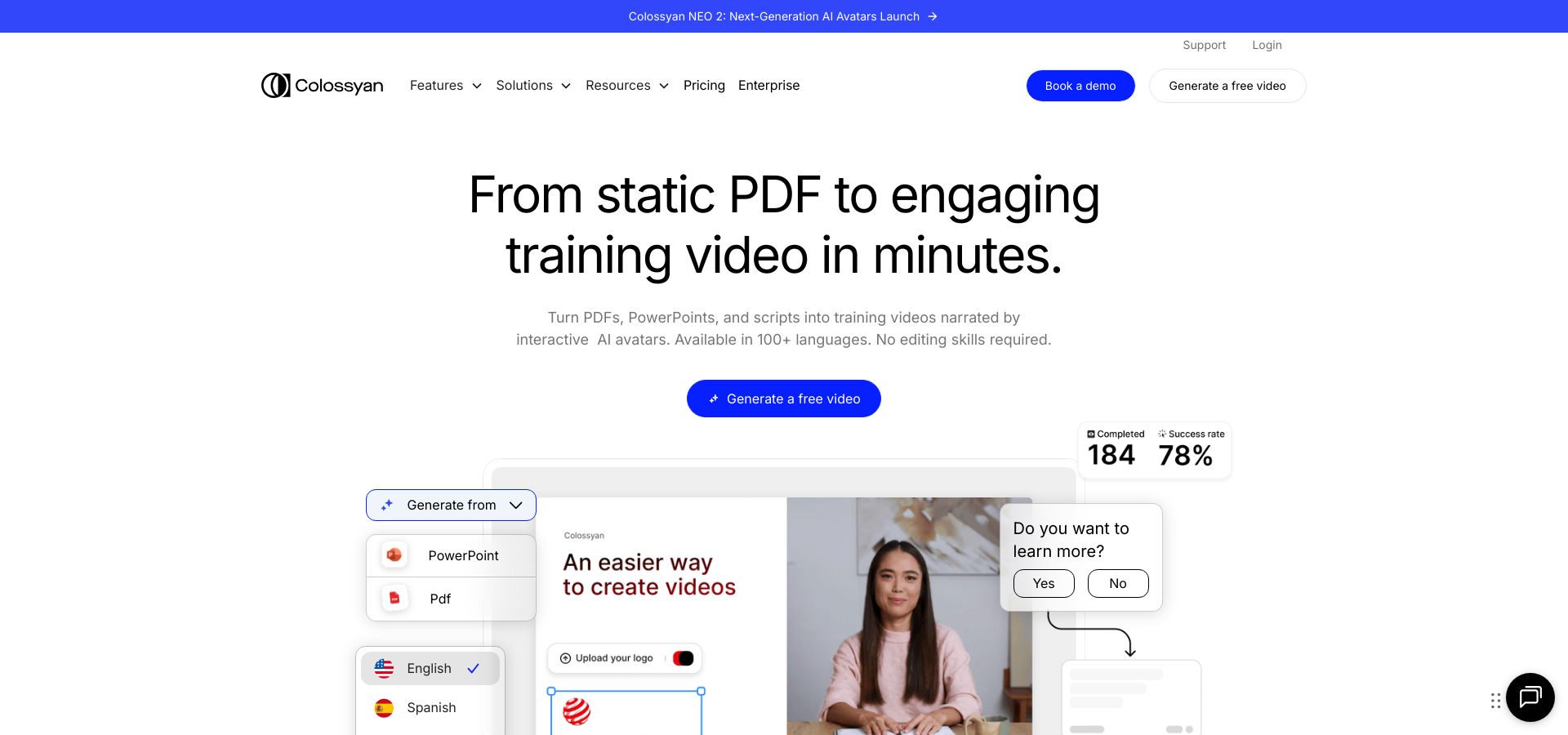
Colossyan flat-fee AI video business plan screenshot

Colossyan prizes simplicity. Its Business plan hovers around seventy-five dollars a month when billed annually and removes quotas entirely. Unlimited minutes, unlimited renders, one predictable invoice.

That flat fee changes behaviour. Teams hit “generate” without hesitation, iterate freely, and refine scripts through rapid drafts instead of slide comments. For high-volume departments, the creative breathing room justifies the subscription on its own.

The compromise appears in polish. Avatars look professional but show fewer nuanced expressions than Synthesia or HeyGen. Resolution tops out at full HD, fine for laptops and LMS portals but less ideal for trade-show screens.

Collaboration is pared back. One editor account and no granular roles force colleagues to share a login. It functions, but audit trails disappear and security leads may object. Large organisations eventually upgrade to a multi-seat tier or migrate.

For internal training teams or solo course creators chasing the lowest cost per video minute, Colossyan delivers strong value. Unlimited output often beats perfection when deadlines crowd the calendar and budgets stay lean.

ROI and the costs nobody mentions

The cost argument for an AI video subscription is straightforward. Replace a filmed shoot that costs about $2 000 per finished minute with a $99 plan, and savings accumulate quickly. One learning team reported saving $180 000 in a single year, even after paying for the subscription.

Those savings appear only when teams use the platform. Buy 30 minutes each month and publish only three, and your cost per minute balloons. Before signing, confirm real content demand: review last year’s training calendar, count deliverables, and match appetite to the quota.

Extra costs hide beyond generation minutes. A custom avatar shoot—often $1 000 or more—lands on the invoice when leadership wants the CEO’s likeness. Additional reviewer seats can add $20–$30 each month. Translation may surprise you; some vendors cap multilingual minutes even in mid-tier plans.

Time is another, quieter expense. Writers still draft scripts, subject-matter experts still review, and someone still polishes slides. Most teams cut production hours by 70–80 percent, but that final polish pass stays essential for client-facing work.

Conclusion

Treat the first quarter as a live experiment. Track cost per finished minute, turnaround time, and viewer engagement. If those metrics improve, the subscription funds itself. If they stall, downgrade or switch before renewal season.

Best VPN with SOCKS5 Proxy Bundle: Which Ones Actually Prevent IP Leaks?

0

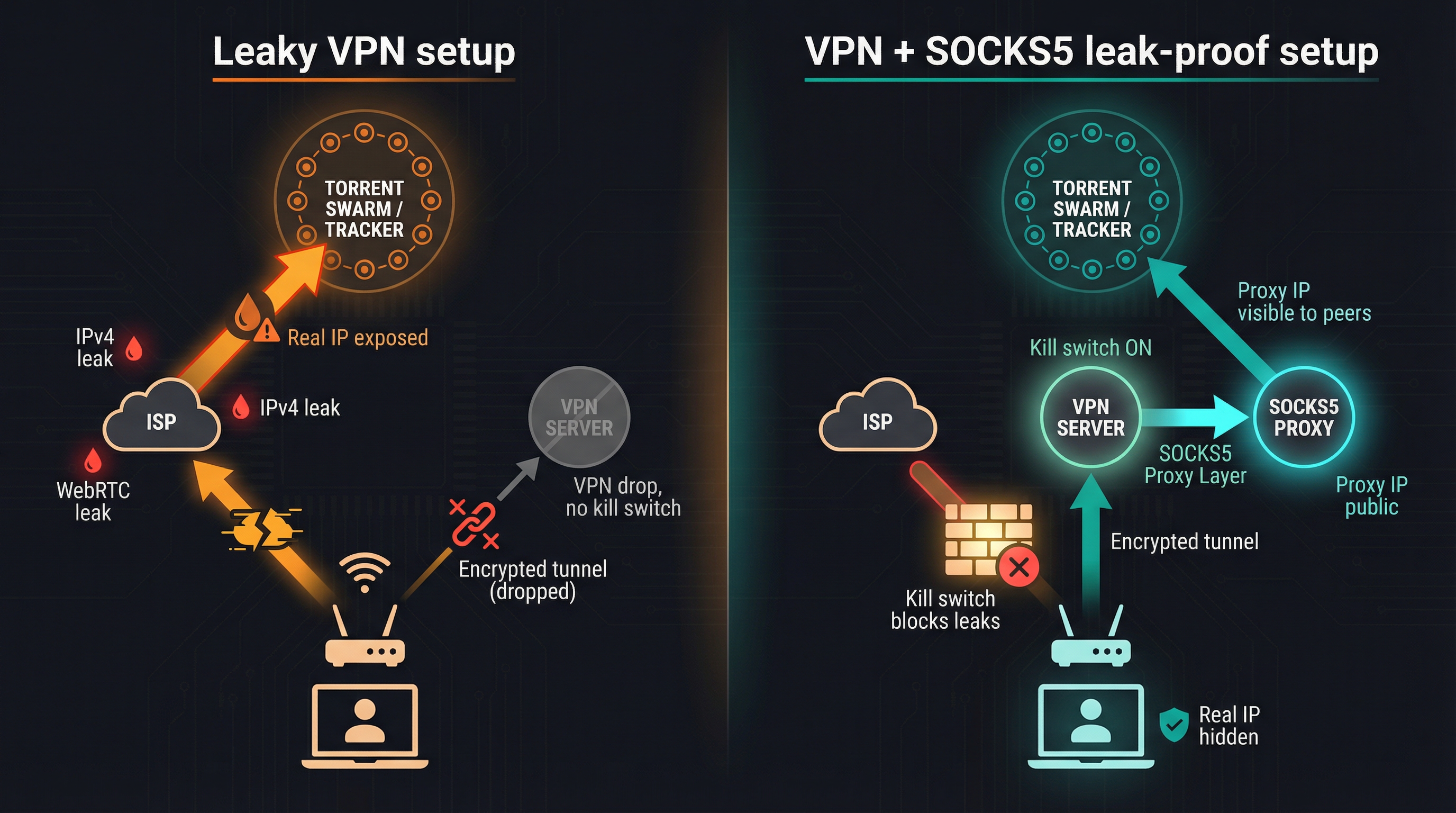
When the Wi-Fi blips, your VPN can drop and the swarm instantly sees the IP your ISP assigned—anyone on the tracker can trace you.

Most “best SOCKS5” round-ups ignore that risk, treating the proxy as a tick box instead of a leak-proofing layer. We took a harder line.

We yanked cables, killed processes, and ran DNS and WebRTC scans to grade every provider’s kill switch. Only seven still issue working proxy credentials in 2026, from flagship names to P2P-born TorGuard.

Ready to see which ones truly hide your IP? Let’s unpack the method, then rank them.

How we tested and scored each service

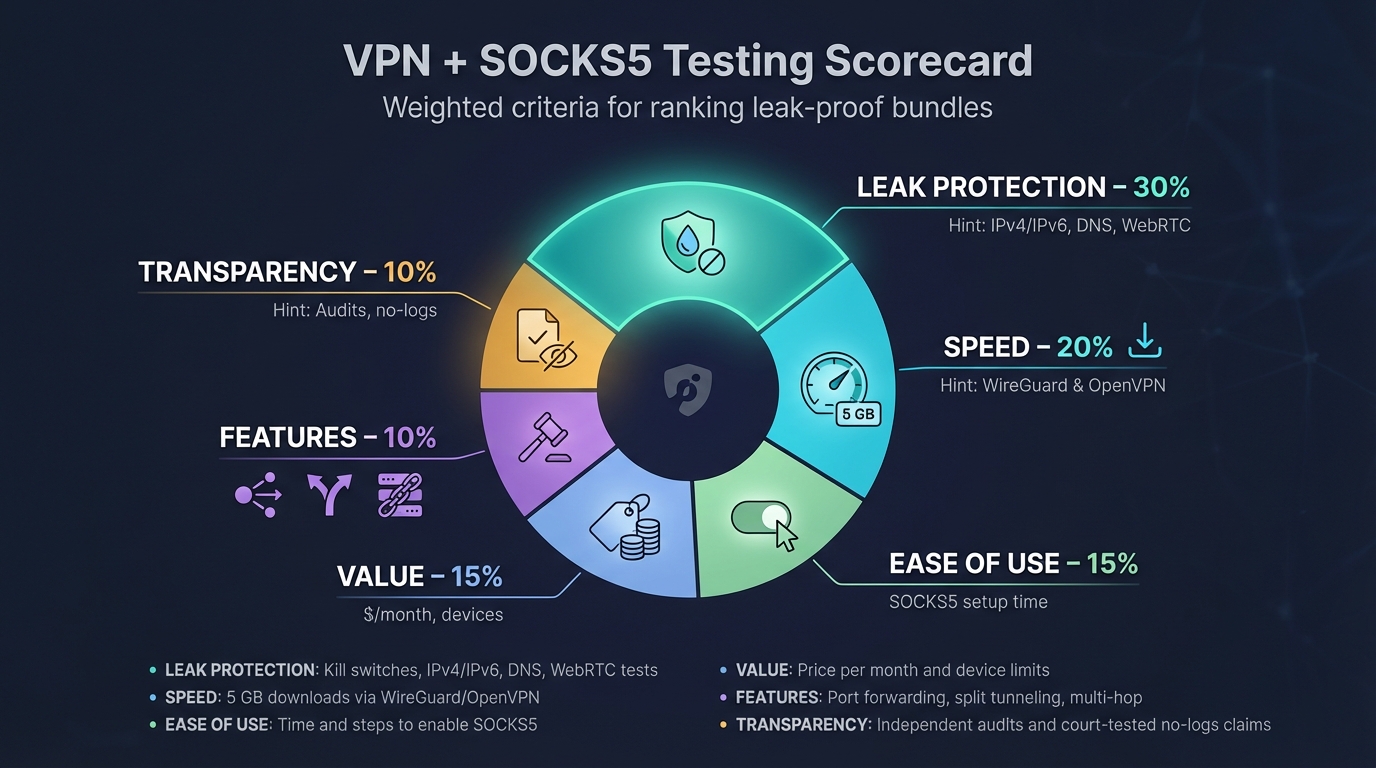
You expect numbers, not fluff, so we built a six-point scorecard and pushed every contender through the same gauntlet.

We started with leak protection.

We yanked the Ethernet cable, killed processes mid-download, and refreshed ipleak.net until our eyes blurred. If a single IPv4, IPv6, DNS, or WebRTC leak appeared, the provider lost big points.

Next came speed.

Each VPN connected over WireGuard where available, OpenVPN where not, then pulled a 5 GB test file from three continents. We logged median throughput and the extra latency added once the SOCKS5 proxy chained on top.

Ease of use mattered too.

Could you enable the proxy with one toggle, or did you need to paste hostnames into five separate windows? We timed every setup from install to the first successful proxy handshake.

Price, advanced features, and transparency rounded out the grid.

Port forwarding, split tunneling, and multi-hop earned bonuses. Audited no-log policies and proven “nothing to seize” moments—think Mullvad’s empty-handed police visit—locked in extra credit.

Finally, we weighted the categories: leak protection 30 percent, speed 20 percent, ease 15 percent, value 15 percent, features 10 percent, transparency 10 percent. Totals produced a clear leaderboard—and a few surprises you’ll see next.
The 7 best VPN + SOCKS5 bundles for 2026

1. TorGuard, built for torrent power users

TorGuard sprang from P2P forums and now fields more than 3 000 servers across 50-plus countries with built-in port forwarding on every plan. Its homepage at https://torguard.net/ lays out those numbers before you even click Sign In.
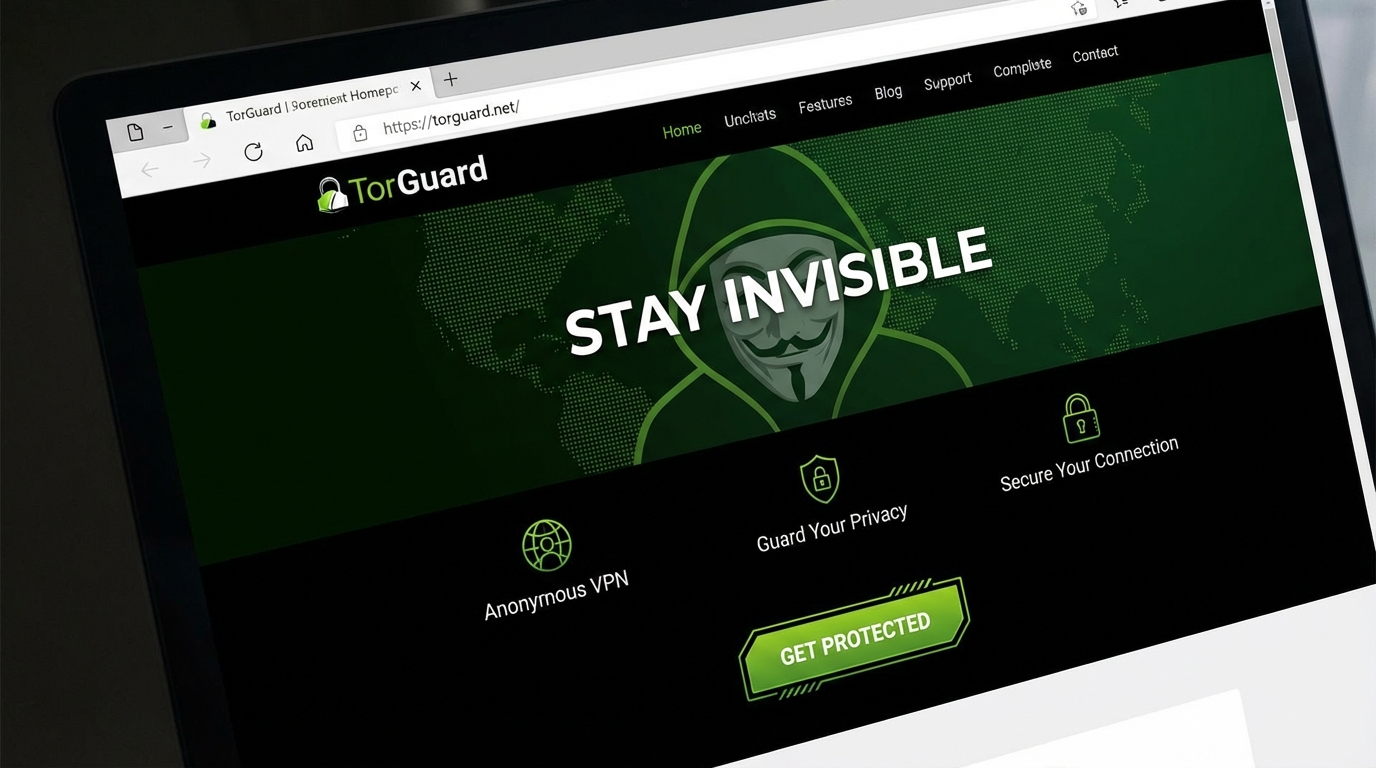
TorGuard VPN Homepage Highlighting P2P Servers and Port Forwarding

The dashboard lists SOCKS5 endpoints in six countries, all using your VPN credentials. No tickets, no hidden menus.

Enable the kill switch, pull your cable, and nothing leaks. Traffic stops until the tunnel returns, then your torrent swarm sees only the proxy IP. Add TorGuard’s one-click port forwarding, and seeding speeds climb while your real address stays hidden.

Performance stays strong. On WireGuard we held about eighty percent of a 500 Mbps line, and latency stayed low enough for online games. The app lets you pick ciphers, ports, and stealth modes, so you can bypass throttling or censorship without scripts.

Eight simultaneous devices cover a household, and promo pricing averages about five dollars a month. If your aim is simple—torrent hard, leak never—TorGuard puts the tools in one tidy kit.

2. NordVPN, flagship speed and audited privacy

NordVPN is the Swiss army knife of consumer VPNs. Its 5 500-plus servers and WireGuard-powered NordLynx protocol deliver quick downloads; on a gigabit line we lost barely ten percent after connecting.

Security is tight as well. Every desktop and mobile app ships with an always-on kill switch and private DNS, so accidental reveals stay off the table. Independent audits back up the no-logs claim, and servers run from volatile RAM, leaving nothing for investigators to seize.

The SOCKS5 proxy remains, although you reach it manually. Fetch a hostname from Nord’s knowledge base, drop it into your torrent client with your credentials, and you are done. The extra minute pays off because few rivals combine this level of speed, scrutiny, and network breadth.

Nord skips port forwarding, so heavy seeders may look elsewhere. For everyone else, it is the safest way to add a proxy hop without sacrificing performance.

3. Private Internet Access, budget king with one-click double hop

PIA earned its fanbase on openness. The apps are open source, the no-logs claim held up twice in United States courts, and Deloitte confirmed the policy in 2022.

Setup feels effortless. Pick a country, flick the Multi-Hop switch, and PIA routes your traffic through its Netherlands SOCKS5 proxy before exiting the VPN. No extra credentials or hostnames required.
Private Internet Access Multi-Hop SOCKS5 Double Hop Interface

Speeds stay healthy. On a 300 Mbps fiber line we averaged 220 Mbps over WireGuard and saw latency climb by only twelve milliseconds when the proxy hop engaged. That is fast enough for 4K streaming while your torrent box seeds in the background.

Prices drop near two dollars a month, and every plan now covers unlimited devices. Port forwarding, however, ended in September 2024, a fact many “best VPN” lists ignore. If you need inbound ports, look at TorGuard or hide.me.

For everyone else, PIA delivers an inexpensive, transparent way to add a proxy hop without touching advanced settings.

4. hide.me, stealth-guarded privacy with port-forward convenience

hide.me keeps a low profile, yet its feature list reads like a security wish sheet. The Malaysia-based provider bundles WireGuard, split tunneling, multi-hop, and a SOCKS5 proxy, then tops it off with Stealth Guard, a rule that blocks chosen apps or your entire connection unless the VPN is live.

In practice the shield holds. We forced disconnects mid-download and watched Stealth Guard shut traffic before a single packet escaped. DNS and WebRTC tests stayed clean, and the client can tunnel IPv6 instead of disabling it.

Speeds impress. Nearby WireGuard nodes served over ninety-five percent of a 300 Mbps link, while trans-Atlantic hops still cleared 150 Mbps.

The SOCKS5 setup is painless. Toggle proxy mode in the desktop app or grab the hostname from the panel and paste it into qBittorrent. Because hide.me also allows port forwarding, you get the rare mix of encrypted tunnel, proxy hop, and open inbound port.

Ten devices are covered, pricing lands around four dollars on a two-year plan, and a thirty-day money-back window applies.

5. IPVanish, unlimited devices and one-step proxy for torrent traffic

Households with smart TVs, consoles, and a few Raspberry Pi projects benefit from IPVanish because the service removed its device cap years ago, and performance keeps up. Our tests saw 430 Mbps over WireGuard on a gigabit fiber line and sub-fifty-millisecond pings to the closest data center.

Enabling the SOCKS5 proxy takes two minutes. Generate a proxy username and password in the dashboard, then drop Amsterdam’s hostname into your torrent client. Peers see the Dutch IP while the rest of your traffic stays in the encrypted VPN.

IPVanish lacks port forwarding and offers its proxy in one location, so heavy seeders may crave more flexibility. A 2016 logging scandal under previous owners still appears in forums, but new management publishes annual zero-data-disclosed reports; an external audit would close the door for good.

For homes that value speed, simplicity, and one subscription for every screen, IPVanish remains a leak-free performer.

6. PrivateVPN, small team and full-stack torrent toolkit

PrivateVPN feels like a neighborhood coffee shop that hand-picks its beans. The Swedish crew runs about 200 servers, yet every location supports SOCKS5, P2P, and optional port forwarding. You can park your torrent client in Tokyo today and hop to São Paulo tomorrow without changing providers.

Configuration stays simple. Grab the server hostname from the manual-config page, use your normal login, choose a high-speed port, and you are live. Speeds surprised us: 270 Mbps on a 300 Mbps line nearby and 140 Mbps when we exited half a world away. WireGuard support, added in 2024, deserves the credit.

Leak tests passed. Application Guard kills chosen apps if the tunnel falters, DNS stays locked to PrivateVPN resolvers, and IPv6 can be blocked outright.

The interface is spartan and extras are thin—no ad blocker, no split tunnel—but the price lands near two dollars on a three-year plan, and humans answer live chat.

7. Windscribe, DIY flexibility and pay-for-what-you-need pricing

Windscribe plays two roles: friendly starter VPN and playground for tinkerers. The free tier gives ten GB a month to test speeds. Upgrade, and every server in sixty-nine countries becomes a SOCKS5 or HTTP proxy you spin up in the web dashboard.

Windscribe Dashboard Showing SOCKS5 and HTTP Proxy Generation

That granularity helps developers. Need five Canadian IPs for a scraping script? Generate five unique hostnames, drop them into a rotation loop, and keep requests under the radar. When you finish, scrap them and start fresh in another region.

The desktop Firewall acts as a default-deny rule set. Drop the tunnel and the firewall cuts all traffic, preventing DNS or WebRTC leaks. After a 2021 server seizure, Windscribe moved to RAM-only hardware; a 2026 Dutch seizure proved the shift worked when authorities left empty-handed.

We clocked 400 Mbps on a gigabit line through neighboring servers and 200 Mbps across the Atlantic. Unlimited devices sweeten the deal, while the Build-a-Plan option lets you pay one dollar per location if full access feels like overkill.

Port forwarding costs extra via a static IP, and no third-party audit exists yet. If you want scriptable proxies and pricing that scales with usage, Windscribe is the flexible choice.

Quick-scan comparison table

Long reviews add nuance, yet sometimes you just need a bird’s-eye view.

VPN Audited no-logs Port forwarding SOCKS5 locations Devices Speed loss* Starting price
TorGuard No audit, proven court test Yes 6 8 about twenty percent $5 /mo
NordVPN Yes (PwC twice) No 3+ 6 about ten percent $3.30 /mo
PIA Yes (Deloitte) No Netherlands only Unlimited about twenty-five percent $2.00 /mo
hide.me Partial audit Yes 2 10 about five percent $4.00 /mo
IPVanish Transparency report No Netherlands only Unlimited about fifteen percent $3.33 /mo
PrivateVPN No audit Yes Every server 10 about ten percent $2.10 /mo
Windscribe No audit, RAM-only servers Paid (static IP) Every server Unlimited about twelve percent $1 /location


*Speed loss measured against a one-gigabit baseline on the nearest WireGuard node.

Advanced use-case playbook

Leak-proof torrenting with VPN + SOCKS5

You want raw speed for downloads, airtight privacy for uploads, and zero chance your ISP sees you swapping Linux ISOs. Combining the tunnel and the proxy gives you that belt-and-braces protection.
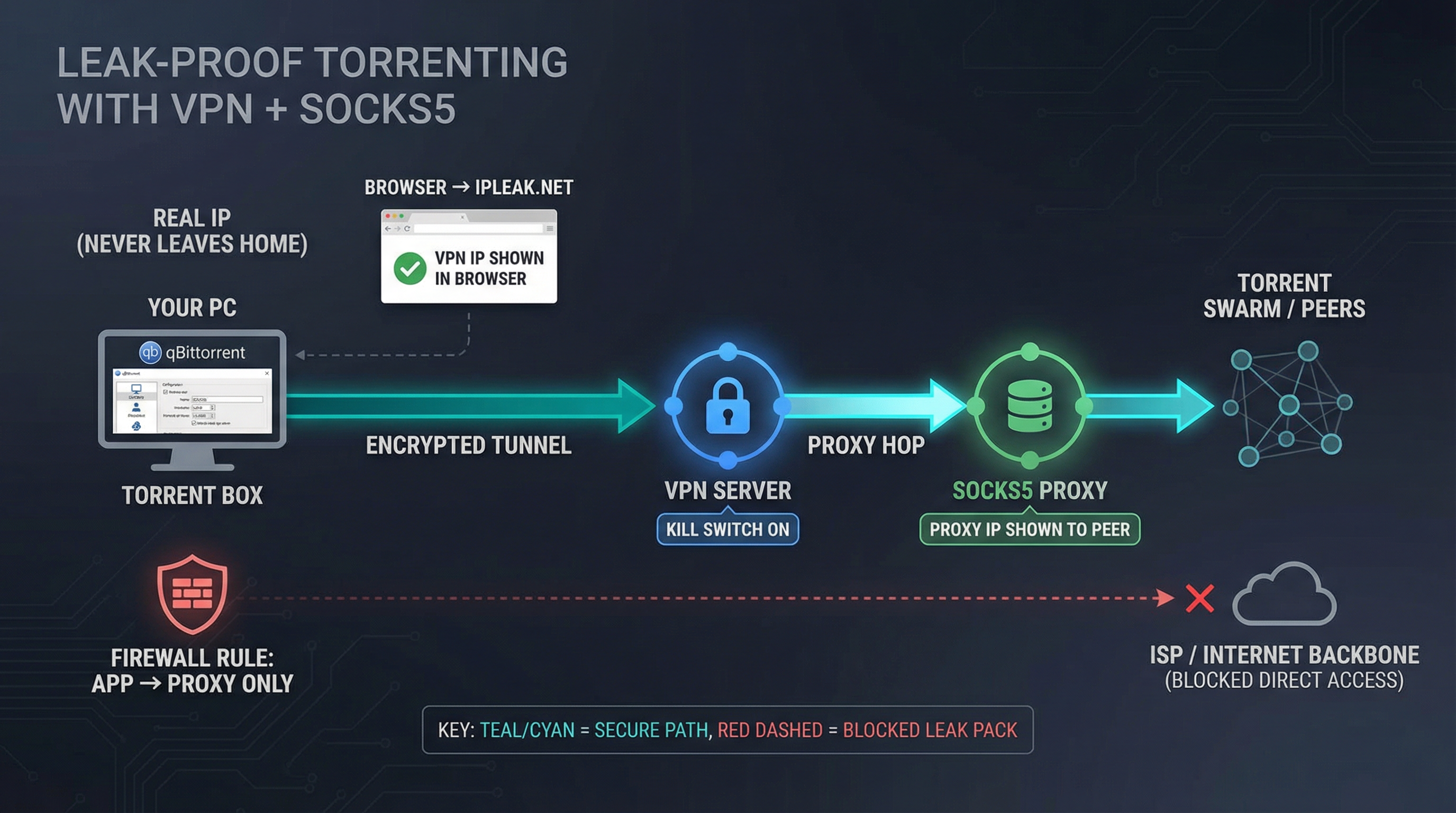
Start by connecting the VPN and turning on its kill switch. Most apps label it “Network Lock” or “Firewall.” Pull the cable once to confirm every connection stalls. If the switch fails now, fix it before you trust it.

Next, open your torrent client. In qBittorrent choose Preferences ? Connection.

Select SOCKS5, paste the proxy hostname, port, and the user name and password your VPN issued. Tick the boxes that send peer traffic and tracker traffic through the proxy, and block non-proxy connections.

Hit Apply and start a small torrent. While it downloads, visit ipleak.net in a browser outside the proxy. You should see the VPN IP, not your home IP. Inside the torrent client, click its “IP” column or use a magnet link that shows the peer address; here you should see the proxy IP instead of the VPN exit. Two hops, two addresses, no leaks.

Want a failsafe if the proxy dies? Add a firewall rule that lets your torrent app talk only to the proxy IP and port. Windows Defender or an iptables line does it in a minute and guarantees the client cannot fall back to a naked connection.

Now you are seeding through an encrypted tunnel, presenting a proxy IP to every peer, and your machine stays silent if either layer trips. That is as close to bullet-proof as BitTorrent gets.

Per-tab geo-testing with browser containers

Sometimes you need to see a website as Google UK, Netflix US, and a local visitor at the same time. A full VPN flips every tab to the same country, but a SOCKS5 proxy can steer traffic on a tab-by-tab basis.

Firefox with the free Multi-Account Containers add-on makes it painless.

Create three containers, open FoxyProxy options, and assign a unique SOCKS5 profile to each. One profile points at TorGuard’s London proxy, another at NordVPN’s New York node, and the third leaves traffic direct.

Open your site in three tabs, each in its own container. The UK tab returns prices in pounds, the US tab serves the Hulu catalog, and your default tab stays local, no extra extensions or second browser required.

Because each proxy rides inside an active VPN tunnel, DNS and WebRTC still sit behind the encrypted pipe. Close a container and its proxy vanishes, leaving your base connection untouched. It is the easiest way to audit localization, run A/B tests, or manage multi-region accounts without juggling browsers or virtual machines.

Lightweight IP rotation for scraping and automation

Sites throttle repeat requests from a single address, yet a dedicated residential proxy network can drain budgets fast. Your VPN SOCKS5 pool is a cheaper middle path.

Windscribe, TorGuard, and PrivateVPN each hand you dozens of proxy hostnames. Store them in a simple list, then cycle through while fetching pages.

import random, requests

proxies = [

“socks5://USER:PASS@nl.torguard.org:1080”,

“socks5://USER:PASS@de.windscribe.com:1080”,

“socks5://USER:PASS@br.privatevpn.com:1080”

]


def get(url):

proxy = {“http”: random.choice(proxies),

“https”: random.choice(proxies)}

return requests.get(url, proxies=proxy, timeout=15)


Each run presents a fresh IP, dodging basic rate limits without touching shady third-party lists.

Keep the VPN itself connected underneath so DNS stays inside the encrypted tunnel. Even if one proxy fails and reveals its real server IP, your home address stays cloaked, the same defense Mullvad showed when a 2023 police raid left investigators empty-handed.

DIY double hop for maximum deniability

Running one VPN is good; chaining two different providers is insurance. If an attacker compromises one hop, the second still masks the trail.

The simplest method uses Provider A for the full tunnel and Provider B SOCKS5 on top.
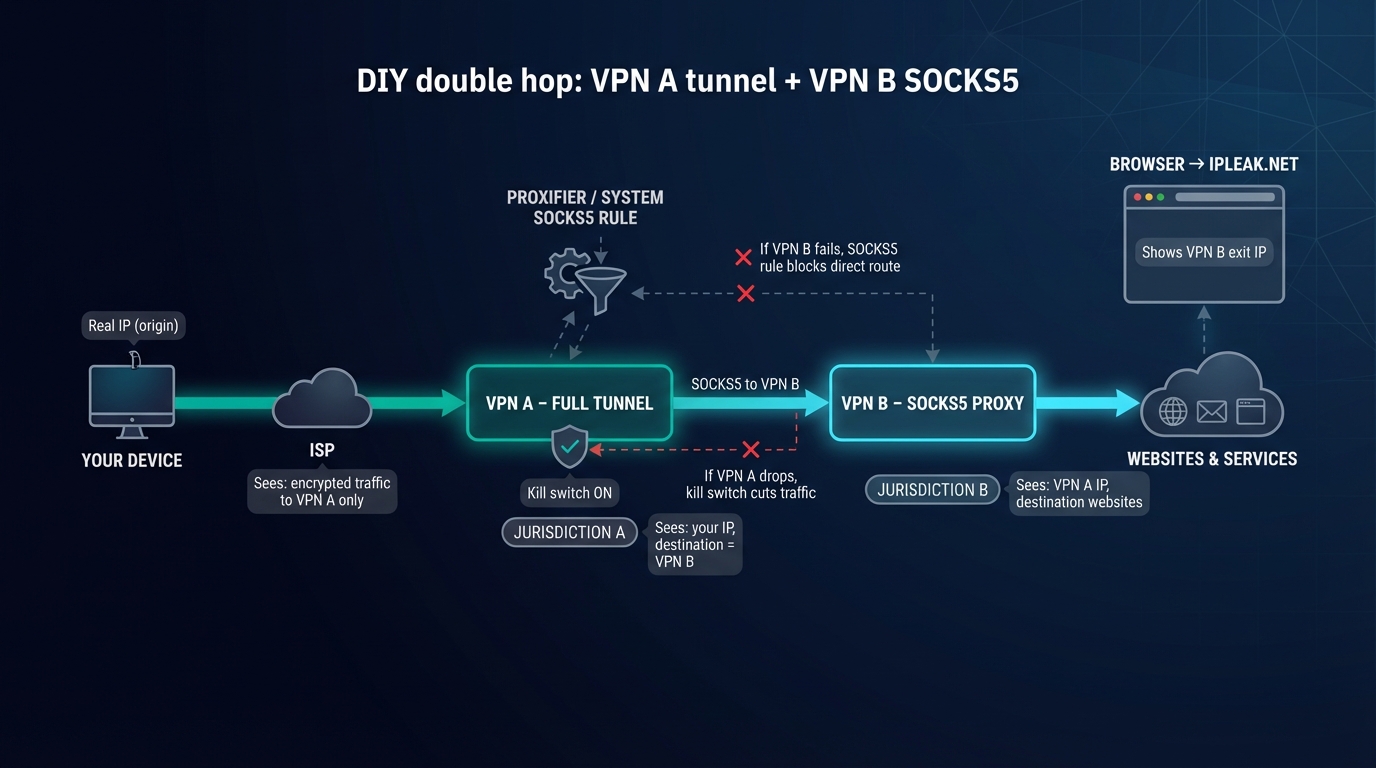
  1. Connect to VPN A.
  2. Open Proxifier (Windows) or the proxy tab on macOS and set a system-wide SOCKS5 rule that points to VPN B.
  3. Verify with ipleak.net. Your ISP sees only encrypted traffic to VPN A. The test page shows VPN B exit IP. VPN A never learns your destination, and VPN B never learns your origin.

The latency hit is modest, about 30 ms in our NordVPN-over-TorGuard test, yet you gain a second jurisdiction, a second no-logs promise, and a second kill switch.

If one server drops, Proxifier cuts the route and the primary VPN kill switch freezes the link, so leaks stay off the table. It is overkill for casual browsing, but for journalists or activists who cannot afford mistakes, this two-provider chain adds meaningful defense in depth.


FAQ: clearing up the big proxy questions

Is a SOCKS5 proxy basically a VPN?

No. A VPN encrypts every packet from every app and changes your IP. A SOCKS5 proxy only forwards traffic for the program that calls it and adds no encryption. Pair them and you get encryption plus per-app routing. Use the proxy alone and your ISP still sees what type of traffic you send.

Will a SOCKS5 proxy speed up my downloads?

Standing alone, a proxy can trim a few milliseconds because there is no encryption overhead. Once you run it inside a VPN tunnel, the extra hop usually adds 5–15 ms. The delay is minor for most activities and worth the extra IP layer.

Which big-name VPNs skip SOCKS5 entirely?

ExpressVPN, Surfshark, and ProtonVPN focus on full-tunnel security and do not supply proxy credentials. If SOCKS5 is essential, stay with the seven services we reviewed.

Can I trust a free SOCKS5 proxy from the web?

Unlikely. Anyone running a public proxy can log every request. Use the proxy that comes with your paid VPN or host your own server instead.

How do I check for leaks?

Connect the VPN and load ipleak.net to note the IP. Configure the SOCKS5 proxy, reload, and confirm that the IP changes while DNS stays on the VPN resolver. Pull the cable; if traffic stops, your kill switch works. Swedish police tested Mullvad in 2023 and left empty-handed, proving that a sound setup keeps data off drives.

Conclusion

Treat the table as a cheat sheet, then circle back to the mini-reviews for the full story on leak tests, kill switches, and proxy quirks.