DD
MM
YYYY

PAGES

DD
MM
YYYY

spot_img

PAGES

Home Blog Page 6004

Explore Krozu for Project Management and Productivity Measurement [Video]

0
Young designer giving some new ideas about project to his partners in conference room. Business people discussing over new business project in office.

When I invested in Florida-based Krozu, I saw the future of project management and productivity measurement. Yes, engineered workflow just the way people work. This is one of the features of Krozu. Watch the video.

Build Project Trees and deliver modular customization regardless of the project or structure complexity. Krozu uses recursive technology to granularize projects making it extremely easy to expand tasks and organize dependencies while improving project outcomes and delivery.

Go and open a free account and use Krozu.

Krozu™ REVOLUTIONIZES project management by organizing projects in the same manner and structure as your business. It makes perfect sense, if businesses have been employing a hierarchical organizational structure for thousands of years, so should your project management tool. This in turn simplifies everything from permissions, roles, progress, dependencies, communication, and much more.

Nigeria is Catching Up with Other Countries in Digital Economy – A Conversation with Dr Ayoola, Founder Robotics and AI Nigeria

0
Young designer giving some new ideas about project to his partners in conference room. Business people discussing over new business project in office.

Editor’s Note: For a number of years, Nigeria has been planning to catch up with other countries in the areas of digital and data economy. From the federal to the state governments, policies have been made and still being formulated towards the right ecosystem for the economy. In this piece, Dr Olusola Sayeed Ayoola, the founder of the Robotics and Artificial Intelligence Nigeria, speaks with our analyst. Looking at some of the early outcomes of policies and programmes of the governments, he believes that Nigeria has what it takes to compete with other countries in the world.

Excerpts

Tekedia: A lot has been said about digital and data economy in the developed world. The discussion has recently entered developing countries, especially the emerging economies such as Nigeria. What does it take be a digital and data economy?

Dr Ayoola: As you know, a digital economy refers to an economy where most of the economic activities use digitized information and knowledge as key factors of production. To be a digital and data economy, three keys things have to be in place; first, you need to have a digital core.  This includes supply and support of physical technologies such as semiconductors, processors, data infrastructure, or simply every technology that enables and gives access to the internet and makes human life easy. Secondly, you need the digital product and service providers. These are our online vendors, fintech and mobile payments, e-commerce, social media among others. Lastly, there are digital applications. Businesses and individuals use products and services of digital providers to carry out their business activities. These, in turn, produce data, a vast meaningful amount of data, which then leads to improvement of services and better business inferences. Nigeria has all these 3 layers in place, we saw a 50% increase of mobile internet users from 2015 to 2020 (42.84 to 99.05 million users).

Tekedia: Looking at the Nigerian government policies and programmes in the area of information and communication technologies in the last 10 years, how would you describe the country in terms of digital and data economy?

Dr Ayoola: The Nigerian Federal Ministry of Communications and Digital Economy last developed the National Digital Economy Policy and Strategy in line with directives from President Buhari. This at least shows a national commitment to building a strong digital economy.  Nigeria is a developing country. In terms of digital and data economy, I’d say we’re growing steadily, although we could leapfrog like China. I believe we will. Last month or so, we saw a Nigerian tech start-up sold for $200M, and in the coming years, more tech start-ups would sell.  According to a McKinsey report, fintech investment grew by 197% in the last 3 years. Github just released a statistics, that showed Nigeria as a top code contributor, ahead of China. Nigeria has a brilliant, resilient, innovative, entrepreneurial, and young population. We are steadily catching up to the rest of the world.

Tekedia: Several reports and researches have noted that digital and data economy cannot be attained and sustained without knowledge economy. Considering various issues in our socioeconomic and political leadership would you say the country is really ready for digital and data economy?

Dr Ayoola: Well, I think the digital economy has started already in Nigeria. Yes, we still have gaps in our knowledge economy, but that is changing gradually. In the last five years, Nigeria has seen a big rise in educational/knowledge-based programs. Companies like Andela, RAINigeria, etc are bridging that gap. Fintech are now taking inclusion seriously and doing almost everything possible to understand and help the unbanked. So yes, we are ready and already in a digital and data economy.

Tekedia: For years, Lagos has been known for centre of information and communication technologies when one looks at the place of Computer Village. However, in our research, we discovered that the foundation of computing was laid in Ibadan in 1963 not in Lagos. What made Ibadan city losses its place? What do you think stakeholders need to do to return the city’s past place of being the first in terms of initiatives and programmes?

Dr Ayoola: Stakeholders should organise programs/events that educate and empower its young population (primary, secondary and tertiary institutions) to be a match in the global world. For instance, the Lagos state government organizes programs such as CodeLagos, Art of Tech Lagos among others. They should also look to partner with organizations that offers these educational services like Coursera, RAINigeria, Google, Microsoft etc. They should also support organizations that already provide these kind of educational service within the state.

Tekedia: What advice do you have for parents and students on the need to embrace digital and data economy?

Dr Ayoola: The best time to be a part of the digital economy was yesterday, the next best time is now. Train at RAIN, develop your capacity today. The universities can only do much, you have to give yourself the best available opportunity. This is what RAIN presents.

Gender should never be a limitation to fulfilling one’s dreams – Oluwatosin Likinyo

0

She has found a calling in a profession dominated by men. Yet, with a strong family support system, she has been able to find excellence in a discipline she has passion for. This is the story of Oluwatosin Likinyo, a Nigerian young woman who made a distinction in her Master’s Degree at the University of Aberdeen. Here are excerpts from her chat with Rasheed Adebiyi…   

Tekedia: Could you tell me more about yourself?

Oluwatosin Likinyo: My name’s Oluwatosin Likinyo. I am an advocate for clean energy, energy equality and energy sufficiency, and strongly believe that sustainable energy solutions are incredible tools for economic development. My experience with the substandard energy sector in my community in Africa, sparked my strong interest in renewable energy. Now, I have a personal commitment towards improving the energy industry, specifically in Africa. I recently graduated with a distinction in my MSc Renewable Energy Engineering degree from the University of Aberdeen, and publish thought-provoking articles on renewable energy, sustainability, and development on my blog. 

Tekedia: As a woman, what has it looked like pursuing a degree in a largely perceived male dominated profession in Engineering? 

Oluwatosin Likinyo: Honestly, there is this notion in the engineering space that as a woman you have to prove that you can perform as good as your male colleagues. Although, this has kept me on my feet, I am grateful to be surrounded by men who have never made feel like being a woman limits my potential to succeed in any field. My parents, who are both engineers, are my biggest source of inspiration.

Gender should never be a limitation to fulfilling your dreams. What is most important is your perception of who you are and the level of faith you have in your goals. History defined engineering as a male-dominated profession but the narrative is changing. The world needs positive impact makers and you can be one – man or woman!

Tekedia: Attaining a distinction in your MSc Degree should mean a lot to you. What exactly does it mean for you? 

Oluwatosin Likinyo : I am overwhelmed with joy! This has been a long dream of mine and I am very glad to have attained it. Beyond my personal joy is the joy of my parents and family. It is just a wonderful experience to make them proud. There were challenges along the way of course and a lot of hard work and sleepless nights. I am grateful to God for the grace to come out at the end of the tunnel stronger. 

Tekedia: What were your experiences like studying in Aberdeen? 

Oluwatosin Likinyo: Oh! Aberdeen is such a beautiful city and has to be my favourite city on earth right now haha! I totally enjoyed living and studying there. I loved going to the parks and sitting by the riverside to have my ‘me-moments’ whenever I was stressed. It really is a nice and peaceful city, and the people are friendly. Also, I loved the diversity of the city with people from different races. Of course, I got to meet a lot of my fellow Nigerians so it did not feel too different from home.

Tekedia: What are your views on how to develop the energy sector in Africa? 

Oluwatosin Linkinyo: Africa is endowed with vast natural resources and is in the best position to adopt renewable energy (RE) technologies and to play a leading role in the global energy RE market. However, the heavy reliance on oil despite the increase in investments from international bodies and foreign countries shows that there is little progress in the renewable energy space in Africa. To illustrate this, the Federal Government of Nigeria has developed the National Renewable Energy and Energy Efficiency Policy that contains the government’s strategy for deploying RE. In addition, the government invested $20 billion in solar projects in 2017. With these, one would think considerable efforts are being made; yet, according to IEA Energy Outlook, electricity generation from fossil fuel is still on the increase with 80% of the power generated coming from gas and most of the remainder from oil. I consider corruption to be the biggest obstacle to RE development in Africa, specifically in relation to policy execution, project management and accountability. How are funds managed and the projects run? These are questions that have to be answered in total transparency before more money is to be pumped in with minimal results to show.

To start to tackle the corruption issue, processes and procedures have to be critically analysed. For example, proper disciplinary and reporting measures must be in place to ensure that energy policies are adequately implemented and public projects or funds are properly managed. More so, the progress of every project must be monitored regularly with public knowledge and necessary remedial actions taken in case of non-compliance.

Furthermore, it is important to bring new players into the game; specifically, young, passionate, and educated minds. This goes beyond financing start-ups to mentoring entrepreneurs on how to build successful RE businesses. A perfect example of this in action is the Tony Elumelu Foundation which is built on the African capitalism concept that emphasizes the role of the private sector in facilitating Africa’s development. We need more of this for the RE industry in Africa. It might sound like a daunting task but it would be worth it as the energy sector influences economic development to a great extent.

One very important benefit of empowering start-ups is competition. The more actors we have in the RE industry, the more competitive the market becomes, and competition drives innovation and helps reduce electricity costs. I shared more of my views here: https://www.tosinlikinyo.com/post/developing-renewable-energy-in-africa-a-practical-solution 

Tekedia: Moving forward, what are your next steps?

Oluwatosin Linkiyo: This next phase for me is to learn and grow while working in the energy industry. No worries, I will keep you updated with what comes haha!

Tekedia: Thanks for your time

Oluwatosin Linkinyo : My pleasure.

Put Efforts To Capture Value In Your Business Even As You Serve Customers

0

I have an upcoming article in Harvard Business Review where I made a strong case about the necessity of capturing value in markets. The covid-19 pandemic has taught us one key thing: flawless execution and delivering superior customer experiences will not magically help you to capture value, if you have not carefully articulated a strategy on how to do that. 

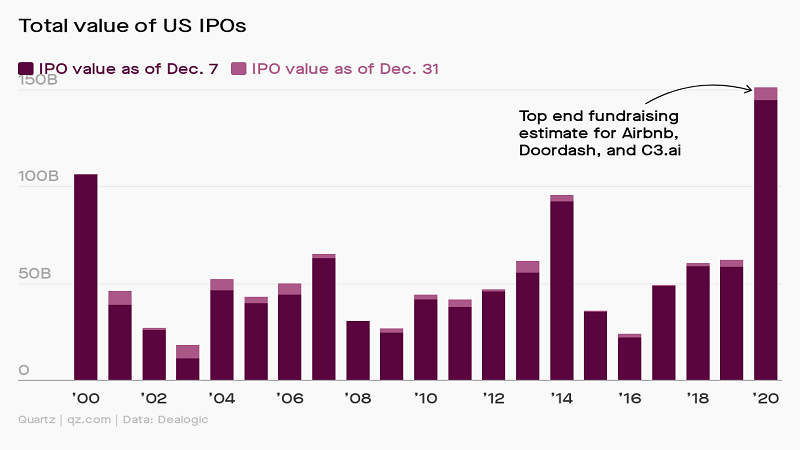
Take this plot: the IPOs of US companies. Who will believe that 2020 is the best IPO year since 2000? These companies are not really the ones working the hardest, but across most metrics, they are the ones which have figured out how to capture value even in the midst of a pandemic.

It is the same redesign in the Nigerian banking sector; they continue to hit record profits even in a dislocated economy. If you think it is easy, you better ask the insurance sector and others why they have not executed a similar playbook.

Think of your Value Capture Strategy; it is not an automatic thing in modern markets.

WhatsApp Introduces Cart Feature to its Business as DoorDash Aims to Raise $3.4bn in IPO

0

From WhatsApp Pay to catalog and now a shopping cart, Facebook is building a huge online market with the instant message apps that are gradually getting all the features of online stores.

The social media behemoth has announced the launch of shopping carts to WhatsApp, a move that came weeks after it introduced catalog to the market side of its instant messaging apps.

“Starting today, we’re excited to bring carts to WhatsApp. Carts are great when messaging businesses that typically sell multiple items at once, like a local restaurant or clothing store. With carts, people can browse a catalog, select multiple products and send the order as one message to the business. This will make it simpler for businesses to keep track of order inquiries, manage requests from customers and close sales,” the company said in a statement.

Just like in other online stores, the cart helps you to reserve items when you visit businesses you plan to order from. You only have to tap the shopping button next to their name, and select the items you want to buy when the catalogue opens, then tap “add to Cart”. You can repeat the process until you get all the products you need. You then can review and edit the contents of the cart before sending it to the business via a WhatsApp message.

Facebook rolled out the WhatsApp cart feature yesterday around the world, signaling preparation for anticipated Christmas season’s business boom.

The introduction of catalogs earlier as a WhatsApp feature, where people can easily see the options available, and companies have the opportunity to organize their chats around specific articles, spurred the need for the cart.

On the other news, DoorDash sets shares in its initial public offering at $102 per share, to raise $3.37 billion, the company announced on Tuesday.

The IPO puts DoorDash’s valuation at around $38 billion, which is more than double of its valuation of $16 billion during a private fundraising round it had in June.

The startup was founded in 2013 and has the backing of Vision Fund, a subsidiary of Japanese tech conglomerate SoftBank Group, venture capital firm Sequoia Capital and sovereign wealth fund Government of Singapore Investment Corp.

It has been a race to survive in the US food delivery market, but surge in demand due to pandemic restrictions spurred growth that UberEats, Grubhub and Postmates have also benefited from.

DoorDash is the largest US food delivery company for restaurants, and has aimed to sell 33 million shares at $90 to $95 per share according to its filing. It had earlier targeted a price range of between $75 and $85. JP Morgan and Goldman Sachs will underwrite the offering.

In a pandemic defying move, the food delivery company joins other Silicon big names like Palantir Technologies Inc and Snowflakes Inc, in issuing blockbuster IPOs.

DoorDash said its Q3 revenue reached $879 million, a significant record compared to the $239 million it recorded in the same period last year. The company also posted a loss of $43 million after reporting its first quarterly profit of $23 million in the second quarter.

Government stimulus packages and hope for vaccines cleared the path for DoorDash and other tech companies’ boosted sales during the last quarters of the year to spike their revenue.

The San Francisco-based company was among the tech companies that have witnessed revenue boom from the pandemic. DoorDash has more than 18 million customers and one million drivers, and has recently expanded beyond food deliveries into groceries, pet food and convenience store items.

DoorDash will trade on the New York Stock Exchange under the ticker “Dash.” The company is poised to become the highest valued food-delivery service when it debuts.

It joins the likes of Airbnb, Wish-parent ContextLogic among others aiming to drive the biggest trading in the NYSE for the month of December.