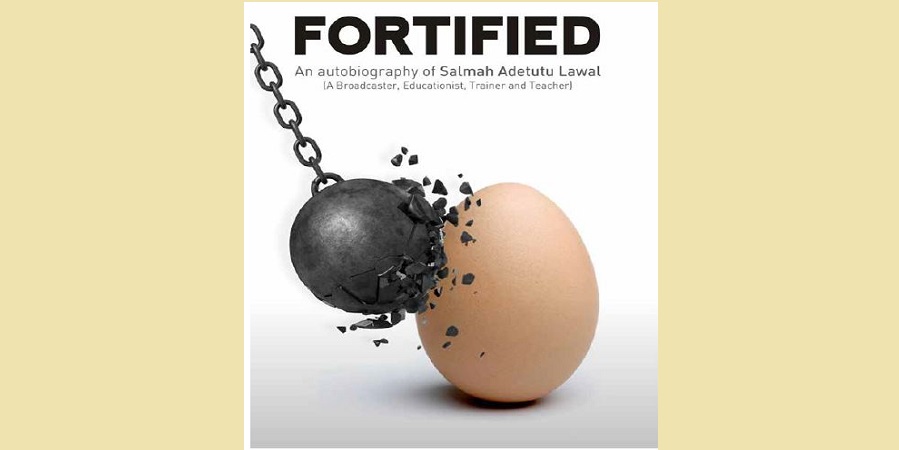
I had a different schedule this Wednesday Morning. Having woken up from sleep earlier by 2am that day and having had to work on an academic project whose personal deadline I had given to myself was becoming elusive, I made up my mind I was going to work on that project for some hours of the day plus some other pending writing assignments. Alas, a browse through my Facebook page and the encounter with a mutual friend and her offer of a free gift of her book “Fortified” made me do a detour of my intended schedule. I visited her website, took advantage of the offer and took a glance at the book hoping I would read it some day when I have the time. This has been a major fate of many books on my increasingly expanding list of to read books packed on my system. I have never had time to read books for leisure. It is either I read when preparing a research article or had a quick read when preparing for classes. But a major glance at Fortified made me stay glued until I finish reading at a single sitting! So, what exactly made me stuck to this 136-page and 12-chapter autobiography of this 40-something year-old woman – Salmah Adetutu Lawal? Please, come along.
First, let me confess that many of the experiences shared within the book resonate with me. Perhaps, this is because we grew up in the same era and time. So, I understand the background against which she was coming from. Two, the book is detailed. She wanted to tell it all – the story of her life- albeit from her own perspectives as she clocked 40. And she did justice to that covering issues that could describe her experience within that number of years she has spent alive- her Mum, early years, Dad, personality, work experience, marriage and even her journey into entrepreneurship. Who would not want to read an auto-biography written by his age mate? Besides, I have had a cause to know the author from a distance. We are friends on Facebook. That was how I delved into the book devouring it at a single sitting as I intended to know her deeper.
So, what is my impression of the book? The book is a good one. The story is simple to read and follow. The author should get kudos for the well-arranged episodes of her life. It makes following the story a piece of cake. The book is equally well spiced with quotations that illustrate her points. This shows the writer is a reader and she is deep philosophically. She also did not hide anything about herself- her strength, weaknesses and vulnerabilities. This is reflected in the way she narrated her ordeal while her failed marriage lasts. She opens this chapter of her life with a direct attack on the beginning of her matrimonial life which eventually fails. With the beginning of her marriage very shaky it would have been a miracle if it had lasted more than it did. Inherent lessons are there for young men and women who are about starting their marital journeys. First, compatibility is not only in terms of blood genotype. Compatibility of a couple in character, passion, drive, and set goals are very critical to the survival of any marital union. The author keeps referring to the fact that being a virgin till a marriage is consummated does not guarantee a lasting relationship in marriage.
Yes, she is right to an extent. She, according to her, remains sexually chaste before her marriage. Yet, the marriage caves in after three children. This is an indication that it is not only sexual chastity that keeps a marriage. After the first night, what keeps the marital union going are mutual respect, mutual understanding, mutual love, empathy and compassion. Just as a woman offering her body to secure a marriage contract would not work, it is the same way that using one’s virginity as a bait to make a marriage lasts will not do the magic. Every intending couple needs to understand that once the signs, before the union is made officially binding, are not good, the marriage may not last. This, I assume, might be the reason for the failure of the author’s marriage. The narration is one-sided. No one may get a complete picture of what transpires between her and her ex-husband.
Away from the author’s marital life, there are other life lessons to pick from her four decades of living. One good point to start with is her career at the Nigerian Television Authority which spans for 16 years! As a part of her generation, I would say she is lucky to have gained admission and graduated at the time she does. Her early entry into the career at the Nigerian national broadcaster gives a leverage. As much as her early entry, her sense of duty, commitment, hard work and goal getting character sustains her not only at the NTA but also when she tries to venture into private practice. A very striking feature of the author is her ability to transit as an English Education graduate to a well-known broadcaster. She uses her knowledge of Islam combined with her experience over the years in the media to make a product for herself upon which she excels. This implies that it does not sometimes matter what discipline you graduate with in the university, you will excel if you are able to combine that with talent and some creativity.
It would do no one any good if the lessons from Salmah’s journey into entrepreneurship are not captured. I assume she wants people to learn from her business sense. In the book, the author dedicates a chapter to talking about what works and what does not work for her. She likes exploring and experimenting with ideas. From an English educator to a broadcaster and then to an Islamic lifestyle entrepreneur, Salmah creates a space for herself and she claims it. Hers is a story of a life built on continuous improvement.
Life, they say, begins at forty. But, for the author, it is the end of an exciting phase and the beginning of another exhilarating path through life. In the concluding chapter, the author does some reflections and projections. She explains what is responsible for her still being unmarried despite advances from men. She wants to be more sure in her choice before she settles down again. I think that is instructive. Nobody wants to repeat the same mistake twice. She wants to explore deeper in her multifaceted career journey as a broadcaster, educationist and a teacher. She hopes for more from life. If the saying that a fool at forty is a fool forever is to go by, then Salmah definitely does not want to appear as one considering her life’s journey over the past four decades. It is a book that is worth reading as it contains lessons of life that are worth learning from.