Nigeria is among the top-leading adopters of cryptocurrency per capita; some have the country as #3. As we expect more weakening of the Naira against major currencies due to expected freeze, out of rising coronavirus, on global economic activities, pushing crude oil price down, more people will seek refuge in cryptos, even if to move money around internationally
The implication is that by late 2021, there would be impacts … (let me not go into details here). But I expect a new regulation in the National Assembly that would be along this line – Know Your Cryptocurrency Client (KYCC) – where financial and banking interface reporting will open some veils in crypto activities and its “opacity” in Nigeria.
Whether you are self-hosting your crypto-wallet or not, you may be required to report more to connect that wallet into the banking infrastructure and network. Ideally, self-hosting wallets could be seen as holding cash under the pillow! Expect the government to ask for changes.
Meanwhile, we have introduced a new course – Blockchain, Cryptocurrency, and Decentralized Finance: Technologies, Trading and Apps Utilities – in Tekedia Mini-MBA from our next edition (register here). The CEO of Bitfxt, Franklin Odoemenam Peters would lead it. We do think that it is time a modern management program has all the elements of modern (evolving) economic systems. We have always had blockchain in our program; now, we are extending to crypto and DeFi.
The meeting came at the heels of the news thatNigerian economy has fallen into recession for the second time in five years, according to data from Nigerian Bureau of Statistics (NBS), which reported that the economy contracted by -3.62% in Q3 2020.
The recession was fueled by the global oil crisis which plummeted Nigeria’s oil-based GDP, and the non-oil sector whose growth was stymied by the COVID-19 lockdowns. The oil sector contracted further by -13.89 per cent in Q3 2020 from -6.63 per cent in the previous quarter, while the non-oil sector contracted by -2.51 percent in Q3 2020, compared with -6.05 per cent in the preceding quarter.
It therefore presented an enormous challenge for the Apex bank, which includes stabilizing Nigeria’s forex to tame the 14.3% inflation and meet the goal of 1.4% GDP growth projected by the International Monetary Fund (IMF) that will enable the country to exit recession early next year.
The MPC reported on many measures it has taken to facilitate growth in many sectors of the economy, and consequently trump the strains of the pandemic and exit recession early enough.
The focus of the Committee were on choices bordering basically on whether: to tighten the stance of policy to address rising price levels recognizing its primary mandate of price stability; to ease support output recovery; or to allow existing policy initiatives to permeate the economy.
Obviously, the existing policy initiatives have been overwhelmed by the current events which have resulted in inflation and recession. Therefore, it beckons a new approach and policy framework to address the fault lines that hinge on poverty, which has limited spending to a degree that cannot spur economic growth; and the rising cost of commodities that has made basic living unaffordable.
Central Bank Governor, Nigeria
Contemplating a way out based on the above mentioned choices, the MPC ignored some approaches that would have otherwise appeared sublime.
The Committee noted that, although the appropriate response to rising inflationary pressure would be to tighten the stance of policy in order to moderate upward pressure on prices, it nevertheless, felt that doing this would exert downward pressure on the recovery of output growth.
The Committee also felt that tightening would negate the Bank’s desire to expand credit to the real sector at affordable terms, not only to boost production, but also to increase consumer spending. To the Committee, tightening was therefore not the appropriate response at this time.
With the economy, whereas MPC felt that government spending and the Bank’s expansionary stance would be desirable to support recovery and guide the economy out of recession, it felt loosening would trigger excess liquidity and worsen the inflationary pressure.
MPC also felt that excess liquidity may impact demand pressure and fuel further depreciation of the naira. With respect to a hold position, the Committee was of the view that this will be beneficial as it will allow current policy measures to permeate the economy while observing the trend of developments.
While these options seem rightly ruled out by the MPC, alternative actions to replace them have become imperatively urgent.
The Committee said that “the heterodox policies of the Bank targeted at various sectors are showing positive results that would further engender growth”. But it is not enough to quell the impact of the disruption in the global supply chain, given that many countries outside Africa, including China, the United States and those in Europe, are still taking restrictive safety measures to curb the COVID-19 pandemic.
The Committee’s final decision hangs on key four steps aimed at retaining existing parameters.
Retain the MPR at 11.5 per cent;
Retain the asymmetric corridor of +100/-700 basis points around the MPR;
III. Retain the CRR at 27.5 per cent; and
Retain the Liquidity Ratio at 30 per cent.
Nevertheless, they seem good enough to upset the economic woes if not that the harbingers are rising on the daily nationally. The insecurity in the north which has almost halted farming activities in the region, keeps adding embers to the burning economy, as food inflation has significantly risen to 17.3% in the Q3 as a result.
On the other hand, infrastructure deficiencies and forex scarcity are posing more challenges to local production. Experts believe the situation could be ameliorated through intra-African trade and practical steps toward the implementation of AfCFTA. But the Nigerian government has shut its land borders for months, putting its over $5 billion ECOWAS-based import/export macroeconomy in jeopardy and stymieing its chances to use macroeconomy as a wedge against the pandemic’s economic shocks.
The World Bank has urged African leaders to develop a framework to resolve border issues, as it is a step towards implementing AfCFTA-based integration.
“The AfCFTA will only succeed if member countries make the regional strategy part of their national policy and proactively address the tensions that arise. Countries should find the sweet spot that reinforces national economic goals and ensures maximum gains from increased integration, looking beyond a static assessment of their priorities,” the World Bank said.
Alas, the Monetary Policy Committee and the federal government of Nigeria are yet to agree with the World Bank on the urgent need to open the borders.
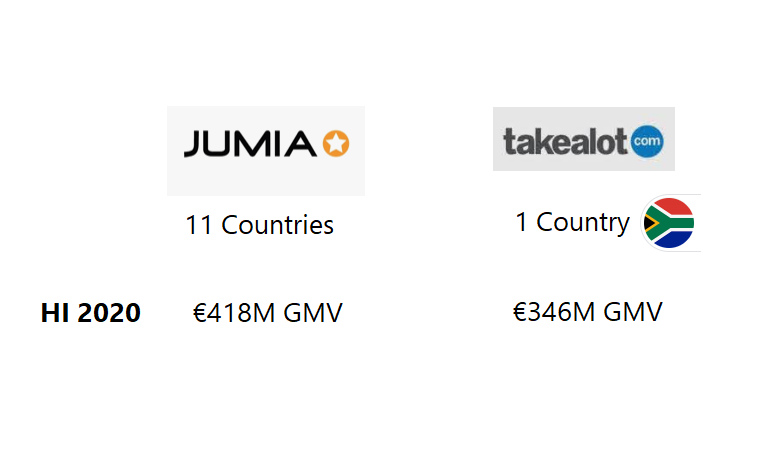
These data sets show how far South Africa is when compared with other sub-Saharan African countries in online commerce; Jumia operates in 11 countries while Takealot is mainly in South Africa.
In H1 202, Takealot Group generated €346 million in Gross Merchandise Value (GMV), which signaled 85% growth year-on-year.
Takealot Group generated R6.26 billion in Gross Merchandise Value (GMV), which signaled 85% growth year-on-year. The Takealot ecommerce platform grew its GMV by 88%, while first-party and third-party businesses grew by 69% and 119% respectively.
The Group also reported a 41% increase in revenue to R3.66 billion for the same period, and these good results culminated in a trading loss improvement of 36%.
In Q1 2020, Jumia GMV was €190 million, after adjustment. In Q2 2020, it was €228 million. That means for HI 2020, Jumia recorded a GMV of €418 million.
Simply, Nigeria and other African countries have huge opportunities therein, even only to catch up with South Africa.
She seems to live a life that appears “strange” to an average digital native. She neither likes photographs nor does she record a video of herself. She attributed that to her religious beliefs. However, she uses the internet to write fictional stories that promote Islamic values. She commands a huge following online using her blog to write stories that examines concepts and values that her religion preaches. Meet Kafayat Jayeoba who studied Electrical/Electronics Engineering but write stories that showcase Islamic principles and ethics.
When asked to introduce herself, she said “My name is Kafayat Jayeoba with the penname Ummu Abdillah, married to Sulaiman Dasuki. I studied Electrical/Electronics engineering, majored in Electronics and Telecommunication engineering in Kwara State Polytechnic, Ilorin but my vocations now are writing and teaching.”
For me as a journalist, I became inquisitive wanting to know how an Electrical/Electronics Engineer turned a writer. Kafayat went down the memory lane tracing how she found herself writing despite being in the technology space. She related “thinking about that recently I think right from my basic education, I have loved art, I have loved stories. I’m a person that stammers so I find it difficult to express myself in words. It’s sometimes difficult and most times when I do, I’m not always satisfied whenever I look back at whatever I’ve said. Then, we used to illustrate stories in pictures, depicting actors and characters.
Doing that, it was always fun to narrate an action movie I had watched and imagined and my classmates did flock around me to listen to my narrations and they did love my drawings too. It was always explicit. That was in primary 1, 2 and maybe 3. When I got to Jss3 class too, there was a trend among girls in my class and that was writing an interesting short story. I also wrote two, very interesting ones that almost all my friends borrowed and read them till it got lost. So I can call all those experiences a flinch of passion. I was always aspiring to go into science, to even become a medical doctor.
But as Allah has destined it, I attended the polytechnic to study engineering.” She then added “during my courses in the higher institution, I picked up my pen to write again but on social media. I should say, that’s where I first discovered that my voice could reach a large audience through my pen. Then, I founded an online forum in a group I created on Facebook. I called it Marital Forum. There, I started delving into issues relating to marriage and I compiled articles which attracted many readers. It was during this article compilation that I thought of writing a novel, which gave birth to my first novel on polygamy. It is titled How Will I Cope?
Further interaction with the young writer shows that she does most of her writing through the Android phone. When prompted to speak further on this and how technology has helped her, she posited “I write on my smartphone. I even find it easier than using a computer. It has helped me a lot. The internet made me realize that I also possess the power to wield a pen just like a warrior wielding his sword. My first readers are my friend on social media. Also, that’s where I got the motivation to make my first story into a book. It has been an avenue where people can find my stories and link up to me directly too. For instance, my blogging journey led me to my second story titled Escape From The Bottomless Pit. It was a series I was sharing online before I decided to compile into a book. I also have a global following through the internet. That is why I’m still learning to use it effectively. Recently, I learnt how I could make banner advertisements, sell my story in soft copy and many more. So, writing on my phone and using the internet has been very helpful and I’m sure it’s going to help a lot in the future.”
Having a conversation of this nature with the budding talent is a reflection that Nigerian youths have the potential to excel if the will is there.
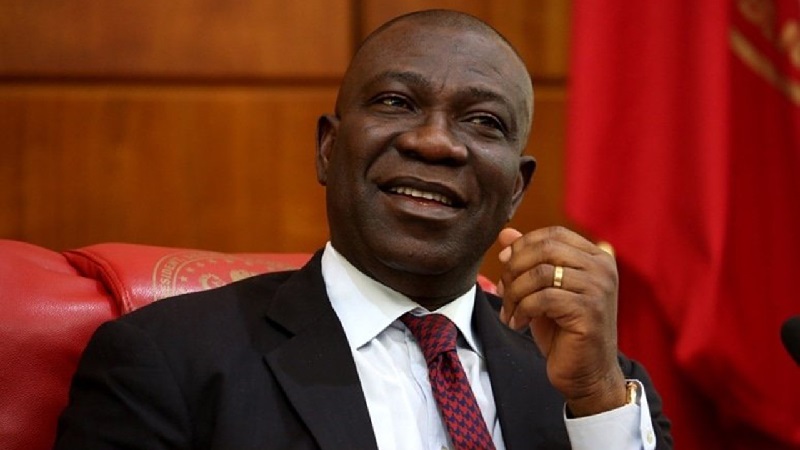
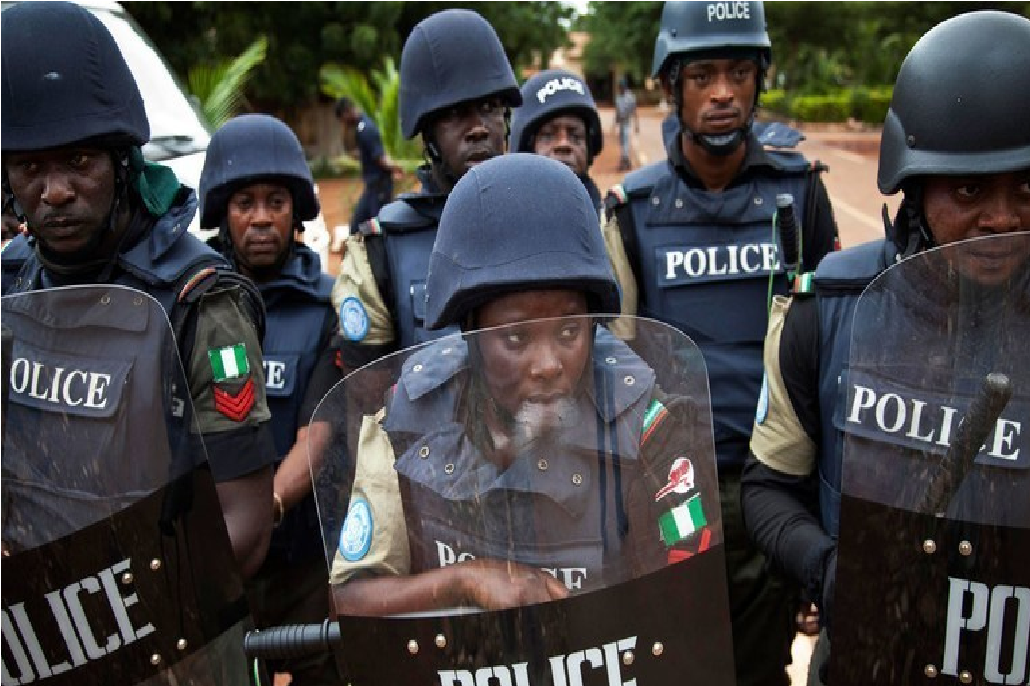
The senator representing Enugu West in the Senate, the upper house of the Nigerian bicameral federal legislature, Ike Ekweremadu, Ph.D., has said that Nigeria is the only known federation globally that runs a central police force. He also stated that sincere conversational dialogues on this and other contradictions of our federation may help in deepening Nigeria’s democracy.
Ekweremadu, former Deputy President of the Senate, who’s concurrently a Professor and Mentoring scholar in E-Governance and Strategic Government Studies at the Southern University, Baton Rouge, Louisiana, USA, contends that it is impossible to achieve effective security governance with the current structure of the Nigeria police.
He also noted that the planned community policing subsumed under the present police structure will be futile because it will not achieve concrete, measurable and sustainable policing of the country, thus, advocating policing institutions controlled by the states in the federation as practiced by other notable federations in the world.
Ekweremadu made these submissions on Wednesday in a lead presentation at the Colloquium tagged, Beyond Branding: Engineering a Citizen-led Proposition for Nigeria’s National Cohesion and Global Positioning, which took place at Sheraton Hotel, Abuja. According to a statement released by Omoniyi Ibietan, the Colloquium is a companion programme of the presentation of an iconoclastic book on marketing communication, Pitch: Debunking Marketing’s Strongest Myths, written by Ikem Okuhu, a former specialised journalist in brands and marketing reporting, and founder of BRANDish, Nigeria’s “first nationally circulating brands and marketing magazine.
Ekweremadu told the audience that a Citizen-led democratic political participation must include, in the Nigerian context, town meetings and special Parliaments of constituency stakeholders which are already instituted in Enugu West Senatorial District, as well as public hearings and referendums among others. At public hearings, he insisted that citizens and communities must be given opportunity to have a say in appropriation, including the nature of projects they require in their constituency, suggesting it is improper for the government to establish projects in communities without consultation with the citizens.
Indeed, Ekweremadu has put in concrete context, a paradigm of development established in the late 1960s that speaks to consultation and inclusiveness that accommodates participation of supposed beneficiaries of development programmes from conception to monitoring and evaluation of projects and programmes.
Ekweremadu bemoaned the fact that referendums, a provision of the Nigerian Constitution, only speak to state or local council creation, and recall. Even though no state creation proposal ever got to the referendum stage, referendums are meant to address more serious issues that transcend the state creation and recall processes, as evident in the applications of referendums in other jurisdictions.
The book reviewer, Nduneche, Ezurike, Head of Brand and Marketing Communications at Polaris Bank, commended Okuhu for use of insights and experiences, and also noted that Okuhu’s use of first person narrative style and storytelling acumen make the book gripping and mentally stimulating. Ezurike also spoke glowingly about Okuhu’s use of graphics, use of case study methods and fact-finding involving over 200 brands as commendable. These include brands like Alabukun, an effective analgesic, indigenous to Nigeria, and ‘bitterleaf’ soup, which momentarily displaced ‘Egusi’ soup as a ready substitute during Shagari Administration’s imposition of austerity measures in the Second Republic.
Okuhu advocated that brands will fare better if CEOs see themselves as CMOs (Chief Marketing Officers) and objected to the use of administrators as CEOs. This impropriety explains why many Nigerian brands, especially main company brands, have been killed or undermined on the altar of newer brands. Okuhu insisted that innovation is great but it must synergise and resonate with utilitarian value of products and services because ultimately, consumers buy utility not innovation.