DD
MM
YYYY

PAGES

DD
MM
YYYY

spot_img

PAGES

Home Blog Page 6116

The Vice President’s Meritocracy Sermon

2

“Meritocracy is crucial in an economically viable value system because it rewards talent and enterprise. And it is talent and enterprise that would drive sustainable growth,” Vice President of Nigeria, Yemi Osinbajo.

I will simply add: Mr. Vice President, make this happen. It is five years now and we are still waiting for you on this matter. We know the problems – and we desperately want solutions.

Nigeria’s desire and pursuit of economic growth and sustainable development is best achieved through the adoption of merit as a national value, according to Vice President Yemi Osinbajo.

The Vice President made the remarks in a keynote address delivered at the Nigeria Leadership Initiative (NLI) webinar series themed: “A National Conversation on Rebuilding our National Values System”.

“Meritocracy is crucial in an economically viable value system because it rewards talent and enterprise. And it is talent and enterprise that would drive sustainable growth,” Mr Osinbajo affirmed.

Stressing the point about the importance of merit to sustainable growth, the vice president said, “Economic growth rests upon the substructure of values. The basis of the entire credit system as we know it, is trust. Indeed, the word credit is derived from the Latin word “credere” —to believe or to trust. For a credit facility to be extended to a person, trust is placed in the borrower and his or her willingness and ability to repay.

A young lady reported here how she made a First Class in a university in the South South region of our nation but because she came from the South West, the school bypassed her and gave the graduate assistantship job to someone who finished below her. How do we expect her to believe in Nigeria that we are fair? But her case is not isolated. From how we choose leaders in schools and offer opportunities to our young people, Nigeria is running a dangerous playbook.

wrote a few days ago, noting that the indigenization of key positions in federal universities in Nigeria is the new order. Yes, being a Yoruba man is not enough in UI; it has to be an Ibadan man. Being an Igbo man does not cut it in UNN, he must be an Nsukka man. And being an Hausa Fulani cannot qualify unless the man is from Zaria for ABU. Too bad that I am using “man” because yes, in nearly 99% of these races, our female professors are overly marginalized.

To make her believe, Mr. Vice President has an obligation to begin to change this evil through policies over just giving speeches. He might have enjoyed a fair merit-based system in his time. I did while in FUTO. We need to fix this lack of merit in the Nigerian system, urgently; now is the time for action.
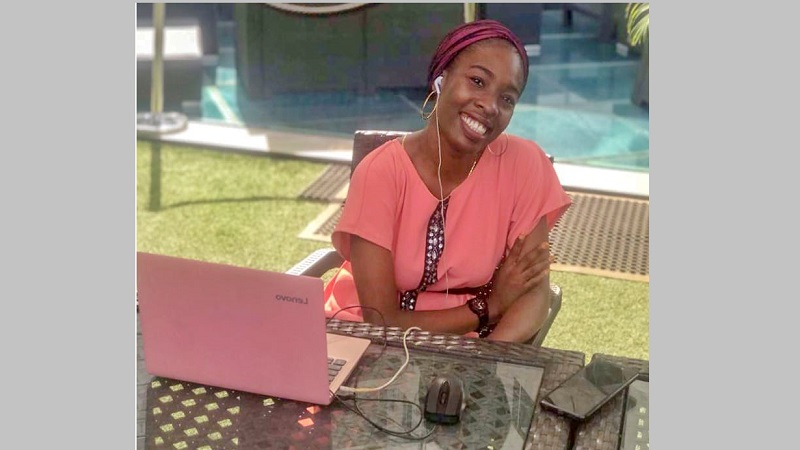
How I spent 6 years getting a degree but never regretted it – Mariam Olayiwola

4

Her story is an amazing one. It simply demonstrates resilience and the need to find one’s purpose early in life. It also captures the essence of self discovery. As an undergraduate, she had to move from Biochemistry in natural sciences to Mass Communication in the social sciences. Consequently, she had to lose about three year because she had to start from 200 Level after having got to 300 Level in her previous course of study  so as to get a degree in a course she has demonstrated passion for. Today, she is happy as her decision has paid off. She has changed jobs twice when millions are finding it hard to find  one. Meet Mariam Olayiwola in this chat with Rasheed Adebiyi where she talks about her journey so far.

Tekedia: Could you tell us about yourself?

Mariam Olayiwola: My name is Mariam Omomolade Olayiwola, a Millennial striving to do things differently and creating magic in this world. I am a digital strategist, content curator, social media manager and a bunch of other things media related.

Tekedia: We learnt you spent six year in the university before you eventually graduated. What happened?

Mariam Olayiwola:  Moving from Biochemistry to Mass Communication was born out of my interest in media and communications after I joined a campus journalism group in school. I started finding myself and my interests after I had started Biochem, and it was hard to deviate from the things I actually loved. My interest in media kept growing and the bad grades in sciences were discouraging me from continuing the course. I just had to opt out.

Tekedia: How does it feel having to go some years back before you graduated?

Mariam Olayiwola: Losing some years was inevitable due to the disparity in the two courses. I already weighed my options and thought it made more sense to lose two years and be fulfilled rather than continue with my worst nightmare and be miserable.

Tekedia: Looking back now, how do you feel about that decision to move from the sciences to the social sciences?

Mariam Olayiwola: Getting a Mass Communication degree is the best thing I’ve done for myself. I can say I wouldn’t have been more useful for myself if I had continued with Biochemistry, and I wouldn’t be happier. For me, my happiness is paramount, and that, I get from my career.

Tekedia: Any takeaway for parents and young undergraduates about choice of career and course of study?

Mariam Olayiwola: It’s odd to give parents advices, because I’ve never parented before. But I’ll like to say my experience has thought me that it’s important to allow people follow their heart and chase their dreams. It’s also very important not to decide for people millennials especially). Our generation is a very complex one, and it is highly different from the previous generation. Therefore, let people find themselves, chase their dreams and make their career decisions themselves. Doing things differently is one thing that keeps Millennials going, and for me, doing things differently saved me. For young undergraduates, I was like you a few years ago, but I distinguished myself by trying my hands on everything positive that could make me relevant. It’s not too early to start creating magic.

Tekedia: Your advice for youths in any educational system that is finding it hard to see clarity and purpose in their life journey?

Mariam Olayiwola: Finding purpose doesn’t happen overnight. I think it’s one of the hardest things about life because sometimes you think you have found your purpose and you still find yourself gallivanting about. Try your hands on the things you love and you naturally find yourself doing. I believe most times, our career paths are born out of hobbies, talent and passion. Do some mental exercises, find these things and develop your interest in them. Finally, back it up with some form of spirituality. I mean you have to pray as well.

Tekedia: Thank you for your time.

Mariam Olayiwola: It’s my pleasure.

Experts Charge University Administrators, Lecturers to Balance Knowledge Production, Manpower Development

0

Nigerian scholars and academics have been advised to combine both the production of manpower and knowledge as against the sole production of manpower that currently plays out in Nigerian higher institutions of learning. This charge was given by Dr. Abdul Rasaq Mohammed Adisa at a one-day retreat organized by the Department of Mass Communication, Fountain University, Osogbo. The retreat had the theme Research, Knowledge Production and Academic Productivity in an Emerging Knowledge  Economy.

Adisa, who spoke on the topic “Mobilizing Pragmatic Research for Sustainable Knowledge Production and Academic Productivity: The What, Why and How?”, emphasized that university teachers have multiple roles as knowledge producer, manpower nurturer and society builder. He identified that for the Nigerian society to move forward, there must be a robust interaction between the town and gown. Adisa posited that knowledge is the most significant variable in the equation of economic development in the 21st century which distinguishes developed nations from underdeveloped ones. He advised that Nigeria should come up with a national policy on knowledge creation and realign research institutes to universities if the country desires an acceleration of its economic development plans.

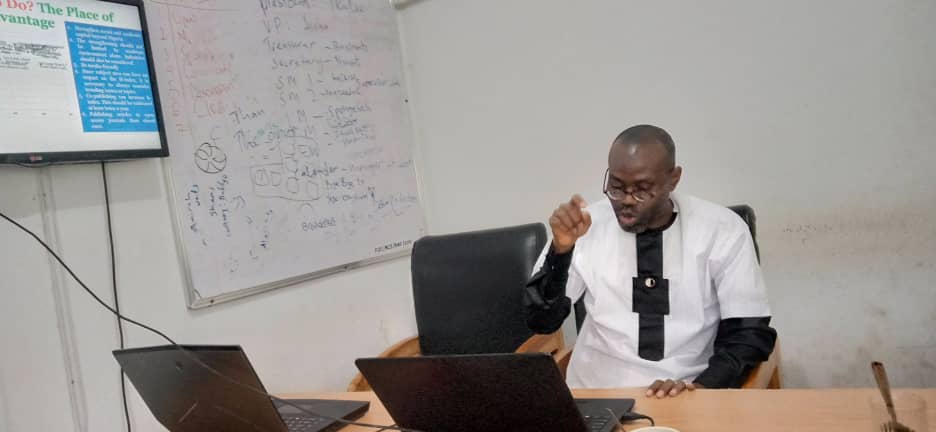
Mutiu Iyanda while presenting at the Retreat

In his own presentation, Mutiu Iyanda Lasisi, a Communication and Research Consultant, charged the department to come up with a strategic growth plan in order to capture value and deliver more values to concerned stakeholders including parents, students, the immediate host community and the university itself. Lasisi, who spoke on “Strategic Review  and Projection: FUO Mass Communication in the First Decade and Beyond’’ said the problem of the majority of universities in Nigeria is their inability to establish a system of achieving their strategic statements as reflected in their vision and mission. He advised the department to draw up its own mission and vision from the university’s strategic statements. Lasisi urged lecturers in the department to also devise a personal strategic growth plan so that they could boost their own career progress alongside that of the department. He emphasized the need for the faculty of the department to also contribute to solving societal and industry problems. He stated that this would open the doors of the industry to the ivory towers.

In his welcome remarks, Kamoru Aremu Salaudeen, who as the Coordinator of the Department, laid the background for the retreat. He said the retreat, which came at a time the department is three years away from a decade of producing manpower for the communication and media industry in Nigeria, provided an avenue for lecturers in the system to reflect on the modus operandi of the department in the last seven years and then devise a strategic growth plan for the years ahead. Salaudeen posited that the department runs a unique curriculum different from other departments of Mass Communication in the country.

The retreat had in attendance all members of the department, Dr. Olusegun Fariudeen Liadi from the Department of Sociology, Mallam Femi Sirajudeen Bakrin from the University Library and other invited guests within the university community.

LIFE EXPERIENCE: Being a Teacher in Nigeria is Equal to Signing a Lifetime of Poverty

2

Before COVID-19 struck in Nigeria, teaching is one of the professions or jobs many Nigerians are doing reluctantly. This is largely due to the low remuneration and welfare package. From the public to the private schools, experiences of teachers are not quite different when the disease emerged. In this life experience documentation (LED Series One), Segun Solomon, a teacher in Osogbo, Osun state capital, chats with our analyst on why being a teacher in Nigeria seems to be a signatory to lifetime poverty.

The Chats

Segun Solomon

I was trained to be an educator within the walls of a school, but I have vowed to never be a ‘teacher’ ever again in my life. I have taught in selected schools of high repute and ‘good payment scheme’ in many locales. However, it amazes me when I tell friends who are also teachers in their own locale how much I earn, and the next thing I hear them say is, “Wow! Solomon, that’s a lot, man!”. Some would even go on to say, “Hey! I knew it! You know you’re always classical in your own way. Guy, I envy you ooo.”

All of those comments are nonsense to me. They are expressions of fellows who fail to recognize their worth and values. It presses me down to earth when I hear that a graduate of Law now teaches Government or Civic Education in a Secondary School where he is being paid #30,000 per month. It sucks!

I know of a Master’s Degree holder who teaches in this nation to earn #25,000. Yet, such woman feels on top of the world amidst others. What a pitiable woman! It’s in this same nation that a man with no certificate earns his own income in multiples of #700,000 within the ambience of governance.

Tell me, how would such one ever thinks of teachers as worthy fellows for a monthly income close to his? As a matter of fact, when you elect such man into the affairs of deciding what and when teachers should be paid, he would conveniently and comfortably owe them 8 months salaries without remorse. After all, education didn’t place him there.

To private school owners, when you hear, “Proprietor”, you should know people are referring to a business man who uses other people’s brain to accumulate wealth for himself. Yes! That’s the situation in Nigeria. They’d use teachers like a roadside cream seller. No sitting. No stopping. Their own slang of motivation is, “All hands on deck.” Crazy fellows!

It saddens me and gives me a sourly vexed spirit when I see the reaction of some people each time, I tell them I am a teacher. At first sight, they’d admire and even want to hire me as a consultant for their business. Let me mention my job description as a teacher. That’s the EOD.

Some would instantly lose their respect and courtesy. Some would even show it in their gesture that they are not meant for such class. They humiliate teachers with their looks and expressions. This is the same nation where some literate uneducated parents who bought their own certificate and would spell “KUDOS” as “KUDUS” would lift their corrupt and depraved hand to hit the molder of their child’s future. What a putrid entity!

I have been young and now I am older, yet I have never seen a job-made wealthy teacher. At least, not in Nigeria. When I say ‘wealth,’ I mean wealth in its actual sense. What has this God-forsaken god-damned leaders and decision-makers done to help the situation? Absolutely nothing! What concerns them about children of the masses? Church-made Proprietors are not even excluded. Do you know what the ripple effects of this situation is in Nigeria? Go back and check the economy and productivity situation of our dear nation.

Over 90% Nigerian graduates of Mechanical Engineering cannot even fix a spoilt bicycle. If you have heard of those ones with exceptional qualities and academic excellence, look for them in Nigeria. I am sure they are no more in their fatherland.

I must stop here to avoid being too wordy. Being a teacher (in the actual sense of this context) in Nigeria is equal to signing a lifetime of poverty.

The Poor Communicator At Bethesda

0

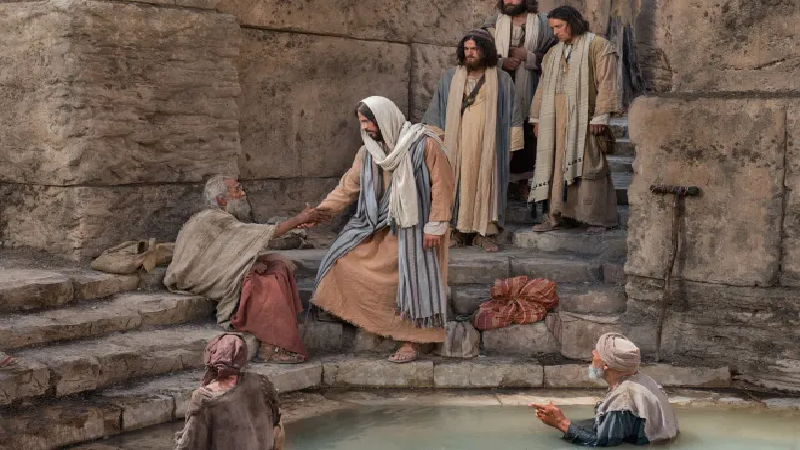
He was paralyzed for 38 years. He expected healing at a pool in Bethesda. Typically, an angel would arrive at the pool, stir the water, and the first to get in would be made whole. That has been the method for years; nothing else matters for many.

Then one day, the Messiah came. He asked the man, “Do you want to get well?”

“Sir,” the man replied, “I have no one to help me into the pool when the water is stirred. While I am trying to get in, someone else goes down ahead of me.”

Notice his answer: he had no one to get him into the water. Simply, he had no connection to Aso Rock, White House or the U.S. Embassy for visa.  Apparently, his healing must come via the same way – stirring water and jumping in, and the process must wait until the next angel arrives. Too bad, he did not know the grand commander of angels was before him.

 We have the same problem. Someone asks you “Do you need a job?” Then you quickly remind him that “Sir, I made a 2.2 and banks, oil & gas, and telcos have never invited me for an interview”.

Get over it. Do not make the path to success to become The Success. There are many routes. Not many would be as lucky as the paralytic man who despite his way-off answer received healing from Christ.

Communicate better. See the big picture. And advance.

John 5:2-9 New International Version (NIV)
2 Now there is in Jerusalem near the Sheep Gate a pool, which in Aramaic is called Bethesda[a] and which is surrounded by five covered colonnades. 3 Here a great number of disabled people used to lie—the blind, the lame, the paralyzed. [4] [b] 5 One who was there had been an invalid for thirty-eight years. 6 When Jesus saw him lying there and learned that he had been in this condition for a long time, he asked him, “Do you want to get well?”

7 “Sir,” the invalid replied, “I have no one to help me into the pool when the water is stirred. While I am trying to get in, someone else goes down ahead of me.”

8 Then Jesus said to him, “Get up! Pick up your mat and walk.” 9 At once the man was cured; he picked up his mat and walked.

The day on which this took place was a Sabbath,