DD
MM
YYYY

PAGES

DD
MM
YYYY

spot_img

PAGES

Home Blog Page 6135

How Nigerian Government Will Distribute the N75 Billion Survival Fund Grant – Osinbajo

2

Nigeria has unveiled a N75 billion fund to help the citizens and small businesses get over the Covid-19 impacts; apply via this link if you have not done so. In an interactive session this week, the Vice President of the nation, Prof Yemi Osinbajo, explained how about 1.7 million Nigerians and businesses would be supported and empowered. Already, about 175,000 people have already registered for the fund. Of course, my thesis has been focusing on growing businesses over spreading to millions.

When you want to empower one million traders with $200, instead of focusing on the top promising few with capacity to scale, you end up wasting resources as nothing changes. We have been running that policy for decades and nothing has changed. We can all believe whatever we want to believe. But the fact is that food prices are going up despite some “alternative facts” created by political hitters. That trajectory is very dangerous right now.

Yet, you cannot fault the government as the cardinal mission may not be to fund future companies, but rather, to share goodies to the lucky few, in a nation with limited identity records which could have made tax credits or other support mechanisms easier.

They are the MSME Survival Fund with the payroll support track as the first scheme to rollout (N60 billion); and the Guaranteed Offtake Scheme (N15 billion) to help cushion the impact of the COVID-19 pandemic. The government said the scheme will be implemented over three months. The scheme is part of the N2.3 trillion stimulus package of the Nigerian Economic Sustainability Plan (ESP).

[…]

“We are looking at 1.3 million beneficiaries under the Survival Fund and under the artisans and transporters grants. Then we have a Guaranteed Off-take Scheme. Under this programme, basically, if you manufacture certain items and food products, we will buy them from you. Our target is about 300, 000 of such producers of foods. Both schemes will benefit about 1.7 million individuals and small businesses.”
The core elements:

  • Free business name registration for about 250,000 persons
  • Payroll support for about 500,000 qualified beneficiaries.
  • Grants to 333, 000 artisans and transporters.
  • 2 million farmers will benefit from the program.


Data from Premium Times

Paga Group Picks London As Its New Legal Home

1

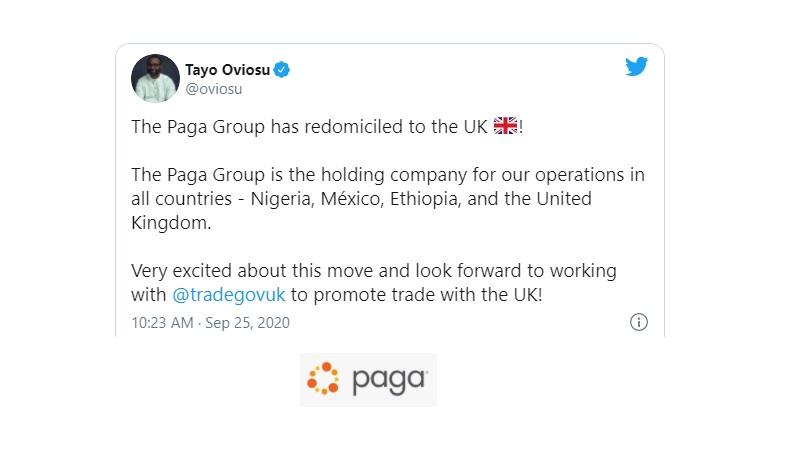
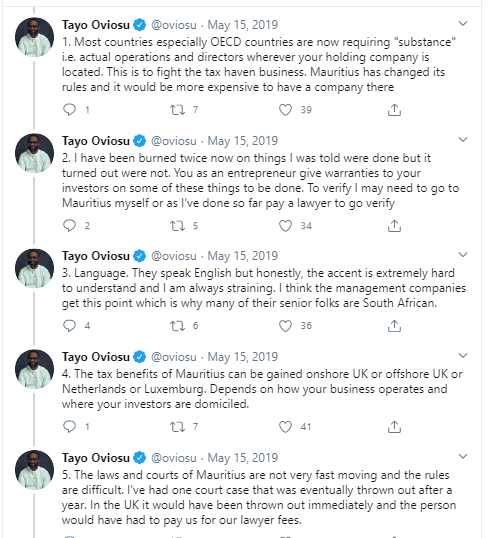
Paga Group, the pioneering fintech out of Nigeria, has given up on Africa, at the level where it matters: legal jurisdiction of the holding company.  Yes, Paga Group CEO, Tayo Oviosu, just informed the world that the Mauritius-based company has redomiciled to the United Kingdom! 

There is nothing new here: holding companies of 99% of fintech companies in Nigeria which have raised at least $2 million are typically not Nigerian. The news here is that the old “reliable” Mauritius has failed Paga Group.  Simply, African legal systems are not catching up with the modern ordinance of market systems. We need to fix those urgently.

Here is the core reason for moving:

“The laws and courts of Mauritius are not very fast-moving, and the rules are difficult. I’ve had one court case that was eventually thrown out after a year.

In the UK it would have been thrown out immediately, and the person would have had to pay us for our lawyer fees.

“Basically, not an easy place to do business. It is more painful than useful. I say stick to good ol’ America or UK or Netherlands or Luxemburg. Where you know there are professionals, and the legal system works.”

The Acceleration of Profit Margins

0

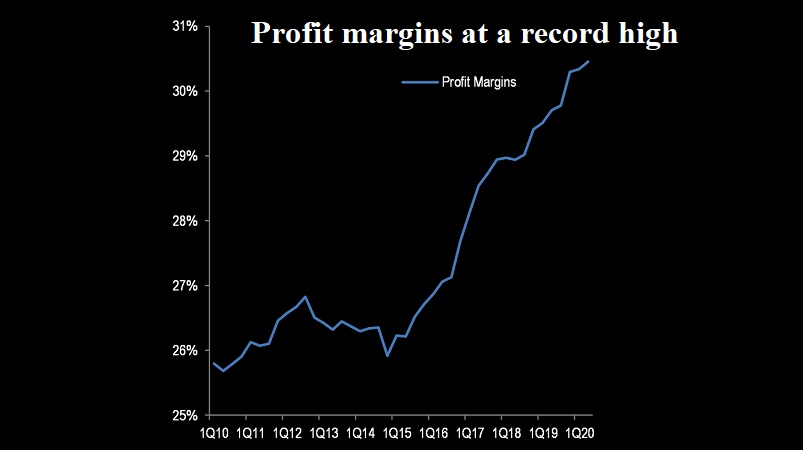
Pricing, cost, and margin are three powerful words in business. In the next edition of Tekedia Mini-MBA, coming up in Feb [early registration has started], we will dedicate a session on how to price to improve margins. Yet, besides the rudimentary cost-based and value-based pricing, the gold standard of modern business is attaining better equilibrium on marginal-cost pricing, via compounding acceleration of simultaneous reduction of transaction and distribution costs.

As you look at this plot, you can notice one thing: as the world digitizes, margins improve. It does not mean that all businesses are experiencing better margins. What is happening is that those capturing values are improving margins faster than the value-dissipation experienced by the disrupted. So, on average, margin moves northwards.

To make it easier to understand. If you average the profit margin of a digital advertising portal (like Facebook) and a print newspaper, you will notice that the margin is improving because Facebook’s margin is growing faster than any reduction in the print margin. Simply, the improving global margin is as a result of digitization and automation in most industrial sectors.

Nigerian States’ State of Financial Deficits

1

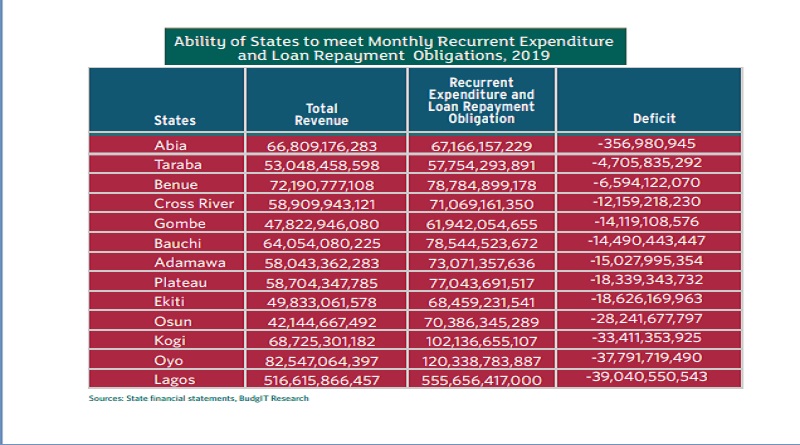
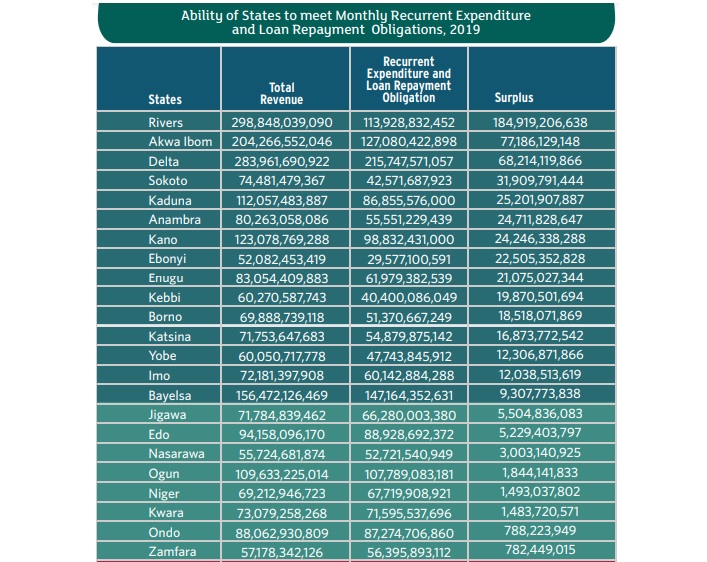
Debts may not necessarily be bad. But in Nigerian states, there are many reasons to worry. According to BudgIT, most of our states are technically yoyo. Yes, Oyo, Kogi, Osun, Ekiti, Plateau, Adamawa, Bauchi, Gombe, Cross River, Benue, Taraba,  Lagos, and Abia states were unable to fund their recurrent expenditure and loan repayments due in 2019.

Across Nigeria, we spend all the time examining the federal government without knowing that nothing is happening in the states. Lagos state seems to be out of order! I mean, the 6th largest economy in Africa needs recalibration. Rivers state seems to be in charge of its future, surprisingly.

For the full report, please click here.

Update: This report has some errors which the authors have acknowledged.

“Indeed, @followlasg (Lagos State Government) cannot be included in the category of States with a recurrent deficit; thus, not borrowing to pay salaries,” BudgIT said.

“Our metrics focused on NET FAAC and IGR as published by the National Bureau of Statistics due to the disparate nature of revenue framework among Nigerian states.

“We also apologise for including a special debt financing program as part of the recurrent expenditure which might be a total representation of its finances.”

The Nike’s Just Do It Strategy of Controlling and Influencing Demand

4

Nike experienced a massive increase, and that is a huge lesson for everyone. The athletics wear leader grew its online sales by 83%, adding $900 million to the company’s top line last quarter. Simply, e-commerce is now 30% of Nike’s sales. It got there three years faster. Two things drove this redesign:

  • Nike developed athletic training apps. This is a consolidation – bring the training inhouse, and make sure your users do not need to go out looking for training apps.
  • Puts its destiny in its own hand by opening Nike stores, shifting away from wholesalers like Macy’s.

While most brands have simply made their apps and e-commerce sites shopping tools, Nike has long understood that digital tools must do more than just support sales and have to insinuate themselves into customers’ lifestyles to really pay off. Otherwise, e-commerce growth often just means business going from one avenue to another, rather than growing the overall pie.

A few years ago, the sneaker maker launched its online NikePlus program, a membership program with tens of millions of members that has helped the company better understand each customer’s interests and shopping patterns, and ultimately sell them more of its products.

Nike is also benefiting wildly from tools like its Nike Training Club App and a running app that offers self-guided runs. Donahoe said more than half of the training club app members had done a workout using the app last quarter. That fosters loyalty with customers and keeps Nike top of mind—as well as filtering users to its commerce site.

If you check what is happening here, Nike is doing more by itself. Sometimes, in this age where supply is not the core issue (controlling demand matters more), finding a way to build your own consumer tribe could be rewarding. Invest not just on your supply part, but also on your demand part, because if you can influence DEMAND, you can sell more. Yes, as those using Nike’s apps for training congregate daily, the Nike’s logo is seen by them, even though the next shoe purchase may be coming in the next 12 months.

For decades, Nike focused on supply, using department stores to sell its products. Today, while that supply element remains, Nike 2.0 is also about controlling the demand experience. And that is why this firm is elevating the game. Across sectors and industries, a strategy to find a way to stay closer to demand is now critical for survival.