DD
MM
YYYY

PAGES

DD
MM
YYYY

spot_img

PAGES

Home Blog Page 6156

Stemming the Impunity of Security Agencies on Civilians

0

Through out history, it has been the inaction of those who could have acted, the indifference of those who should have known better, the silence of the voice of justice when it mattered most, that has made it possible for evil to triumph.—Haile Selassie

The Latest Victim

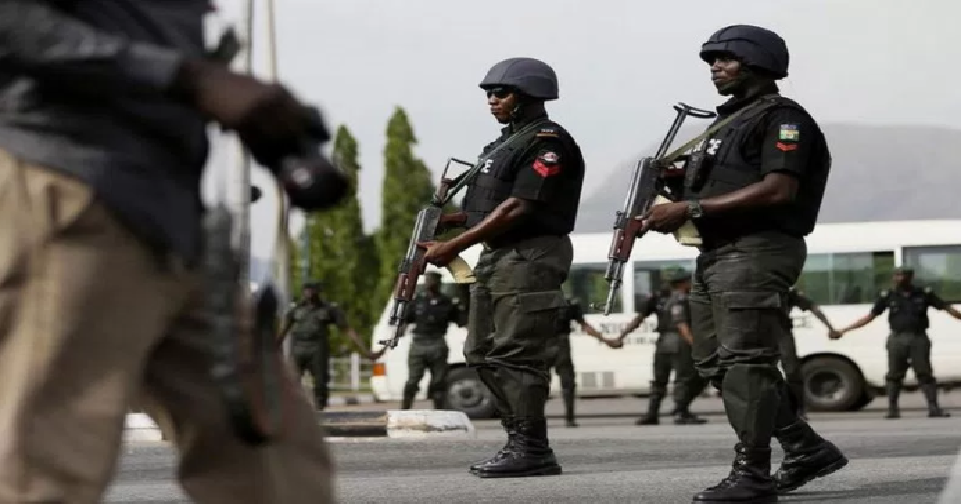
This piece is dedicated to the memory of Collins Osagie and those before him, victims of military and police brutality on defenceless civilians. According to the Punch you paid the supreme price for having the audacity to mediate in a disagreement between a soldier and a trader.

Recollection

While reading this bad news, my mind raced back to my childhood days growing up in the barracks. I have witnessed not a few agonizing torture of civilians. A particular one stands out because my Dad had to intervene to prevent it from turning ugly.

It was a cold Sunday morning with the rain pouring throughout the night and ceasing at the break of dawn. As we stepped out for church behold, our next door neighbours, two of them in full military fatigue, were torturing a civilian. They first emptied the containers of water my Mom had collected from the rain on the poor victim, put him in the gutter, stamped and kicked him with their boots and whipped him with their belts that had metals. It was a terrible sight for my siblings and I.

My Dad ordered them to stop and demanded to know his offence. They said he was their friend that stole their properties when they were in Kaduna. They had looked for him for two years until they got an Intel that he was in town.. They mobilized and picked him up before the cock crow. As their superior, my Dad said the torture was enough they should let him go. So imagine, if soldiers could treat a friend in such a manner, then your bet is as good as mine: we are all “bloody civilians!”

The Purpose of the Military

The role of the armed forces, that’s, the Army, Navy, and Airforce, as contained in the Constitution of the Federal Republic of Nigeria as amended, Section 217-220 does not include the abuse of the rights of the citizens. Such abuse isn’t exclusive to the military but all uniformed security institutions in the country. This impunity must be stemmed completely.

The Need for the Reorientation of the Rank and File

The abuse of power is a clear misconception of its purpose. In the military hierarchy, we have the officer corps and the other ranks, the former are more professional and refined than the latter. It’s the rank and file we see on the street everyday and are susceptible to abuse by civilians, this is so because the officer corps is prohibited from using public transportation. The civil populace have highly esteemed the military compared to the Nigeria Police Force. The atrocities of the police against the citizens have made them public enemy number one. However, it’s worrisome that the Nigerian military, judged to be the most disciplined and professional institution in the country should allow its good reputation to be dragged in the mud by its rank and file. This group of soldiers need the refinement that is exclusive for the officers.

Conclusion

As the nation grapples with insurgency and security in the entire north of the country with resources stretched to its limits in the face of the Covid-19 pandemic, the appeal by the military authority for the citizens to help it with Intel will only fall on deaf ears if a more serious approach is not taken to end the abuse of our fundamental human rights and build a cordial relationship with us. I do not insinuate that the military authority is doing nothing about this. I am aware of the existence of the Civil Military Relations Department of the Nigerian Army, more need to be done for the entire armed forces.

“He who’s slow to anger is better than a warrior, and he who controls his temper is greater than one who’s captures a city. —Proverbs 16:32

The superior training a soldier gets should make him conform to the quote above.
Nigeria’s N31 Trillion Debt Burden

0
Naira

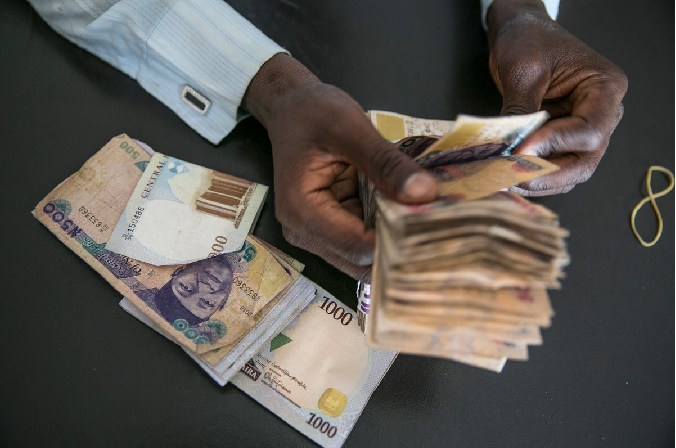
Nigeria’s total public debt stock stood at N31 trillion as of June 30, 2020, according to a report released by the Debt Management Office (DMO) on Tuesday.

The report thus indicates an increase of N2.38 trillion compared to the first quarter of the year. The debt stock which includes the total debt of the federal and state governments saw such a massive rise due to COVID-19 induced borrowing.

The DMO’s report includes Nigeria’s Actual External Debt Service Payments for Q1 2020 as well as Nigeria’s External Debt Stock for the period ending June 30, 2020.

“The data shows that in naira terms, the total public debt stock which comprises the debt stock of the Federal Government, the 36 state governments and the FCT stood at N31, 009trn or $85.897bn. The corresponding figures for March 31, 2020, were N28.62trn or $79.303bn,” the DMO said.

The additional N2.381 trillion or $6.593 billion was as a result of the borrowed $3.36 billion from the International Monetary Fund (IMF) and domestic borrowing used to finance the revised 2020 budget, the DMO explained. It added that the figures include the issuance of the N162.557 billion Sukuk, and promissory notes issued to settle claims of exporters. And it expects the debt stock to grow.

“The DMO expects the public debt stock to grow as the balance of the new domestic borrowing is raised and expected disbursements are made by the World Bank, African Development Bank and the Islamic Development Bank which were arranged to finance the 2020 Budget.

“Recall that the 2020 Appropriation Act had to be revised in the face of the adverse and severe impact of COVID-19 on government’s revenues and increased expenditure needs on health and economic stimulus, among others,” it said.

The debt profile significantly rose by 155.86% to stay at N18.9 trillion in five years, starting from July 2015.

While the federal government holds the larger part (81.52%) of the total debt sum, State governments have notably increased their share to 18.48%. It is therefore N25.28 trillion for the federal government and N5.73 trillion for the states and Federal Capital Territory.

On domestic debt, Lagos State has the highest debt stock as of June 30, 2020, with N493.3 billion in its profile followed by Rivers and Akwa Ibom States, with N266.9 billion and N239.2 billion respectively.

The five-year debt increase has resulted in debt servicing gulping a large sum of capital from the Appropriation Act. Nigeria spent N921.93 billion on domestic debt servicing in the first half of the year. The government said the combined expenditure in both domestic and external debt servicing amounts to N1.57 trillion for the first six months of the year.

Punch reported the Minister of State for Budget and National Planning, Mr. Clem Agba, acknowledging that the government has spent N1.57 trillion on debt servicing for the first six months of 2020. He added that the government’s retained revenue was N1.81 trillion or 68% of prorated target.

The development has triggered backlash from Nigerians as high cost of governance takes most of the borrowed fund, and a little has been invested in infrastructure projects.

“The borrowing is getting too much,” said Prof. Akpan Ekpo, an economist and Chairman of the Foundation for Economic Research and Training. “If you really need to borrow, you must justify it, and there should be transparency about what you are borrowing for.”

Government’s attempt to justify the recent spending has been centered on COVID-19 pandemic. Social Economic Rights and Accountability Projects (SERAP), in August 10, made Freedom of Information requests on how the government has handled coronavirus dedicated funds. In response to the request, the federal government said it spent N31 billion in four months (April-July 2020), but did not give a breakdown of the spending. However, the response means that 84% of the N36.3 billion of both donated and dedicated funds for COVID-19 response has been spent, leaving a balance of N5.9 billion in the special account.

Accountability and reducing the cost of governance in Nigeria is a subject of discussion that the government appears not ready to have, and it is baring venomous fangs on the economic development of the country.

The DMO said the states and federal government are expected to borrow more money in the future. With the oil economy still staggering, it means this trend of increasing domestic and external debt will continue, and recurrent expenditure will be sustained at the expense of infrastructural development.

SPECIAL REPORT: The Place of Nigeria on 2021 Ease of Doing Business Ranking Induced by CAMA Act 2020’s New Provisions

2

On March 10, 2020, the Senate passed the Companies and Allied Matters Act (Repeal and Re-enactment) Bill. The Bill became Act on the 7th August, 2020, when President Muhammadu Buhari signed it into law. From the public analysts to economists and business managers, the passage into law is a welcome development.

Despite seeing it as a good omen for the economic development and growth, especially industries with a large number of small and medium businesses, some analysts still believe that some of the new provisions against effective and efficient operations of non-governmental organisations. However, this piece is not about x-raying the views of the supporters of the new provisions and those who against the provisions. It aims at interrogating the moderating roles of the provisions in the country’s possible place on 2021 Ease of Doing Business.

Provisions that Aid Ease of Doing Business

  1. Provision of single-member/shareholder companies
  2. Restriction on multiple directorships in public companies
  3. Appointment of Company Secretary now optional
  4. A Director can’t hold the office of a Chairman, CEO
  5. Procurement of Common seal not mandatory
  6. Concept of Limited Liability Partnership and Limited Partnership
  7. Virtual AGMs
  8. SMEs exempted from appointing auditors
  9. Enhancement of Minority Shareholder Protection and Engagement
  10. Business Rescue provisions for Insolvent Companies
  11. Disclosure of persons with significant control in companies
  12. Merger of Incorporated Trustees
  13. Reduction of Filing Fees for Registration of Charges
  14. Provision for electronic filing, electronic share transfer and e-meetings for private companies

Our Data and Measures

The CAMA Act 2020 and Nigeria’s position on Ease of Doing Business in 2019 and 2020 were our data sources. The first CAMA Act was enacted in 1990. Then, it was believed that the provisions and sections were enough for the country to have a better business environment and making businesses thrive without significant frictions. In spite of this, public analysts and business owners intensified campaigns against some of the provisions, most importantly provisions that contradicted sections and provisions stated in the Nigerian Code of Corporate Governance.

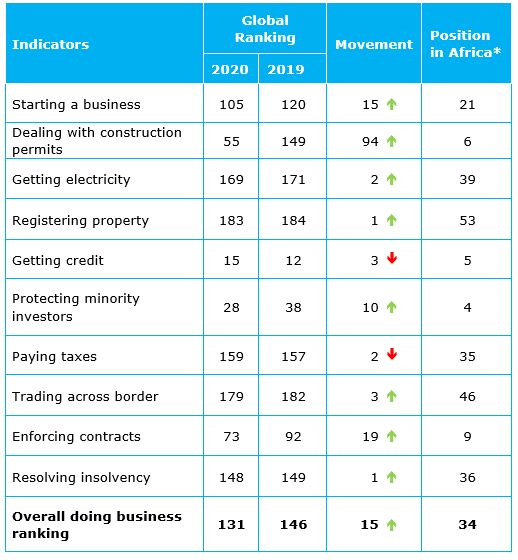
In 2020, Nigeria was ranked 131 on the World Bank’s Doing Business 2020 Index. According to the Index, the country moved up 15 places from its 2019 spot [see Exhibit 1]. Based on the rank, the agency concluded that the country is one of the most improved economies in the world for running a business. The improvement, according to the agency, happened after reforms carried out by the Federal Government.

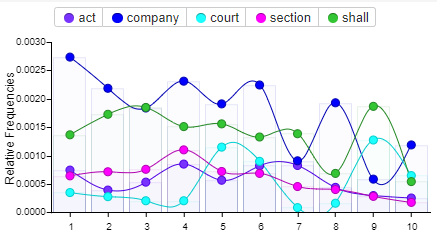
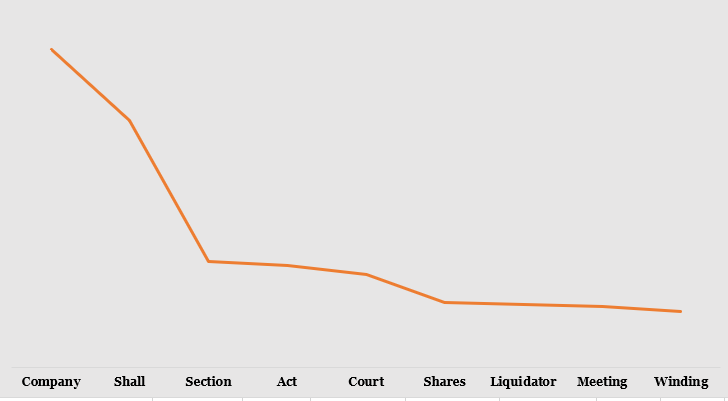
The total number of words and most frequently used words were the specific data extracted from the CAMA Act 2020. Exploratory analysis of the data shows that 207,386 words were used for stating sections and provisions in the new Act. Analysis also reveals that company (3696), shall (2863), section (1228), act (1183), court (1085), person (816), shares (767), liquidator (731), meeting (712) and winding (653) were the most frequently used words. Relatively, analysis shows that the new Act was structured towards making companies/businesses strong legally [see Exhibit 2].

Exhibit 1: Movement in Nigeria’s rankings

Source: Deloitte, 2020

Exhibit 2: Trends in CAMA Act 2020

Source: CAMA Act 2020; Infoprations Analysis, 2020

Moderating Roles of New Provisions on Ease of Doing Business

Since public affairs analysts and business managers believe that the new provisions will enhance the business environment. In this regard, our analyst examines the influence of the provisions on the country’s positions in 2019 and 2020 using extrapolation analysis [using previous data to advance future knowledge and insights].

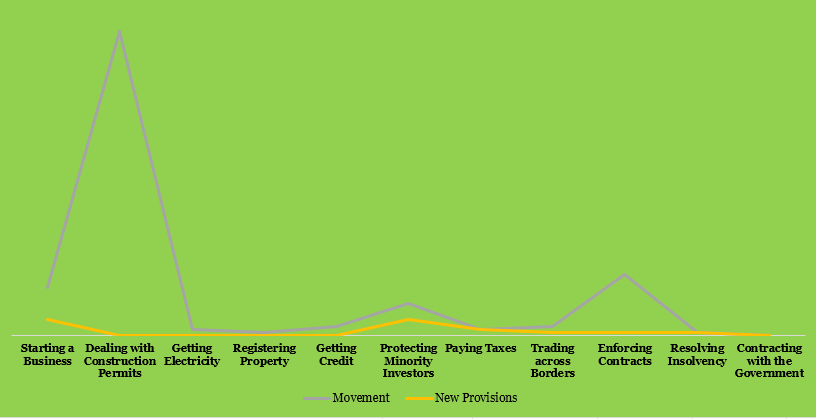
Analysis indicates that if Nigeria has added the new provisions before the World Bank released its 2019 and 2020 Ease of Doing Business ranks, the provisions could have ensured 31.6% connection with moving up on the ranking ladder [first connection scenario]. From the second connection scenario, analysis shows that the provisions should have brought the country down by 10%.

These results indicate there are positive and negative consequences of the provisions on the rankings. With these results, our analyst notes the negative consequence could have emerged due to lack of political will and enabling legal and corporate framework to implement the new provisions effectively.

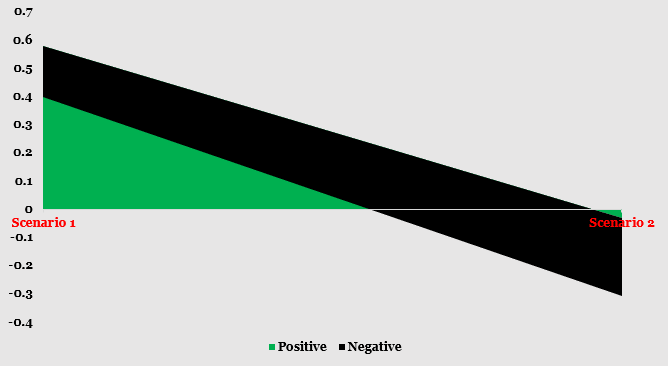
To understand the possible place of the country on 2021 Ease of Doing Business Ranking, our analyst constructed two scenarios using a polarity approach [since connections have established positive and negative impacts of the provisions] [see Exhibit 5]. In the first scenario within the positive consequence [S1-PC], analysis indicates that the ranking would increase by 57.9%, while it would be reduced by 18.3% [S1-PN]. In the second scenario within the positive consequence, mixed insights emerged as the expected positive consequence turned negative. Our analysis shows that the new provisions would reduce the ranking by 3%, while the expected negative consequence would be 27.9%.

Exhibit 3: Word Adequacy Ratio Trends

Source: CAMA Act 2020; Infoprations Analysis, 2020
Source: World Bank Ease of Doing Business 2019-2020; CAMA Act 2020; Infoprations Analysis, 2020

Exhibit 5: Possible Effects of New Provisions on Nigeria’s 2021 Ease of Doing Business

Source: World Bank Ease of Doing Business 2019-2020; CAMA Act 2020; Infoprations Analysis, 2020

A Change Management Business Case: Culture in A Retail Bank After Acquisition of a Fintech

0

“A large retail bank – one of the biggest and oldest companies in the industry, recently acquired a fintech startup in a bid to leap ahead of the digital curve and maintain its competitive edge. The acquired fintech was founded seven years ago by two young engineering graduates, who created an online payments solution that quickly gained traction to become the go-to app for middle-class millennials in the region…. ”  was a business case question developed by our Faculty, Omowunmi Adenuga-Taiwo.

For Lab #1, question 2, we have the permission of Adanma Ekekwe* (no relation to Ndubuisi Ekekwe) to share her Lab assignment. In Tekedia Mini-MBA, our Faculty work with our members, providing critical feedback to them as they work on Challenge Assignments and Labs. Labs are like extended business cases.

Most of our members after their Challenge Assignments and Labs have been promoted in their offices. Some have also used the documents to raise capital.

*no relation to Ndubuisi Ekekwe

The Epic Games’ Poor Game On Apple!

3

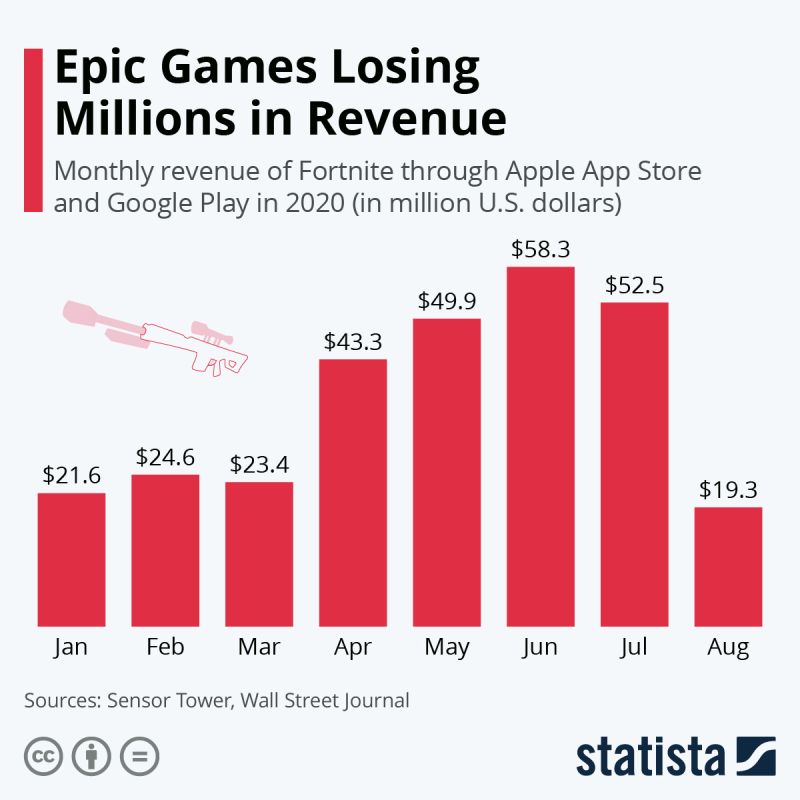
Epic Games is a great venture but its management has scored a major own-goal, going against Apple which taxes all apps developers 30% for the privilege of having them in its App Store. Epic Games wanted a special highway, for Apple to waive or reduce that tax. Good people, it is costing that company big time: it lost $30 million in August as it wages a battle against Apple and Google.

Personally, I do think that Epic Games is making a very big mistake. You do not fight this type of battle alone. This is not a lifesaving drug or food: it is just a game. The implication is that politicians and celebrities will not even care. So, the capacity to amplify the heat on Apple is not directly there because NOT playing games is not that a big deal. As Apple countersues, Epic Games will see why own- goals are bad: they set you back:  “Although Epic portrays itself as a modern corporate Robin Hood, in reality it is a multi-billion dollar enterprise that simply wants to pay nothing for the tremendous value it derives from the App Store”, Apple noted in its filing.

Apple has hit back at Epic Games in its ongoing battle with the gaming company, filing a countersuit Tuesday alleging the company breached its contract with Apple and asking to be awarded punitive damages. The dispute began when Fortnite launched an update that allowed users to pay for in-game content without Apple receiving a cut. The tech giant retaliated by removing the game from its app store; Epic Games sued Apple later that day, and two weeks later, Apple suspended its developer account. Epic has until Sept. 18 to respond to Apple’s countersuit. (LinkedIn)

Epic Games is making a really poor game in this battle with Apple. The fact that other game makers have not joined it should have sent a clear signal by now. According to Epic, its video game has lost 60% of its daily active users since Apple booted the game from its App Store.

Since Apple confrontation with Epic Games kicked into high gear, the game maker has seen its Apple-based users plunge, Epic said in a legal filing on Friday.

Daily active users of Epic’s blockbuster battle-royale game Fortnite on Apple’s iOS operating system have declined by more than 60% since the tech giant removed the game from the Apple App Store, Epic said in the filing. More than 60% of Fortnite users on iOS access Fortnite only on Apple devices, the video-game company said.