DD
MM
YYYY

PAGES

DD
MM
YYYY

spot_img

PAGES

Home Blog Page 6161

Ndubuisi Ekekwe To Speak at 26th Nigerian Economic Summit

2

Finally – the invitation came, and I have accepted. Hello Nigeria, the village boy from Ovim, Abia State, is going to the most prestigious platform when it comes to economic matters in Nigeria. Ndubuisi Ekekwe will lead a very important session during the 26th Nigerian Economic Summit. People, it is not going to be just talk – we will take it all the way, from design to implementation. To the Honourable Minister, NESG CEO, and someone here who recommended me, thank you for the invitation.

The 26th Nigerian Economic Summit (NES #26) will convene national and global policy makers, business leaders, development partners and scholars to lead and participate in sessions that will focus on building strategic partnerships and cooperation between governments, businesses and the civil society for resilience.

Digital Transformation is key to Africa’s future

0

Many young people in Africa feel they have been  lied to; education no longer equals post-graduate employment and employment no longer guarantees economic mobility. Entrepreneurship, meanwhile, is an ever-risky escape. Without digital and problem-solving skills, African youth struggle to find secure employment and create sustainable enterprises. Our increasingly technology-driven world is leaving them so far behind that even when jobs and untapped sizeable markets exist in Africa, they miss out. 

Youth (18-35 years) account for 60% of Africa’s jobless (Source: World Bank). Rejected by formal employment and education opportunities, millions embrace entrepreneurship. Over 70% of youth in Nigeria, Ghana, Senegal, Mali, DRC, Congo, Rwanda, Uganda, Ethiopia, and Mali are self-employed or in family work (Source: Brookings Institution). Unsurprisingly, then, small and medium-sized enterprises (SMEs) are the primary driver of economic activity across the continent. In  Africa’s largest economy, SMEs contributed 48% of GDP in the last five years, accounting for 84% of employment, and comprising 96% of all businesses (Source: Nigeria Bureau of Statistics). And yet, these businesses fail at alarming rates. 

In Africa’s second largest economy, 50% of SMEs disappear within 24 months (Source: Standard Bank South Africa). For instance, one entrepreneur who had started a recycling company in Nigeria to empower youth to monetize recycling services had grown her monthly revenue to $3000 within one year, but was now struggling as customers and employees alike grew wary of all high-contact businesses. The failure of SME’s has so many devastating effects- When SMEs fail, livelihoods fall under threat, Food cannot be purchased, Medicine cannot be procured, and Tuition cannot be paid.  

The proliferation of technology has transformed the workplace as people increasingly interact digitally with ever-smarter machines. “The need for some skills, such as technological as well as social (problem-solving), analytical and critical thinking skills, will continue to rise, even as the demand for others, including physical and manual skills, falls. These changes require youths, entrepreneurs and workers everywhere to deepen their existing skill sets or acquire new ones.  Companies, too, will need to rethink how work is organised within their organizations.” (McKinsey & Company, 2018). Without digital literacy and problem-solving skills, African youth will struggle to create technology-enabled enterprises that survive the increasingly frequent disruption (e.g. COVID-19, automation) in today’s world. Our world is in the midst of digital transformation, and so far, as a result of COVID-19, many have been left behind.

Employment change since the first steam powered textile looms displaced craft workers in 18th-century Britain. Consider the effects of the first Industrial Revolution: at one point, more than 95% of jobs involved growing food; today fewer than 2% of people in the developed world work in agriculture.  
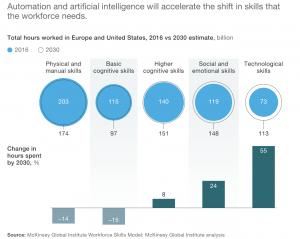
Reports, such as the World Economic Forum’s 2016 The Future of Jobs, suggest that we are entering a very different jobs era. In this fourth industrial revolution, automation and disintermediation are destroying jobs and disturbing the way businesses operate at such an unprecedented pace that new jobs are no longer sufficient to replace those redundant roles. 

Upskilling and Reskilling in the age of COVID-19, is the Way to Go

Startups that continue to innovate consistently outpaces that of established businesses. (EY Job Creation Survey). Technologies require people who understand how they work and can innovate, develop, and adapt them. Hence, there is a significant need for everyone to develop at least, basic digital skills for the new age of automation and post-COVID era. In EY Global Job creation survey 2016, It was  found that among 25 skills analyzed, basic digital skills are the second-fastest-growing category, increasing by 69 percent in the United States and by 65 percent in Europe. (EY Job Creation Survey).

Digital skills must also function alongside together with other abilities such as strong literacy and numeracy skills, critical and innovative thinking, complex problem solving, and an ability to collaborate, and socio-emotional skills. However, Nigeria and Africa’s education system is not well prepared to deliver this need because the education system and curriculum do not give flexibility or allow room for innovation and technological advancement. We are stuck in the old methods of the school system focused on hard skills with very little or no real-world practical application. Therefore, we need more Edtech platforms in Nigeria and Africa to fill this gap.

To better understand these needs, I conducted stakeholder interviews with university students, recent graduates, and employers in Nigeria. Our conversations revealed that many young people, some despite receiving university education, have poor computer skills, including little knowledge of Microsoft Suite or G-Suite. Many also expressed extreme difficulty finding employment even months after graduation. These challenges are worse for youth with no higher education, and young entrepreneurs are also struggling because they lack the basic skills to succeed in their businesses. With Nigeria’s growing population, our government will be in tumult if nothing is done to revamp the education system to become more problem-solving focused. 

Digital skill shortages have negative implications for the economy and the labor market. They can result in increased labor costs, lost production due to unfilled vacancies, slower adoption of new technologies, and the implicit and explicit costs of higher unemployment rates. Conversely, appropriate soft skills in individuals can boost economic growth.  The skills required to stay competitive are both soft skills such as problem-solving, innovation, creativity, critical thinking, and communication. And basic digital skills such as using cloud computing tools like Microsoft teams and Google Suite Applications for collaboration. There are more advanced skills like programming and analytics but not everyone can adapt. What is required is that at least everyone, regardless of your occupation should gain basic digital skills to stay competitive in the 21st Century Workforce.

Edtech Startups are Rising to the Challenge

Edtech platforms are rising to fill the skill shortage gap. Like Nigerian-based nonprofit, Inspire Africa for Global Impacts Initiative launched the Ignite Innovation Lab (IGL) Virtual Digital Transformation, centered on elevating young people in Africa to be able to take hold of these opportunities – opportunities to drive towards their goals, opportunities to thrive and opportunities to survive. IGL Digital Transformation lab directly addresses these challenges, teaching digital business skills through design thinking,  virtual collaboration and fostering entrepreneurship to help young people create new technologies, businesses, and jobs.

Launched in July 2020, IGL is exposing African youth to digital business skills in the age of COVID-19, by bringing together young talents virtually to innovate and collaborate on solutions to some of Africa’s most pressing challenges. The individuals use cloud computing to collaborate with their team members online and are supported by their mentors who provide direct feedback on the platform. They are equipped with the toolkit needed to develop digital enterprises that are progressing the Sustainable Development Goals and the skills to thrive in the 21st Century Workforce.  

The Ignite Lab approach of digital transformation is a unique way of upskilling the youth and tackling high SME failure rates. It galvanizes young people to learn digital skills and business know-how and apply them towards solving issues that affect Africa and the world. The virtual Lab is using simple, yet powerful, tools like human-centered design-thinking and business technology, but builds a pan-african digital learning experience around them. Participants aren’t simply ingesting one-way information, or executing without guidance.  With the support of expert facilitators, mentors and a network of social entrepreneurs, they are ideating, debating, collaborating, communicating, problem-solving, and more. As a result, more than the typical MOOC, the IGL Digital Transformation becomes an incubator, a hackathon, a mixer, a virtual watering hole for Africa’s future young leaders. 

The longer term outcomes of the Digital Transformation activities are even more numerous and notable. Youth unemployment is directly targeted and one who chooses to seek formal employment will have more opportunities available to them due to their new digital skills, and their employers will be more productive for it. Those that choose to start a business will be more likely to succeed because of their learning and, therefore, break cycles of unemployment–not only for themselves, but for others as research shows that startup hiring consistently outpaces that of established businesses (EY Job Creation Survey). Increasing employment will decrease socioeconomic inequality and contribute to economic productivity at national and regional levels. Beneficiaries of this methodology will be better positioned to contribute and benefit from greater African economic integration, having collaborated across borders during the program. 

Tony Elumelu describes Africa as a continent of opportunities with huge returns on investments, therefore, we must prioritise training and mentorship, just as we prioritise capital. We must also ensure that relevant platforms to learn digital business skills are created just as Inspire Africa for Global Impacts Initiative  and many others have done. 


Article written by Cynthia Mene and contributed by Mene Blessing

The New Nigeria’s Companies and Allied Matters Act (CAMA)

4
CAC

The updated Companies and Allied Matters Act (CAMA) in Nigeria is a good policy. With a minor update, it has a promise to unlock massive investments while boosting economic growth. For me, the new CAMA is very close to what you have in most modern economies except that it went deep into the affairs of religious organizations and non-profit organizations. 

With what we have seen with AMCON, the bad debt agency in Nigeria, I would not trust Aso Rock (of today and the near future) to have the accrued powers, as stated in the Act, over nonprofits, churches, (and mosques). That one is a no go area: they can take over a church school and sell it off because we have seen that playbook in the past. Today, no one has clearly stated what happened to stocks of Bank PHB even though that bank was traded on the Nigerian Stock Exchange. Until we can do simple things, governments should leave churches (and mosques) alone. 

I support the religious leaders who are asking the government to amend that section. Aso Rock over the years have not shown discipline to be trusted with sacred assets. If a pastor criticizes a government, that church would be in trouble with the assets frozen, and management changed. You can say that about imams and mosques. Giving politicians a legal tool to suspend, fire and change religious and non-profit leaders  will not be wise. Governments should focus on the capital markets and fix them before thinking of helping churches. If you check, our churches do not need help as we are the fastest growing market in that domain in the world. Abuja can stop that growth with New CAMA. Yes, it is working – leave it alone.

So, if you can ignore the above noted issue, this Act is what Nigeria needs now. Here are five key things in the Act which you will like:

  • 1.the insolvency provisions to help companies in distress
  • 2.Restriction on the number of public companies in which a person can serve as a director
  • 3. Ability of an individual to form a single-shareholder company
  • 4.Replacement of authorized capital with minimum share capital
  • 5.Electronic filing, virtual meetings and electronic share transfers.

Nigeria’s New Companies Act (CAMA) Will Attract Investments And Boost Economic Growth

Nigeria’s New Companies Act (CAMA) Will Attract Investments And Boost Economic Growth

0
CAC

The reenactment of the Companies and Allied Matters Act (CAMA) has been a subject of controversy in Nigeria’s public space, as some sections of it have been described as oppressive.

Section 839 (1) of the Act stipulates that religious and non-governmental organizations will be under the regulation of the Register-General of the Corporate Affairs Commission (CAC), and a supervising minister who will strictly regulate their affairs.

Under this rule, the CAC may wade into the organizations’ affairs, particularly when there is crisis. The Act thus empowers the Commission to suspend board of trustees of public organizations when a case of mismanagement is established, and appoint interim manager or managers.

Based on this section of the Act, many, especially religious leaders and non-profit organizations, are calling on the Federal Government to suspend it.

CAMA has been repealed and reenacted to boost ease of doing business in Nigeria, and the majority of its sections are geared toward that aim.

However, while religious leaders lead the uproar against the Act, experts said it’s in line with international best practices and should be welcomed.

Taiwo Oyedele, Fiscal Policy Partner and West Africa Tax Leader at Price water house Coopers (PwC), during the capability enhancement workshop organized for journalists by PwC, on Wednesday, said that the new CAMA will have significant impact on doing business, competiveness, attracting investments, and economic growth.

He highlighted five key changes that were introduced by the new CAMA: 1.the insolvency provisions to help companies in distress 2.Restriction on the number of public companies in which a person can serve as a director 3. Ability of an individual to form a single-shareholder company 4.Replacement of authorized capital with minimum share capital 5.Electronic filing, virtual meetings and electronic share transfers.

Compared to the old CAMA that had been in force since 1990, he said that key provisions and changes introduced by the new Act will have positive economic bearing on the country if implemented. Taiwo cited a section of the old CAMA that made provision for dissolving of public organizations instead of setting up interim management as provided in the new CAMA, to show that it isn’t as bad as it is perceived.

He however, outlined some steps that the government needs to take to ensure effective implementation of the Act.

Taiwo said the Act needs to be gazetted with a future commencement date to facilitate ease of transition. He added that for CAMA to yield the needed result, it has to be harmonized with other laws such as the Companies Income Tax Act which still requires audited accounts by all companies regardless of size.

“In addition, more flexibility is required for foreign companies who wish to operate business in Nigeria such that a branch registration should be permitted while incorporating a subsidiary will be optional. It is also necessary to ensure that the new law is kept under constant review with more frequent amendments or re-enactment say every five years,” he said.

While he applauded the new CAMA, he condemned governments’ use of taxation as means of revenue generation following the downturn of the oil sector as a result of COVID-19.

The federal government has been introducing new taxes since the outbreak of the pandemic, starting with the increment of VAT to 7.5% and the controversial Stamp Duty tax. And consequently, some state governments are following suit.

The Lagos State government introduced in August, a tax rule that requires ride-hailing drivers paying 10% tax on each trip, though it was reduced to N20 flat fee per trip after backlash. The State’s Film and Video Censors Board also introduced 5% levy on all audio and visual content produced and used however in Lagos.

There have been insignificant stimulus packages from the governments as business groan under the weight of the pandemic. With the increase in taxes, businesses, especially SME’s that are already functioning on life-support may not survive.

Experts have urged the governments to lower taxes especially as there has been little or no bailout for hardly hit business. The International Monetary Fund (IMF)  had warned Nigeria in June, that is not the time to introduce new taxes.

PwC said the governments need to spend more to provide palliatives, tax concessions and support to vulnerable persons and businesses.

Given the unusual situation, government needs to be deliberate in implementing tax measures and fiscal policies. The overall objective should be to generate revenue in a manner that does not hamper economic recovery, the firm said.

The Playbook for Growth – Tekedia Mini-MBA for Corporates

0

How can you find opportunities in this age of immense economic paralysis? How can you sharpen your antenna to anticipate opportunities before they happen? How can the evolving redesign of market architectures be captured for growth? The world of business is changing on Form and Space. To unlock that redesign, we have Tekedia Mini-MBA for Corporates. Working with us, together, we will architect a new future for your business. By the time you are done, you will have a Playbook for Growth.

Tekedia Mini-MBA for Corporates is a customized version of the general Tekedia Mini-MBA. It is designed for private and public institutions. It focuses on the same theme of innovation, growth, and digital execution. But unlike the 4-month general Mini-MBA, the Corporate vision goes for 4, 6, 8,10 or 12 weeks.  There would be scheduled webinars but no physical contacts.

When you sign-up, our team will schedule a meeting with you, discuss your business frictions, and during our program, we will work with your company to find solutions to those frictions, even as they learn. The outcome of the process has been amazing: internal innovation at scale.

We are helping companies to make their workers to become better strategists, analysts, researchers, and innovators. Yes, your staff would go through a methodological process to think of solutions for the business.

With our class notes, videos, live sessions, and cases, your team will have the right tools to produce that FUTURE for the business. You already have a great team, make them BETTER.

Let us serve you as an Innovation & Growth Partner, and using your team, you will find a new nexus to innovate, grow and advance the mission.

Tekedia Mini-MBA for Corporates is on-demand which means there is no scheduled start time; we are ready once a client is ready to start. It will be online, and fully on a secure dedicated digital board only your staff will have access for the innovation & growth training.

Tekedia Mini-MBA: a compass to business growth.  Email tekedia@fasmicro.com for a brochure.