Good People, join the last edition of this year, take action immediately here – www.tekedia.com/programs
CODE
PROGRAM
MINI
Tekedia Mini-MBA costs US$140 (N50,000 naira) per person.
MINR
Add extra (optional) $30 or N10,000 if you want us to review and provide feedback on your labs.
Add extra (optional) $60 or N20,000 for each certificate specialty course. You must have attended, begun or about attending Tekedia Mini-MBA to qualify. The following Certificate tracks are available:
CLSM
Certificate in Logistics and Supply Chain Management
CSBM
Certificate in Startup and Small Business Management
CETS
Certificate in Exponential Technologies and Singularity
CPCD
Certificate in Personal Career Development
CPFM
Certificate in Personal Finance & Wealth Management
CBIS
Certificate in Business Innovation, Growth & Sustainability
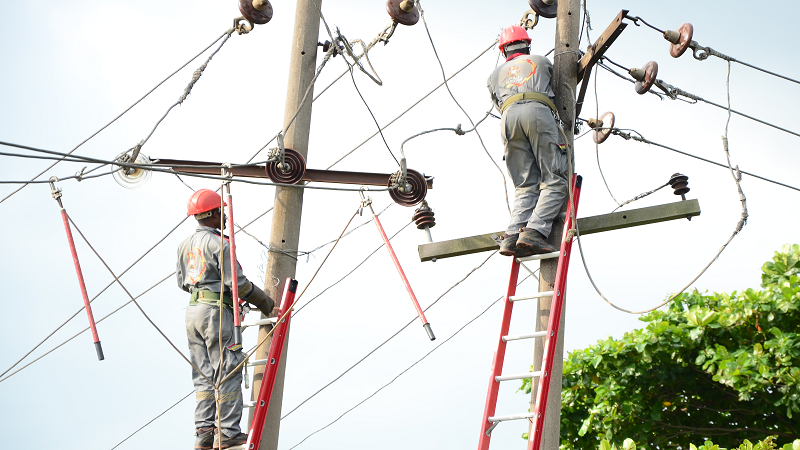
Finally….the market system is coming. President Buhari has approved New Electricity Tariff in Nigeria. Yes, the current cost of electricity in Nigeria is hopeless for anyone to expect light. That cost has produced darkness for years. Now that the cost has improved, I am very confident that investors will come with the good greed in capitalism.
Like the new generation banks taught us, Nigerians are open to pay for better services. Yes, banks those days introduced COT (commission on turnover) and still attracted customers because it was better to lose N3k per N1,000 than waste 4 hours in a bank to collect your money. Mr. President, you need to now deal with the generator mafia and ensure we do not have more excuses in our NESI – Nigerian Electricity Supply Industry. Any sabotage should be all the way to Kirikiri! Orange is the new black…
Indeed, the new playbook is very promising: “President Buhari on Tuesday approved the increment of electricity tariff for selected consumers. The decision is in line with the proposed cost-reflective electricity tariff for the Nigerian Electricity Supply Industry (NESI).” And by adding mass metering in the equation, there could be a way out of our electricity inadequacy paralysis. But give this to the World Bank which had requested for one thing: your electricity pricing is out of phase and if you do not change it, no investor will come. The government had requested $1.5 billion for the sector, but the World Bank made it clear – either you increase tariff or you pray for that money to come, as no investor will likely come. But with this Buhari’s playbook, expect more actions in NESI.
President Muhammadu Buhari on Tuesday approved the increment of electricity tariff for selected consumers. The decision is in line with the proposed cost-reflective electricity tariff for the Nigerian Electricity Supply Industry (NESI).
Under the NESI tariff, residential areas classified as poor will not be affected by the new tariff, as it is aimed at industrial areas.
Tariff increment has been a bone of contention between electricity suppliers and consumers, with Distribution Companies (DisCos) attempting repeatedly to implement proposed upward review of billing. But the government’s intervention has restrained the planned tariff review for months now.
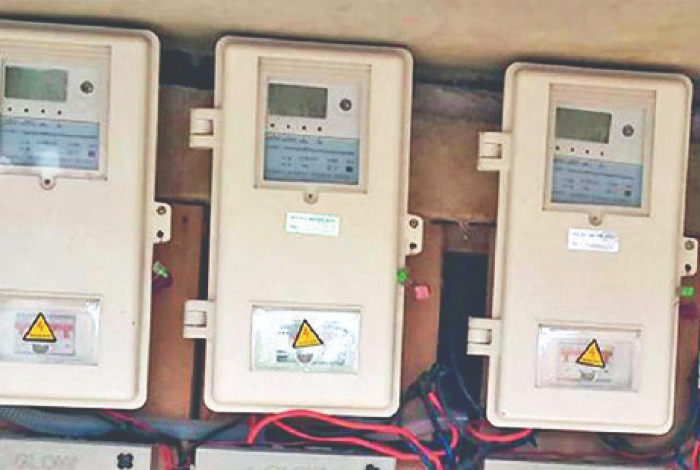
Electricity meters
This is a good move by the government as I noted in the past on the need to price products well in Nigeria.
Do not think too far – the tariff for potable water in a state in South South geopolitical region in Nigeria was last reviewed in 1987. Yet, the state is looking for investors to provide potable water in the state! I saw the document and wrote to the project manager, and asked him if he could get the state to update the water rates. The response was typical – “The government cannot increase rate because it will be politically sensitive”. Of course, nothing happened, and no investor thought there was anything there.
Our leaders must find a way to engage Nigerians honestly on open conversations to move the nation forward. From electricity to potable water to healthcare services, unless there is decent revenue factor in the equation, it will be hard to move from the miry clay on the provision of basic services.
And the legal institutions need help and only the National Assembly can help them by updating the laws to avoid confusions in markets. Yes, the updates will help to engineer reflective costs that will make services become available as investors are attracted by the opportunities therein to participate. This does not mean that Nigerians should be priced out. Yet, Nigeria cannot also afford to price investors out. A win-win is needed on these services on cost.
As we examine this new tariff, consider another big one in which the central bank took over revenuecollection from DISCOs and handed it over to banks. It makes real sense: if Nigeria has to take loans to help “private companies like Discos” fix themselves, Nigeria needs to play a role to see what is coming in as revenue. The Discos put themselves in this position. Yes, if they had executed well, the government would not have come with its big sticks.
President Muhammadu Buhari on Tuesday approved the increment of electricity tariff for selected consumers. The decision is in line with the proposed cost-reflective electricity tariff for the Nigerian Electricity Supply Industry (NESI).
Under the NESI tariff, residential areas classified as poor will not be affected by the new tariff, as it is aimed at industrial areas.
Tariff increment has been a bone of contention between electricity suppliers and consumers, with Distribution Companies (DisCos) attempting repeatedly to implement proposed upward review of billing. But the government’s intervention has restrained the planned tariff review for months now.
Apart from COVID-19, metering is another issue that keeps instigating the intervention of the lawmakers. The national assembly has insisted that consumers be metered before any tariff plan would come into effect. Therefore, an attempt by the Minister of Power Sale Mamman to shift the proposed increment to July 1 was opposed by the leadership of the national assembly.
The Senate President Ahmed Lawan said then that consumers must be properly metered before any plan to hike tariff would be condoned, and given the economic impact of the pandemic on Nigerians, the timing for the tariff increment was wrong.
“The joint leadership of the National Assembly sat with DisCos and Nigerian Electricity Regulatory Commission. We believe that this is not the right time to increase the tariff in the electricity sector. Nigerians have a lot of challenges today because of the COVID-19 pandemic and the situation requires that we do everything possible to make life easy for our citizens.
“Of course, the government is doing a lot in this respect but we believe that DisCos should meet with consumers, find better cost-effective tariffs. But before then, there must be some steps to ensure that the consumers are properly metered, otherwise, you will still go back to guessing what consumers are consuming. That is to say, that to let the billing be scientifically based, it has to be based on what you actually consumed,” he said.
Consumers have been groaning under the weight of estimated billing as a result of insufficient metering. The situation has been attributed to the 35% levy imposed on imported items, which forced DisCos to abandon meters at the ports. The development has thus stalled the implementation of the Meter Asset Providers (MAP) scheme.
To close the metering gap, Buhari approved a one-year waiver of 35% import tax on prepared meters. The Cable reported that the decision came after the Minister of Finance; Zainab Ahmed made a plea for speedy deployment of meters to fast-track the MAP scheme.
The special adviser to the Minister on media and communications, Yunusa Abdullahi acknowledged in a statement that the 35% tax is stymieing the implementation of MAPs.
“The 35 per cent levy was imposed on the recommendation of the Federal Ministry of Industry, Trade and Investment, to encourage local production, as well as protect investments in the local assembly of electricity meters.
“An important feature of the MAP regulation is a gradual up scaling of the patronage of local manufacturers of electricity meters with an initial minimum local content of 30 percent with the potential of significant job creation in the area of meter assembly, installation and maintenance.
“Even though the 35 percent was in existence since 2015, the MAP regulations by NERC in 2018 to bridge current electricity metering gap did not factor the 35 percent levy in arriving at the regulated cost of electricity meters to end-users.
“This is to immediately bridge that gap between the demand for electricity meters and local supply. It is also envisaged that this will provide protection for local electricity meter manufacturers and the opportunity to ramp local capacity in the production of meters,” Abdullahi said.
The new tariff will be reviewed quarterly upon kickoff from September 1. The federal government has been seeking a $1.5 billion loan from the World Bank, for the power sector. The World Bank had given tariff increment as a criterion for the approval of the loan, saying it’s the only way investors can come into Nigeria’s power sector.
Buhari therefore ordered mass metering to end arbitrary charges emanating from estimated billing.
In the current piece, our analyst found that two indigenes of Osun State recently conversed on how civic engagement in the state should be executed on the virtual sphere. Ajetunmobi Umar Olansile and Sogo Omo Osun discussed some issues within the context of the virtual public lecture organised by the state government to mark the 29th anniversary of the state creation.
Ajetunmobi Umar Olansile
Ajetunmobi Umar Olansile: Osun Government media team, what’s happening? A virtual public lecture held, but little did we hear about it ; after all, it’s a VIRTUAL PUBLIC LECTURE to mark Osun at 29! What made it virtual and public then?
In this era of digital glocalisation, I don’t think government policies can be popular and widely accepted if the policies aren’t communicated to the right people, using integration of media. Relying on traditional media alone for policy communication in this era is like drumming to the ears of the deaf- this is the time of media convergence. You can’t do without the youth! Where can they be found? On digital platforms!
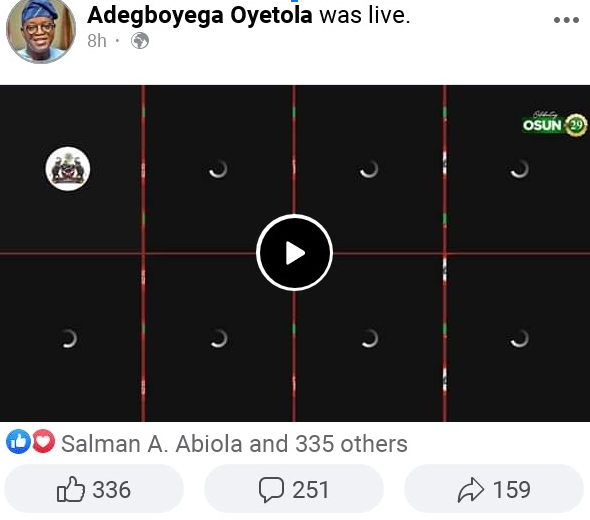
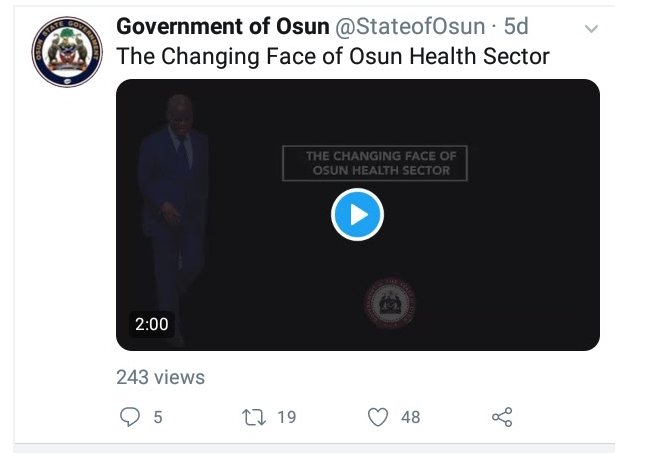
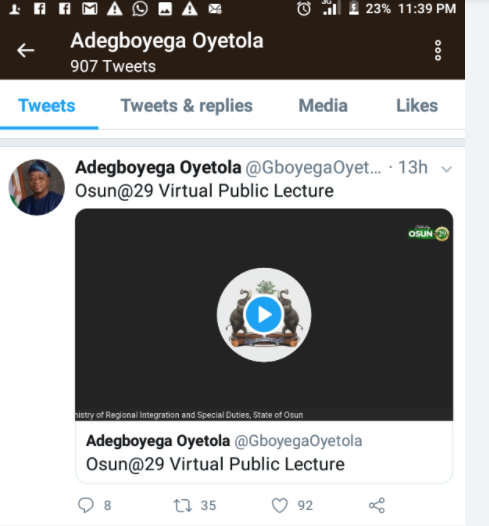
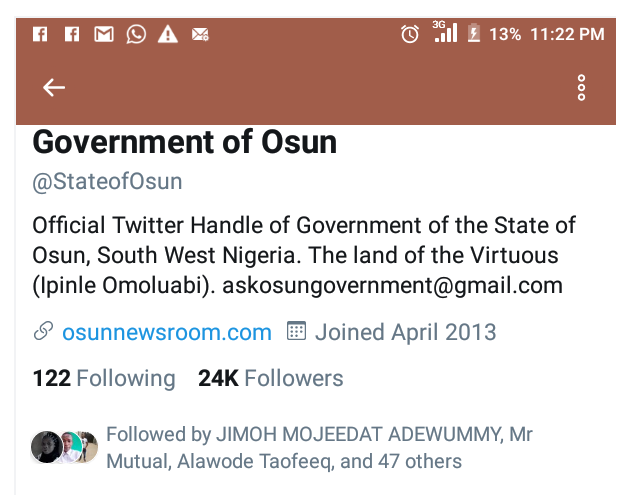
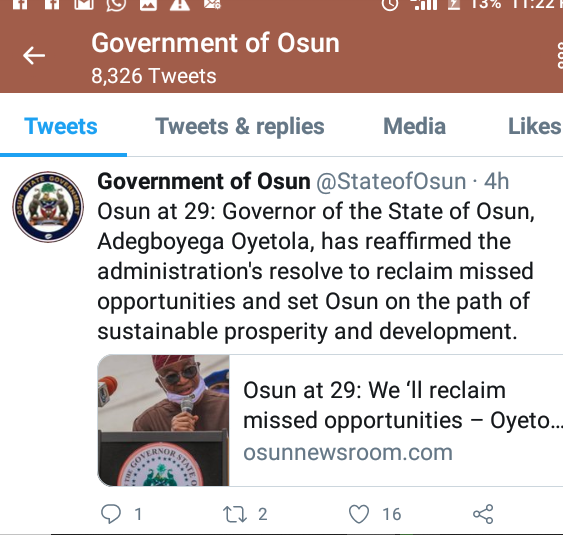
My background checks (pictures attached) revealed that on Twitter, the Governor’s handle (or perhaps one of) had less than 10 comments when the video of the lecture was posted. Less than 10 comments in over 8 hours of the post? No engagement! Two, the Government of Osun handle was updated in the last 5 days! Who are the handlers? Are they promoting the government for free? No engagement! Three, the Facebook video on the Governor’s page generated a number of comments unlike what was observed on Twitter.
Something is amiss. A common trend wasn’t observed on behalf of the government on Twitter! There are people who understand the science and the arts of Twitter trends. Where are they, dear media team? What does it take to have trends on Twitter? Some people may ask: Does that translate to good governance? We aren’t saying it does- it’s a win-win argument. However, practical experiments have shown that effective open governance opens door for transparency and engaged citizenry.
Recommendations? In 2019, a team of researchers had recommended what the government needs to do. The recommendations are available here for download and evaluation. We wish the government well.
Sogo Omo Osun
Sogo Omo Osun: Mr. Rasheed Adebiyi for calling my attention to respond to the publisher. Firstly, I want the publisher of this post to understand what new media engagement entails and audience consideration while using a new media platform as an interactive medium to engage the audience or a community of influencers, Osun is a Facebook community, I mean the majority of the active users of social media apps in osun are Facebook crusaders, so we concentrate more on the result of our feasibility studies.
Yes, we recorded little patronage on Twitter according to the man who projected this, but we had great and massive audience tweet and retweet from all axis, if I am not wrong, I doubt if the publisher considered the target of our message and the essence of hosting the public lecture, concluding that a trend on government handle expresses the level of participation is a statement colored with an agenda or an interest. Though the publisher might not understand the basic essence of our concentration on Facebook than another medium, he might not have carried out research to decode that many of our influencers in Ipinle Omoluabi are indigenous that uses Facebook because of the easy operating system and format.
According to the publisher’s third paragraph, he claimed Mr. Governor’s handle suffered patronage in the cause of the live streaming but unfortunately his data about the engagement of the handle lacks integrity and objectivity, I will upload a screenshot of the ratio of viewers flow in and out of the streaming, in other to castigate his opinion about the level of activeness and credibility of Mr. Governors media team members. Meanwhile, my reaction to this interest cooked paragraphs of the critic is strictly mine, not to be attached to any other source.
I can boldly tell you that the event was a success, the massive campaign, and publicity given to the event before, during and after the event is overwhelming, this alone depict the massive turnout of osun indigenes home and abroad level of participation which has alone recommended good character and brilliancy of the players involved. In conclusion, no wonders of the past can be better than the living miracle of today. I leave the rest for the good people of Osun to react while we prepare for more tasks ahead.
Finally, I want the publisher to provide his Twitter handle to verify his numbers of followers, if more than 5,000 followers, I will accept his claims but if not, it’s clear that our state is a community of Facebook customers. By and large, many improvements can still be made in our subsequent outing, we are in for improvement if only it is objectively delivered.
Thanks
Ajetunmobi Umar Olansile: I am sure you are aware that the 24k followers the Osun Government has on Twitter are not alien to Osun and her governance. Are you saying the 24k followers are not active users of Twitter? What demography do you say are active users among these followers?
Sogo Omo Osun: Don’t mix things up bro, I have no business with the state government of Osun’s handle, apology. I am interested in the handle of his excellency, I don’t speak for the government, my capacity is restricted to the office of the governor. So, whatever we will discuss should be concentrated within our scope of work. Why I actually reacted was because I took part as a technical support staff for the lecture.
Sogo Omo Osun: Meanwhile, the level of patronage of the handle should give you an insight that osun is a Facebook community, please compare their Facebook handle with the Twitter handle.
Ajetunmobi Umar Olansile: 2. The post below was posted not long after the Facebook post here was posted. What went amiss initially?
Sogo Omo Osun: The handle has been existing since 2013 and all the handle can get is just 24k followers? If 90% of the followers of the handle are from Osun, statistically the patronage would be more than this, don’t forget, proximity is a key factor to be considered in a news story, trust me whoever that is not from Osun will not react or retweet, because they share no interest in the happenings in the state, I hope you can understand me.
Ajetunmobi Umar Olansile: 3. Governor’s handle has 33k followers. Who are they? Are there not up to half Osun active members on this handle? Why just one video? Couldn’t the team have a thread of his discussions? How many people would watch the video? Can you see the number of comments on the video? 8? For a whole Governor of a state? Is that a pass for a policy-driven lecture? The publisher is not your opponent. He is only calling your attention to media integration and the need for convergence! Check Twitter handles of some Governors, and see how matters like this are discussed.
Ajetunmobi Umar Olansile: If Osun is a Facebook community, the media team made it so. If Osun is a Facebook community, why opening a Twitter account for the Governor? Who will he be tweeting for? Non-indigenes? It’s even a big indictment to say, without data, that Osun is a Facebook community. The 33k followers the Governor has on Twitter aren’t there for freelancing. They want to be engaged! The media team doesn’t engage them. That’s why it’s seen as if Osun is a Facebook community! There’s no harm in doing more. For now, Mr Governor’s Twitter community cries for engagement.
Sogo Omo Osun: I discuss to derive knowledge, I hold no grudges for expressing your opinion, it’s a free world. With the 33k followers, that alone should convince you further of my explanation so far, check Sanwo Olu, Dapo Abiodun including Seyi makinde’s handle, you will discover that they enjoy much participant than their Facebook pages, why, the 3 state studies show that their influencers are much active on Twitter than other apps. Check Ondo and Ekiti, verify their tweets and you will discover the focus of my discussion. It’s good we are discussing, from our conversation, ideas can be birth, so I don’t take offense in your observations.As a government staff, it is our responsibility to defend, inform, react, and correct insinuations when necessary while we also gatekeep with the mission to pass feedback to the appropriate desk.
Sogo Omo Osun: I am happy to inform you that what is indigenous can never be digitalized within a twinkle of an eye. We do more than engaging, we act when necessary, but funny enough, many don’t even patronize the app. If I may ask, don’t you have an Instagram handle? Do you stay on the app like others, so, why did you open the app? The same response you give will answer your question of why twitter handle was registered for Mr governor..
Ajetunmobi Umar Olansile:Sogo Omo Osun, the summary of the discussion is: The media team needs to do more. The states you mentioned didn’t start getting engagement in a day. They started from somewhere. The tweet you said enjoyed wide retweet had less than 40 retweets and less than 100 likes. Such an algorithm isn’t effective enough for policy communication. There are recommendations on your fingertip. Get the technical report I attached to my first post, and see how there can be a better process in Osun media engagement. If you have it already, you can find time to evaluate it. I have no grudges against the media team, neither do I have against the government. We are only canvassing a better process.
Sogo Omo Osun: Meanwhile, can I ask, do you follow other governors’ handles on Twitter? If yes, you are one of the 33k followers that will not react but follows the handle just because of the personality involved. I am a follower of more than 30 Governors handle but I don’t react to their tweet because I am not interested in their activities, so I am one of their high rated followers with figures but with no single engagement.As for the recommendations, please kindly inform the concerned to choose an appropriate medium to market what they can offer the government in other to enjoy patronage rather than rubbishing the effort of others.
Ajetunmobi Umar Olansile:Sogo Omo Osun, no one is rubbishing your efforts. After all, you aren’t doing it for free. You are a consultant giving services. Pointing out areas to improve does not mean anybody desires government’s patronage. Far from it! Your attention was only drawn to the needful as one of the government’s consultants. The Governor is a prominent person in terms of news value. He discussed about illegal mining of gold in Osun in his lecture. That is an issue of national significance considering that the Federal Government is now talking about gold. Isn’t that worthy of wider coverage. Why should a media team wait for long to give us highpoints of the event (that’s not a discussion for now).
You are talking about other governors. Yes, they enjoy followership because their media teams are doing something behind the scene. On new media, followership goes beyond statehood. Your team works for the government as his PR agent using every available medium to portray him beyond his imagination. Have you ever seen people from other states comment on the posts of those governors you follow? Why are they commenting? The contents pushed out are engaging. For your information, getting insights from constructive critics is a ladder to improvement. Osun media landscape can do better than these.
Like other countries in the developing world, Nigerian farmers and entrepreneurs in food processing and production are facing a number of challenges. These range from deforestation to overgrazing and drought to erosion and flooding, for the farmers. Over the years, entrepreneurs, processing agricultural raw materials into finished products are experiencing a lot of challenges due to unstable micro and macro economic indices or policies.
On several occasions, concerned stakeholders have been urged and still being advised to work out appropriate modalities to resolve the challenges towards ensuring sustainable food production and security. In this piece, Mojoyinola Adeyemi, a graduate of the Department of Communication and Language Arts, University of Ibadan, speaks with Tekedia on the need for the governments to provide an enabling environment for the agriculture sector and entrepreneurs.
Excerpts:
Tekedia: One of the needs human beings must have for surviving on earth is food. What are your views about food production in Nigeria?
Mojoyiola Adeyemi: Food production in Nigeria is on the average, we are not producing at a full capacity and this is because the enabling environment is not encouraging enough for farmers and agriculturists. I believe that with the right policies in place, we can become the largest food producers in West Africa. It’s rather unfortunate that as a country we are still importing foods that we can conveniently produce locally.
Tekedia: Is Nigeria producing what it needs sufficiently?
Mojoyinola Adeyemi: I don’t think so. But I know we have the potential to be the largest Food producers in West Africa. However, I hope the government of the day can lend 100% support to the agriculture sector, especially the processing segment. We have exportable foods like Cocoa, Sorghum, Rice,Palm Oil,Cotton,Garlic,Ginger, Groundnut and so on. The land is green. Our lands are arable. Our youths are able. When the needed support is given to the sector, there won’t be any need to import food into the country.
Tekedia: By 2030, Nigeria and other countries are expected to attain responsible food production and consumption goals of the global goals. How would you describe the country’s readiness?
Mojoyinola Adeyemi: The country’s readiness at this point based on my observation is 10%. Our Government has not come to terms of investing heavily in Agriculture, which I believe will go in a long way in boosting the economy. We still largely dependent on oil, which I am afraid might not hold us up for too long considering the dwindling oil price and the fluctuating dollar exchange rate.However,it’s not too late to key in and take advantage of the opportunity as it still presents itself, I believe with that we can slightly meet up but not on a 100%.
Tekedia: Recently, you started a food production business, how does your brand resonate with responsible production and consumption goals?
Mojoyinola Adeyemi: I started a pizzeria with my Husband 5 years ago, in which we produce flour based foods like pizza,shawarma,bread, chops among others. We cannot dispute the fact that flour is a major food component because it is made out of wheat and from wheat, we get bread, cakes, pizza and so on. I can proudly say that everything locally produced goes a long way in boosting food production, the economy and aids healthy consumption for the populace.
Tekedia: What do you think stakeholders need to do for the realization of the goals?
Mojoyinola Adeyemi: The stakeholders need to work together in unison to make sure that Nigeria attains global food production. It is doable. We have what it takes, but of course, this is only attainable if the government can pull their full weight and give the agricultural sector the needed support. Without this in place, it will be an exercise in futility.
Tekedia: How do you see your business in the next three years?
Mojoyinola Adeyemi: In three years time I hope to become a household name and to be able to align with the sustainable development goals (SDGs) in food consumption and production.