DD
MM
YYYY

PAGES

DD
MM
YYYY

spot_img

PAGES

Home Blog Page 62

Core Personal Consumption Expenditures (PCE) Inflation Cools to 2.8%, Solidifying Case for Imminent Fed Rate Cut

0

The core Personal Consumption Expenditures (PCE) price index, the Federal Reserve’s preferred inflation gauge, indicated a lower-than-expected annual rate of 2.8% in September.

This long-awaited data point, released by the Commerce Department’s Bureau of Economic Analysis (BEA), strongly reinforces expectations that the Fed will opt to lower interest rates at its monetary policy meeting next week.

The report’s release was significantly delayed—originally scheduled for late October—due to the government shutdown, which had halted all data collection and economic reporting for over 40 days. Despite the data being backward-looking, it is the final piece of inflation evidence the FOMC will receive before making its rate decision, granting it immense significance.

PCE Readings and The Fed’s Rationale

The September core PCE annual rate of 2.8% was a slight deceleration from 2.9% in August and was 0.1 percentage point below the Dow Jones consensus forecast. The monthly core PCE rise of 0.2% was in line with expectations.

Measure September Annual Rate Monthly Change Comparison to Expectations
Core PCE (Excluding Food & Energy) 2.8% (Lowest since May) 0.2% Annual rate lower than 2.9% consensus
Headline PCE (All Items) 2.8% (Highest since April) 0.3% In line with 2.8% consensus

Why the Fed Prefers PCE Over CPI

Federal Reserve officials use PCE as their primary policy tool for inflation targeting (2% long-term goal) over the better-known Consumer Price Index (CPI) for several key methodological reasons.

The PCE index’s weighting of goods and services is updated monthly, which better captures how consumers substitute cheaper goods for more expensive ones when prices rise. The CPI only updates its weights annually.

PCE is a more comprehensive measure because it includes expenditures made on behalf of consumers by third parties, such as employer-provided healthcare and government programs. The CPI only tracks out-of-pocket expenses.

PCE places a greater emphasis on healthcare and a lower emphasis on housing costs compared to the CPI, which is often seen as providing a clearer picture of underlying inflationary pressures.

The details of the report revealed a divergence in price pressures between goods and services. Goods prices rose 0.5% on the month, accelerating sharply. This is largely attributed to the continued impact of President Donald Trump’s tariffs working their way through the economy.

Services prices were up just 0.2% (a step down from 0.3% in August). The main contributors to the services increase were health care and housing, and utilities (led by rent).

Food prices rose 0.4%, while energy prices were up 1.7%, driving the slight acceleration in the Headline PCE rate.

The data also showed that Personal Income rose 0.4% (a beat over the forecast), while consumer spending was up 0.3% (a slight miss). Real consumption, when adjusted for inflation, was flat for the month, which, alongside the unchanged personal savings rate of 4.7%, signals a loss of momentum in household demand after a resilient summer.

Path to a Rate Cut

The softer Core PCE data, particularly the annual decline from 2.9% to 2.8%, strengthens the position of the FOMC faction that supports additional rate cuts to head off potential weakness in the labor market.

The odds of the Fed cutting the benchmark interest rate by a quarter percentage point when it meets next week held firm at 87.2%, according to the CME Group’s FedWatch tool.

While labor market indicators show a slow pace of hiring, a separate report on Friday revealed consumer sentiment improved more than expected to start December (the University of Michigan survey rose to 53.3). Crucially, consumer one-year inflation expectations dropped to 4.1%, easing policymakers’ concerns about the public’s view of future prices.

The combination of cooling core inflation, slowing momentum in consumer spending, and contained long-term inflation expectations sets a clear stage for the Fed to deliver a widely anticipated rate reduction next week.


USE.com Presale Ignites Massive Early Demand as Traders Race for First Access Ahead of the Beta

0

USE.com is igniting a wave of early demand as its presale accelerates and traders across global markets race to secure first access ahead of the highly anticipated Beta launch. The platform’s rapid rise in visibility reflects a growing belief that USE.com may become one of the most influential new centralized exchanges entering the market in 2025. With a fully developed ecosystem, next generation infrastructure and a global rollout timeline, the presale is capturing strong attention from both retail and professional traders.

The surge in demand is driven by a broader market shift. Traders are no longer satisfied with unfinished products or speculative early stage offerings. They want exchanges that are built, tested and engineered with real performance standards. By entering the presale with a ready-to-operate multi-product ecosystem, use.com is setting a new benchmark for presale credibility in the exchange sector.

Presale Momentum Fueled by Advanced Exchange Readiness

The hallmark of the USE.com presale is its foundation in real infrastructure. The platform’s ecosystem includes spot markets, perpetual futures, earning products and token launch tools already built into a unified interface. This level of readiness is uncommon in presale environments and has become one of the main catalysts behind the presale’s explosive traction.

Contributors entering the presale understand that they are supporting a platform that is operationally prepared rather than reliant on future development. This immediate clarity is driving strong early confidence in use.com across global trading communities.

Traders Moving Quickly as USE.com Approaches Its Beta Phase

The approaching Beta launch is creating additional urgency. Early contributors recognize that first access to the platform offers a strategic advantage, allowing them to evaluate execution speed, liquidity behavior and platform stability before the general public.

Beta launches typically act as decisive turning points for exchanges, and expectations are particularly high for USE.com due to its performance-first engineering. Contributors want to be among the first to experience what analysts believe could become one of the fastest and most stable new trading engines in the sector.

Global Demand Driven by High Performance Engineering

The platform’s technical architecture is a key reason traders are entering the presale swiftly. USE.com is engineered with a low latency, high throughput matching engine designed to maintain stability even under extreme market volatility. This performance-driven design appeals to traders who depend on precision, speed and reliable order flow during fast-moving market conditions.

The fact that use.com is introducing such advanced engineering at the presale stage is generating considerable hype, particularly among active traders who demand institutional-quality infrastructure.

A Surge of Interest Rooted in Security and Operational Integrity

Security is also playing a major role in the presale’s rapid growth. USE.com integrates multi-tier custodial protections, robust internal oversight and a compliance-aligned operational framework, offering contributors a level of assurance rarely seen in early-stage exchange offerings.

Traders who have previously experienced challenges with unstable or poorly structured exchanges are gravitating toward use.com because of its strong operational discipline. This credibility is fueling both the presale’s momentum and the platform’s global visibility.

A Potential Landmark Moment for New Exchange Launches

The market has been waiting for a new exchange launch that reflects modern technological standards and disciplined operational structure. USE.com is entering the sector at a moment when traders are actively seeking alternatives to older exchanges that have struggled with outages, operational inconsistencies or slow development cycles.

As anticipation grows, use.com is being recognized as a presale that could mark a landmark moment in the next wave of global exchange rollouts.

Analyst Perspective

Analysts observing the presale note that USE.com demonstrates several characteristics associated with early-stage platforms that later become major players. These include advanced technical readiness, a comprehensive product ecosystem, strong security foundations and an aligned presale-to-Beta rollout strategy. If the Beta delivers the performance expected, USE.com may emerge as one of the strongest new exchanges of 2025, making the current presale phase a strategically significant early opportunity.

Telegram: https://t.me/useglobal

X: https://x.com/useexchange

PeniWallet Has Processed Over $900M Trading Volumes, Six Months After Launch

0

PeniWallet, the non-custodial crypto wallet developed by the SMC DAO ecosystem tied to $WKC and projects like WikiCatCoin, has indeed shattered expectations by processing over $900 million in total transaction volume within just six months of its official launch in June 2025.

This milestone, tracked transparently via smcstats.com analytics, underscores the wallet’s rapid ascent in a crowded DeFi space—fueled by features like seamless BNB Chain support, mass transfers via “Spray” enabling sends to 1,000+ addresses in one tx, and bank-grade security without compromising user control.

As of early December 2025 from community-reported dashboards and on-chain data $900M+ up from $894M at the four-month mark in September, with daily peaks hitting $1M+ in August. 265K+ overall, with single-day highs of 6.5K August 12 and consistent weekly volumes like 8K txns/$540K late July.

64K+ wallets created, 52K+ app downloads ~10K+ on Google Play, 4K+ on iOS by July, accelerating post-backend upgrades. 1.9K+, tokens supported with $WKC dominating activity—driving burns and holder growth ~2K new holders in one day, 300B $WKC torched for $20K value. $30K+ for the ecosystem, highlighting early monetization via tx fees and integrations.

This isn’t hype—it’s verifiable momentum in a bearish 2025 crypto winter, where overall exchange volumes dipped to $1.59T monthly lows in November. PeniWallet’s growth mirrors Pendle’s TVL surge earlier in the year but on the wallet front, outpacing many incumbents like Trust Wallet in niche adoption speed.

Hitting $900M in half a year isn’t just a vanity metric—it’s a signal of structural shifts with ripple effects across DeFi, WikiCat $WKC, and beyond. In an era of hacks, $600M+ lost to exploits YTD, PeniWallet’s encryption, biometric auth, and self-custody model have converted skeptics.

64K wallets in six months implies ~10K/month organic growth, rivaling early MetaMask phases. Reduced friction for retail onboarding, especially in emerging markets via Spray’s charity/rewards tools—potentially slashing remittance costs by 50-70% vs. traditional rails.

Ecosystem Synergies with $WKC and SMC DAO

The wallet isn’t standalone; it’s the on-ramp for WikiCat’s deflationary mechanics, 1% auto-burn per txn and SMC’s community treasury. $WKC’s MC exploded from $7M to $255M post-launch, and volumes here directly amplify burns— 300B tokens in a day.

A self-reinforcing loop—higher wallet activity = more $WKC utility = scarcity-driven price pumps. Projections from community analysts peg $1B volume by year-end, which could 2-5x $WKC if historical patterns hold.

As the “flawed but fierce” precursor per founders, PeniWallet’s backend upgrades pave the way for Peniremit—a full remittance bank on BNB Chain, teased for September but delayed to Q4. Scaling to billions in cross-border flows could position SMC DAO as a “crypto-native Western Union,” capturing 1-2% of the $800B global remittance market.

Revenue share already $30K funnels back to DAO governance, boosting $WKC staking yields and community grants. Amid BTC ETF outflows ~$900M single-day in November and low vol, PeniWallet’s BNB focus dodges ETH gas woes while riding Solana-like speed narratives.

Upside in a liquidity thaw—whales could rotate from equities ~$900B inflows post-election into DeFi plays like this. Backend “frustrations” like transaction delays risk churn if unaddressed, and regulatory scrutiny on wallets/remittances could cap global expansion.

In short, $900M is the spark: PeniWallet’s proving wallets can be utility engines, not just keychains. For $WKC holders, it’s rocket fuel—expect volatility as Peniremit nears, but the trajectory screams multi-bagger potential.

WikiCat’s burn mechanism is turning scarcity into a superpower. With that 1% auto-burn on every transaction chipping away relentlessly, hitting 50% feels like it’s not just inevitable, but imminent.

No new tokens minting in, no team dumps lurking; it’s all about that daily grind toward diamond-hoofed deflation. Over 45% of the original 1 quadrillion total supply is already torched around 454 trillion gone, leaving roughly 546 trillion circulating.

At this pace—think 200-300 billion burned per day during peaks, like the 1T scorched in just five days back in August—the math points to crossing that historic half-burn mark in a matter of weeks, maybe sooner if volume spikes.

In a sea of inflationary memes, WikiCat’s setup is pure catnip for long-term plays: reduced supply + steady demand from the SMC DAO education ecosystem = upward pressure that could make early bags purr.

If you’re stacking, eyes on that liquidity pool—it’s already lean at ~14T, so any real inflows could ignite exponential pumps. What’s your take—riding the burn wave to the moon, or got a target price in mind for the 50% pop?

Ethereum’s Bullish Run Looks Promising, but Ozak AI Prediction Outshines in ROI Models

0

Ethereum continues building one of the strongest bullish structures in the market as investors position early for the next leg of expansion. Its role in powering Layer-2 ecosystems, staking infrastructure, institutional liquid staking demand, and smart-contract growth keeps ETH firmly in the spotlight as a top performer heading into 2025–26.

Yet even with this impressive momentum, analysts are increasingly noting that Ethereum’s ROI outlook—while strong—cannot match the explosive upside projected for Ozak AI, an early-stage AI-native project whose small market cap, deep utility, and fast-growing Ozak AI Presale give it a far steeper long-term growth curve.

Ethereum Builds a Strong Structure

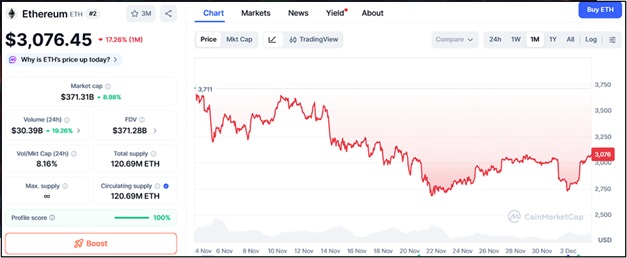
Ethereum, trading near $3,076, is following a clean upward trend supported by strong demand zones at $2,985, $2,912, and $2,851. These levels have served as repeated accumulation points for institutional buyers, long-term stakers, and ecosystem developers. ETH’s bullish momentum remains intact, but for a decisive breakout, the asset must overcome resistance at $3,138, $3,260, and $3,372, each historically linked to large continuation moves.

With Layer-2 networks thriving and increasing institutional interest in ETH as a yield-bearing asset, the long-term case remains powerful. Still, its massive valuation naturally limits multiplier potential — a reality that is steering many traders toward smaller, AI-driven tokens with far greater upside.

Why Analysts Say Ozak AI Outshines ETH in ROI Forecasts

Where Ethereum offers stability and proven demand, Ozak AI offers exponential possibility. The project enters the market as a next-generation AI intelligence layer for Web3, integrating millisecond-speed prediction engines, multi-chain analytics, and ultra-fast 30 ms signal execution delivered through its partnership with HIVE. This real AI infrastructure positions Ozak AI not as a speculative token but as a high-functioning utility system capable of powering automated strategies, real-time insights, cross-chain analysis, and AI-driven execution.

Through its integration with SINT, Ozak AI gains autonomous AI agents capable of reading blockchain data, executing tasks, automating workflows, and responding to voice commands — a rare level of real utility for an early-stage project. This depth of functionality is why analysts consistently estimate that Ozak AI’s long-term multiplier potential far exceeds that of established assets like Ethereum.

Ozak AI Presale Momentum Confirms Its Explosive Upside

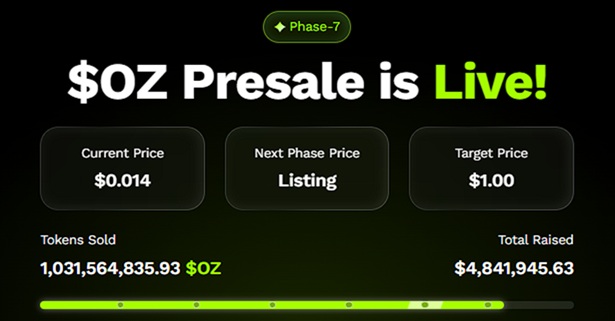
The acceleration of the Ozak AI Presale is strengthening its breakout narrative. With over $4.8 million raised and more than one million tokens sold, demand is mirroring the early accumulation patterns of past cycle giants that later moved 50x–100x after launch. Strategic partnerships support this momentum:

  • Perceptron Network’s 700K+ node infrastructure provides decentralized intelligence inputs.
  • HIVE delivers lightning-fast market signals and real-time data flows.
  • SINT contributes advanced AI agent technology for automated execution.

This synergy positions Ozak AI uniquely within the AI-crypto sector, giving it a transformative edge as AI becomes the dominant narrative of the next cycle.

ETH Stays Strong—Ozak AI Leads in ROI Potential

Ethereum remains a top-tier asset with strong fundamentals, rising demand, and massive ecosystem strength. Its bullish structure suggests further upside and continued dominance within the smart-contract sector. However, when it comes to raw ROI potential, analysts overwhelmingly identify Ozak AI as the market’s standout. Ethereum may shape the infrastructure of Web3—but Ozak AI is being positioned to shape the next generation of high-growth AI-powered crypto.


About Ozak AI

Ozak AI is a blockchain-based crypto project that provides a technology platform that specializes in predictive AI and advanced data analytics for financial markets. Through machine learning algorithms and decentralized network technologies, Ozak AI enables real-time, accurate, and actionable insights to help crypto enthusiasts and businesses make the correct decisions.


For more, visit:

Website: https://ozak.ai/

Telegram: https://t.me/OzakAGI

Twitter: https://x.com/ozakagi

Myriad Markets Launches Pool with Trust Wallet Integration

0

Myriad Markets, a decentralized prediction market platform built by DASTAN, the parent company of Decrypt and Rug Radio, officially introduced “Myriad Pools” on December 4, 2025.

This feature marks a key step in the platform’s evolution toward greater decentralization by allowing external users to provide liquidity to its markets, rather than relying solely on internal team-provided liquidity.

Deeper liquidity pools mean tighter spreads, reduced slippage, and a smoother trading experience when buying or selling shares in prediction markets, like on events in crypto, politics, sports, gaming, culture, or tech.

Participants can earn a share of the platform’s revenue from trading fees plus additional incentives, which are yet to be fully detailed (TBA). This could include points toward potential airdrops of the $MYR token, based on community speculation.

Myriad Pools build on the platform’s constant function market maker (CFMM) model, where liquidity is added to pools backing specific market outcomes. Traders interact with these pools to buy/sell shares, and imbalances adjust prices dynamically while keeping the total shares constant.

The feature is designed to support Myriad’s automated markets, which resolve every 5 minutes, and integrates with chains like BNB Chain, Abstract, and Linea for low-cost access. Early access is available via a waitlist on Myriad’s site. Users connect EVM-compatible wallets and can start providing liquidity once rolled out.

With prediction markets booming alongside Polymarket and Kalshi, this addresses a core challenge: liquidity depth. Community buzz on X highlights it as a low-risk entry for passive earners, potentially boosting $MYR airdrop eligibility.

Constant Function Market Makers (CFMMs) are a foundational mechanism in decentralized finance (DeFi) and automated market making systems, particularly popularized by protocols like Uniswap. They enable permissionless, automated trading without traditional order books by relying on liquidity pools and mathematical invariants.

At its heart, a CFMM is an automated market maker (AMM) that uses a constant function or invariant to determine prices and facilitate trades. Unlike centralized exchanges that match buyers and sellers via bids/asks, CFMMs maintain a pool of assets where traders interact directly with the pool.

The key innovation is a mathematical formula that must remain constant before and after each trade. This invariant governs how prices adjust dynamically based on supply and demand.If a trade imbalances the reserves, the price shifts to restore the invariant.

No external oracles or human intervention is needed for pricing—it’s purely algorithmic. Users trade by adding one asset to the pool and removing another. The amount received is calculated to keep the invariant unchanged.

Typically, a small fee (e.g., 0.3%) is skimmed from trades and distributed to LPs as rewards. CFMMs are “constant function” because the product, sum, or other function of the reserves stays fixed, ensuring the system is self-balancing.

In Myriad’s case liquidity is added to pools for market outcomes. Traders buy/sell shares, and imbalances adjust prices while keeping total shares constant—suggesting a constant-sum-like model.

After the event, winning shares redeem for $1 or equivalent, losers for $0. Unresolved markets resolve via oracles or automation (e.g., every 5 minutes in Myriad’s automated markets). Pool starts with 50 Yes shares and 50 No shares.

Price of Yes = Yes reserves / total = 0.5 (50% probability). Trader buys 10 Yes shares: Deposits collateral, pool becomes 40 Yes and 60 No. New Yes price ? 0.6. This creates a probability-based market where prices converge to true odds via crowd wisdom.

In platforms like Myriad, they democratize prediction betting by making liquidity provision open, potentially with rewards like token airdrops. This launch aligns with Myriad’s broader mission to embed prediction markets into everyday content consumption via browser extensions and media integrations.