This is the biggest deal in the evolution of the African tech systems since Bill Gates pioneered, through Windows and Intel/IBM chips, personal computing in ways anyone could participate. Yes, foreign companies planning to do business in the Kenyan ICT sector must be required to surrender 30% shareholding to Kenyans, corporates or individuals. This new ordinance is captured in the National Information Communications and Technology Policy Guidelines 2020, which was published last week, spelling out new regulatory mandates for players in the ICT sector: “It is the policy that only companies with at least 30 per cent substantive Kenyan ownership, either corporate or individual, will be licensed to provide ICT services.”
The ICT policy further says foreign companies will be given three years to meet the local equity ownership threshold, and may apply to the CS for a one-year extension with appropriate acceptable justifications. “For listed companies, the equity participation rules will conform to then extant rules of the Capital Markets Authority,” explains the policy.
[…]
“This will take the form of rules that allow companies to be licenced for certain services and only pay for the licence when they commence operations or achieve benchmark goals within predefined time frames,” explains the policy.
The State anticipates the policy will create 20 Kenyan multi-national ICT companies, 300 mid-sized firms, 5,000 small and medium enterprises and 20,000 startups.
This is expected to increase the number of startups through easing their barrier to entry. The policy also proposes a government venture capital fund that will invest in start-ups for a portion of the equity on a first-loss basis in case the startup fails.
This may not be palatable but Africa needs to have tough conversations for its future. A few weeks ago, a “Kenyan company” was acquired. As I researched for a piece, I noticed that 100% of it was owned by non-Kenyans. The Board has no single Kenyan; I decided not to run the piece as there was nothing Kenyan in it; it was a foreign company with operations in Kenya, deceiving journalists that it was “African”.
I expect Nigeria to arrive at the same conclusion by 2023. Yes, the wealth being created in the technology space today, in Nigeria, is largely not Nigerian. More than 70% are controlled outside Nigeria. From registering startups in the U.S. to using entirely foreign boards, I expect changes because if we do not act, we will get only marginal benefits as a nation. I will be happy to help the government write the brief, free, if it is serious.
I salute Kenya for this move. it is going at the root: OWN something and keep some home.
Sankofa is a word in the Twi language of Ghana that translates as “Go back and get it” (san – to return; ko – to go; fa – to fetch, to seek and take) and also refers to the Asante Adinkra symbol represented either with a stylized heart shape or by a bird with its head turned backwards carrying a precious egg in its mouth. Sankofa is often associated with the proverb, “Se wo were fi na wosankofa a yenkyi,” which translates as: “It is not wrong to go back for that which you have forgotten.” (Wikipedia)
Sankofa innovation which is “reach back and get it” type innovation. It emphasizes continuous improvement by looking back and learning from past experiences.
Read my book and understand Sankofa Innovation. If you have registered for Tekedia Mini-MBA, you get it free. Start reading.
I am from Awkuzu, in the Oyi Local Government Area of Anambra State. The famous Awkuzu SARS is in my hometown. In fact, the road that passed beside the SARS office leads to my village. If I need to go anywhere from my hometown, I stay at the front of the SARS office to board a vehicle. I’m only stating these so you will know that I am not a JJC when it comes to SARS and their doings in my town.
I will, however, enjoin you not to prepare your mind to hear dark stories about SARS. Nigerians have done enough justice to that so I will avoid repeating the obvious. I am, however, not going to sing their praises because we all know that SARS officials have done a lot of harm to the citizens of this country.
The first time I heard about SARS was from my father. Then he called them “Shoot At Sight” (SAS). To my father, that a criminal has a god father that protects him and bails him out of the police net is because the person has not met SARS. According to him, once SARS arrests a deadly criminal, especially the ones that murder their victims, that person will never be heard from again. Now, my father wasn’t saying these because he loved telling stories; he obviously must have known deadly people that were removed from society by SARS.
My mother still believes that Awkuzu SARS station was located there because of how bad that area was. People that know Awkuzu know that you dare not stop at the popular Awkuzu Junction in the night. To be honest, if your vehicle spoils along the Awkuzu axis of the expressway, you have to drag it, using whatever means possible, out of Awkuzu. Then, the bustling Awkuzu junction empties out around 7pm. If you find yourself in that place from 8pm and decide to board okada, well, you’re on your own. That was how bad my town was in those days.
But then, Awkuzu is cool now. I can come into my town by 10 pm and even walk from the junction, through the road that passes beside SARS office and head for my village. I wouldn’t have dared this before. SARS actually made it possible now. Even students from Chukwuemeka Odumegwu Ojukwu University, Igbariam Campus, avoid issues with SARS. That is why you hardly hear of cult wars in that school. SARS is actually sitting on their necks.
Now, SARS has not been a nursemaid for Awkuzu. They showed us pepper, trust me. Then, parents that have young boys were afraid because their sons may fall into SARS nets. Night live was seriously reduced to the lowest ebb then. SARS usually comes raiding in the night and they pack up boys in beer parlours and places like that. But, to be honest, I have not heard of an innocent person from my kindred, who was arrested by SARS and never returned. The only thing then is that if SARS comes for raiding or wants to arrest suspects, they pick up all the young boys and men within the vicinity and then allow the innocent ones to go later (after they must have bailed themselves out with a huge amount of money). But the main people they came for in those raids/arrests are usually not granted bails, at least not immediately. Our annoyance then was why SARS would pick up both the innocent and the non-innocent and then make money out of the innocents.
The problem I see with SARS is their use of intimidation and brutality. But they are not the only ones that do that; every security agency in this country intimidates and brutalises the masses. Even private security agencies use unnecessary force to execute their authorities.
But let’s look at the ENDSARS campaign that is ongoing for some time now. We know that SARS officials have been accused of several extrajudicial killings. They have been called out for their brutality towards the youths, especially the young men. Evidence is even there to show that they are guilty of these accusations. But is that the reason to scrap it off? Well, I don’t think so.
It will be an utmost lie for someone to say that SARS isn’t working in Nigeria. Their inception is for a reason and I believe they are performing their primary duties. The things that SARS officials do, an ordinary olopa cannot even dream of doing half of them. Scraping SARS off will only ensure a massive return of crimes (not that we don’t have massive crimes anyway). But I fear what will happen if SARS ceases to exist.
Like we all know, there are bad eggs in every profession. Among bankers we have found fraudsters. Rapists have been discovered among teachers. Murderers exist among health practitioners. And people have lost their properties to their family lawyers. But then, do we have to scrap banks, schools, hospitals and courts of law because of the bad eggs that work in them? Of course the answer is “No”. This is why we should channel our energy towards weeding out bad eggs in SARS instead of asking for the special force to be closed down.
Today, we provided funding to a startup undergoing training in Tekedia Mini-MBA. Over the last 6 weeks, the team has grown revenue in a niche area on payment and remittance. Our experience with receiving payment across Africa on Tekedia Mini-MBA has pushed me to declare that nothing has truly happened on African intra-payment. From Ghana to Cameroon to Tanzania, and beyond, Africa remains far away when it comes to payment.
We lost members from Tanzania as they were unable to pay. In Cameroon, we were saved as we have a country manager. The same happened in Ghana, etc. In Congo DR, a friend had to help: his fellow citizens pay him; he pays us via PayPal USA. The story is the same: inter-border payment within Africa remains primitive.
With that experience, I started looking into the payment and remittance nexus. We will announce this firm when the team gets ready this week. Tekedia Mini-MBA besides being a management training school is also an accelerator. We have data now to begin to support innovators.
I call young people to continue to build; the future has abundance.
From Professor Olufemi Adebisi Bamiro to Professor Isaac Adewole, the University of Ibadan community was promised better infrastructure, welfare and continuous development for 10 years. By November 30, 2020, it will be 15 years that the community has received messages and pledges of good fortunes from candidates for the position of Vice Chancellor of the University. On this date, Professor Abel Idowu Olayinka will complete his 5 years single term of being the Chief Executive Officer of the oldest University in Nigeria.
In the last few days, our analyst has been writing insights and established metrics that could be used by the stakeholders in charge of selecting and appointing a new Vice Chancellor of the University. This piece is another one that aimed at revealing some of the gains of Professor Abel Idowu Olayinka’s leadership and what the incoming Vice Chancellor could learn from his deficiencies. This is imperative because the University cannot afford not to have a strong strategic leader who would continue from where he will be stopping and correct the lapses.
This piece emerges because of the need to have a robust discourse around Professor Olayinka’s leadership. Like the analyst noted in one of the previous articles, Professor Olayinka has done his parts. After all, he is not an angel. He is destined to make mistakes and retrace his steps for future growth. Therefore, the article should be seen as a way of gauging his performance in relation to his strategic plan titled “Accelerated Development through Consolidation and Innovation.”
Our Measures and Data
To the best of our knowledge, this is the first time an article is x-raying an outgoing Vice Chancellor in any University in Nigeria. He is being judged considering his contribution on academic, research and quality assurance, administration, financial management and branding of the institution in the last few years. Specifically, the piece interrogates the key resources in terms of relational, strategic, structural and human capital, he employed to deliver value he promised the University Community, especially staff and students.
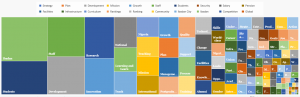
As stated earlier, our first data source was his strategic plan. Since the plan is his strategic template for managing human and material resources towards the realisation of the mission and vision of the University, we leveraged it and extract keywords [dominant words he used to explain his ability and capability to lead the University for 5 years]. We called the select keywords strategic keywords because we found that the words were used as constructs and concepts to depict his vision and mission for the University in relation to the University’s own [see Exhibit 3]. As constructs and concepts, we found most of the words as promising and deciding how the resources will be allocated across the University and outside it.
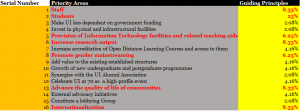
Guiding principles and goals inherent in the strategic plan were our second data category. Guiding principles are the fundamental assumptions tied to each of the priority areas [see Exhibit 1] he intended to focus on as the University’s Vice Chancellor. The principles establish specific steps that he would take in order to realise each of the priority areas. Our analysis, however, suggests that the principles are prescriptive in nature. This means that there is possibility of altering them while implementing the plan due to unexpected situations. The third data source was his recently released My Stewardship Report. In the report, he documented all his activities from 2015 to the current year. We also analysed his speeches, delivered within the University environment.
His Strategic Plan: What is in It?
In our analysis of his plan, we found 16 priority areas with 48 guiding principles. In terms of guiding principles allocation to the priority areas, analysis indicates that Professor Olayinka believes in amassing his resources towards the realisation of the priority areas differently [see Exhibit 1]. Analysis further reveals a connection of 79.7% of guiding principles and goals [short, medium and long terms].
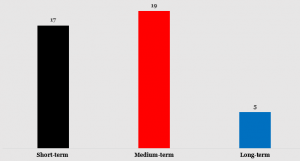
To realise his vision and mission for the University, he developed 17, 19 and 5 short, medium- and long-term goals respectively. In spite of the high percent of connection of guiding principles and goals, analysis reveals 63.6% of the principles leading to the formulation of goals he had. This means that other factors that were not part of the principles accounted for the remaining percent.
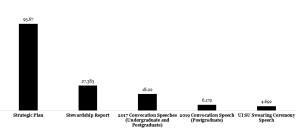
Beyond the principles and goals, we selected 118 strategic keywords [see Exhibit 3]. These words were searched in the strategic plan, stewardship report and speeches he delivered within the University environment. From the analysis, we found a total of 6,709 of the keywords in the strategic plan after counting frequency of each word. A total of 2,080 of the keywords was found in the stewardship report. This indicates a difference of 4,629 keywords.
In his 2017 convocation speeches [comprising undergraduate and postgraduate], we found a total of 1074 keywords. This is quite different from what we discovered in his 2019 convocation speech delivered during the award of postgraduate degrees. Analysis establishes a total of 348 keywords. His speech during the swearing ceremony of members of the Students Union Executive had a total of 210 keywords.
Looking at the data further, we discovered that Ibadan [590 times] appeared the most in his strategic plan, while it was students [154 times] in his stewardship report. Students [102 times] also appeared the most in his 2017 convocation speech and research occurred the most in his 2019 convocation speech. Again, occurrence of students as keyword 46 times made it most used word in his speech during the swearing ceremony of Executive Members of the Students Union.
What are the implications of these results? This was further explored by our analyst with the specific reference to how the keywords contributed to his actions [activities during the years]. In all, analysis establishes strong percent of the link between the keywords in his strategic plan and those used [replication of the words was considered] in the stewardship report and speeches he delivered.
Our analysis reveals that the keywords in the plan and stewardship report were related by 83.7%. This percent dipped when we analysed the connection of the keywords in the plan along with those in the 2017 convocation speech. We discovered 76.8% linkage. This also dropped when the connection between the keywords in the plan and those in the 2019 convocation speech [we discovered 70.1% connection] and 2019 UI SU swearing ceremony [we found 52.0%] was analysed. These results imply that Professor Olayinka has only managed to appropriate his keywords in planning and reporting achievements than applying the same vigorously while engaging with the stakeholders [see Exhibit 4].
This is another factor we considered imperative to understand how he has employed and deployed financial capital. We examined projects/contracts he has executed, excluding the projects/contracts that commenced in the years before his tenure started in 2015 [2014 downward] The year 2015 was counted because there is a need for him to continue with projects/contracts already approved during his predecessor (Professor Adewole).
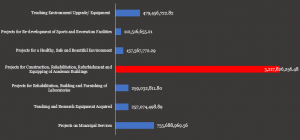
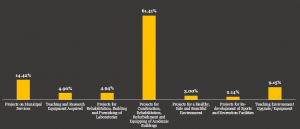
Our analysis shows that he spent N5,239,163,687.05 between 2015 and 2018 [this includes projects/contracts awarded before he became Vice Chancellor in December, 2020]. During the period, N748,451,955.29 was the average spending on projects/contracts [see Exhibit 5]. Examination of his stewardship report indicates that a brand new 200kva Perkins Engine Power generating set for the Vice Chancellor’s lodge & other location was procured in 2018 at N15,235,500.00. Electrical materials worth N160,195,911.03 was supplied. In 2018, one new Prado VX, V6 leather petrol 2017/2018 model was purchased for Pro-Chancellor at N55,938,750.00.
We also found that a Mathematics Laboratory is being constructed at the rate of N75,247,128.80, while construction of Laboratories and Offices for Faculty of Pharmacy, practically completed, was awarded at the rate of N170,000,000.00. The Lecture Theatre, Offices, Seminar and Conference Rooms for the University of Ibadan School of Business Lot 1, 2 and 3 were completed using N211,447,14 7.60 allotted to them. Despite stating 12 projects as those carried out at Halls of Residence, the total amount expended on each project was not stated in his stewardship report [the part is highlighted using red colour without any explanation].
Beyond these results, we explored the implications of Professor Olayinka’s guiding principles, goals and strategic keywords on the projects/contracts. Our analysis indicates that one percent of the principles increased his spending on the projects/contracts by 34.5%. It was 37.8% when we considered the goals [short, medium and long terms]. Surprisingly, analysis shows that one percent of the strategic keywords reduced his spending on the projects/contracts by 35.3%. With these results, there are positive and negative implications for advancing the University as stated in his strategic plan. One of the implications is that the principles and goals seem better in terms of helping him realising his vision and mission for the University than the keywords.
Exhibit 5: Spending on Key Projects/Activities between 2015 and 2018 (in Naira)
This question will be answered in the second part of the article, which x-rays the implications of the guiding principles, goals and the keywords on human and material resources he has been managing since 2015.