DD
MM
YYYY

PAGES

DD
MM
YYYY

spot_img

PAGES

Home Blog Page 6238

Univ of Ibadan VC Selection: 7 Contenders and Their Contributions to Public Understanding of the University in 5 Years

18
University of Ibadan, a federal university

By December 1, 2020, a professor would be in charge of affairs of the University of Ibadan as the new Vice Chancellor. The expiration of the tenure of the current Vice Chancellor, Professor Abel Idowu Olayinka would necessitate this development. Professor Olayinka’s tenure will officially come to an end on the 1st of November, 2020. Since the seat of Vice Chancellor has been announced by the Registrar of the University, a number of professors in Nigeria’s oldest University, have indicated their interest through applications.

Our checks revealed that some of them have engaged with the University community at different fora, informing staff most especially what they have for the school’s advancement. However, this piece is not about x-raying what they wanted to do in terms of welfare and better environment provision for sustainable teaching and learning. Instead, the piece focuses on demographics and psychographics of seven contenders.

Our analyst believes that this is imperative for the public to understand what and how any of the contenders would advance the vision and mission of the University nationally and globally. Our analyst specifically focuses on Professor Oyebode Adebowale of the Department of Chemistry, Faculty of Science; Professor Remi Raji-Oyelade of the Department of English, Faculty of Arts; Professor Adeyinka Abideen Aderinto of the Department of Sociology; Professor Oluyemisi Adefunke Bamgbose, SAN of the Department of Law, Faculty of Law; Professor Emiola Oluwabunmi Olapade-Olaopa of the College of Medicine; Professor Temitope Alonge of the University College Hospital (UCH) and Professor George Olusegun Ademowo of the Department of Pharmacology and Therapeutic, Faculty of Basic Medical Science.

Scholarship and the Seat

According to the vacancy message released by the Registrar, the candidate is required to possess a good university education in addition to being a highly distinguished scholar of the rank of Professor, with a minimum of ten (10) years’ experience. These are sufficient in terms of qualifications and academic prowess. In addition to these, the person must have the ability and capability of commanding the respect of the national and international academic communities through his/her track record. Our analyst examined these and discovered the select contenders possess the requirements at varying degree. They all have significant number of publications and more than 10 years of experience required. However, our checks showed that two of the contenders’ presence on the known academic database [Google Scholar] is low. In spite of using deep search and data mining tools, publications of Professors Remi-Raji Oyelade and Oluyemisi Adefunke Bamgbose were not found when our analyst used 2015 to 2020 as search period.  Further research, however, indicates that Professor Remi-Raji Oyelade has some of his publications on personal website, while this cannot be said of Professor Bamgbose.

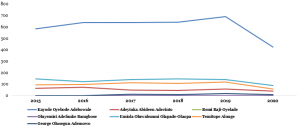
Beyond knowing the publication frequency during the period, we analysed the number of citations each of the contenders has. Averagely, Professor Kayode Oyebode Adebowale has been cited 1,032 times. He is being followed by Professor Emiola Oluwabunmi Olapade-Olaopa, who has been cited by 222 times. Professor Temitope Alonge is in third position with 166 citations.  We further developed more interest in understanding how the publications and citations helped the University in terms of being searched by people throughout the world. Here, our focus is to find out the extent to which people had interest in the University through the contenders’ publications or citations from January 1, 2015 to July 26, 2020.

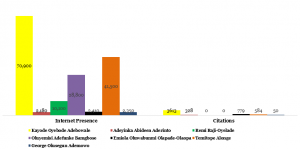
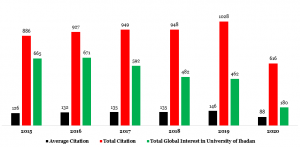
Using 5 of the contenders [those with presence on Google Scholars and Semantic Scholars], analysis indicates 49.4% of the Collective Total Citations variation in global interest in the University. When we analysed the citations using Collective Average Citations, the percent increased by 1% (49.5%). These results imply that during the five years, the 5 contenders can only account for less than 50% of people interest in the University, signifying a low interest in knowing the University through their publications or voices on national and international issues. This position becomes more useful when analysis of their presence on the Internet only accounts for 4.3% of public interest in the University. Meanwhile, disaggregated analysis reveals that Collective Total Citations is better at directing public attention to the University. From the total of 158, 240 Internet presence results for the 5 contenders, 116,306 results facilitated public interest in the University.

Exhibit 1: Candidates’ Citation Trends from 2015 to 2020
Source: Google Scholar, 2020; Semantic Scholar, 2020; Infoprations Analysis, 2020

Exhibit 2: Internet Presence Versus Citations
Source: Google, 2020; Google Scholar, 2020; Semantic Scholar, 2020; Infoprations Analysis, 2020

Exhibit 3: Candidates’ Scholarship Network and Global Interest in the University
Source: Google Scholar, 2020; Semantic Scholar, 2020; Infoprations Analysis, 2020

Management and the Seat

In line with the Registrar’s release, candidate should be a proven, successful manager of human and material resources; be a person of proven integrity; demonstrate ability to provide academic and administrative leadership for such a well-established institution strengthen the bridges between staff, students and other members of the University community; be a person with a clear vision for the development of the University and attract the much-needed funds into the University.

Tracking and analysis of Professor Oyelade’s views on national and international issues reveal that he believes in changing his immediate environment using his writing skills and leadership experience. “Writers need to come together more often to deal with real national issues, rather than personal and local issues. We seem to be too afraid to be accused of being vocal without being active,” he said during a recent interview. While addressing a number of people in the University Community, Professor Adeyinka Abideen Aderinto also said the University needs a Vice Chancellor that will re-engineer and re-invigorate its greatness nationally and internationally.

Demographic and Geographic, and the Seat

Like what we have in the Nigerian larger society, as the race gets hot up, people have been expressing their views on who emerges and from which town or state. Our analyst themed this as socio-political mentions and listening in which people and associations from Ibadan have started seeing the seat as what should come to the city considering that none of the city’s professors [working in the University] has been Vice Chancellor of the University.

Examining the contenders using a geographical lens, analysis shows Professors Emiola Oluwabunmi Olapade-Olaopa and Remi Raji-Oyelade and Kayode Oyebode Adebowale are from Oyo state, while Professor Oluyemisi Adefunke Bamgbose, SAN is from Ogun state. Professor Adeyinka Abideen Aderinto and Professor Temitope Alonge are from Osun and Ondo respectively.

Following the Registrar’s release, our analyst also picked the age limit requirement for analysis. The release states that candidate must not be more than 65 years old as at the date of possible assumption of duty on 01 December, 2020. Analysis shows that the average age of the select 7 contenders is 57 years [see exhibit 4].

Exhibit 4: Age of Contenders
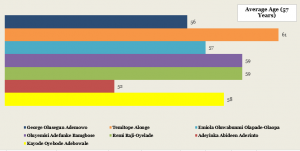
Source: University of Ibadan’s Staff Profile, 2020; Others, 2020; Infoprations Analysis, 2020


Things Nigeria Should Consider Before Enforcing Stamp Duty On Rent

0

It all started with VAT increase. On February 1, 2020, the Federal Government implemented the increase of Value Added Tax from 5% to 7.5%. It didn’t go down well with many people but it was overlooked because, technically, VAT is not paid for all goods and services obtained. For instance, we don’t pay VAT when we buy goods from our local open markets. So, somehow, we can manage with the increase.

As Nigerians were getting used to seeing 7.5% VAT on invoices, banks landed with their N50 stamp duty on deposits. People wondered what was happening. We checked and learnt that the Federal Government approved the charges, even though it was for transactions above N10,000. But banks deducted the charges even if the money deposited was just N10,000. Well, we swallowed it; after all it is just N50.

But we didn’t know the FG is not done with us yet; they were releasing their lashes one after the other. The VAT increase and imposition of Stamp Duty on electronic and cash deposits into savings and current accounts were just their ways of testing the waters. It was “testing the microphone one-two”. They have more things coming. And the ones that come after each stage will affect more and more people. So they released the next level, this time for almost everyone, especially those that are struggling to breathe. This very monster was released on Wednesday 22 July, 2020.

On Wednesday 22 July, 2020, the Director of Communication and Liaison Dept, Federal Inland Revenue Service (FIRS), Mr. Abdullahi Ahmad, announced that henceforth, landlords and property agents should charge and collect Stamp Duty from tenants, renters and leasees. He made it known that the burden of this tax is on the tenants, renters and/or leasees, as was stated in the Stamp Duty Act.

Of course you must have known how Nigerians reacted to this, especially when the first press release generalised that the tax is 6% on the total sum of rent.

However, on 25th July, 2020, FIRS took to its Twitter page, @firsNigeria, to make clarifications on how Stamp Duty on rent will be paid. According to them, the tax is not 6% flat for all tenancy and lease agreements, as was earlier stated, but for those that will exceed 21 years. Hence, the tax will be charged thus:

  1. Tenancy/lease of 1 – 7 years = 0.78% (39kobo/N50).
  2. Tenancy/lease of > 7 years but < 21 years = 3% (N1.50k/N50).
  3. Tenancy/lease of > 21 years = 6% (N3/N50).

This shows that many Nigerians will be affected by options ‘a’ (residential) and ‘b’ (businesses). Option ‘c’ will, however, affect most companies such as banks and other multinational companies.

Let’s put this simply. What is going to happen from now onwards is that all the landlord’s tenants, shop renters and people that leased houses must pay either 0.78%, 3% or 6% of their rents to the government. These charges are not tax deductible. Whatever your landlord said you should pay as rent, you should pay the applicable percentage of that amount as stamp duty to the government. What is still shady is whether this payment is done once or whether it is renewable. We only found out that we will not pay 6% because of the public outcry.

I don’t know who drafted this law but it is obvious that the person has never known what it takes to live and survive in Nigeria. It is obvious that the people that put this law together have never experienced deprivation. It is obvious that they are not Nigerians. Or rather, they are not Nigerians that grew and lived in Nigeria. If they are, they would have realised the pains they will cause average Nigerians through this tax.

Like I noted earlier, it is unclear whether this tax is renewable. I mean, do we only pay it when we are moving into an apartment? Or is it something the landlord can wake up and say he made some amendments to his tenancy agreement and so all of us should pay stamp duty to make it legal?

Apart from that, why do we pay compulsory legal fees, agent charges, tenement, and what have you, to the landlord and then come back to pay stamp duty to the government so that our agreement will be legal? Are these not extortions? Why won’t the legal fee and the tenement cover up for stamp duty? I am just wondering, anyway.

Then coming to the government imposing tax on people for finding shelter, is the government indirectly telling us that finding a place to sleep is now luxury? Are we not supposed to live in houses anymore? Or did the government provide low-cost houses for us, which we rejected for cosy ones? Why exactly does the government feel that tenants should bear the burden of this tax? We constructed the roads that entered our houses. We clear bushes around them. We take care of our waste disposals. We buy water, electricity, electricity cables, even transformers, we bought all of them. So why should we pay the government for renting a house they did not build? It would have been a different ball game if the government provided housing units for us and decided to collect taxes from those that preferred private ones. But we know such a thing doesn’t exist; at least not in my area.

By the way, that money the government wants us to pay stamp duty from has already been over taxed. We pay income tax from our salaries, which were deducted before we receive the pay. We pay stamp duty when the money is paid into our bank accounts. We pay VAT for household consumables we bought with part of the salary. And then, we still pay stamp duty for rent, from that same salary. Mark that I didn’t mention other charges like electronic transfer charges among others. By the end of the day, you’re left to wonder what is happening. Are we going to kill ourselves paying taxes?

Another thing I am seeing here is that landlords will use the opportunity given by this stamp duty to victimise their tenants. As we are now, most of us condone our landlords and their unsuitable apartments because we can’t afford the extra charges that come with changing apartments. But here, the government is increasing the problems for us. Well, the government should consider regulating rents and attaching laws that will ensure that landlords do not abuse the implementation of this tax. For me, the only way this can happen is for the government to make sure that the landlords bear the burden of this tax. In fact, it should be done in such a way that the higher the rent, the higher the tax (and the tenant must not be forced to pay for it). That will make our landlords that increase rents indiscriminately think twice before adding any kobo to it.

But if the government insists on retaining the status quo, I want them to understand this:

  • Rents are not cheap in this country.
  • People suffer to pay rents (plus tenement and legal charges).
  • Landlords increase rents every year.
  • Tenants are not the beneficiaries of rent; we pay to stay out of the weather and to keep ourselves and belongings secured.
  • Rent is not luxury.
  • Government did not provide housing units for us.
  • We provided our own basic and social amenities.

I know the government needs tax to run its ministries but it will not kill the citizens in order to pay its bills. It should place that stamp duty on landlords because they are the ones that will spend the money paid as rent. Besides, that will help to curtail how they increase rents. Honestly, I don’t know why the government is letting off greedy landlords and punishing tenants for crimes they didn’t commit. The burden of stamp duty on rent should not be placed on tenants, renters and leasees.

Let those that made this decision go back and re-evaluate their plans. Nigerians are already passing through a lot; they shouldn’t add more problems to our already existing ones.

Work With An Innovation & Growth Partner – Innovate, Grow and Advance the Mission

0

When you send a minimum of ten staff to Tekedia Mini-MBA, our team will schedule a meeting with you, discuss your business frictions, and during our program, we will work with your company to find solutions to those frictions. The outcome of the process has been amazing: internal innovation at scale.

We are helping companies to make their workers to become better strategists, analysts,  researchers, and innovators. Yes, your staff would go through a methodological process to think of solutions for the business. 

With our class notes, videos, Live sessions, and cases, your team will have the right tools to produce that FUTURE for the business. You already have a great team, make them BETTER.

Let’s serve you as an Innovation & Growth Partner, and using your team, you will find a new nexus to innovate, grow and advance the mission.

Visit Tekedia Mini-MBA and register.

https://www.tekedia.com/mini-mba-3/

The Dangote System – Exclusive for Tekedia Mini-MBA Participants

0

“I built a conglomerate and emerged the richest black man in the world in 2008 but it didn’t happen overnight. It took me 30 years to get to where I am today. Youths of today aspire to be like me but they want to achieve it overnight. It’s not going to work. To build a successful business, you must start small and dream big. In the journey of entrepreneurship, tenacity of purpose is supreme.” – Aliko Dangote

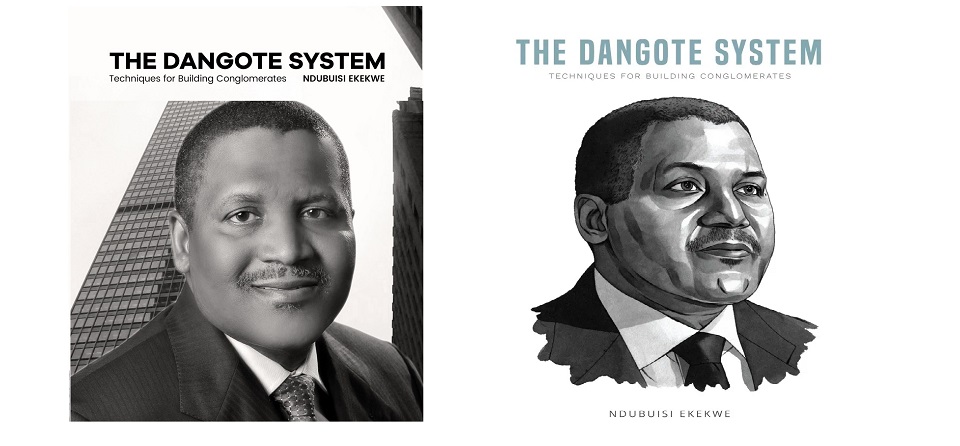
“The Dangote System: Techniques for Building Conglomerates” arrives this week. Exclusive for participants of Tekedia Mini-MBA edition 2 and 3. REGISTER here.

https://www.tekedia.com/mini-mba-3/


Tekedia Mini-MBA: Get 2 Free eBooks, Free Facyber Cybersecurity Course; Beat Early Bird Deadline

0

Registration for Tekedia Mini-MBA edition 3 begins. This program is a 4-month weekly innovation management program, beginning Aug 10 to Dec 3, 2020. It will comprise videos, flash cases, written materials and webinars delivered online, and optimized for business execution and growth, with digital operational overlay. When we finish, we will issue a certificate from the Tekedia Institute USA.

Register and join us. You will emerge transformed with tools and capabilities that engineer confidence, performance and growth.  Accelerate your leadership ascent with us and have access to speak with me on your career and professional development! Tekedia is also unveiling certificate courses.

CODE PROGRAM
MINI Tekedia Mini-MBA costs US$140 (N50,000 naira) per person.
MINR Add extra (optional) $30 or N10,000 if you want us to review and provide feedback on your labs.
Add extra (optional) $60 or N20,000 for each certificate specialty course. You must have attended, begun or about attending Tekedia Mini-MBA to qualify. The following Certificate tracks are available:
CLSM Certificate in Logistics and Supply Chain Management
CSBM Certificate in Startup and Small Business Management
CETS Certificate in Exponential Technologies and Singularity
CPCD Certificate in Personal Career Development
CPFM Certificate in Personal Finance & Wealth Management
CBIS Certificate in Business Innovation, Growth & Sustainability

The Certificate program is completely capstone-based. Tekedia capstone is a research paper or a case study exploring a topic, market, sector or a company. Tekedia Institute supervises the work.

How To Register: click here to registerDo it on time for