DD
MM
YYYY

PAGES

DD
MM
YYYY

spot_img

PAGES

Home Blog Page 6239

Global Contracting and Global Supply Chain At Tekedia Institute

0

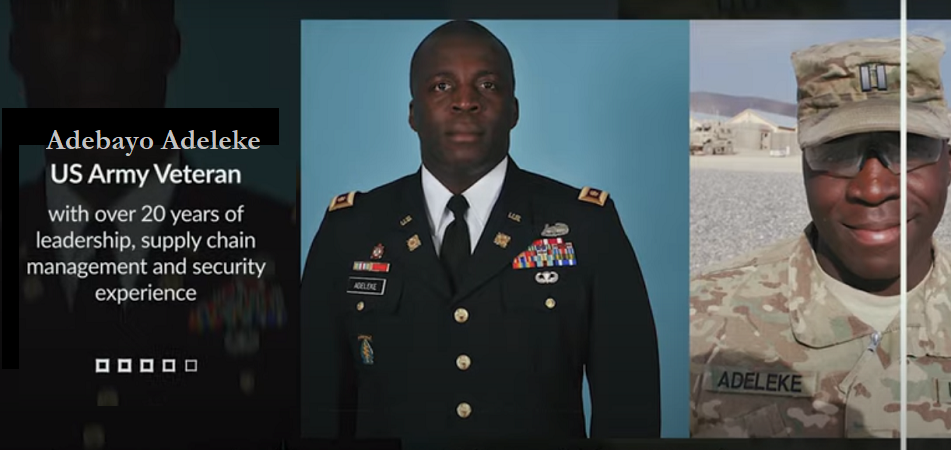
He served the U.S. Army for more than 20 years. He rose to the position of the Director of Contracting Operations. He began as a Logistics Specialist, then Logistics Supervisor, then Warehouse Manager, and then Materials Manager. Then, Operations Manager, Procurement Manager, Director of Logistics, Contingency Contracting Team Lead, and Chief of Contracting.

If you can run logistics for the military, peace and war time, you really know logistics. Adebayo Adeleke is the godzilla of global supply chain and contracting. He knows so much about the global semiconductor supply chain  that during a recent conversation I stopped talking. I mean, I thought I knew the pieces, but Bayo was way high up there in the frequency.

Bayo, a seasoned combat veteran of the United States Army, and a Tekedia Institute Faculty, will lead a session on Global Contracting and Global Supply Chain. Go Global with Bayo here.

https://www.tekedia.com/mini-mba-3/

Media, Communications, and Public Relations At Tekedia Mini-MBA

0

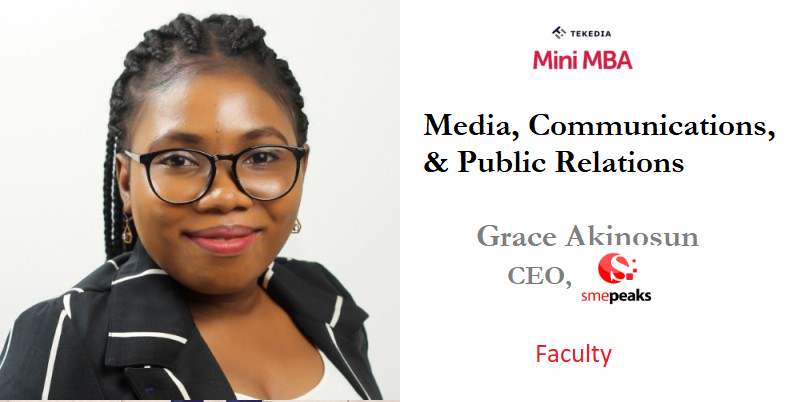
smepeaks is a new media and communication platform leveraging technology to create content about, and tell the stories of African SMEs and startups. From news publishing, industry insights, market trends to basic hacks, smepeaks provides end-to-end solutions that cater to the needs of African emerging businesses and help them find a place among their global contemporaries.

Grace Akinosun, a Tekedia Institute faculty, and CEO of smepeaks, will lead a session on Media, Communications, and Public Relations, during Tekedia Mini-MBA. Her expertise on digital media will help our learners discover paths to tell their business stories better.

Attend Grace’s class and become a better market communicator at Tekedia Mini-MBA.

The Need to Review the Use of Capital Punishment

0
Emerging technologies like AI would have transformation impacts on Law (source: law.com)

I was about to drop this article when I came across the news of the gruesome murder of Fahim Saleh, the founder of Gokada. I can’t explain what I felt after I read the way he was killed, dismembered and packed into different polythene bags; it was just like what we watch in horror movies. I told myself that Saleh’s death has confirmed that we have a lot of cannibals living amongst us. Of course, the only person that can do this sort of thing is someone that wouldn’t bat an eyelid as he or she butchers a fellow human being. This news actually made me sit back and re-ask myself why I thought that capital punishment should be abolished.

It is certain that anybody that hears about the murder of another human being will desire that the culprit(s) should be made to pass through what the victim experienced. In most cases, people feel satisfied when they hear that a murderer is sentenced to death. This comes to say that the major drive behind capital punishment is revenge, and not justice.

Of course, different logical reasons behind the use of capital punishment exist. One of the reasons I have heard of is that death penalty is a way of reducing the number of hardened criminals in the world. A writer of an article I read some weeks ago insisted that death penalty ensures that the people that enjoy harming their fellow humans are sent out of this planet. This, he says, is the only confirmed way of making sure that they don’t hurt people again. This reason is logical, I must tell you. But then, is death the only way to stop these people from harming others? Let us also remember that a serial killer with a good lawyer is most likely to walk out freely from a courtroom and continue with his pastime. This is just to say that capital punishment has not reduced the number of murders and murderers in the world.

Another argument for capital punishment is that it serves as a deterrent to others. This is supposed to be the best reason for using this measure but unfortunately, it didn’t stop the rate of crimes in the world. In those countries, where people are sentenced to death for drug trafficking and extramarital affairs, death penalty has not been able to stop those acts. Drug dealers still carry out their business and married and unmarried couples still engage in illicit affairs. So, how did killing those found guilty of certain crimes reduce the number of the affected crimes?

Like I stated earlier, retribution is one of the reasons for instituting death penalty. It is obvious that the person seeking vengeance is not the victim, but his relatives. Yes, I know that some cultures believe that a person that was murdered does not find rest until his death is avenged. Well, that is cultural differences. But I believe that if the dead so much want vengeance, he or she can do it without the help of people in this world.

Kindly note that I am not entirely condemning death sentences, especially in very severe cases, but the way it is being meted out in some parts of the world is a call for concern. If care is not taken, every crime in this world will soon be punishable by death. Apart from that, killing people because they killed others questions the morality behind it. People are discouraged from killing their fellow humans because life is supposed to be preserved. But when those that preach against murder, turn out to do the killing, their own moral standard becomes questionable.

There are several ways of eliminating crime. We should start from our judiciary. If someone is indicted for murder, and there are enough evidences to prove it, why then should the person be set free because he has a lawyer that knows how best to dance in the courtroom? Meanwhile, another person that can’t afford a good lawyer will face the “hanging squad”. What then is the moral behind this? How can such reduce crime?

We should also consider incarcerating criminals properly. I know that prisons are called correctional facilities, but I also know that not all criminals can be corrected. Some of them seem to have this inner trait to commit deadly crimes that harm their fellow human beings. People that belong to this later group should be permanently confined to places for people like them. This way, they will never have access to innocent people they can harm.

Tekedia Live Thursday, 7pm to be Anchored by TAFFD USA Team

0

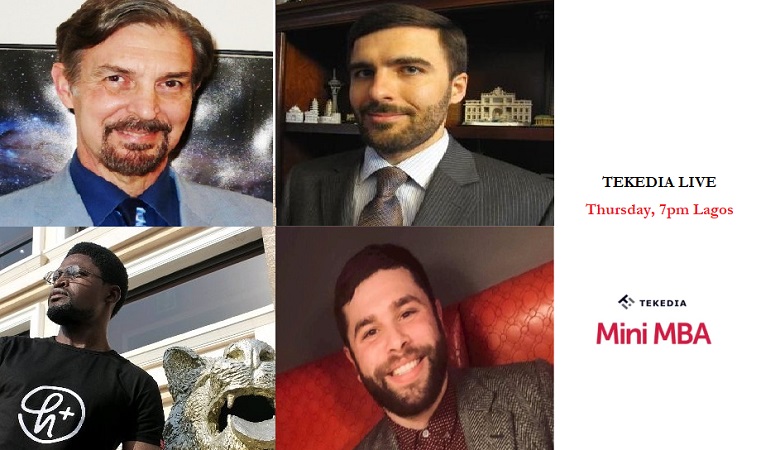
Today was a huge one with one of our faculty members leading Tekedia Live; the recording is now in the Week 4 Board. Tomorrow, Thursday, Live is scheduled at 7pm Lagos. The focus of this session is singularity, emerging &  exponential technologies. Transdisciplinary Agora for Future Discussions, Inc (TAFFD), Georgia, USA has graciously supported Tekedia Institute with its experts for this session.

  • Edward Hudgins, PhD

  • Chogwu Abdul, PhD

  • Gennady Stolyarov II

  • Brent Ellman

More so, Tom Ross, President & CEO of TAFFD, will give a short opening remarks.

For members, go to the Week 4 board for Zoom link https://www.tekedia.com/2week4/ . For non-members, join us here via YouTube Live https://www.tekedia.com/live/

Tekedia Mini-MBA >> Nurturing Innovators.

Fahim Saleh, Gokada Founder and CEO Murdered in New York

4

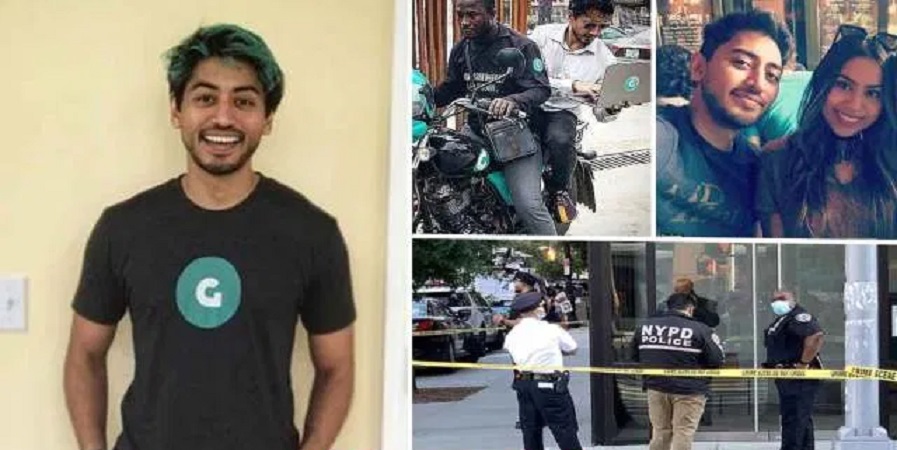
The dismembered body found in a New York City apartment on Tuesday was said to belong to the founder and CEO of Gokada, Fahim Saleh. His gruesome demise was confirmed Wednesday in a tweet posted by the Gokada handle.

“We are deeply saddened to inform you about the sudden and tragic loss of our founder and CEO, Fahim Saleh, Fahim was a great leader, inspiration and positive light for all of us.

“Our hearts goes out to his friends, family and all those feeling the pain and heartbreak we are currently experiencing, here at Gokada,” the post said.

It was a tale of horror coming from Fahim’s Manhattan condo on Tuesday afternoon. When his sister went to check on him, after not seeing or hearing from him for some days, she found Fahim’s body dissected with an electric saw which lay beside his remains, local news reported.

Fahim was said to have bought the condo in 2019 for $2.25 million. The New York Police Department (NYPD) who answered his sister’s 911 call said the police don’t have a motive yet.

“We have a torso, a head that’s been removed, arms, and legs. Everything is still on the scene. We don’t have a motive,” said NYPD spokesman Sgt. Carlos Nieves.

According to local reports, a surveillance camera caught Fahim walking into the elevator for his seventh floor condo, and there was a man wearing a hat, gloves and mask hurrying after him. The police said the killer was a professional.

Fahim became popular among Nigerians when he started the motorbike hailing company, Gokada that ensured faster movement in traffic prone Lagos. But motorbike hailing was banned in January by the Lagos State Government, putting Rahim’s Gokada business in Nigeria to a halt.

Apart from Nigeria, Fahim is also popular in Bangladesh, his country of origin, where he co-founded the ride-hailing company Pathao, which is popular in Bangladesh and Nepal in 2015.

The 33 years old was known for his love for gadgets. He created his first company, prankDial.com while in high school at 16, a prank calling website, before he moved into venture capital.

In his story on Medium, Fahim shared three lessons that helped him get even: “When you’re serious about a project, you need to find others who will take it seriously also; focus your energy on one or two ideas; at the end of the day, you need to make sure it’s something you’re truly passionate about.”

It is not clear what the motive behind his murder is, but he is believed to be targeted.

Those close to Fahim said he is a cool, gentle and inspiring personality who has shown leadership in his capacity as a tech founder and CEO.

The co-founder of Pathao, Hussein M Elius, told Bangladesh’s Daily Star newspaper: “Fahim believed in the potential for technology to transform lives in Bangladesh and beyond.

“He saw the promise in us when all we had was a common purpose and a shared vision. He was and will forever remain, an incredible inspiration for Pathao and our entire ecosystem.”

As Fahim Saleh trends on Twitter, Nigerians are telling their stories about him.

“A great loss. Had a conversation with him about a month ago on their new B2Bdelievery, amazing guy and extremely friendly,” Shina Charles Memud wrote on Twitter.

Unfortunately, this tragic event is happening at a time when Gokada is struggling to find its footing. After the ban by the Lagos State government, the company has been exploring other strategies to stay alive. Pivoting with logistics companies was a top choice on its menu of options.

Fahim Saleh’s sudden death has thus thrown Gokada’s existence into oblivion. The company said “all updates and changes will be communicated…, as it unfolds.” Without Fahim in the helm of affairs, the expectation offers little hope.