DD
MM
YYYY

PAGES

DD
MM
YYYY

spot_img

PAGES

Home Blog Page 6249

This Week in The Nigerian Capital Market: Earnings Season Is Here

0

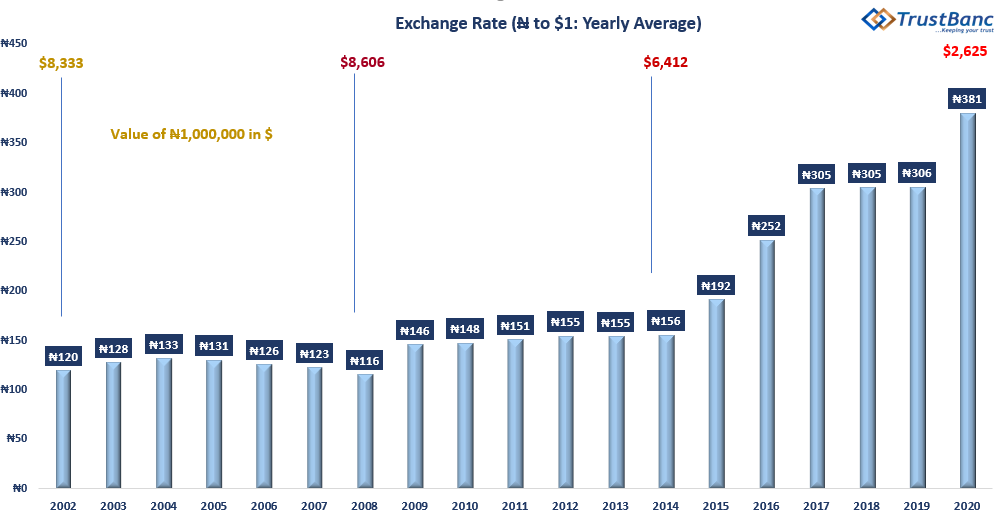
It crawled from 12.13% in January to 12.26% in March, jumped from 12.34% in April to 12.56% in June, inflation is gaining momentum, beware. Four months into the first wave of Covid-19 storm and the Naira has already lost 19.71% of its value.

Earning in Naira is a daily hustle, preserving your earnings in Naira is a day and night struggle. Welcome to This Week in The Capital Market.
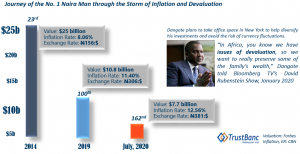
Over time, inflation and devaluation reduce the value of your savings, this isn’t the time to save, you need investments with decent returns and a financial adviser to weather through this Covid-19 economic storm.

Earnings season is here: brace-up for heavy bites from Covid-19

Earnings season is the period of time during which the majority of publicly-traded companies listed on the Nigerian Stock Exchange (NSE) release their quarterly earnings reports. Typically, earnings season begins one or two weeks after the last month of each quarter.

This season is particularly important as companies’ financial data will provide insights on the impact of coronavirus on the economy. Earnings reports do not just tell stories about the performance of companies, they can also be used to measure the economic pulse of the country, sector by sector.

This week, we saw the first major earnings release – the half-year financial performance of United Capital Plc. It gave us a first glimpse of what the earnings season will look like for Banks and other Non-Bank Financial Institutions.

The Story: a decline in profitability as a result of huge impairments from Non-performing Loans (NPLs). NPLs from companies that have been heavily battered by the prolonged total economic shutdown.
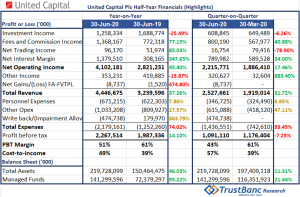
Impairment allowance grew by over 373% in three months. N474 million impairment allowance is about 19% of the company’s total revenue. This pushed down profit before tax by 7.25% and PBT margin declined by 18% percentage points quarter on quarter.

However, the year to date performance of the company was strong enough to grow PBT by 14.10% despite the impairment allowance. This is a decent performance

We expect huge impairment from the financials of Banks too but the profitability of majority of these Banks are resilient enough to absorb this first wave of impairments.

The likes of GTB are well capitalised and enjoy good profitability, which combined, provide a decent buffer to withstand expected asset quality deterioration and looming impairments. In addition, these banks maintain a cheap deposit-based funding profile.

The strengths mentioned above are balanced against Nigeria’s uncommon operating environment which is worsened by depressed oil prices, depleting reserves and the coronavirus pandemic.

The financial result of Airtel will be out on 24th July, if you believe they are one of the biggest beneficiaries of this pandemic, get their shares before the result is out.

Global Standing Instruction (GSI): the days of serial and habitual debtors are numbered

On 13th July 2020, the Central Bank of Nigeria (CBN) issued the Global Standing Instruction (GSI) for various eligible individual accounts such as savings, current and domiciliary accounts. The GSI will also cover joint accounts, investment/deposit accounts and electronic wallets.

The GSI will serve as a last resort by a creditor bank, without recourse to the borrower, to recover past-due obligations from a defaulting Borrower through a direct set-off from deposits/investments held in the Borrower’s qualifying bank accounts with participating financial institutions.

The GSI is expected to:

1. Facilitate an improved credit repayment culture;

2. Reduce Non-Performing Loans (NPLs) in the banking industry; and

3. Watch-listing consistent loan defaulters

This is a significant move by the apex bank, our concern is the impact of GSI on NPL portfolios since it will only apply to individual accounts – these accounts constitute only about 10% of the loan portfolios of the banking industry.

Regardless, any guideline that will improve the access of decent Borrowers to loans and reduce NPLs in the banking industry is a positive step in the right direction and we are all for it.

Have a great week ahead.


This week in the capital market provides a cocktail of information, education and insights on how you can take advantage of investment and funding opportunities to grow your wealth.

Leave your questions and comments below. If you need private financial advisory, send your enquiries to azeez.lawal@trustbancgroup.com or call 08028379367. Advisory is free.

Tekedia Mini-MBA 3rd edition Registration

0

Early bird registrations end tomorrow. You can still register after Monday but the special benefits would not be there. Self-paced, 100% online, 4 months and goes for $140 or N50k. Innovate, execute and grow. Join Tekedia Mini-MBA edition 3 (Aug 10 – Dec 3) and experience excellence, from our glocal faculty; register here 

https://www.tekedia.com/mini-mba-3/


Twitter Hack Puts Social Media Platforms on Spotlight As US Election Nears

0
Twitter CEO

After the hack targeting high profile people on Twitter earlier in the week, social media platforms have come to be in the spotlight.

Hackers gained access to accounts belonging to former US president, Barack Obama, Jeff Bezos, Elon Musk, Kanye West and four others, in what seemed to be a Bitcoin scam. The hackers used the accounts to solicit Bitcoins from thousands of Twitter users, and allegedly gained over $100,000 worth in less than 30 minutes.

“I am giving back to my community due to Covid-19! All Bitcoin sent to my address below will be sent back doubled. If you send $1,000, I will send back $2,000! Only doing this for the next 30 minutes! Enjoy.,” Obama’s account tweeted

The incident left millions of social media users in shock, given that the access has been gained internally. Twitter said in response to the attack, that the hackers somehow succeeded to access some administrative privileges.

“We detected what we believe to be a co-ordinated social-engineering attack by people who successfully targeted some of our employees with access to internal systems and tools,” Twitter said.

This level of security breach comes with enormous consequences that reach beyond social media. Twitter has become a choice platform for powerful people in politics and business. The influence of many users of the app has a significant impact on how political and business world fares.

Twitter stock went down Wednesday, losing $1.3 billion in market value following the incident. But that’s not where the major concern lies; the political implication wields heavier consequences.

On Thursday the FBI launched an investigation into the matter as questions from governments around the world poured in. The Bureau, like many others, believes there is more to the hack than bitcoin scam, and urged everyone to be vigilant.

The US Senate Commerce committee has demanded Twitter brief it about the incident by July 23. The UK’s National Cyber Security Center has also reached out to Twitter and urged users to treat requests for money and sensitive information on social media with extreme caution.

“We are aware of a cyber attack on Twitter and have reached out to the company.

“While this appears to be an attack on the company rather than individual users, we would urge people to treat requests for money or sensitive information on social media with extreme caution,” it said in a statement.

Senator Roger Wicker, chair of the Senate Commerce committee wrote to Twitter expressing concern over the development.

“It cannot be overstated how troubling this incident is, both in its effects and in the apparent failure of Twitter’s internal controls to prevent it,” he said.

Twitter said on Thursday that more than 130 accounts were targeted in the attack, and subsequent findings revealed that hackers were able to initiate password reset for 45 of those accounts. The firm said it is working with the owners of the impacted accounts to determine “whether non-public data related to these accounts were compromised.”

The social media platform has been working with the FBI to determine further intent. On Saturday, it confirmed that there was more than a Bitcoin scam.

“For up to eight of the Twitter accounts involved, the attackers took the additional step of downloading the account’s information through our “Your Twitter Data” tool.”

Twitter said the investigation is still ongoing. But with the establishment of information download from users’ accounts, it is becoming clear that the objective of the hackers goes beyond Bitcoin.

With the US election coming in November, the concern is growing there could be a repetition of the 2016 alleged interference by Russia. Social media platforms have been at the center of controversies concerning political misinformation, as it is believed to be a tactic usually deployed by external forces to influence the elections.

Though the Twitter account of Donald Trump was not compromised the sophistication of the security breach exposes how vulnerable the social media platforms are, and how easily they can be used to manipulate people.

The usual suspect, Russia, has been fingered. It is believed that the hack could be a test-run of a major attack to compromise the US elections.

“We already know Russia is planning to meddle in the 2020 election just as they did in the 2016 election,” said Dr. Heather Williams, from King’s College London. “Social media manipulation is one of their favorite tools. So this hack shows just how vulnerable social-media platforms are and how vulnerable Americans are to disinformation.

“If something bigger was at stake, such as the presidency, this could have really disastrous consequences and undermine our democratic process.”

It is not yet known if sensitive information is downloaded by the hackers, but the hack has brought the ability of social media platforms to protect users’ privacy into serious questions.

Dr. Drew who recently co-authored a paper warning about the possibility of Twitter being used for disinformation said the platform has not done enough to protect users.

“Social media companies such as Twitter and Facebook all have a duty to consider the damage and influence their platforms can have on the 2020 election. Twitter actually has a good history of being forward-thinking and proactive in this space. But whatever the source of this attack [it seems they have] still not done enough,” she said.

On the other hand, social media platforms have a reputation that could be marred by what happens to the privacy of users. William Dixon, World Economic Forum cyber lead said of the hack: “Twitter reputation is the cost of this cyber-attack.”

Nehemiah’s Project Management X Factor and Timber from the King’s Forest

7
Timber from the King’s Forest

His ancestors had dedicated a Temple around 10th century BC to Yahweh. But Nebuchadnezzar II destroyed it around 587 BC during the siege of Jerusalem, by Babylon. It had taken many years to build that Temple.

He grew up, and rose to become one of the most important men in Persia (in modern Iran): a cup-bearer to Artaxerxes, king of Persia, and later, the king made him a governor of Persian Judea. To rebuild the Jerusalem wall, the king gave his permission to use timber from the king’s forest. In the imperial Persia, which had conquered Babylon, commanding the territories with military and economic powers, the king’s timber went with the king’s builders and security.  The wall was rebuilt within 52 days.

Yes, Nehemiah rebuilt the city wall circa 408 BC – the very one that stood in Jerusalem during the time of Christ. Later, Roman Generals Titus and Vespasian destroyed the Temple in the city during the siege of AD 67 -70.

I am yet to read of any man that understands foreign policy, diplomacy and large project management better than Nehemiah. In this piece, I explain thus:

If Nehemiah had used any timber that was different from timber from the king’s forest, he would have failed. Understanding the situation in the region, and asking for the king’s timber was the reason he executed within 52 days. You must have the capabilities to decipher the most important component to have a successful project. And you must make sure you have that component.

Simply, any project that received timber supplies from the king’s forest was as good as executed. And only the most important projects qualified. As the aides shipped the timber, the guards would follow, making sure that none was wasted. Another set of guards would monitor compliance.

When I teach in Christian masterclass, I have called this The Nehemiah Xfactor on Project Management. It simply implies: know the most important resource to ensure that a project succeeds. For Nehemiah, it was to get the timber from the king’s forest. I enjoyed the Quality & Asset Management lecture by Tekedia Mini-MBA faculty, Michael Odigie.  In his Tekedia Live session, he used the word “critical” many times, as he explained reliability, quality, project execution, etc. You must understand the “criticality” of the components in your project map.

X Factor – a variable in a given situation that could have the most significant impact on the outcome.

Finish this piece here.

The Timber from the King’s Forest

Good People, I quote Adam Smith, Peter Drucker , Steve Jobs, Buhari, etc. But as a Scripture Union kid, Sunday school in college, and a teacher in the Church, I quote the Bible more often. I get more management insights from the Bible than any document out there. Take this as a nice case study on how to lead and manage projects, even though the reference is the Bible. Have a great Sunday.

Barcelona Housing Laws, A Model for Abuja Empty Houses

1

In Barcelona, Spain, the authorities are forcing landlords to fill empty houses with occupants or watch them taken by the government as public housing to lower-income tenants.

The city’s housing department has written to 14 companies that collectively own 194 empty apartments, warning that if they fail to find tenants next month, the city will take possession of their properties, and compensate them with half of their value.

The warning also said that the companies could be fined between €90,000 and €900,000 ($103,000 and $1,003,000) according to local media.

In the Catalonia region of the country, a 2016 law empowers the municipalities to take control of properties abandoned for more than two years. The law gave the cities the right to rent out the properties for a period of four to ten years before returning them to the control of the owners.

In 2019, Barcelona approved a legal tool that empowers the city to purchase the properties at half the market price. The aim is to curtail the crisis in the region’s housing sector.

Bloomberg reported that Spain’s dwindling property market is forcing the country to take drastic measures. The empty houses menace is attributed to the country’s 2007 to 2008 financial crisis that depleted every sector of the economy. As the market struggles to bounce back, homeowners are waiting for the market to revive.

Many housing units were repossessed by banks that think of them as assets to be managed rather than essential public resources. Reports said it has resulted in a high rate of empty houses and neglected properties in the city. Adding to the menace, the abandoned homes have become Narcopisos (Narco-flats), where drug dealers and users trade and consume narcotics.

According to Bloomberg, Barcelona has been devising on how to solve the problem for a while. The tools deployed by the city include levying heavy fines for vacant units, while some empty vacation rentals have also been used as emergency housing during the pandemic.

The new approach is quite wider than others previously used. All properties up for potential expropriation belong to owners with multiple with multiple units.

But a house could only be eligible for forced purchase if it has stayed as long as two years without record of utilities use. Occasionally used houses are exempt.

The city housing commissioner, Lucia Martin said the aim is not to pressure landlords into renting their own units.

“We are not here to expropriate. What we want is for apartments to be rented. If the answer is no, we will open the file and they will go to expand the city’s public housing sector,” she told the local newspaper 20 minutos.

The city is seeking stiffer penalties for abandoned houses. The enforcement is seeking to persuade the Catalonian authorities to expand the program by narrowing the time period of forced sale from two years to six months.

But many house owners are voluntarily handing over their houses to the city. Spain’s national bank SAREB, reportedly handed over rights to rent out 256 squatted apartments they own to the city this week. Just so, they could be rented and the drug dealers and users could be pushed away.

In many other countries in the world, the housing situation is opposite of what is obtained in Catalonia. Though there are still empty houses even though the demand is high.

In the capital city of Nigeria, Abuja, there are over 600 abandoned houses rotting away when there is a huge deficit in the country. Nigeria has 22 million housing deficit, and Abuja contributes 1.7 million to that gap.

The situation has been attributed to many factors ranging from corruption to the cost of rent. Acting Managing Director, Abuja Property Development Company (APDC), Lawal Aliyu Magaji told Guardian earlier in the year that lack of an effective tax system among other things has contributed to this.

“If we have a good property tax system where those houses are being taxed, people would not continue to keep houses unoccupied. When the owners are being taxed for houses they built which is not fetching them any profit, they would have a rethink,” he said.

He added that the unoccupied houses were built by those who have no interest in “getting any income from them,” which poses a morality question. In a city where there is a 1.7 million housing deficit, should over 600 houses be unoccupied?

The call to get occupants into Abuja empty houses have been ringing for long, and the Nigerian government’s plan to use a tax regime to effect it seems far-fetched. The Catalonia housing laws therefore, present a model that the federal government can borrow to solve the Abuja unoccupied houses problem.