DD
MM
YYYY

PAGES

DD
MM
YYYY

spot_img

PAGES

Home Blog Page 6252

Nigeria’s Facilities Management Industry to Register 6.4% CAGR with $12.7 billion Worth in 2027

0

A new market report has indicated that the Facilities Management industry in Nigeria is expected to have a compound annual growth rate of 6.4% from this year till 2027. The report shows that the market value of the industry during the year (2027) will be $12.7 billion. Examining the value, our analyst discovered that the industry will have $1.8 billion as average value from 2020 to 2027.

From the analysis carried out by the producer of the report, it is obvious that the commercial segment of the industry is likely to generate about three-fourths share during the forecast period. The current prediction is not quite different from what has been predicted by our analyst through qualitative understanding of the industry. For instance, for years, the key players in the industry have largely focused on industrial and commercial users of FM solutions, especially in Lagos, Port-Harcourt, Abuja and other big cities at the expense of residential places.

“On the other hand, growth in investments and incentives by the government for the construction industry and infrastructure sector is anticipated to offer remunerative opportunities for market growth. Further, an increase in investments in commercial infrastructure is expected to create the need for effective facility management solutions such as security, cleaning, and catering.

By application, the commercial segment dominated the Nigerian facility management services market in 2019 and is projected to grow at a CAGR 6.6% during the forecast period. By service, the property segment led the Nigerian facility management services market in 2019,” Notes to the report reveal.

The report wants players and professionals in the industry to have the right strategies and tactics for effective mitigation and elimination of the Covid-19 impacts. According to the report, uncertain micro and macroeconomic policies of the current government would hamper the growth of the industry.

“The novel coronavirus has undesirably affected a variety of facility management services, which include catering, security, plumbing, and electrical amongst others in the building industry. The adverse trends in the Nigerian economy is projected to worsen the growth of the Nigeria facility management services industry. Additionally, travel bans due to lockdown and absence of workforce have also influenced the demand for facility management services in Nigeria.”
The Wisdom from Netflix

1
From a CNN article:
The company mentioned WarnerMedia, Disney and NBCUniversal, which have launched HBO Max, Disney+ and Peacock, respectively. Netflix even gave a shout out to short-form video app, TikTok, calling its growth “astounding.” Warner Media is owned by AT&T and is the parent company of CNN.
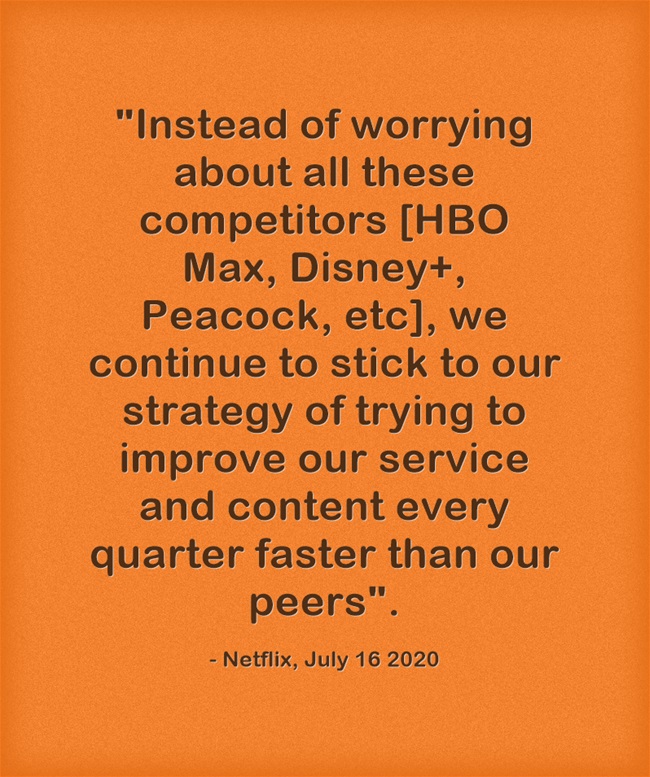
“Instead of worrying about all these competitors, we continue to stick to our strategy of trying to improve our service and content every quarter faster than our peers,” Netflix said on Thursday. “Our continued strong growth is a testament to this approach and the size of the entertainment market.”

Yes, that is it – Netflix said it all. Indeed, poor execution destroys more startups than competition. That is why after they are gone, the market frictions remain unfixed. Spend more time thinking of your execution than worrying about competition which may not really matter in inventive but NON innovation societies.

The Problems With Inventive Societies [Video]

Recording of Tekedia Live of July 16, Schedule for July 17 Session Posted

0

This is the recorded Tekedia Live for July 16. Four faculty from TAFFDS, Georgia USA led the session. Tomorrow (Friday, July 17), Tekedia Institute Quality & Asset Management Faculty, Michael Odigie, will lead a session at 7pm Lagos. These sessions are optional to learners. We provide them to help those who may have questions.

For members, go to the Week 4 board for Zoom link https://www.tekedia.com/2week4/ . For non-members, join us here via YouTube Live https://www.tekedia.com/live/.

https://www.youtube.com/watch?v=yH-llWZds_I&feature=em-lsb-owner

Google’s $4.5 Billion Investment in Reliance Jio, and the Potential of India’s Telecom Industry

0
Google-Headquarters
Google-Headquarters

A day after Qualcomm invested $97 million in Reliance Jio, Google joined the ranks of other high profile firms to back the Indian company. The search giant is investing $4.5 billion for a 7.73% stake in the leading Indian telecom.

Google became the latest Silicon Valley company to grace the Indian telecom industry that is rapidly growing. Facebook is backing Reliance Jio with $5.7 billion for a 9.99% stakes. This marks the first time Google and Facebook are throwing their financial weight behind the same company.

Reliance Jio has in a period of four years, become the most valuable company in India, amassing over 400 million subscribers to beat its competitors.

Google’s investment in Jio puts its valuation at $58 billion. The two companies are working on a customized-version of Android operating system to develop low-cost, entry-level smartphones to serve hundreds of millions unserved in India.

Reliance Jio’s owner Ambani said the deal is to develop smartphones that will support Google Play and future wireless standard 5G.

Google has on Monday, rolled $10 billion for digital infrastructure in India, as part of Google’s India’s mission. Google’s CEO, Sundar Pichai said the aim of Jio’s partnership is to put smartphones at the hands of more Indians.

“Getting technology into the hands of more people is a big part of Google’s mission. Together we are excited to rethink, from the ground up, how millions of users in India can become owners off smartphones. This effort will unlock new opportunities, further power the vibrant ecosystem of applications and push innovation to drive growth for the new Indian economy,” he said.

Google’s recent interest in India depicts how the rest of the world sees the Asian country at the wake of trade conflict between the US and China that is jeopardizing business interest for many companies. More companies are seeing India as an alternate destination to China, and companies of Indian origin are positioning themselves to take advantage of the situation.

Jio, which already has a variety of services on its platform is keen on using this opportunity to widen its digital capacity in India, and thus cement its dominance.

“Jio, for its part, has made an extraordinary contribution to India’s technological progress over the past decade. Its investment to expand telecommunications infrastructure, low-cost phones and affordable internet have changed the way its hundreds of millions of subscribers find news and information, communicate with one another, use services and run businesses,” said Pichai, he added that “today, Jio is increasing its focus on the development of areas like digital services, education, healthcare and entertainment that can support economic growth and social inclusion at a critical time in the country’s history.”

Jio Platforms have raised about $20.2 billion in the past four months from 13 investors, selling 33% stake in the firm. India has become a top choice to investors. Indian startup ecosystem raised $14.5 billion in 2019, and with a booming demographic for digital innovation, it is set to attract more investors as political and economic factors are pushing the tides to its advantage.

China dominates Indian smartphone market, with Alibaba and Tencent as the major investors. The recent border conflict between China and India seems to have opened an opportunity for India to put its indigenous companies ahead.

Smartphones made in China are expensive for Indians, making it difficult for many for many to own smartphones. The Google and Jio partnership will produce affordable phones that will bridge the gap of the unserved and underserved.

India has a huge population of 700 million phone users, but it also means there is still huge potential for growth. There are over 300 million people who are yet to own smartphones. The gap appears to be attracting investors who are willing to commit more money to India.

The more people own smartphones, the more digital opportunity there is in India. From ecommerce to fintech to social media, investors see untapped mines.

“One of the exciting success stories has been the digitization of small businesses. Just four years ago, only one-third of all small businesses in India had an online presence. Today, 26 million SMBs are now discoverable on Search and Maps, driving connections with more than 150 million users every month.

“What’s more, small merchants across the country are now equipped to accept digital payments. This has made it possible for more small businesses to become part of the formal economy, and it improves their access to credit,” said Pichai.

Nigeria Goes Gold

3

Nigeria goes gold – crude oil is running wild these days. So, let us go all the way, and seek alpha from aurum. But do not open your bottle of zobo for celebration, gold will not save Nigeria. Nigeria’s problem is not lack of money but lack of vision. Go to Osogbo, Kano, Owerri, Jos, Yobe and Uyo, and ask anyone where Nigeria is going, you would be surprised that no one knows. Oh thou gracious heaven, the sun rises and sets!

But during the effervescence of the spark of leadership – the days of Sam Mbakwe, Lateef Jakande, etc – the citizens knew where the governments were taking them. Mbakwe would wake up, address Imolites and remind them that from tomorrow, they would receive slips to make donations to the state government, for a new palm plantation, power station etc. He would remind school kids to ask their parents for money to help build poultry farms, etc. Everyone knew that Jakande was for universal education irrespective of your abode in Lagos state.

Today, raise your hand if you know where your state or federal government is taking you in Nigeria? We are sure of one thing in Nigeria: the sun will rise and set. Any other thing is siddon-look. Mining gold will not change that. Nigeria needs to build mines of knowledge.

Nigeria has produced, for the first time ever, in June 2020, artisanally-mined gold that has been processed and refined according to the London Bullion Market Association (LBMA) standards required for the use of gold as a reserve instrument by the Central Bank of Nigeria.

This means that the Central Bank will be purchasing gold that has been mined, processed and refined under the Presidential Artisanal Gold Mining Development Initiative for use as part of Nigeria’s external reserves.

The first batch of artisanally-mined gold bars to be purchased by the Central Bank will be unveiled at a presentation ceremony to President Buhari in July 2020. This milestone is a demonstration of President Muhammadu Buhari’s commitment to diversifying Nigeria’s economy and foreign reserves.

This milestone is the culmination of 24 months of intense efforts between the Solid Minerals Development Fund, Kebbi and Osun States Government, Ministry of Mines and Steel Development, and the Ministry of Finance, Budget, and National Planning under a Steering Committee led by the Chief of Staff to the President, Professor Ibrahim Gambari.

Mines of Knowledge