DD
MM
YYYY

PAGES

DD
MM
YYYY

spot_img

PAGES

Home Blog Page 6259

OPEN LETTER: How Eduwalt Concierge, an agency facilitating Students’ movement to Canada, collected N200,000 without providing agreed Service

2

When getting the needed education at secondary and tertiary levels becomes difficult, parents and guardians and individuals consider countries where the expected education could be provided. However, most admission seekers and their parents usually consider educational consultants. As news reports indicate in the last few years, many people have been duped by agents or consultants. For instance, in 2018, a news report has it that a travel consultant issues fake Canadian admission letters to 22 students.

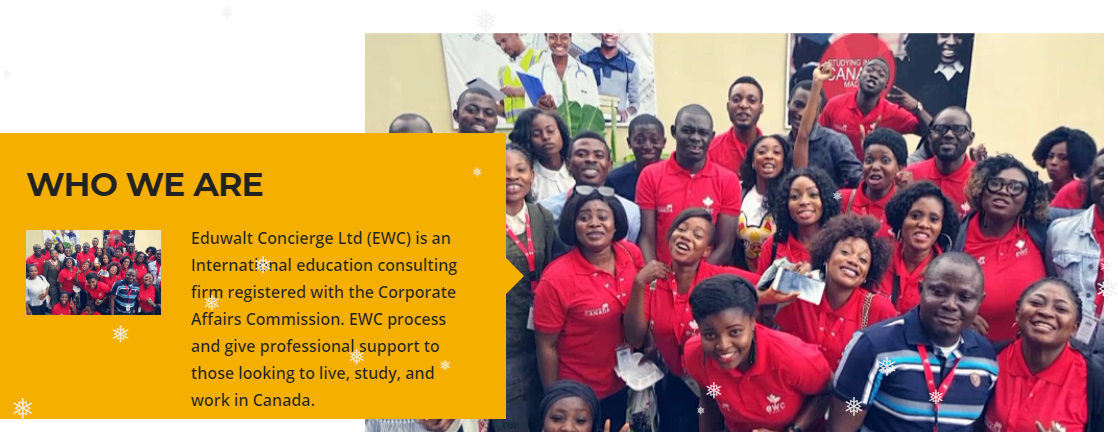
The story of Adetula Segun Augustine is not quite different from the 22 students. In 2019, in his efforts of seeking further education in Canada, he approached Eduwalt Concierge at its Ibadan branch for the facilitation of his movement to Canada. The company collected N200,000 as professional fees, which was paid immediately into the company’s account details. For more than four months, the company repeatedly notified him that his admission has not been successful.

“I got to know about the company in March, 2019 through their communication materials and I went into a transaction with them on June 26, 2019. After the engagement at their office located at 12th Floor, Cocoa House, Ibadan, I was told that the visa processing would be concluded within two months. But, to my surprise nothing was forthcoming and this made me to get worried. I started asking for what exactly was the issue.”

Segun informed that it was later clear that the company relocated to another place after efforts to get them at Cocoa House. “I went to their office sometimes in October, 2019 and was told they have left to another location without informing their clients. I later tried to locate them to Opposite First Bank Polytechnic Road, Eleyele, Ibadan, through one of their staff. When I got there, I met them with another name (SNOWFOX). They apologized to me about the sudden change of office location and promised my admission and visa would be ready by the end of November, 2019. When nothing was forthcoming, on January 27, 2020, I sought for refund of N200,000 I paid into their Zenith Bank Account (Eduwalt Concierge Limited; 10151725216). Till this day (9/7/2020), I am yet to get my refund. All entreaties to get the refund has proved abortive. The known employees of the company keep referring me to the Head Office in Lagos, located at Lekki.”

Segun wants the Federal Complaint and Consumer Protection Commission and relevant anti-crime agencies to help locate the underlisted employees and intervene in the matter.

  1. Mr Fred Ojemaye, Managing Director, Lagos (08143746550)
  2. Mr Spencer, Branch Manager, Ibadan (08036315905)
  3. Francis, General Manager, Lagos (08165209698)
  4. Office Mobile Number (+2347002225222)

Supporting Evidence

If Netflix, Amazon Prime Outbids MultiChoice (DStv, GOtv) for Live Football in Africa, DStv Will Fade

11

Samuel Nwite examines how MultiChoice and Netflix companies are battling for Africa.

Two years after Netflix was launched in Africa, in 2016, it gained around 400,000 users, mostly in South Africa, MultiChoice’s country of origin. And to instill more fear in MultiChoice, Netflix announced a budget of $8 billion for original contents targeting the African region among other places. Showmax Pro will hopefully keep MultiChoice subscribers within its ecosystem by inserting sports in the digital product.

“Provided that happens, a double play of holding off Netflix online while giving DStv set boxes room to grow offline may materialize. Provided MultiChoice controls live sports, Africans may not have no choice, and that means subscribing to both Netflix and Showmax Pro/DStv at the same time, as the products are not clear substitutes to each other.

My prediction is this: Netflix will bid for live sports rights for its African operations when that opportunity becomes available. The streaming business in Africa will be won with live sports and since it has a $8 billion content budget, dropping say $300 million for Africa operations seems balanced. That is the biggest threat ahead for MultiChoice. If it loses control of live sports, in Africa, it would fade in relevance.

With Naspers out of the picture, DStv faces the biggest threat in years as Netflix can decide to inflict wounds  by going to Europe with a bigger purse for football TV rights. (MultiChoice, now outside Naspers – Africa’s largest firm by market cap-, does not have the enormous capital to battle for TV rights as before.) Also, do not count Amazon Prime out.  Amazon already streams live sports in its ecosystems, and can create a product for Africa. If DStv does not have European football, it is game over for MultiChoice.

Fighting Corruption in Nigeria: Questions of Trust and Confidence

0

When people and organisations have the course to discuss corruption in Africa, Nigeria always comes into mind as one of the countries on the continent with systemic economic and political corruption. This issue has been linked with the several years of maladministration by the military and democratic governments. In 2000 and 2003, the administration of former President Olusegun Obasanjo created the Independent Corrupt Practices and Other Related Offences Commission and the Economic and Financial Crimes Commission for the purpose of fighting socioeconomic and political corruption.

For 20 years of the ICPC and 17 years of the EFCC, there have been obstacles and successes on the road to get rid of the corruption in the public and private sectors. In some cases, the two agencies’ activities and functionality have been obstructed because of the limited political will, insufficient structures such as personnel, finance among others, and insufficient judiciary. Like his predecessors, during the electioneering campaign, President Muhammadu Buhari promised Nigerians and the international community that he would stamp out corruption from the country. Since 2015, some observers and citizens believe that he has not lived up to expectations. This view has largely been driven by the poor rankings on Corruption Perception Index since 2015.

Apart from the systemic structural and legal issues impeding the two agencies’ activities, leadership problem has continued to impact the war against corruption as the country keeps changing chairmen. From Malam Nuhu Ribadu to Farida Waziri and Ibrahim Lamorde to Ibrahim Magu, the EFCC has not has so good in terms of leader who is free of issues while steering leadership of the agency. Some days ago, several reports had it that Ibrahim Magu has been suspended from office as the acting chairman of the agency after some hours of interrogation by Presidential Panel.

Issues at hands

With the leadership instability at the agency, our analyst believes that many issues need to be addressed if Nigeria is really serious about fighting corruption in the private and public sectors. Now, it is obvious that President needs to address leadership problem at the agency. This is necessary because citizens and the international community are doubting President’s ability and capability to eliminate corruption as he promised. For instance, a recent study indicates that Nigerian Netizens described incompetence, dishonesty and confusion that undermine the anticorruption measures poignantly. President in collaboration with the National Assembly needs to exhibit the needed political will towards addressing systemic issues in the country’s criminal justice, making the EFCC’s execution of activities in line with the constitutional provision impossible. This will increase public confidence in the war against corruption and level of trust in the government’s ability and capability towards total eradication of the scourge.

Exhibit 1: Trusting Political leaders (n=1,600 Nigerians)

Source: Afrobarometer, 2019

What is at stake?

With the examination of 20 allegations levelled against the suspended acting chairman of the agency, it is clear that Nigeria has many things at stake. A total of 16 of the allegations was found to be associated with processes for executing expected mandates of the agency and documentation purposes required of an establishment created for the elimination of corruption. More than 10 of the allegations signify severe threats to the war against corruption.

Exhibit 2: Issues in Magu’s Select Allegations and Their Threat to War Against Corruption

Source: Vanguard, 2020; Infoprations Analysis, 2020

MultiChoice Goes Double Play, Launches Showmax Pro for Live TV Streaming

1

MultiChoice has launched a new service called Showmax Pro, a streaming service designed to serve on-demand streaming and live TV. The platform has been on the pipeline since June last year as part of efforts by MultiChoice to challenge the presence of Netflix in Nigeria and exert dominance in Sub-Saharan Africa.

The company rolled out the streaming platform in Nigeria and Kenya on Tuesday, and said it will subsequently get to other countries in four to eight weeks.

“This is the biggest thing we’ve done at Showmax in the five years since we first launched. Africa is an incredibly diverse continent, so offering a single monolithic product may not be the best solution. Our approach is to standardize where we can and tailor where we need to,” Niclas Ekdahl, CEO of the Connected Video division of MultiChoice, told Forbes contributor Toby Shapshak.

“That’s why you’ll see different local content on Showmax in Nigeria than you will in Kenya, and South Africa’s content is different again.”

Over the past one year, Ekdahl and his team had worked to localize the contents and price of the Showmax platform according to country. In Nigeria, full Showmax Pro costs $16.25 (N6,300) and $8.26 (N32,00) for Showmax Pro Mobile. In Kenya, Showmax Pro and Showmax Pro Mobile will sell for $19.68 (Ksh 2,100) and $9.84 (Ksh 1,050) respectively.

“Payment methods and partnership have to be localized, but meanwhile the need for a mobile-only option and the desire for great international sporting content is universal,” Ekdahl said.

This is coming a few days after the news that DStv is considering dropping the purchase of EPL and Champions League rights in Nigeria. The packages on the Showmax platform include live football matches from the English Premier League, Italian Serie A, the Spanish La Liga and South Africa’s Premier Soccer League among other sports events.

Since 2014, MultiChoice has been pushing to create a profitable presence in the streaming industry. It launched Showmax in 2015 in a bid to foster the growth of its streaming services. But it was stalled by a lot of factors that included the use of mobile phone and broadband services which were low in quality compared to the capacity needed to sustain streaming services.

This among other factors discouraged MultiChoice from pursuing its goals on streaming. But in 2016, when Netflix showed up, MultiChoice knew it had to up its game on the streaming line or get eaten up by the US company.

Two years after Netflix was launched in Africa, in 2016, it gained around 400,000 users, mostly in South Africa, MultiChoice’s country of origin. And to instill more fear in MultiChoice, Netflix announced a budget of $8 billion for original contents targeting the African region among other places. Showmax Pro will hopefully keep MultiChoice subscribers within its ecosystem by inserting sports in the digital product. Provided that happens, a double play of holding off Netflix online while giving DStv set boxes room to grow offline may materialize. Provided MultiChoice controls live sports, Africans may not have no choice, and that means subscribing to both Netflix and Showmax Pro/DStv at the same time, as the products are not clear substitutes to each other.

Ever since then, Netflix has gone ahead to claim more contents and viewers in the continent. In Nigeria, it has secured exclusive rights to popular Nollywood movies, including Genevieve Nnaji’s Lion Heart.

It was a daring challenge that MultiChoice accepted with unflinching manliness. However, in 2018, MultiChoice’s majority shareholder, Naspers announced it would divest from the company through an IPO which was completed in February 2019. The absence of Naspers introduced a financial vacuum that MultiChoice knew it needed to fill, and it fueled its need to push the streaming services.

MultiChoice has been working to fix the lapses that had stymied the growth of the streaming services, from upgrading the platform from offering on-demand video services to live TV, Multichoice has also addressed the issue of Showmax device friendliness. The company said it has worked on the platform to consume less bandwidth.

“We have been adapting the service for the data connectivity constrains on the continent and focusing on the most-used viewing devices,” the company said.

But these upgrades and efforts aren’t just about competition with Netflix, it is suggesting that MultiChoice may be preparing to stop football services via the DStv in countries where the cost of rights is high. Techcabal noted that DStv is available only in a few African countries, and that limits the number of its viewership.

The DSTV is absent in Francophone Africa where OTT and Canal+ are dominant. But with the internet-based Showmax, there will be no limit to its reach. It appears that Multichoice is catching up with the trend of live streaming that many other companies, including Apple and Amazon have delved into. Though it is going to stir serious competition with Netflix, Showmax’s offers for live games will likely give MultiChoice an edge.

However, it is not clear what this will mean for DStv.

Online Education: Today’s Gift, Tomorrow’s Critical Success Factor

0

In February 2020, the internet community was grieved by the news of the demise of the inventor of the cut, copy and paste commands in computer, Larry Tesler. John Warnock and Charles Geschke (Adobe Reader inventors) are still with us. These computer scientists deserve our respect because of the impact of their works in file management for learning and development. It isn’t enough that a student attends classes to receive lectures, or visits libraries to read the books on shelves; students can copy texts or download resources online via the Internet and save in a word or pdf file for study at a later time. Because a student may have enthusiastically set out to receive a lecture on campus but find his/her mood swinging like a pendulum bob in class till the whole lecture is lost on him/her.

Online learning is not the future of education; it is the present, the gift of today’s education. It can be likened to a delivery service that brings you your order at one’s doorpost instead of one having to visit the physical office of the delivery service provider. It won’t matter how one unboxes the gift—the value of the gift remains the same. The “unboxing” of this gift, of education online or offline, is, unfortunately, what has underscored many arguments about online learning. It is debatable whether the discussion of the validity of an education should be polarized along these two delivery methods, online and offline learning, since learning is not an exclusive activity but is, rather, perfected by a multiple of events. For example, in an offline learning mode of education delivery—as formerly described in the beginning of this essay—where courses are delivered and graded offline towards the award of an academic degree, students are given assignments to take home and bring back at a future date for correction.

Quizzes are sometimes conducted as open-book tests, where students have liberty to use any resource at their disposal to answer the quizzes. Students do leverage the Internet to help them with such work, from browsing quiz topics online to downloading assignment materials for study at their own convenience. How, then, does this differ from quizzes and assignments delivered online? Interestingly, this modus operandi in delivering education is not new; in what was known as correspondence education as far back as in 1840, Isaac Pitman mailed postcards to students and instructed them to transcribe passages from the Bible into shorthand and return them, by post, for correction. The difference between this distance education in the 19th Century and what we now refer to as online learning is simply the Internet.

But because of our peculiar nature as social animals, our proclivities towards forming connections and memories through interactions between ourselves and new environments make us often opt for the traditional, offline physical system of learning where physical presence or structures are found. That is why a fresh secondary school leaver would most likely opt to start freshman year in computer science, for instance, in a tertiary institution far from home than enrol in an online degree programme even though the latter may be more valuable for self-development and in securing great opportunities in the future. Even executives in senior management levels in organizations are not exempt from this popular behaviour; without recourse to the higher cost of offline learning than online learning, they vacate their hot seats in their organizations and travel to a school to spend weeks taking, say, a management course.

Others follow suit sometimes because of the prestige that comes with the evidence (pictures or live videos/presentations with faculty on the school’s campus) of their association with the educational institution. Online education givers have recognized this peculiar behaviour of humans and have devised ways to still bring back this human element in the edu-tech setting. Virtual learning platforms that offer access to networking forums for interactions with fellow students and instructors online and offline have been designed by online education providers to give students the feel of the typical classroom setting. Students can form their own communities online or offline and meet up at a time convenient for them rather than within a strict academic calendar. And they can also visit the learning institutions, if they so desire, to collect their certificates or awards in person. Learning is, thus, an open access education experience centre personalized for remote convenience.

The future of education is not in the offer of an age-long mode of educational delivery (distance learning) but in the acceptance of the same, in the advent of a digital world where nations and the interactions of variables within and around them that give rise to their prosperity are continuously being unconstrained and unbounded by geography. The Fourth Industrial Revolution for the world is predicted to give rise to a job market increasingly segregated into “low-skill/low pay” and high-skill/high-pay” segments, the divide differentiated by the weight of capabilities accumulated by workers. Hence, traditional brick-and-mortar educational institutions — and even those that have evolved correspondingly with the changing education delivery methods — need to reinvent themselves from just being knowledge gatekeepers to becoming knowledge exporters on a large scale by building strategic linkages with a network of online education providers.

And that is the advantage that professional bodies have over academic institutions — that they are able scale to reach many regions of the world via partnerships with educational delivery organizations across the globe. With the penetration of the Internet deepening in emerging economies, knowledge will be further radicalized and explored unapologetically than preserved in the highest esteem. Consequently, any foreign university could consider partnering with  Tekedia Institute to meet the development needs of the workers of the future in Africa who are constantly in a race against time towards achieving the highest productivity using the lowest possible cost. Workers of the future—knowledge workers—and the present, too, in our digital world [would] have their skills constantly and rapidly dislocated by technology, predicating that the appraisal of one’s productivity would most often times than not be satisfied by measuring value added against time. And this increasingly criticality of time as a finite success factor of productivity means online learning as a time-saving, value maximizing method of education delivery is, and will continually remain, a success factor for the growth and development of [today’s and] tomorrow’s knowledge worker.