DD
MM
YYYY

PAGES

DD
MM
YYYY

spot_img

PAGES

Home Blog Page 6268

Tekedia New Certificate Courses; Tekedia Mini-MBA Edition 3 Registration Begins

2

We processed feedback from Edition 1 and members noted they would like to do projects. Accordingly, we have unveiled Certificate courses which are completely capstone-based. Tekedia capstone is a research paper or a case study exploring a topic, market, sector or a company.  You must have attended, begun or about attending Tekedia Mini-MBA to qualify to register. Each certificate course costs $60 or N20,000.

  • CLSM Certificate in Logistics and Supply Chain Management
  • CSBM Certificate in Startup and Small Business Management
  • CETS Certificate in Exponential Technologies and Singularity
  • CPCD Certificate in Personal Career Development
  • CPFM Certificate in Personal Finance & Wealth Management
  • CBIS Certificate in Business Innovation, Growth & Sustainability

Tekedia capstone is a research paper or a case study exploring a topic, market, sector or a company. You will pick a topic which the Institute will approve.Then you will go and execute that project. Think of this as a final year student product in a university. We expect it to last a maximum of 3 months. The member will submit a report at the end of the capstone. For someone who wants to start a business, you may choose a topic to do market study in that sector. You design a questionnaire and execute your study. Essentially, the essence of this is to apply what you have learnt in the Mini-MBA to produce a practical business document. Here, we provide potential capstone topics (the topics are limitless):

  • A digital logistics strategy for Lagos State
  • Market study for website design business in Northern Nigeria
  • The competitiveness positioning of Jumia in African ecommerce
  • The future of fintech in Ghana
  • Implication of AI technologies in African banking
  • My personal career roadmap: 3, 5 and 10 years
  • Building wealth via Treasury Bills
  • Business longevity roadmap for ABC Limited
  • Angel investing market in Kenya
  • A comprehensive business plan with market data for ABC Limited
  • Mobile banking and impact of USSD

For more, visit – https://www.tekedia.com/programs/

Note for Edition 2 members, you can still add a Lab Review to enable Tekedia Institute review your labs. Cost is $30 or N10,000 naira. 

Finally, registration for edition 3 (Aug 10-Dec 3) has started. This edition 3 is the same as edition 2 (June 22-Oct 22); some stakeholders have asked us to run another edition now that the pandemic is stabilizing in most regions. Same $140 or N50,000.

To add/register for these courses, begin here https://www.tekedia.com/pay

Our Nov 2019 Article Predicting OPay Meltdown

0

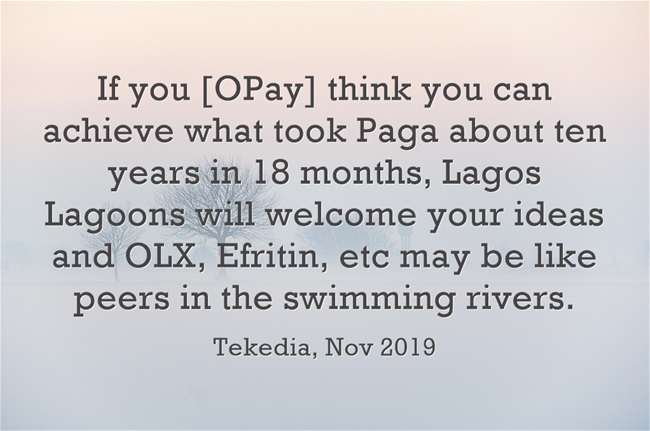
Tekedia accurately predicted the OPay paralysis when we wrote that it had “no future” unless it changed its growth hypothesis. I concluded that piece with this quote, “If you [OPay] think you can achieve what took Paga about ten years in 18 months, Lagos Lagoons will welcome your ideas and OLX, Efritin, etc may be like peers in the swimming rivers.”

OPay has hit Nigeria’s legendary “long” gestation period before a business can turn a profit. Because you are your own electricity board (via your generator), your own waterboard (via your borehole), your own police (via your guards), etc, you have many inefficiencies in the utilization of your factors of production. Unlike in the U.S. or Europe, where your real challenge is growing the business, in Nigeria, you have to deal with orthogonal matters that may trip you the whole day. Yes, the generator man forgot to buy diesel and now there is no light to power the laptops!

People, Nigeria is different; throw away your London, Beijing and New York playbooks.

The OPay’s Massive 1% “Tax” on Nigerians

The U.S. Government’s Purchase of All Available Remdesivir Drug May Have Nationalistic Consequences

1

The move by Trump’s administration to buy up all available remdesivir drug for the United States alone has been widely condemned. Remdesivir is a promising drug for the treatment of COVID-19, which has been on trial for months.

This week, Trump’s administration bought up almost the entire supply of the drug, which means, other countries will not have access to it until maybe the next three or four months.

“President Trump has struck an amazing deal to ensure Americans have access to the first authorized therapeutic for COVID-19. To the extent possible, we want to ensure that any American patient who needs remdesivir can get it,” said the US health and human services secretary, Alex Azar. “The Trump administration is doing everything in our power to learn more about life-saving therapeutics for COVID-19 and secure access to these options for the American people.”

Remdesivir was developed by Gilead Sciences; a California-based pharmaceutical company, being the first to produce an internationally recognized drug, approved by health authorities and effective for the fight against coronavirus. Trump’s move has been seen as a disruption to the global synergy in the battle against the virus, and it is being enforced by his “America first” rhetoric.

“We know Trump was Mr. ‘America first,’ but this is still a deplorable act in the face of a global crisis,” said Michael Smith, University of Aberdeen.

Apart from the “America first” ideology, patent rights that has resulted in monopoly of goods and services, especially when it has such a global impact, has been brought into question. Gilead Sciences put the cost of remdesivir at $3,200 per treatment of six doses, and due to patent, it is the only company that can produce it in developed countries.

“This is what happens when the world relies on a broken system driven by greed and profit during a pandemic,” tweeted Global Justice Now, a UK-based advocacy group.

The director of Global Justice Now, Nick Dearden said the government should override the patent to save the situation.

“Governments have a right to override this ludicrous patent system under international law, and they should take the opportunity to do that now, saving the [National Health Service] and patients around the world from the profiteering of these dysfunctional corporations,” he said.

The situation has alarmed the rest of the world, experts and campaigners said the US’ unilateral action will have wider implications when a vaccine becomes available.

Gilead’s decision to charge $3,200 per privately insured patient has been also condemned by advocacy groups. Public Citizen said it is “offensive” given that more than $70 million taxpayers’ money was thrown into developing the drug.

The US Health and Human Services Department (HHS) said it has secured the entire projected production for the next three months, because its purchase “represents 100 percent of Gilead’s projected production for July (94,200 treatment courses), 90 percent of production in August (174,900 treatment courses), an 90 percent of production in September (232,800 treatment courses), in addition to an allocation for clinical trials.”

This means that, even after September, the rest of the world will not have access to the drug unless the UK and other nations use the only option available. The Guardian reported that the UK and other nations have the choice of purchasing remdesivir through “generic companies in Bangladesh or India, where Gilead’s patent is not recognized.”

Gilead has voluntary license agreements with drug manufacturers in Egypt, India and Pakistan to supply remdesivir to 127 lower-income countries. It is under this agreement that generic production of the drug is permitted but with specified conditions.

Although it is not sure if remdesivir will provide the remedy for COVID-19 as studies during its trial yielded not much significant result from other drugs, Gilead has been asked to relinquish its patent. Advocacy groups said it is not time to think of profit when humanity is at war with a pandemic.

But with the Trump administration’s position on the matter, it appears impossible that any other nation will have access to remdesivir through Gilead. The whole situation seems to have been politicized with Trump desperately looking for a magic wand to turn events around in favor of his reelection. His handling of COVID-19 pandemic has been described as “disastrous” and it has jeopardized his chances at the November election. Trump believes that getting effective drug for the virus will turn things around in his favor.

In mid-March, Trump had reached out to Germany with a billion dollars offer to purchase a coronavirus drug being developed by the firm CureVac only for the United States. Germany responded to the offer saying that “Germany is not for sale.”

The “America first” ideology and the recent political interest have compounded the situation. Other nations are still working on vaccines for the cure of coronavirus. With this move by Trump, the United States may be excluded from the coronavirus global synergy that is supported by the WHO’s COVID-19 Technology Access Pool (C-TAP), if a cure is found outside the US.

Another concern is that it has set a precedent that other nations may follow. Dr. Deborah Gleeson, a senior public health lecturer at La Trobe University in Australia, called the development “outrageous” and “a concerning precedent.”

“It’s quite outrageous that the US government has bought up almost the entire next three months’ supply of remdesivir. It’s a very concerning precedent because if we see the vaccine coming from a US company, we’re likely to see the same type of behavior and hoarding by the US and other developed countries. With a pandemic like COVID-19, the problem won’t be solved until it’s sold for the whole world,” she said.

The MultiChoice (DStv, GOtv) BIGGEST Survival Game in Nigeria

36

As predicted when I wrote that MultiChoice’s DSTV and GoTv could simply abandon European football rights in Nigeria, the satellite TV company is moving in that direction: “DSTV’s parent company is considering not to renew its premiership and UEFA Champions League broadcast rights when they expire”. The deteriorated naira value and the fact that DSTV cannot increase rates even as its raw material price is increasing are reasons noted. If MultiChoice follows that path, and does not renew, Nigerians may now depend on NTA, the national TV station, and the government for this luxury product. 

MultiChoice seems to have been caught up in a difficult situation, the DSTV’s parent company is considering not to renew its premiership and UEFA Champions League broadcast rights when they expire.

ThisDay reported on Thursday that a source from the satellite TV company revealed how financial losses are forcing it to make the difficult decision not to renew for the 2021/22 football season.

The development was attributed to Nigerian business environment that has yielded low patronage, which does not make up for the cost of broadcast rights which the company said is exorbitant. Moreover, the free fall of naira against the dollar is said to have compounded the situation.

ThisDay quoted the source as saying: “It is becoming impossible to maintain many of these sports rights, especially the EPL, for Nigeria. The recent fall of the naira against the dollar has equally not helped matters.

“Rights for the African continent used to be bought singly, but this changed in 2007 when a competitor, backed by the federal government, forced the EPL to excise Nigeria from the rest of Africa. Now, the cost of the rights for Nigeria has risen to almost the same with the rest of the continent put together, while the number of subscribers in Nigeria is only about one quarter of the rest of the continent.”

Once NTA makes it tender to Europeans, it will notice one thing: the cost of this product has been rising: “The cost of English Premier League broadcast rights has risen almost 8% to 9.2 billion pounds ($12 billion) for the next three seasons”. If you make it a direct correlation, it simply means that DStv should be increasing costs by 8% over the next few years. But in Nigeria, even though naira is losing value to the euro or pounds sterling, DStv is expected to freeze its rates. That does not make sense! 

Technically, unless MutiChoice has changed its business charter to non-profit, it has no business in Nigeria. When you add the new muted plan to force it to license its expensive London luxury product to local players, at Umuahia rate, you will understand the outcome. Yes, MultiChoice will abandon Nigeria and will not renew its EPL rights unless Nigeria allows it to increase rates, to compensate for increasing cost of the raw material and naira deterioration.

Hello Kano Pillars & Enyimba! Yes, local sports teams are still there.

The statistic depicts the revenue from the Premier League television broadcasting rights from 1992 to 2019. From 2013 to 2016 the Premier League generated over 3 billion pounds in revenue from its marketing of TV broadcasting rights per year. (source: statista)
Comments from LinkedIn Feed

With (1) rising cost of EPL license, (2) deteriorating value of the naira, (3) government interference in pricing and (4) a detached-from-reality expectation by customers for the company to offer PAYG, it is quite probable that the numbers no longer stack up and the company wants to quit. It may well be that the only option of watching EPL in Nigeria is via streaming on pirate websites and over expensive and sub-optimal connections. Good luck to all the viewers.

MultiChoice’s DSTV Considers Dropping EPL and UEFA Rights in Nigeria As Loss and Pressure Mount from Government

31
DSTv court

MultiChoice seems to have been caught up in a difficult situation, the DSTV’s parent company is considering not to renew its premiership and UEFA Champions League broadcast rights when they expire.

ThisDay reported on Thursday that a source from the satellite TV company revealed how financial losses are forcing it to make the difficult decision not to renew for the 2021/22 football season.

The development was attributed to Nigerian business environment that has yielded low patronage, which does not make up for the cost of broadcast rights which the company said is exorbitant. Moreover, the free fall of naira against the dollar is said to have compounded the situation.

ThisDay quoted the source as saying: “It is becoming impossible to maintain many of these sports rights, especially the EPL, for Nigeria. The recent fall of the naira against the dollar has equally not helped matters.

“Rights for the African continent used to be bought singly, but this changed in 2007 when a competitor, backed by the federal government, forced the EPL to excise Nigeria from the rest of Africa. Now, the cost of the rights for Nigeria has risen to almost the same with the rest of the continent put together, while the number of subscribers in Nigeria is only about one quarter of the rest of the continent.”

Based on this statement, the DSTV has been operating on loss when it comes to football broadcast in Nigeria. The cost of rights for the EPL and UEFA Champions League is about $250 million and €100 million respectively. Paying the huge sum while making less every season has become a burden that MultiChoice needs to shed itself of to stay in business.

Among the factors that have contributed to the loss are the low cost of subscription by Nigerians for EPL and UEFA Champions League matches, and the number of subscribers onboard the football packages. The source said the cost of subscription in Nigeria is below par with other African countries, forcing MultiChoice to consider not renewing the rights for the sake of its survival.

“The cost of subscription in Nigeria continues to lag behind what is paid in the rest of Africa, especially in the face of the falling value of the naira. The company is approaching a situation in which it may be forced to choose between continuing to broadcast the EPL and its business survival,” the source told ThisDay.

While the development has been blamed on the cost of broadcast rights, Nigerian government’s meddlesomeness with the broadcast industry cannot be ignored.

On June 1, DSTV introduced new charges that will reflect the current realities of the situation, but the House of Representatives rejected the move and ordered them to reverse the charges citing COVID-19.

The chairman of the House Ad-hoc Committee on broadcasting, Unyime Idem said the increased charges are unacceptable in the face of COVID-19 pandemic and ordered DSTV to halt every plan they have for increment until further notice.

The Committee also asked the DSTV to implement pay-per-view that Nigerians have been praying for a long time. “We have already made the decision on pay as you go,” Idem told NBC acting chairman Armstrong Idachaba. “We are not here to negotiate; we are only here to inform you of our decision so that you can go and implement it.”

The Committee has been investigating the excesses of the satellite broadcasting company and expressed regret that Nigerians are bitterly complaining about their charges.

“I am sure you must have been hearing of the yearnings of Nigerians for years now, who are the subscribers to these services that they are not happy with the current services they are getting from the providers.

“They have been crying on a daily basis that they are not satisfied with the services they are getting from the providers in terms of high charges, price hike and, most importantly, considering what is obtainable in other countries of the world, that is pay-per-view offer that other countries are giving to their subscribers,” Idem said.

Apart from the issues of charges, the House Committee and the Ministry of Information and Culture have been bent on killing the right of exclusivity in the broadcasting industry. They said it has encouraged monopoly which has favored the DSTV and resulted in the untimely death of many satellite TVs of Nigerian origin that couldn’t compete.

Responding to the Committee’s queries, Idachaba acknowledged what DSTV had said, that Nigerians pay lower than others in other African countries.

Experts have urged the Nigerian government to cease interfering in broadcasting industry business, and allow market forces to determine the growth of the industry.

In less than ten years, three satellite TVS have come and gone in Nigeria: HiTV, TSTV and recently Kwese’. It appears that the DSTV is trying to avoid sharing the same fate.