DD
MM
YYYY

PAGES

DD
MM
YYYY

spot_img

PAGES

Home Blog Page 6272

Trump Drops A Playbook for Nigeria on HND-Degree Dichotomy

3

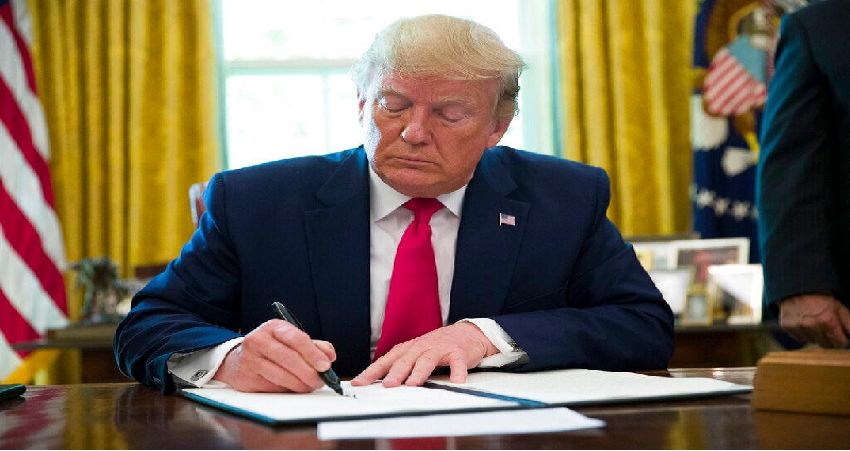
Nigeria needs to learn something from U.S. just as we continue our legendary discrimination of HND graduates against their degree counterparts: what matters is capabilities, not certificates.Yes, President Trump has signed an executive order which makes reliance on college degrees for federal jobs largely muted. Mr. Trump is not saying you should not get degrees. He is simply making it clear that not having one should not be an issue if you have the skills (irrespective of the path taken) to get the job done. Of course, some areas like medicine will require degrees and the associated certifications. But most other things, we can do without those papers.

President Trump signed an executive order that overhauls hiring for federal jobs, prioritizing skills over college degrees. The move doesn’t fully eliminate the college requirement, but stresses skills in positions where having a degree is less important. The administration says the move will lead to a more inclusive workforce. Two-thirds of Americans do not have a college degree. And the federal government is the country’s biggest employer with 2.1 million civilian workers. A CNBC op-ed notes degrees have been given less importance in recent years at major companies, including Apple, IBM, and JPMorgan.

Personally, I recommend that you get degrees if you can. You do hear that stupid line: being a good student does not guarantee you success. Sure, but being a poor one cannot make one an automatic legend, either. So, being a good student does not necessarily hurt.

Getting a degree goes beyond the paper. It is one of the first signs you can set a goal and accomplish it as a young person in Nigeria. To graduate, you learn time management, personal planning, team building, etc. Those things matter more than the actual classroom works.

So, as President Trump signed that document, we need to be sure not to miss his intentions: he is not anti-degree. He simply wants to expand the employment pool bucket  since “two-thirds of Americans do not have a college degree”.

Nigeria needs to focus on capabilities and not papers. And that means removing the discrimination against HND. Trump has provided a playbook on where the world is going to; joining IBM, Apple, etc.

Nigeria Should FOLD All Polytechnics Into Universities

This Week in The Nigerian Capital Market: World Bank and Stock Market Update

0

On the 24th of June, World Bank provided an update on the development of Nigeria, the Bank disclosed that poverty rate is now projected to increase by 2.4%, implying that the number of poor Nigerians would rise by 7.2 million in 2020.

If you are looking for ideas, insights, policies or you just want to get scared, we recommend this report for you. It is for students, unemployed, Founders and Executives. We attempted a summary of the 88-page-long report for you.

Before we read from The World Bank, let’s listen to tunes from the stock market.

Stock Market: A week in Red

After 30 years, Liverpool finally ended their premier league title drought this week. Their arch-rivals, Manchester United, scored their first hattrick in 7 years this week.

In the stock market, it was another kind of red for Investors this week. The Bears stampede the stock market all week until the final trading hour on Friday when Airtel led the charge of the Bulls to lift the market up from red to green.

Note: we use Bear or bearish to describe the equity market when it’s in red or declining. Bull indicates gain or green. See image of the stock market performance below:
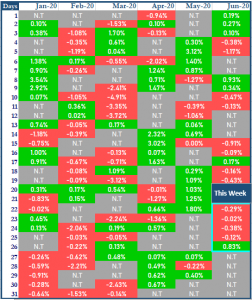
In about 122 trading days year-to-date, the performance of the market has been that of mixed sentiments. This week, sentiments were majorly negative as the market recorded 44 declining stocks compared to just 20 stocks that appreciated. Here is the list of the best and worst-performing stocks for the week.
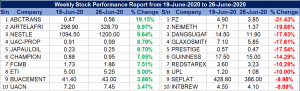
The $0.03 dividend declared by Airtel was the light the Market needed to end a dark week, month and quarter. Next week will usher in a new quarter, the half-year dividend season. Talking about half-year and dividends, we have a buy rating on the shares of GTB, Zenith Bank and UBA.

During the lockdown, we all saved transportation/fueling cost only to see our data cost surge by over 200%. Microsoft Teams replaced our offices while Zoom replaced training centres and meeting zones. If you believe in the new normal, you should believe in the shares of MTN. We have a buy rating on MTN, they will be one of the biggest beneficiaries of Covid-19. In addition, they pay half-year dividend.

Healthcare stocks are interesting too, the CBN has disclosed that they will be supported with intervention funds during this pandemic. GSK, Fidson and Neimeth are stocks to pick in that healthcare basket, but, like the Coronavirus, these stocks are not for weak hearts, they are volatile! If you are averse to risk, it’s better you stay safe.

We like the shares of Presco and Okomuoil too. According to The World Bank, Agriculture is the only sector that is projected to grow in 2020, that sector is somewhat shielded from the effects of lower oil prices.

On a general note, don’t run after prices when the market is in a bearish mode, let prices find you. If you find your stock, don’t rush to commit your funds at once, buy in bits. Most importantly, talk to a stockbroker.

Click on the link https://bit.ly/2XrvIf9 to open a stockbroking/share purchase account and trade within 24 hours. Send your questions to azeez.lawal@trustbancgroup.com.
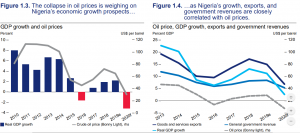
Nigeria Development Update (NDU) by The World Bank

The Nigeria Development Update (NDU) is a World Bank report series produced twice a year. The NDU assesses recent economic and social developments and prospects in Nigeria, and places these in a longer-term and global context. The NDU also provides an in-depth examination of selected economic and policy issues and an analysis of Nigeria’s medium-term development challenges.

Disruption in Flow of Dollars: weakened oil prices, eroding foreign portfolio flows and disruption in foreign remittances

The macroeconomic implications of COVID-19 in 2020 and 2021 will be severe even if Nigeria manages to contain the virus. Nigeria’s economy was still recovering from the 2016 recession when the COVID-19 pandemic emerged in early 2020.

  • The collapse of oil prices is destabilizing Nigeria’s macroeconomic balances.
  • Over the past five years, oil has represented:
    • More than 80% of exports
    • 30% of banking-sector credit, and
    • 50% of general government revenues.
  • A large share of the country’s non-oil industrial and service sectors also relies on foreign-exchange inflows generated by the oil industry.
  • Slump in oil prices reduced government revenue from an already low 8% of GDP in 2019 to a projected 5% in 2020.
  • This sudden drop in revenue comes just when fiscal resources are urgently needed to contain the COVID-19 outbreak and stimulate the economy, creating a financing gap that threatens to destabilize the government’s fiscal position.
  • The pandemic will reduce global remittances to Nigeria, which in 2019 were equivalent to 5.3% of GDP and 40% of oil exports.
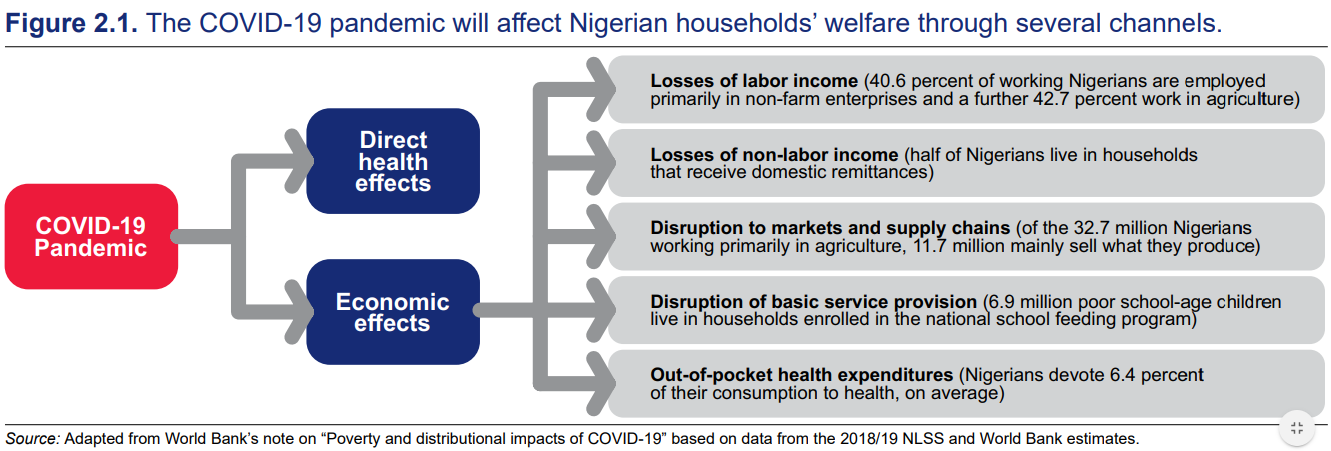
  • The fall in remittances is likely to affect household consumption because half of Nigerians live in remittance-receiving households, of which about a third are poor.
  • Meanwhile, eroding investor sentiment is causing a decline in foreign portfolio flows (volumes were down 46% in the first quarter of 2020), thus compounding the pressure on foreign reserves imposed by the widening current account deficit.
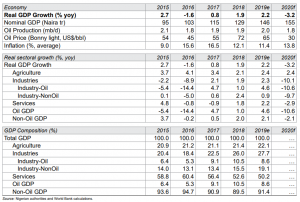
Recession is certain: it can be twice as deep as 2016 and worst in 40 years

The Nigerian economy is expected to contract in 2020 by at least 3%. The projection assumes that oil prices will average $30/bbl, the domestic spread of COVID-19 will be largely contained, and current response policies will continue.

  • In the baseline scenario, the economy would contract by 3.2% this year. This assumes an annual average oil price of $30 a barrel.
  • It also assumes that the spread of COVID-19 eases by the end of the second quarter and is contained in Nigeria by the third quarter of 2020.
  • Unlike the 2015–16 oil shock, when COVID-19 emerged Nigeria’s external vulnerabilities were already heightened. This will make the predicted 2020 recession at least twice as deep as that of 2015–16 and the deepest since the 1980s.
  • In this scenario, real GDP growth would recover gradually and by 2022 would converge with the population growth rate of 2.6%.
Growth is uncertain: unpredictable oil prices and OPEC, severe Covid-19 outbreak

Weakening global demand for oil, compounded by the unpredictable policy decisions of OPEC and other major oil producers, are serious threats to Nigeria’s economic outlook.

  • Unlike the 2015–16 oil shock, when COVID-19 emerged Nigeria’s external vulnerabilities were already heightened. This will make the predicted 2020 recession at least twice as deep as that of 2015–16 and the deepest since the 1980s.
  • In this scenario, real GDP growth would recover gradually and by 2022 would converge with the population growth rate of 2.6%.

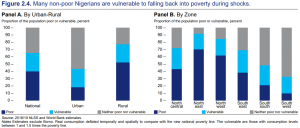
Poverty: COVID-19 shock alone will push an additional 4.9 million Nigerians into poverty this year

The human cost of COVID-19 will be high: beyond the loss of life, as the economy contracts and per capita incomes fall, the pandemic is projected to leave 5 million more Nigerians living in poverty in 2020 relative to the pre-COVID forecast.

  • In 2019, about 83 million people—equivalent to 4 in 10 Nigerians—were already living below the national poverty line, with millions only barely above it, making them vulnerable to falling into poverty when shocks occur.
  • Before COVID-19, the poverty rate was expected to increase by about 0.1 percentage points from 40.1 percent in 2019 to 40.2 percent in 2020, implying that the number of poor Nigerians would rise by 2.3 million, largely due to population growth.
  • However, due to the recession, the poverty rate is now projected to increase by 2.4 percentage points to 42.5 percent in 2020, implying that the number of poor Nigerians would rise by 7.2 million. Thus, the COVID-19 shock alone is projected to push an additional 4.9 million Nigerians into poverty in 2020.

This unprecedented crisis will require an equally unprecedented response.

Download full report here.

Thank you

Boycott Threats Force Facebook to Change Hate and Racial Policies

0

The protests for racial justice following the death of George Floyd, an African-American who died in the hands of the police in Minneapolis weeks ago, have weighed the business policies of Facebook on the scale of morality.

The social media giant has come under intense pressure from companies and individuals to rein in hateful content or risk being boycotted. Facebook came under severe criticism after it allowed Donald Trump’s “when the looting starts, the shooting starts” response to the protests to stay on. The CEO Mark Zuckerberg said the statement, though it has racial connotation, did not violate Facebook policies, whereas on Twitter, Trump was flagged for posting the same message.

The incident has drawn wide condemnation, from Facebook staff to companies and individuals who buy ads from the social media platform, and thus puts a question mark on what matters more to Mr. Zuckerberg between morality and money.

In the past week, more companies like Patagonia, The North Face, Ben & Jerry’s and REI have joined the Stop Hate campaign organized by civil rights groups, and some other companies are changing names with racist hints to reflect the new antiracial message.

Facebook has over the years, asserted for itself enormous influence on people around the world, using its over 2 billion population. But that has also made it a powerful weapon at the disposal of hate mongers, a situation civil rights groups have been trying to remedy before it gets out of hand.

The groups, the ADL, NAACP, Sleeping Giants, Color of Change, Free Press and Common Sense, have held private meetings with Mr. Zuckerberg for years on how to improve the way the platform handles racist, bigoted, white supremacist and other contents of extremism.

While there was no deal, the group is using ‘ad boycott’ in the wake of racial justice rallies to force Facebook to change its stance on racist, bigoted and violent posts, thanks to the credence from George Floyd protests.

“I think the country is reckoning with this legacy of systemic racism in a way that it hadn’t before. You see this playing out in the public square and it seems to be playing out in political arena. That environment, I think, creates the conditions in which this advertising pause has so much appeal,” Jonathan Greenblatt, the CEO of the Anti-Defamation League (ADL) told The Hill in an interview.

The groups launched a campaign last week calling on advertisers to boycott Facebook in July. They are demanding that Facebook create a threshold for ham, so that users facing threats and harassment can speak to an employee, and that it develops an internal mechanism for removing ads labeled as misinformation, and also a system for flagging content in private groups.

The campaign has drawn support from over 100 companies pledging to stop buying ads on Facebook and Instagram. Outwear companies Eddie Bauer and Arc’teryx and web browsing company, Mozilla, shipping company Local Postal, film distributor Magnolia Pictures and global freelancing platform Upwork, Unilever, Verizon, Lending Club, etc have all joined the campaign.

The CEO of Upwork Hayden Brown said they are joining the campaign because they can’t stand and watch the message of hate become a norm on social media.

“As the world largest on-demand remote talent platform, we are committed to building a safe and inclusive space for companies and professionals. We cannot stand by and be complicit to or complacent about the spread of hate, racism, and misinformation, and that is why we are supporting the Stop Hate for profit advocacy campaign,” he said.

More companies are joining the movement to force Facebook to yield to their demand. Facebook said earlier it would respect the decision of any company that joined the campaign and will continue to work with concerned advertisers in effort to rid the platform of hate speech.

Facebook has massive ad revenue that stood at $70 billion in 2019, and a one-month boycott will do little or no harm to its ad-based revenue that experts said would likely increase despite the scourge of coronavirus. However, the campaign is already forcing Facebook to mend the rules.

On Friday, Mr. Zuckerberg announced that Facebook is changing its policies to address hate speech. Under the new policies, the social media platform will ban ads that claim people from a specific race, ethnicity, nationality, caste, gender, sexual orientation or immigration are a threat to the physical safety or health of anybody else.

“I am committed to making sure Facebook remains a place where people can use their voice to discuss important issues. But I also stand against hate or anything that incites violence or suppresses voting, and we’re committed to removing that content too, no matter where it comes from,” he said.

Mr. Zuckerberg said henceforth, Facebook will protect immigrants, asylum seekers and refugees from ads that suggest that they are inferior to other nationalities or groups. And that will also apply to ads that express contempt, dismissal or disgust directed at them.

Facebook’s stock went down 6% on Friday. It is not clear if the #StopHateForProfit Movement is going to halt its plan to boycott ads in July, following the announcement of these new policies.

Innovation Equation and Processes to Develop a Complete Innovation

0
Innovation lives in Africa

Adopting an innovation requires a change of mindset. A change in mindset means leaving the world’s current way of doing things or system to an upgraded one, because an innovation must solve a problem in a more efficient and effective way than an old system.

That was the story behind the invention of the motor car industry. It was in 1886 when sir Carl Benz invented the three wheeled motor car and subsequently four wheeled coach without the usual horse driver. But, the people of that time were reluctant to adopt the new invention because they did not see the obvious reasons to do so.

Something dramatic had to take place. Bertha Carl, the wife of this inventor, had to develop a market strategy that will solve this adoption puzzle. The marketing strategies succeeded. That was how the motor car was adopted by the people of those days and the industry was born.

As at 2019, the market worth of the motor car industry is $398.58 billion, Busineswire reported.

According to Statista, the total sales and production of 2019 are 91.3m and 92m respectively. That was when the innovation of the motor car was complete, when the users accepted it and started using the value in exchange for money.

The focus of this analysis is to know the processes it takes for an innovation or invention to be complete.

What Business Experts Say About Innovation and Market

To do that we shall start by looking at the hypothesis of some business experts on the subject of innovation.

  • The Third law of value states that the value of a product is determined when it undergoes a market test –  When money is exchanged for the value. This was stated by Progress Ibrahim in the book “3S Rules”.  Innovation =f(Market Test).
  • Prof. Nduibisi Ekweke stated in the ongoing Tekedia Mini MBA that, Innovation is simply invention plus commercialization. Innovation =: invention + commercialization.
  • Peter Drucker states that innovation (I) and marketing (M) are what makes money (P) for a business, others are cost ©: (P=I+M-C).


These principles pointed out the fact that innovation becomes useful market friction solutions when it is accepted and used by the market. But, what are the processes of making an innovation complete?

 Processes to Develop a Complete Innovation

I will explain four phases in making an innovation complete from the idea to the final product.

 Business Model phase.

In order not to invent what the market does not need, it is very crucial you develop a business model for the idea that is behind the innovation. Ideas and imaginations are good but most ideas are not strategic enough to move the market forces.

So the business model is the architecture of every business. It will help you to thoroughly consider the value propositions of the proposed innovation. It will help you to build the most suitable revenue models for such innovation and it will help you to connect the innovation to the market target.

 Invention phase

This is the second phase of an innovation. This is where with the help of the model, you designed the right framework for the proposed innovation.

This is where the engineering designs and the technical works of the innovation will come in. This is where you add layers and flesh to the idea to make it come to life but should be guided by the model.

 MVP and Marketing phase

The MVP is the minimum viable product(MVP) of a new product or an innovation in the market. It is usually like a beta version of the full and complete product, with fewer features.

The essence of the MVP is to test the business model behind the innovation. It is to test if the hypothesis of the innovation is valid or invalid by knowing if the market accepts it or not through feedback from users.

To do this you need a marketing strategy for the MVP. Marketing is the process of taking a product to the people that need it even when they know and they don’t know they need it.

Complete Product phase

Let assume that the product or innovation was accepted in the MVP phase, that is there is value in the new product. It also shows that there is a market for the new product. At this phase, the product can now be launched to the market as a complete innovation, that is having complete features.

On the other hand, when the MVP fails the market test, then there is a need to tweak the innovation for another test.

To develop an innovation that has value is to develop an innovation that is accepted and used by the market and which the market is willing to exchange money for.

It is a cost effective approach that business owners,entrepreneurs and innovators should use when introducing new product lines or new business ideas into their business.

It is only the market that has the power to know if your invention is an innovation or not, until then it is not yet an innovation but an idea.

Damaging Effects of Paternity Tests

1

The only thing stopping a lot of men from checking the paternity of their children is the cost of the test. Somehow, DNA tests have become the order of the day. Some men look at their lovely children and wonder if they are their biological fathers. This is both hilarious and scary.

While in secondary school, I believed that DNA tests only existed in Biology textbook, notebook, exam question paper and exam script. I knew then that there was something called DNA and another one called RNA. But what they actually mean has never been my concern. My only interest then was to pass my Biology exams. But today, every Tom, Dick and Harry knows about the DNA test because the world is beginning to question the fidelity of wives.

It is quite funny that all of a sudden men decided to ensure that the children that bear their names are actually theirs biologically. It may be necessary if these men should go home and ask if they belong to their fathers. Maybe when they do this, they will understand the damaging effects of demanding for their children’s paternity tests.

Of course I know that none of the men dragging their children and wives to hospitals for this test will be courageous enough to ask of their own status.

I know some people will say that I stand against men checking their children’s paternity because I am a woman. No problem. Any woman that kicks against this has been tagged with several vile names. Both men and women waste no time to tell her that she is unfaithful to her husband and is, therefore, unsure of her children’s father. Hence, she fights against paternity tests to protect her crimes. Well, that still won’t change the fact that opting for that test, when it is not needed to sort out legal issues, is damaging.

Damaging Effects of Demanding for a Child’s Paternity Test

The effects of this act will be considered under its effect on the child, the wife and the man.

  • Effects on the Child

No child will want to hear that the man he calls “Father” is questioning whether he has the right to call him such a name. You can imagine the psychological trauma that child will pass through when he finds out that his father once questioned his paternity. It is untrue to say that the child won’t know because he will definitely understand later that the sample collected from him at a particular time in his life was because his father needed a piece to decide whether to provide for him or not. Believe me, a lot of people ignore their fathers these days because they, their fathers, once questioned their paternity. Men that made this mistake regret it at their old age, when they realise that it takes more than mere sperm donation to have a child. Unfortunately, the cycle is repeating, showing that the future will produce more adults that hate their fathers.

  • Effects on Wife

No woman takes joy in proving her innocence. The fact that their husbands suspect them of infidelity breaks them. For the rest of their lives, they will always talk about their husbands’ suspicion and accusations. It is inconsolable. So when women kick against their husbands asking for their children’s DNA testing, it may not be because they have something to hide but because of the reason behind it. It is an act of betrayal, and no one wants to be betrayed. And when a woman is betrayed, it is hard to say what she will do next.

  • Effects on Men

Sometimes I wonder what these men that spend their hard earned money on their children’s paternity test pass through. Do they have sleepless nights, wondering if the woman lying beside them cheated on them? Do they look at their children with fear that they may not be theirs? Or do they look at them with looting, hoping that the test will give them a reason to kick them out of their lives? These men obviously placed themselves at tight corners. No wonder we hear of the ones that kill their wives and children because a piece of paper told them so. Truth is, any man that looks at the lovely children in his home and wonder if they deserve him, actually doesn’t deserve those children. In fact, those children should be taken away from him even if DNA tests declare him as their biological father.

You know, the Igbo culture isn’t stupid to declare every child born in a man’s household as his. Obviously the forefathers must have seen the damaging effects of questioning a child’s paternity and, therefore, declared that every man must inherit a child born for him (including the ones born by his unmarried daughters). It is time we stop westernising family lives and think of how to bring back our culture because it is there to protect us.

But like I stated earlier, any man that still wants to conduct DNA testing for his children, should be courageous enough to question his own paternity. Let the golden rule apply here. If you would have been happy that your father questioned your paternity, then go ahead and question that of your children. Remember not to complain when the monster you created comes back to haunt you.