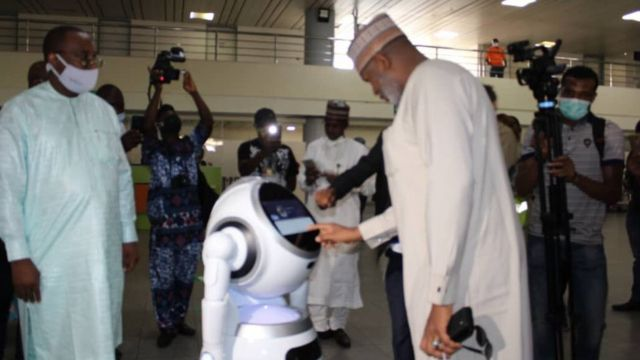
As the Nigerian government pushes for the reopening of the aviation industry, stakeholders have been working on modalities to contain the spread of COVID-19 at the airports. Consequently, the federal government has announced plans to deploy robots at the airports all over the country.
The robots are being deployed for passenger facilitation activities, including profiling, check-ins and temperature checks, as well as detection of security threats.
The authorities said the measures are being taken to ensure safety as the country is about to lift the flight ban. The General Manager, Corporate Affairs, Federal Aviation Authority, Henrietta Yakubu said a test run is currently going on at the Lagos airport.
“It’s a demo that is going on in Lagos. It’s been demonstrated. If it works fine, it will be adopted,” she told Punch.
The aviation industry has been grounded since March as precautionary measure to curb the outbreak of coronavirus, and the decision has come at a high cost.
The suspension of flight operations in Nigeria since March has reportedly put the aviation industry at N21 billion monthly loss.
Part of the preparation to unlock the sector was a test run of flights. The Nigerian Civil Aviation Authority (NCAA), has conducted a simulation flight ahead of the reopening of commercial flight activities.
The flight operated by Aero Contractors flew the Lagos – Abuja routes as well as Port Harcourt. It is expected that the Nigerian airspace will be opened for domestic flight operations soon by the authorities.
The Minister of Aviation, Hadi Sirika said that as part of the precautionary process, travelers will have to arrive at the airports three or five hours before their flight. This he said will allow the robots and other safety measures to be put in use. He added that additional measures will be announced in due time.
“We will announce all the protocols again before opening. But you need to be at the airport three hours ahead of your flight. The experience is quite nice but it takes a bit of time which is why you will need to be at the airport three hours before your local flight. For an international flight, we may do five hours,” he said.
The Minister further addressed the concern of profitability of aviation operations, given the new protocols and the tendency of being infected with the virus that will likely throw passengers off. He said that the adopted measures will address the concerns in a way that will make the industry profitable.
Among the safety measures being taken, Sirika said the toilets at the airports are now COVID-19 compliant, and pilots, engineers, traffic controllers, catering staff among others are certified to carry out operations only when they have the clearance to do so.
“Those new norms are coming and we will implement them in such a way that flights are profitable. The World Health Organization and the International Civil Aviation Organization have developed protocols of the sitting,” he said.
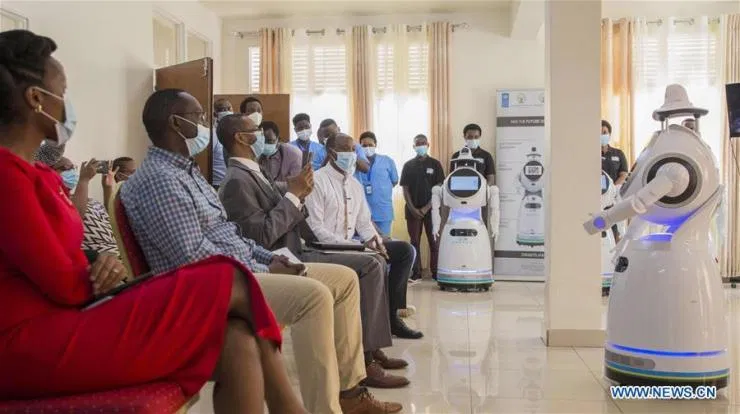
Rwanda was the first African country to deploy robots in the battle against COVID-19. The machines were used in the testing of coronavirus cases and delivery of essential services. The Rwandan Health Minister Ngamije Daniel said the robots made service delivery faster and they saved lives working in the stead of humans.
The Rwandan Ministry of ICT and Innovation and the United Nations Development Programme (UNDP), teamed up to develop the robots. Experts have recommended the use of machines in the fight against COVID-19 pandemic, due to its infectious nature.
However, there is concern that government’s move to reopen the aviation industry right now will yield more trouble. The number of cases has been increasing on the daily. As of Sunday, 28 June, there were 24,077 cases in Nigeria, with Lagos taking the maximum share of 10026 cases, followed by the Federal Capital Territory’s 1,736.
While many entertain the fear that the virus will spread, others are hoping that robots will help to eliminate the chances of spread at the airports and enable safe flights.
The IEEE said in a tweet on Saturday that the robots are ready for flight operations in Abuja.
Like this:
Like Loading...