DD
MM
YYYY

PAGES

DD
MM
YYYY

spot_img

PAGES

Home Blog Page 6303

The TStv’s Failed Battle Against DStv, GOtv

20
TStv

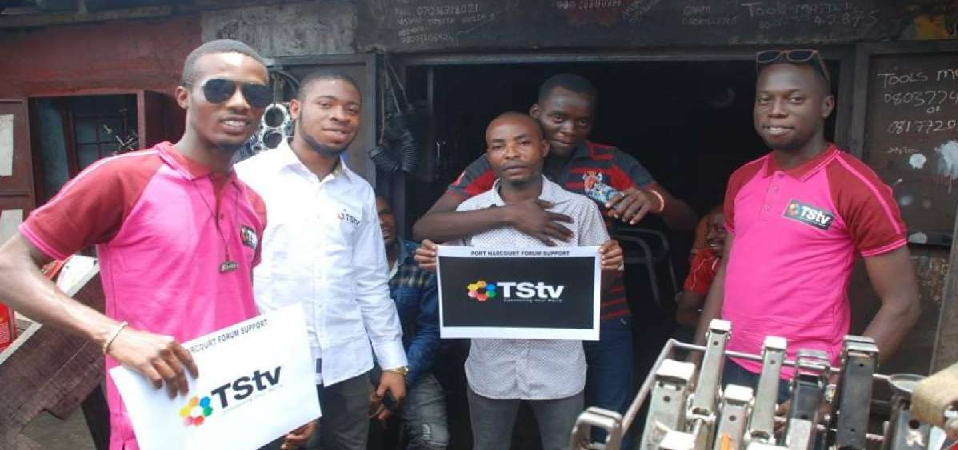
It came with a promise to take down DStv and GOtv. But it seems TStv, a satellite TV provider in Nigeria, cannot take care of itself.  Premium Times reports that the company could not pay its rent, and has been kicked out! Going against the richest company in continental Africa by market cap, Naspers, and a single company that could buy all the stocks in the Nigerian Stock Exchange with just then-30% of its value in the Johannesburg Stock Exchange was boldness.

The West African Business Platform Ltd., a law firm, has taken possession of the Abuja Headquarters office of Telcom Satellite Ltd. Television (TSTV) due to its inability to pay its rent.

The Abuja Headquarters office of the television company is situated at Plot 1191, Jahi District, off Gilmore Construction Company, FCT.

The property was taken over on Tuesday following the judgment entered in favour of the plaintiff by Justice Yusuf Halilu of the FCT High Court in Nov. 2019.

Officers from the Execution Unit of the FCT High Court, including four police officers, were stationed in the premises during the takeover.

The law firm through its principal, Raphael Adakole, had filed the suit in 2018 with No. CV/2739/18 against the television company and its Abuja Managing Director, Bright Echefu

TStv had no chance, but do not blame it for trying. Yes, many of us were worried as Naspers, the then-direct custodian of MultiChoice brands like DStv and Gotv, could outbid even Facebook or Google on things dear to it. It is that liquid with electronic money, not liquid water from my village. With truckloads of cash, DStv was going to win European Football rights bidding provided C. Ronaldo and Lionel Messi continue to earn the budget of Abia State for kicking a round leather around.

The elders will remind you NEVER to fight against your god – and some wiser people will say “choose your fights wisely”. TStv was stubborn and it has paid for it.

Sure, this is not to say one cannot dream big. But you need to be strategic when dreaming. This is what I do suggest when it comes to dealing with these ICT utilities with unlimited piles of cash – read here in Harvard Business Review.

I titled an article when TStv launched, “TStv’s Goliath Challenge of DStv“. I did note that  “it has to plan very well as it takes on the Goliath of pay TV in Africa. Sure, Goliath has been beaten in the past and that should be encouraging for TStv.” Unfortunately, TStv does not have “David” as a second name.

TStv, a new pay TV company, is beginning a journey to challenge the largest company in Africa by market valuation. Naspers which owns MultiChoice operates the DStv brand across sub-Saharan Africa. DStv is a digital satellite TV service which leads its category in the region. It is well funded by South Africa’s Naspers which has a valuation of $100 billion.

TStv’s Goliath Challenge of DStv

A Key Gene In The New Species of Digital Companies

0
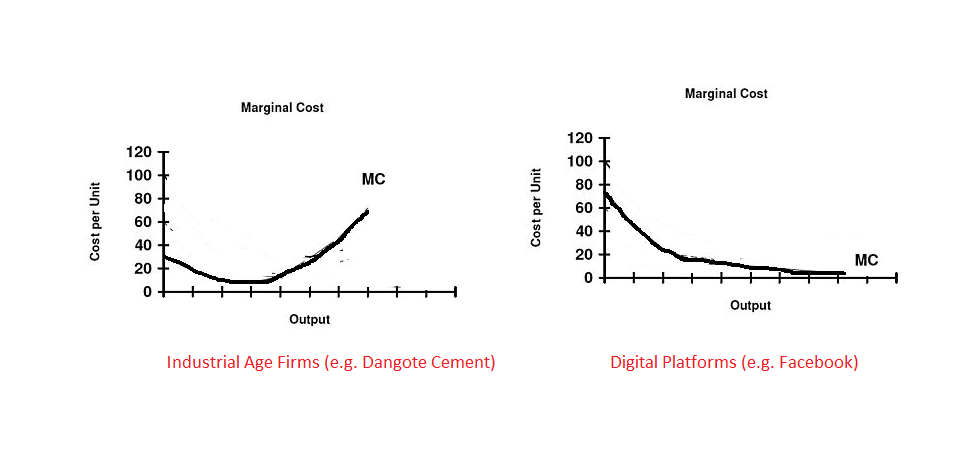
Marginal cost of industrial age firms and digital platforms


This curve (Right) differs from the typical U-shaped marginal cost curve (Left) which has been used in the industrial age era microeconomic modelling. Largely, for companies like GE and Dangote Cement, as output increases, the marginal cost would fall first, but over time it will begin to rise. Because of that eventual increase in the marginal cost, these firms are bounded and constrained on how far they can grow.

That is why GE and Dangote Cement cannot be in every local government in the world because unbounded outputs will harm them as their marginal costs rise (see Left)!  If you studied economics in secondary school, the shape you see is actually the shape of Average Fixed Cost which benefits, initially, from the economies of scale before diminishing returns set in.

Digital platforms do not have this limitation as increasing output takes marginal cost to near absolute zero (see Figure 1.3 Right). With that, Facebook can be technically available anywhere, boosting its ability to scale and grow, unbounded and unconstrained.

As a digital consumer sector entrepreneur, pushing your marginal cost to a good position is a very important strategy.


Take Advantage of Free Facyber Cybersecurity Training By Joining Tekedia Mini-MBA

0

Good People, please do not forget to take advantage of this. Lagos-based Infoprive which works with many banks, airlines, etc on their digital security needs will support some of our graduates in their cyber labs in Lagos. Some Diploma students, if you move to that phase, will do internships in Infoprive, eSentry and other partner organizations we have closed relationships.

Good People, remember that registering for Tekedia Mini-MBA edition 2 qualifies you for a FREE First Atlantic Cybersecurity Institute (Facyber) certificate course. Facyber has courses on cybersecurity policy, technology, management, intelligence & digital forensics.

  • Certificate in Cybersecurity Policy (CCYP)

  • Certificate in Cybersecurity Technology (CCYT)

  • Certificate in Cybersecurity Management (CCYM)

  • Certificate in Cybersecurity Intelligence & Digital Forensics (CCDF)

This is part of the Tekedia Institute Mini-MBA Community Circle which launches today (more info coming in hours). Our goal is to find ways to seed meaningful knowledge through industry partnerships.

Tekedia Mini-MBA gives you a FREE Facyber certificate course on any of Cybersecurity: policy, technology, management, and intelligence & digital forensics.

REGISTER for Tekedia Mini-MBA here if you have not.


https://www.tekedia.com/mini-mba-2/

Jamborow Raises $400,000 to Provide Financial Services to Nigeria’s Informal Sector .

1

Jamborow, a new Blockchain-based B2B fintech platform has raised $400,000 to launch in Nigeria. The fintech is working to extend financial services to the unbanked populace of the West African country.

Jamborow is Africa’s first B2B AI and Blockchain driven fintech platform focused on financial inclusion and grassroot empowerment.

The fintech was founded by Moses Onitilo, John Kamara and Olusegun George. The three have expressed earnest desire to take financial services to rural communities across Africa, using diverse tech system to close the existing gap between the banked and unbanked.

The founders have vast experience from works across fields in many countries. George was the account director in West Africa for the Governance Risk and Compliance division at Thomson Reuters. He was also a Group head at UBA Group in Lagos, and a former market analyst with Goldman Sachs.

Kamara worked as a director at the Machine Intelligence Institute of Africa in Cape Town, South Africa. On his part, Onitilo is an IT veteran with 25 years’ experience in ITSM, ITIL, Digital Transformation, AI, Blockchain, Encryption, Security, Process transformation, IT strategy, Governance, enterprise Management, and Emerging Technology.

The founders raised $400,000 from its shareholders and are poised to close a seed funding round over the coming weeks as they are hoping to launch into new markets.

Jamborow is targeting small-scale businesses, and low income earners in the rural areas as it aims to be Africa’s first inclusive and intelligent fintech platform built for the grassroot populace.

The co-founder and CTO of the company, John Onitilo says the idea was developed after extensive research on how to better serve the people in rural areas.

“Jamborow was conceived to promote financial and economic inclusion for the developing world. We conducted extensive research by traveling to various parts of the continent. What we discovered is that the grassroots population often suffered the same challenge: The inability to access formal financial services,” he said.

The two years old company is offering users access to digital payment options and mobile money, using its AI-powered robo-advisor and blockchain tech that creates a credit footprint. To implement its design and to reach the target audience, the firm is working with many stakeholders, such as banks, SME lenders, cooperatives, traditional savings group, microfinance institutions etc. in the finance industry to deliver financial services to the unbanked.

According to techmoran, Jamborow recently partnered with seven micro institutions that are now serving over 27 million members across African countries like Kenya, Nigeria, Tanzania, Sierra Leone and Liberia. And it is also using the services of payment facilitators like credit reference bureaus, mobile network operators, and e-commerce providers to simplify financial inclusion in Africa.

Co-founder and CEO of Jamborow, Olusegun George said Africa is ripe with financial markets and they saw a niche to provide financial services beyond what is common.

“Where we saw the niche in the market was by providing a whole ecosystem that looked beyond the predatory lending practices that we have witnessed in a number of markets we researched. Merely providing access to credit products falls short of the measurable and sustainable targets we envisioned at Jamborow, hence our slogan; ‘Beyond Financial Inclusion,’” he said.

Nigerian startups raised $55.37 million in the Q1 2020, and 99% of the funding came from foreign sources, according to data from Techpoint.

In Africa, approximately $350 million was raised in the Q1. South Africa, Nigeria, Kenya and Egypt led the way, according to data from Briter Bridges, a tech ecosystem data consultancy.

The Q1 result brings hope amidst the economic ravages emanating from COVID-19 pandemic. The African tech ecosystem is showing signs of resilience in a difficult time compared to the first quarter of 2019 which Weetracker put at $300 million, Q1 2020, has done better. In the last quarter of 2019, African startups raised $576.98 million.

It is hoped that if the fundraising continues in this terrain, the fourth quarter of 2020 will see African start-ups raising more funds than they did in the previous year.

Nigeria’s Former Vice President Atiku Will Run for President Again

2

Nigeria’s former Vice President Atiku Abubakar will contest the 2023 presidential election in Nigeria. His son, a commissioner in Adamawa State, has said. This is not surprising if you have been following Atiku’s recent writings. He is positioning himself as a thought-leader. If PDP zones presidency to the northern part of the country again, Atiku has a chance. 

The son of Nigeria’s former Vice President Atiku Abubakar, Adamu Abubakar, has said his father plans to contest the 2023 presidential election.

“Personally, I don’t see anything wrong with my father contesting for the presidency. In 2023, my father will be aspiring to the number one office in the land because he has been an astute, strategic, master politician for almost four decades,” Mr Abubakar who currently serves as commissioner for works and energy in Adamawa State was quoted saying by the Punch.

He made this known while marking the one-year performance of his ministry under the leadership of Governor Ahmadu Finitiri of Adamawa state.