DD
MM
YYYY

PAGES

DD
MM
YYYY

spot_img

PAGES

Home Blog Page 6306

Nigeria in Financial Crisis: Robbing Our Children to Pay for Our Freedom – Atiku Abubakar

3

Nothing has shocked me in my entire life in public service as the revelation from Nigeria’s First Quarter 2020 financial reports in the Medium Term Expenditure Framework and Fiscal Strategy from the Federal Ministry of Finance, Budget, and National Planning, which shows, alarmingly, that whereas Nigeria spent a total sum of N943.12 billion in debt servicing, the Federal Government’s retained revenue for the same period was only N950.56 billion. This means that Nigeria’s debt to revenue ratio is now 99%.

No one should be deceived. This is a crisis! Debt servicing does not equate to debt repayment. The reality is that Nigeria is paying only the minimum payment to cover our interest charges. The principal remains untouched and is possibly growing.

We are at a precipice. If our revenue figures do not go up, and go up quickly, Nigeria risks a situation where our revenue cannot even sustain our debt servicing obligations. Meaning that we may become insolvent, and our creditors may foreclose on us, as has occurred in Sri Lanka and the Maldives.

In my opinion editorial of December 17 2019, titled ‘Endless Borrowing Will Lead Nigeria to Endless Sorrowing’, I had cause to counsel the Federal Government to desist from indiscriminate lending, and offered suggestions on ways to both increase revenue and reduce expenditure. However, my counsel fell on deaf ears. And now we have come to this.

Again, on May 15, 2020, I counselled that the Federal Government ought to reduce Nigeria’s budget by at least 25%, to reflect the economic realities of the times that we live in. Again, my entreaties were brushed aside.

As part of an administration that paid off Nigeria’s entire foreign debt, I am concerned by the alarming and avoidable unprecedented increase in our debt to GDP ratio and debt to revenue ratio. The alarm I sounded last year is now sounding louder.

Not only have we squandered our opportunities, we have also squandered the opportunities of our future generations by bequeathing them a debt that they neither incurred nor enjoyed.

As a matter of utmost urgency and importance, I call on the Federal Government to take immediate steps to drastically reduce its expenditure, especially on wasteful projects, such as maintenance of the Presidential Air Fleet, and unnecessary renovations of buildings that could serve as is, limousine fleet for top government officials, overseas travels and treatments, and the N4.6billion Presidential villa maintenance budget, etc.

We cannot be on the verge of economic ruin, while still maintaining a Presidential Air Fleet that has more planes than the Presidential fleets of those from whom we take these loans. Nigeria must sell those planes and channel the revenue to other vital areas of need while taking additional steps to reduce the cost of running our government.

The Federal Government cannot continue to justify these unsustainable numbers by pointing at Nigeria’s debt to GDP ratio. That is only half the picture. Our debt to revenue ratio paints a much more realistic portrait of our financial situation, especially as our revenues are majorly tied to a mono-product, oil and gas, which are very vulnerable to global shocks.

Again, I warn that Nigeria is facing a crisis, and we cannot continue to keep up appearances by taking out more loans to prop up our economy. That will amount not just to robbing Peter to pay Paul, but to robbing our children to pay for our greed!
What A Bank Could Learn from Queueing Theory

0

I had an idea in 2013 to help improve, optimize or even eliminate queues in banking halls. It was about two years into my career as a HR professional. It is now about 10 years into my career and I still believe in the idea.

I first came across the concept of queuing theory in 2013 and its applications to banking were self-evident. I tried to conceptualize solving virtual queues with the theory_ imaginary queues like number of persons on a “promotion queue” as well as number of persons waiting to go on leave to mention a few. I shared my cogitations with my then team members. It was a wonderful presentation. But then it ended at that – a wonderful presentation, nothing more.

I was young in my career, so obviously, I had little clout to pursue my theories to a logical conclusion, albeit if implemented would have been one of those innovations that could have caused an inflection point in Banking

I would walk you through the conceptual solution to the queuing challenge I formulated in 2013. But before then let me lay a background to queuing theory.

Queuing Theory

Queuing theory is “a mathematical study of congestion and delays of waiting in line. It is a discipline in Operations Research that examines every component of waiting in line to be served, including the arrival process, service process, number of servers, number of system places, and the number of customers”

Two important metrics in studying any kind of queue (or waiting) is the mean arrival rate (mAR) and mean service rate(mSR). A queue will always form when the former exceeds the later, i.e mAR > mSR. And there also lies the solution to a queuing challenge: tinkering with mSR.

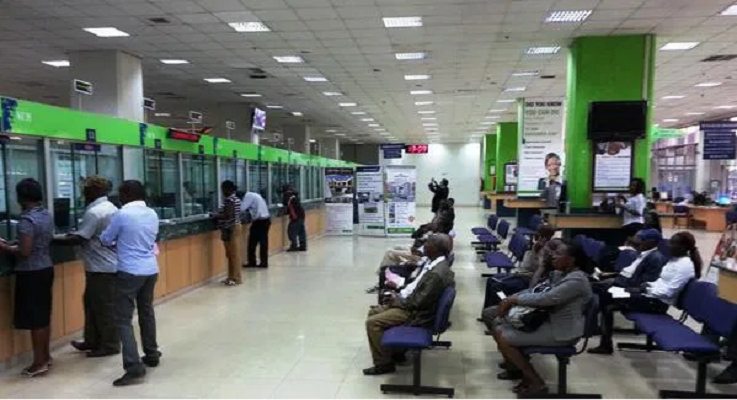
Now for a Bank with a distributary of branches, (sometimes two less than a km away) while it can not control the arrival rate of customers, it can calculate mAR for every branch. Armed with this metric, it is theoretically possible to reassign tellers and customer service personnel such that mSR will be equal to mAR at the minimum. We all have had experiences where we went into a bank at supposedly peak hour to find the banking hall empty and under-utilized personnel.  The answer for Banks is not hiring new staff, it is redistribution of personnel. An action which will be armed with proper analytics of the mAR per branch.

Calculating mAR and mSR for a Bank

With the advances in Machine Learning (ML) and Artificial Intelligence (AI), it is not difficult to conceive how mAR can be calculated for every customer who comes to the branch over a time period. mAR calculations deal with customer arrival patterns and the time difference between the arrival of one customer and the next. mSR calculations deals with the average time it took to service the customer. Most banks already have data on mSR (or at least an approximation of it) without knowing. Most in branch banking transactions are electronically logged e.g. like the time stamp when a teller calls up an account to post on it and when the transaction was successfully posted. The time difference per customer divided by the total number of customers is an approximation of mSR for some class of customers.

For mAR, one can easily train a facial recognition software to recognize a human being at the entrance and log the time of entry between each successive customer. With mAR and mSR, queuing challenges can be optimized in a bank.

Summarizing

While this is a simplistic and high-level solution to the problem, it does reveal that at least there is a conceptual solution to the problem of waiting; not just for banks but for any service industry. And about the same conceptual thinking can be adopted to solve the problem.

A Strategy Consultant To Teach Change Management in Tekedia Mini-MBA

0

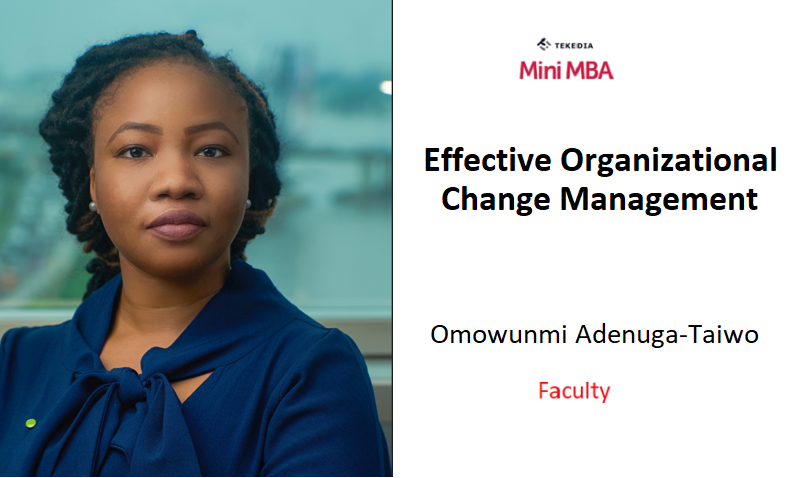
She made First Class from the prestigious University of Lagos. She is a business management consultant with a career spanning Accenture and Deloitte (most recent role as a Strategy Consulting Manager with Deloitte). She has spent the last seven years shaping business strategies, and leading and executing enterprise transformation initiatives for clients in the FMCG, healthcare, financial services, telecoms, public service and development sectors.

As a change manager, she has supported the end-to-end execution of change management, assessing change impact, crafting change communications, analysing change readiness, designing learning programs, and facilitating stakeholder engagements to manage the people side of change.

Omowunmi Adenuga-Taiwo is coming to Tekedia Mini-MBA to lead a session on Effective Organizational Change Management. Experience CHANGE here.

https://www.tekedia.com/mini-mba-2/

Ndubuisi Ekekwe To Speak in Founder Institute

0

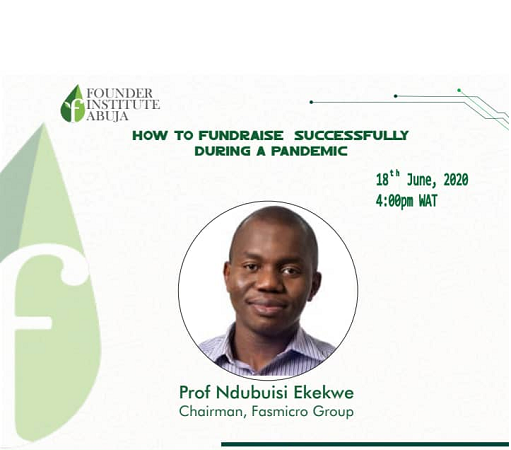
With Samuel Akinniyi Ajiboyede, CEO of Zido Logistics, another portfolio business, & others, we will discuss how to raise money during a pandemic in the Founder Institute Abuja.

The Founder Institute is an American business incubator, entrepreneur training and startup launch program that was founded in Palo Alto, California. Although based in Silicon Valley, The Founder Institute maintains chapters in over 180 cities and more than 65 different nations across the globe.

Thursday June 18th at 4pm Lagos time. Register FREE at FI website.

A HR Leader to Lead Human Resources Management Session In Tekedia Mini-MBA

0

She has a Master’s degree in Management Information Systems from Cranfield University, UK, a Bachelor’s degree in Economics from the University of Reading, UK and a Diploma in Psychology from Middlesex University, also in the UK. She is a certified Project Manager and an accredited Global Professional in Human Resources (GPHR). She hosts the annual HR Bootcamp Conference, a platform she established to explore new paradigms for reinventing people management practices.

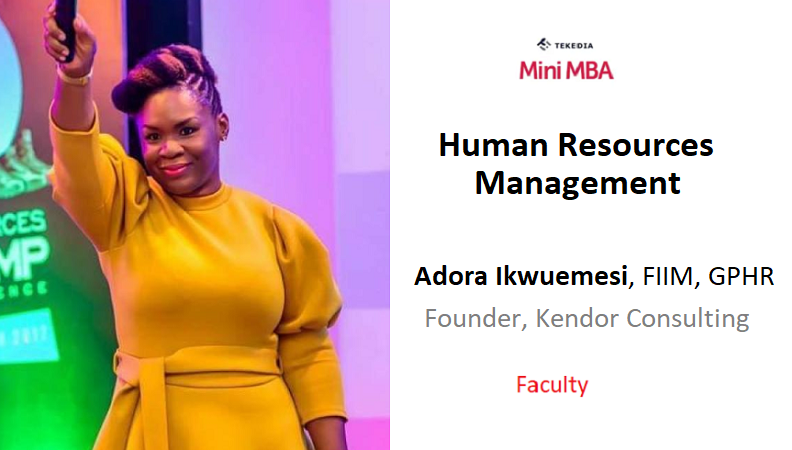
She is a speaker, author of “Change Your Career”, and a globally certified professional in the field of human resources management. She is the founder of Kendor Consulting, a Human Resources Management consulting firm that develops HR Professionals that stand out, and make a positive difference, and enhance the lives of the people and organisations they serve. 

Adora Ikwuemesi will lead a session on Human Resources Management in Tekedia Mini-MBA. With experiences from Phillips Consulting, Interswitch, Transcorp Plc, and founding Kendor Consulting, Adora will help our members to understand how to build a winning team. How do you hire? How do you build to motivate? Learn more.

https://www.tekedia.com/mini-mba-2/