DD
MM
YYYY

PAGES

DD
MM
YYYY

spot_img

PAGES

Home Blog Page 6310

Impending Problems in Nigerian Education System

0

The online teaching and learning style is trending in every part of the country. Many private schools that have websites added a page where students and parents can log in to access learning materials. Some schools went as far as creating websites in order to join in this trend. This development in developing countries, such as Nigeria, is a welcomed idea but it comes with a price, and that price is an impending crisis in our education system.

In Nigeria, schools are regulated by government-owned agencies. These agencies provide curriculum for each class and insist that it must be finished before a child is said to have completed a class. These agencies also set up general academic calendars that specify periods of resumption and closure for each school. No school in this country, no matter who the owner is, can ignore the directives of these agencies and go scot free.

Some may say that tertiary institutions have their own academic calendars and sets of curriculum for different schools and departments. Well, this may be so in other countries but never in Nigeria. Polytechnics, for instance, get their curricula from the National Board for Technical Education (NBTE) and this board comes for regular inspections to make sure that every department sticks to the stipulated items in the curriculum. Failure to do so leads to the withdrawal of the department’s accreditation or the agency may mete out any other sanctions it deems fit.

As for the dates for yearly resumption and closure of higher schools, Joint Admission and Matriculation Board (JAMB) sees that. This agency controls schools resumptions through the UTME exam schedules, result release and posting of students for admissions. When they post students to the school, it is expected that their admissions should be processed within a certain period of time. Schools that miss that period may be denied access to freshers for the following session. However, tertiary institutions are in positions to decide when and how their semesters run. The most important thing is that they resume and close within a specified period of time. And that they cover up the contents of the curricular before the students graduate.

Now, you must have noticed that some schools have already gone deep into the scheme of works for 3rd term (for primary and secondary schools) and course outline for second semester (for tertiary institutions) through online classes. But one special thing about these schools engaging in online schooling is that they are all private-owned. No government-owned school has been recorded to be engaged in any of this practice, and no announcement by the government directed schools to start online classes. In fact, just recently about twelve universities have been approved to start distance learning, which they are yet to do. This is just to say that all the schools in Nigeria that carry out online teaching and learning are, like our people will say, on their own.

Now, let’s look at how the educational crisis will happen as a result of these online schools.

  • Paying Salaries when Schools Reopen

From what I know, many schools engaging in online classes have made their students pay their 3rd term school fees. This must have been used in paying salaries and settling other logistics because these schools insisted that their teachers come to work. We know that very soon schools will definitely reopen for the completion of second term/first semester, and the resumption of third term/second semester. One is then left to ask how these schools plan to pay teachers and other workers their salaries when they resume fully and officially.

  • Re-Teaching Previously Taught Contents of the Curriculum

It is obvious that these schools are going to re-teach physically all they have taught virtually. This comes to ask how the teachers and children can stand this repeat because it will definitely lead to loss of interest in academic activities. It is more worrisome when one considers that this is bound to happen for about three months or more within the term. It would be better if schools are asked to reopen and vacate at their own discretion, but that will create more problems. Besides, it is unwise to leave some children at home when others are in school. However, this can be advantageous if well utilised. The teachers may need to spend more of their time on evaluation and practical than on teaching what they have taught before.

  • Problem with External Examinations

It would have been easier to re-organise school calendars if external exam bodies, such as WAEC, do not exist. But in a situation where countries that subscribed to WAEC re-opened their schools while Nigerian schools are still shut down, there is bound to be a problem. Many Nigerian WAEC candidates are in government-owned schools that do not engage in online teaching and learning, and so did not engage in any lessons that will help them with their studies and preparation for the exam. This will be most unfair to them because WAEC may not consider them when it fixes exam timetables. These children truly need help.

It is known that the education agencies that regulate school activities are working round the clock to ensure that schools are reopened and that it will be safe for the children to go back to school. As they plan for school reopening, they should also consider these mentioned problems and find ways to address them too.

The Big Threats Against Nigerian Telcos like MTN, Glo, Airtel NG, 9Mobile

7

I made a prediction a few years ago, noting that Nigeria would enter the year of immersive connectivity by 2022: “2020s, starting at 2022, will be the decade of immersive connectivity.” I used the same model which I used in my book – Nanotechnology & Microelectronics – which received IGI Global Book of the Year award, to model that by 2022, a parity would develop, closing some telecom infrastructure gaps and unleashing immersive connectivity at scale in Nigeria.  I do think we are getting there.

In today’s videocast, I make a case that Africa will enter the era of affordable broadband internet in 2022. That will be the year we will begin a new dawn of immersive connectivity where you can eat and surf all you can. Industry players will take off the Internet meter and then focus on service, experience and quality. From satellite broadband vendors to the MNCs with balloons and drones, the sector will become very competitive and service will drive growth. This has happened in the past – every decade, Africa experiences a major industrial transformation. We saw that in banking and voice telephony. 2020s, starting at 2022, will be the decade of immersive connectivity.

But as that happens, there would be major dislocations: Google and Facebook which I baptized as ICT Utilities in a Harvard Business Review article, will play key roles. There is a convergence and consolidation of power in technology. Yes, once you have capabilities in one thing, the cost of doing other things is so low that you can just do it. Blame Moore’s Law for it. So, as time goes on, the powerful technology companies are doing more things in-house and becoming more powerful.

Today, Facebook makes hardware for its servers. Google does the same. Now, they are becoming telcos in Africa, offering possibly near-free broadband services. Sure, they will serve you adverts. But who will resist that? Add the promise of Elon Musk and his Starlink, you get a future-worry for the likes of 9Mobile, Airtel, Glo and MTN.

Yes, if Google and Facebook provide broadband services at near-free cost, before us is a massive disruption. In this piece, Samuel Nwite explains what is happening in that space.

For some years now, Google and Facebook have been working to provide free global internet. However, this push to help internet users, especially in Africa to access reliable and fast internet has become a topic of interest recently due to the disruption it will cause to existing internet structure in the African continent.

There would be a new order, depending on what regulators do. But if they do not do anything smart, I will ask the telecoms to follow the same thing I have recommended to startups in the above Harvard Business Review article: do not resist frontally; simply, find a way to work with Google and Facebook because they are utilities, and utilities like electricity and water boards do not offer choices. Yes, any frontal confrontation will lead to value destruction for traditional telcos. Telcos need to master the flank strategy from Sun Tzu’s Art of War!

For Facebook, the playbook is one thing: control demand (yes, users).

In the digital age, what matters is not who controls supply, but who controls demand. Supply is largely infinite as there are many ways to get to the web, and because it is infinite, users congregate to platforms to help them navigate and make sense of the web.

In 1980, before the digital age as we have it today, the most powerful people in media were newspaper publishers. They were the people you needed to reach to get your message to the world. They decided what everyone read on the dailies and they were powerful. They controlled supply and by controlling supply, they shaped everything including advertising.


Comment on LinkedIn Feed

Comment: Do you think that is what the Indian Telco Jio’s parent (Jio platforms) has recently done with FB taking some stake in it, in part sensing what you are saying?

My Response: Absolutely – that is the only option for Jio. The real question is how do you partner with these ICT utilities? Jio got a good deal and was very smart to have done that. For every $100M, Facebook spends/wastes to get more IPs in India, it would add at least $500M in its market cap. So, investing in India was not to make direct “profit” but to get IP addresses (users) which it can convert into another value as its stocks move upwards. It is like using $10m to do discount in retail stores a week to end of quarter to improve same store numbers so that your stock can add $100m by beating estimates.

Nigerian Telcos Jitter As Google And Facebook Roll Out Plans for Free Internet

Nigerian Telcos Jitter As Google And Facebook Roll Out Plans for Free Internet

0

For some years now, Google and Facebook have been working to provide free global internet. However, this push to help internet users, especially in Africa to access reliable and fast internet has become a topic of interest recently due to the disruption it will cause to existing internet structure in the African continent.

Last year, Google announced a plan to build a new private subsea cable that would connect Africa with Europe. The subsea cable nicknamed (Equiano), after Nigerian-born 18th century writer and abolitionist, Olaudah Equiano, is designed to run between Portugal and South Africa and make its landing in Nigeria in 2021.

Facebook had in 2018, made plans to launch a low Earth orbit, non-geostationary orbit satellite to power internet services on places around the world with no or low internet networks. That’s after the 2016 SpaceX’s explosion destroys Facebook’s AMOS-6, a product of Facebook’s internet.org, designed to provide internet for the unserved and underserved, particularly in sub-Saharan Africa.

As the realization of the global satellite internet is still far from reality, Google and Facebook are banking on the more practical way – the undersea cable. While the idea appears sublime to all internet users in Africa, it poses a threat to telecom companies and internet providers.

Telecom operators are worried that the move will push them out of business since internet data services is an integral part of telecom operation. And they rely heavily on internet users to augment revenue from call services.

The Chairman, Association of Licensed Telecommunications Operators of Nigeria, Gbenga Adebayo said that organizations like Facebook generate revenue from ads, making it easy for them to offer free internet to users. Moreover, they have no tax obligation in countries where they are operating, unlike telecom companies.

“Virtual operators like Facebook are organizations that mainstream operators have to watch out for because a number of services they render today are free of charge. Their revenue is mostly from advertisement. They don’t have tax obligations; they don’t have any obligation like the conventional licensee have to the government.

“If they should come with this service that is free end-to-end, it will be a significant threat to the survival of the mainstream operators.

“Right now, we have enough broadband capacity on the seashores but we have not been able to transfer such capacity to the hinterland. Unless that problem is solved, we will not feel the positive impact of such additional traffic pipes coming in,” he said.

The inability of the operators to transfer the capacity of the undersea cables into the hinterland has been the major reason for poor internet connectivity in Nigeria.

Nigeria has notably, about five undersea cables landing, delivering nine terabytes per second of broadband capacity sufficient to provide speedy internet in the country. Ntel’s South Atlantic 3 fiber optic, is worth over $600 million; Dolphin Telecoms’ Ace cable is worth about $700 million; MTN’s West African Cable System stood at $650 million; Globacom’s Glo 1 cable is about $800 million, and MainOne costs about $300 million.

Though there is a new 2020 -2025 Broadband Plan designed to deliver data download speeds across Nigeria of a minimum 25Mbps in urban areas, and 10Mbps in rural areas, with effective coverage available to at least 90% of the population by 2025, at a price not more than N390 ($1.10) per 1GB of data, there are still other challenges.

One of them is the “right of way” that operators have been lamenting about its cost. State governments have been charging N4.5 million ($11,600) for the laying of a kilometer of broadband cable, and that has contributed to the inefficient yet expensive internet service in Nigeria.

So far, a few states in Nigeria have shown interest in cutting the cost for laying broadband cables, which signals that the 2020 -2025 Broadband Plan may not be attainable. Ekiti State in South-west Nigeria has reduced the right of way charges by 96%, and Imo State in the Southeast crashed the price to N145 per meter. Others are still dragging feet, compounding the woes of the telcos.

This situation has opened an opportunity for Google and Facebook to implement their plan with ease, as other African countries are facing similar challenges.

Consequently, operators in Nigeria are worried that state governments’ failure to address the cost of right of way in tandem with the federal government’s new broadband plan will usher in a new era of free internet, masterminded by Google and Facebook and it will disrupt the broadband market.

Despite the huge investments these Nigerian telcos have in undersea cables, internet services are still very poor in Nigeria and Africa as a whole. Africa has download speed of 1.56 megabytes per second (Mbps), which keeps its internet market at the bottom quarter of UK’s analytics firm, Cable’s global broadband speed ranking for 2019. Madagascar is the only African country that boasts of 10 Mbps as of last year.

But the president, Association of Telecommunication Companies of Nigeria, Olusola Teniola said that Google and Facebook’s plan will result in affordable internet in Nigeria, as it will provide additional broadband capacity. But he added that the regulator, the Nigerian Communication Commission (NCC), should ensure a level playing ground for all operators.

“What it will do in conjunction with the five active undersea cables is to provide some level of resilience and redundancy to the undersea cables. It is important to also note that it should improve affordability to communities that have not got connectivity or affordable data.

“If an OTT player is coming to lay down critical infrastructure, though it is welcome, the NCC needs to ensure that the playing field is level and that those who have already invested millions of dollars in deploying infrastructure can see a return on investment,” he said.


The IKEA Effect and Post Covid-19

8
  • Last Thursday at work while having lunch—yam chips and sauce—with great relish using my fingers, I was oblivious that my activity arrested the attention of my colleagues who were also having lunch. Then Tolu’s voice interrupted, “David, where did you buy your food that’s making you lick your fingers like this?” Most of us usually order take-out, even the married ones too due to the nature of work in Lagos. “Don’t mind me,” I said, “the food is so delicious. I made it this morning.” “Oh, I see! It’s because you cooked it yourself that’s why it’s delicious to you.” “I don’t think so, it’s really delicious. Don’t worry tomorrow you will taste my cooking.” I retorted with an air of finality, and they all burst into laughter.
  • I was completely unconscious that I just displayed a behaviour termed by economists as the IKEA effect. I came across this term on Saturday while reading Sarah Thooft’s article on How will restaurants adapt to the future. I was so curious to know more about this concept. What I learned is so instructive with practical application in our daily affairs; and I have decided to share this knowledge with those who do not know about it.

Definition and origin

“The IKEA effect was identified and named by Michael I. Norton of Harvard Business School, Daniel Mochon of Yale, and Dan Ariely of Duke, who published the results of three studies in 2011. They described the IKEA effect as “labor alone can be sufficient to induce greater liking for the fruits of one’s labor: even constructing a standardized bureau, an arduous, solitary task, can lead people to overvalue their (often poorly constructed) creations.””

Therefore, IKEA effect is a cognitive bias in which consumers place a disproportionately high value on products they partially created. The name is derived (the behaviour itself is as old as man) from a Swedish manufacturer and furniture retailer, IKEA which sells many furniture that requires assembly. Customers were found to fall in love with the products they help create. That is, loving the fruit of their labour. In the words of Dan Ariely, “The effort we expend on a task increases our love for them and blinds us from the perspective of others.” This aptly captures my drama eating what I cooked.


Graphical Illustration

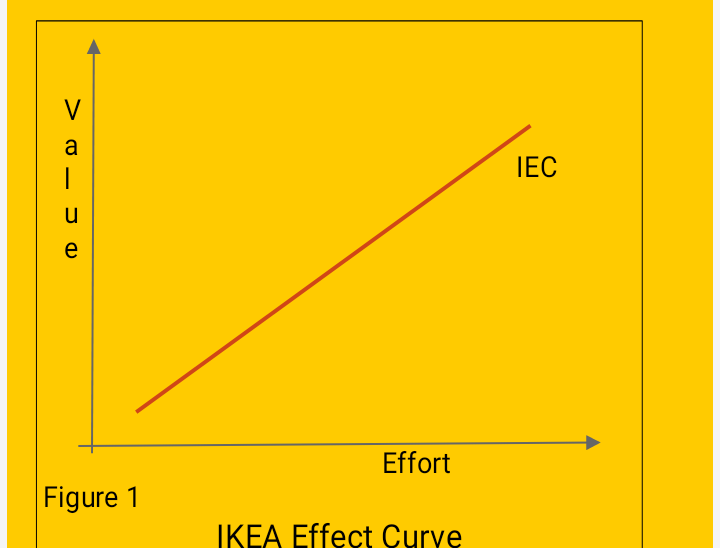
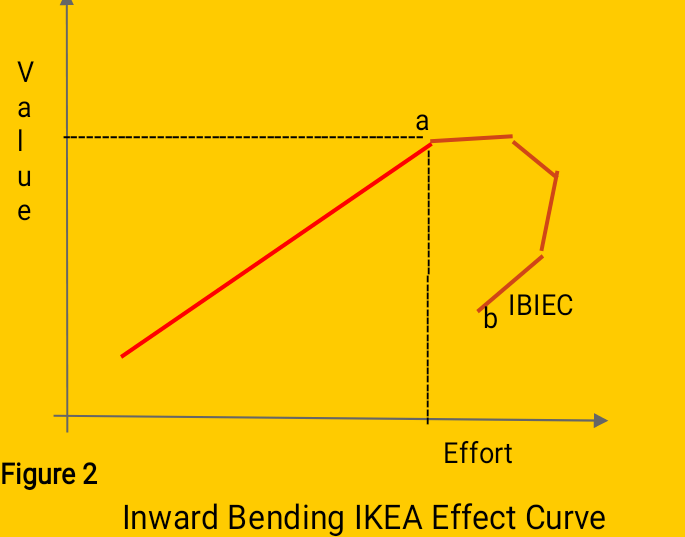
In figure 1, the IKEA Effect Curve, IEC, rises from left to right indicating an increase in value estimation as an individual invests more effort/labor in the creation of a thing. On the contrary, Gibbs and Drolet 2003, warned companies not to challenge consumers too much, lest they be unable to complete a task and then end up dissatisfied. I derived Figure 2 to illustrate their warning. Point a is the frustration point where marginal effort reduces value. If at this point the job can not be completed, abandonment will set in with less and less effort being added on the effort-axis. This consequently forms the Inward Bending IKEA Effect Curve, IBIEC.

Some Areas of Application

  1. Personal Life

As humans and creatures of habit we sometimes display this principle unknowingly but can easily notice it in the behaviour of others. When I graduated from the university I gave out my apartment for almost double the price I paid for it because I customized it to my taste. I must admit I almost gave up as many prospective buyers undervalued my masterpiece. The IKEA effect gives us the feeling of confidence to display competence in our accomplishments.

  1. Mother-Child Relationship

God in the Book of Isaiah 49:15 asked, “Can a mother forget the baby at her breast and have no compassion on the child she bore?” The love a mother has for her child is always greater than the love she has for her husband. Why is it so? The nine months incubation period in the womb and the pain of labour created a great bond. She was not part of the creation of the husband that’s why she can reduce her love for him in favour of her child. Because parents will hardly trade their children for anything, Dan Ariely concluded that, “Kids have the greatest IKEA effect.”

  1. Business

IKEA, the Swedish company has successfully used this principle more than any other to increase its sales and customer loyalty to the brand. The opportunities this strategy offers to businesses is yet untapped in developing countries like Nigeria. According to Tervooren, “Whenever you can, let your customers customize the products and services you offer to fit their needs. Make them feel like their own creativity and effort went into getting what they need from you. They will pay more for it.” The Inward Bending IKEA Effect Curve in Figure 2 should guide businesses in the application of this principle by knowing the limit of involving customers in product design, development, and testing.

  1. Politics and Governance

When a new political party wins election and forms its government, one thing they don’t fail to do is to throw away the baby with the bathwater of anything that has to do with the previous government. Good projects, programs, and policies are always abandoned to the detriment of the growth of the country and welfare of the citizens. This is easy for the political class because they were not co-creators and therefore do not value anything from the other party.

  1. Teamwork

The IKEA effect should be helpful to employers and managers for hiring the best fit and for motivation. If you lower the bar in the hiring process to favour someone, know that that person will undermine the goal of the team and not give his best. Aronson and Mills in 1959 conducted a research by requiring female participants to undergo “no initiation”, “mild initiation”, and “severe initiation” before entering a discussion group. The women’s later appraisal of the group’s value was proportional to the effort that had been demanded of them before being allowed into the group.

Conclusion

Post Covid-19 and the IKEA Effect

A lot of things have been said about the new normal in all spheres of life. The quantum of changes that the pandemic brought is unprecedented. I see this as a phenomenon: there must be pain to bring in the new. One of the new normals is the Work From Home, WFH that’s here to stay. Since the IKEA Effect is psychological, it means not only customers will be susceptible to it, employees too. The best outcome is only possible by teamwork. There should be a limit to the implementation of the WFH in the light of this.

The future we talked about during the global lockdown is now here as economies reopen to new opportunities. Businesses are saddled with the regeneration of the global economy by fixing market frictions exposed/created by the pandemic. Businesses should use the IKEA effect and get everyone involved because everyone will come out for a new start.

Let’s ride!

An Investment Banking Firm DMD Will Lead A Session on Investing & Fundraising

0

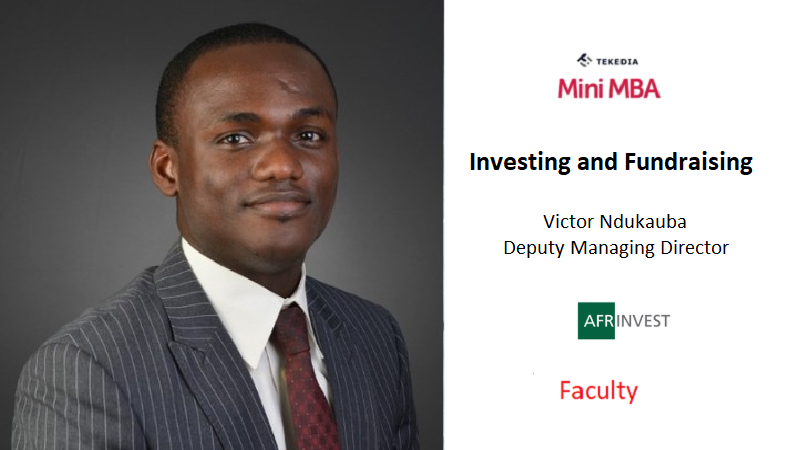
How do you finance that project? How do you invest that capital? How do you structure that deal? One of the best in the business will lead our session on Investing & Fundraising during the second edition of Tekedia Mini-MBA. Victor Ndukauba is the Deputy Managing Director Afrinves, a leading independent investment banking firm with a focus on West Africa and active in four principal areas: investment banking, securities trading, asset management, and investment research.

Learn from the best; Victor is ‘interested in early-stage start-ups as well as companies “on the bubble.”’ This session is going to be a huge one. When it comes to fundraising in Africa, all eyes open. Get ready – it would be a moment.

BEGIN here.