DD
MM
YYYY

PAGES

DD
MM
YYYY

spot_img

PAGES

Home Blog Page 6323

The Many Definitions of Corporate Social Responsibility (CSR) and Sustainability: What They Are and What They Are Not – A Practitioners’ Guide

4

By Eustace Onuegbu and Eunice Sampson 

  • Corporate Philanthropy, Corporate Social Responsibility (CSR), Environmental, Social and Governance (ESG), Corporate Sustainability (CS) and Sustainability

Corporate Philanthropy (CP), Corporate Social Responsibility (CSR), Environmental, Social and Governance (ESG) and Corporate Sustainability (CS) seem to be used interchangeably by most people, including a number of practitioners. But they do not mean the same thing, either in concept or practice.

Corporate Philanthropy is the act of a corporation or business promoting the welfare of others, generally through voluntary, charitable initiatives, such as community projects, cash donations, scholarships, etc. It could also be in the form of voluntary donation of time, skills, and other resources for community service initiatives through, for example, employee volunteering activities. 

Recently, a major player in the Nigerian Cement industry donated quite a number of security vehicles to Lagos State and Ogun State Governments, to help boost security operations in those States. This is an example of a voluntary donation, and therefore, an act of Corporate Philanthropy

On the other hand, International Organisation for Standards (ISO) defines Social Responsibility as: 

“the responsibility of an organisation for the impact of its decisions and activities on the society and environment, through transparent and ethical behaviour that:      

  • contributes to sustainable development, including health and welfare of the society;      
  • takes into account the expectations of stakeholders;      
  • is in compliance with applicable laws and consistent with international norms of behaviour; and      
  • is integrated throughout the organisation and practised in its relationships.”

This definition demonstrates the difference between Corporate Philanthropy and (Corporate) Social Responsibility. While the former is voluntary, the latter is a “responsibility.” If it is a responsibility, then it is obligatory, and a business could therefore be branded as “irresponsible”, or probably, “unethical” if it fails to fulfil its corporate social responsibilities. 

This explains the definition of Corporate Social Responsibility given by the World Business Council for Sustainable Development (WBCSD): “The continuing commitment by business to behave ethically and contribute to economic development while improving the quality of life of the workforce and their families as well as of the local community and society at large.”

This definition by WBCSD highlights some of the direct and indirect key stakeholders of businesses: workforce, families, local communities, society. These “people” or “social” agents broadly summarize the ideal focus of a business’ corporate social responsibility strategy. 

Since businesses would usually take a lot from these actors (their workforce, host communities, households, etc.) in their day-to-day operations, and as part of their value chain activities, it makes sense that they should integrate SR principles that enable them to contribute to the wellbeing of these important influencers, not as one-off charity or philanthropic gesture, but creating shared stakeholder value. 

We have said that a key responsibility of a business should entail making positive impact on its people, communities and society – which ultimately could be categorised as its “Social Responsibility.”

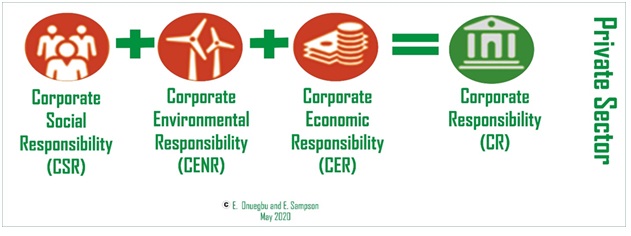
But “Social” is not the only responsibility that a business is held accountable for.  A business also has a responsibility towards ensuring the wellbeing of the environment where it carries out its business and from where it extracts raw materials and other resources without which business operations would not be possible. Environmental stewardship includes deliberate efforts that a business makes to minimize and offset its negative environmental footprints, such as use of renewable energy as against fossil fuel, reforestation initiatives, energy consumption and greenhouse gas emission reduction programmes, responsible waste management practices, and so on.  

Added to this is a business’ economic responsibility, that is, its economic impact and stewardship, with emphasis on the economic value it creates for all stakeholders and the larger economy (such as paying taxes to government, dividends to shareholders, salaries and wages to employees, and other forms of value creation, to local contractors and vendors, for example).
It is important to note that the concept of Social Responsibility applies to all organisations, not just businesses, any entity – government agencies,  institutions or associations – comprising of one or more persons, having a particular purpose and interacting with some of the ‘social’ agents as earlier identified. This explains why ISO 26000 identifies this as Social Responsibility (SR), rather than just “Corporate” Social Responsibility. 

While Corporate Responsibility is about a company’s engagement with its stakeholders and its commitment to socially, economically, and environmentally responsible practices (as shown in the diagram above),  on the other hand, Environmental, Social and Governance (ESG) is a criteria mostly used by discerning global investors in assessing the “non-financial” and ethical practices and performance of companies that they invest or plan to invest in. Both concepts are aimed at driving a sense of responsibility in businesses, and when effectively managed over time, achieves Corporate Sustainability. 

What then is Corporate Sustainability? For the business enterprise, sustainability means

…adopting business strategies and activities that meet the needs of the enterprise and its stakeholders today while protecting, sustaining, and enhancing the human and natural resources that will be needed in the future. 

Corporate Sustainability is therefore a business model that prioritizes the effective and proactive management of the impacts (positive or negative) that a business has on the society, environment and the economy, while leveraging good corporate governance practices to enhance the opportunities and minimize the risks that may arise from these impacts. In a nutshell, Corporate Sustainability is a long-term concept that covers social, environmental, economic and governance responsibilities of businesses.
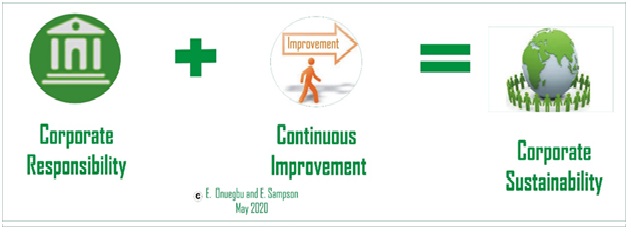
But Corporate Sustainability is only an angle of the broader societal Sustainability concept. 

When the UN World Commission on Environment and Development defined Sustainable Development (Sustainability) in 1987 as “development that “meets the needs of the present without compromising the ability of future generations to meet their own needs,” the idea was not to entirely leave the burden of achieving global sustainable development on corporates. Governments (the broad spectrum of the public sector) and the civil society (citizens at individual and institutional levels) also have their roles to play. 

Sustainability could therefore be defined as the collective responsibility and obligation that all social and economic agents hold, to pursue and achieve sustainable development – development that is accountable for the social, environmental, and economic wellbeing of current and future generations.

Defined in this way, sustainability balances resource usage and supplies over time. In other words, sustainability assures intergenerational equity. When the resources we use match the earth’s capacity to regenerate adequate future supply, then our systems remain balanced indefinitely. However, if resources used exceed this capacity, then current demand is being met by borrowing from the future, which will eventually lead to an inability to meet future societies’ needs. Achieving the sustainability milestone as a society, requires the combined efforts of businesses behaving in a responsible manner; the citizens performing their civic responsibilities; and the ability of the government to provide good and responsible governance.   

The illustration below explains the relationship between these concepts.
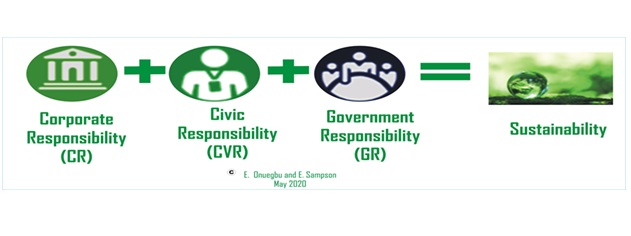
As shown in the diagram, in the long term, Corporate Responsibility translates to Corporate Sustainability, with an underline on the word “Corporate.” This underline is necessary because corporate sustainability as earlier stated is only one angle to “Sustainability.”  

The quest to achieve sustainability best practices is already starting to transform the competitive landscape, and promises to compel companies, governments and other major global actors to change the way they think about governance, environmental wellbeing, business continuity, innovation, technologies, processes, profitability, growth, development and socioeconomic equity. It has become a key driver of disruptive innovation in both the public and private sectors, and particularly so during times of socioeconomic and environmental uncertainties.

By Eustace Onuegbu and Eunice Sampson 


About the Authors:

Eustace Onuegbu is one of Africa’s leading management consultants with expertise in corporate sustainability – strategy and implementation. A certified Management Systems (ISO 26000, 14001 and 45001 standards) consultant, facilitator, and auditor. 

Eunice Sampson is a seasoned Sustainability and CSR professional with two decades of experience working with high profile African businesses. She is one of the pioneer Sustainability practitioners in Nigeria and has supported diverse industry standards setting initiatives and programmes. 
President Buhari Remains “Consistent” in Support to AfDB President Akinwumi Adesina

1

President Buhari makes his support to Akinwumi Adesina, African Development Bank (AfDB) president, evidently public. Ideally, that should do it for the AfDB President on the allegations leveled against him. Yet, it is hard these days to understand what President Trump wants.

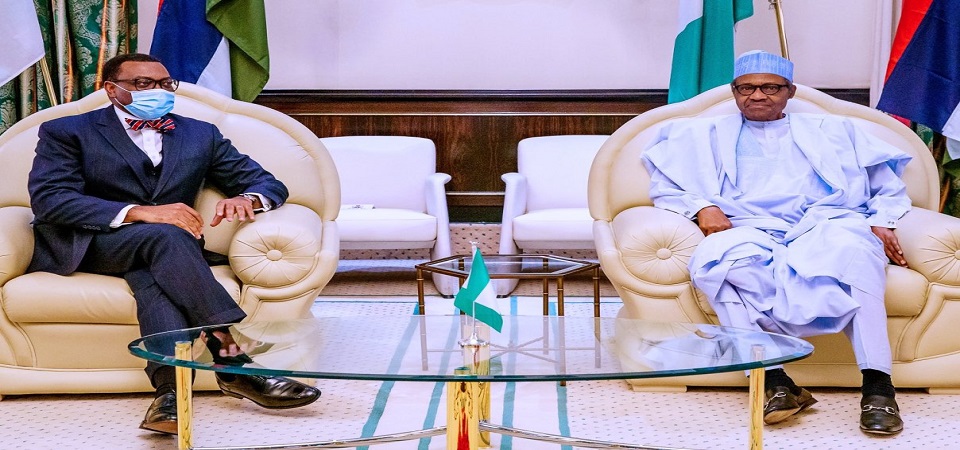
President Muhammadu Buhari says Nigeria will stand solidly behind Akinwumi Adesina in his bid to get re-elected as President of the African Development Bank (AfDB). The president spoke at the State House, Abuja, Tuesday, while hosting Mr Adesina.

“In 2015, when you were to be elected for the first term, I wrote to all African leaders, recommending you for the position. I didn’t say because you were a People’s Democratic Party (PDP) Minister, and I belonged to the All Progressives Congress (APC), so I would withhold my support. I’ll remain consistent with you, because no one has faulted the step I took on behalf of Nigeria,” said Mr Buhari.

Many here have written that African Union and AfDB should just ignore the U.S. and carry on. That would be a momentous stupidity because if the U.S. treasury classifies AfDB as a “corrupt institution”, rightly or wrongly, the bank will crash. Banks thrive on the trust score more than the amount of cash in the vault. 

Case in point: Venezuela was pumping oil, but was getting poorer because a layer was placed on its banking system. We’re living in a unipolar financial system and the U.S. runs the show. You just need to find  a way to be in the good books. Sure, you may wish China. Unfortunately, China buys U.S. debts as though there is a cookie bonanza:  as of December 2019, China owns $1.07 trillion of the $23 trillion U.S. national debt.

China has steadily accumulated U.S. Treasury securities over the last few decades. As of December 2019, the Asian nation owns $1.07 trillion, or about 5%, of the $23 trillion U.S. national debt, which is more than any other foreign country

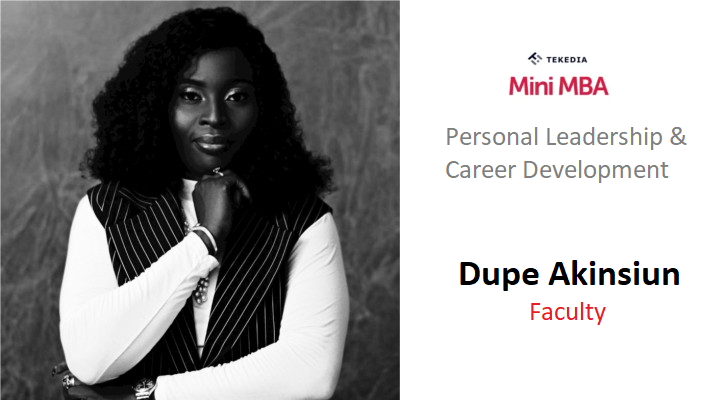
A Global HR Leader Will Teach Career & Personal Development During Tekedia Mini-MBA

0

She is a Certified Leadership & Behavioural Consultant, and heads the Leadership & Culture Center of Expertise (CoE) in one of the finest companies in the world. As a strategic HR Business Partner, she covers nine countries. Her experiences cut across  management consulting, financial Services, pharmaceutical, and FMCG. She seeks to “equip emerging leaders with the knowledge, skills and abilities required to excel in life and in their respective careers”. Dupe  Akinsiun, a Tekedia Institute Faculty, will lead a session on personal leadership and career advancement during the second edition of Tekedia Mini-MBA.

Join Dupe and our Global Faculty, and accelerate your leadership and general management ascent. Register here.

Innovation In Times Of Crisis: How A Nigerian Inventor Is Taking The Lead [Video]

6

Crises are always good drivers of innovation and creativity. Mass manufacturing of automobiles, great literature and several technological inventions were born out of the Spanish Flu which ravaged the world between 1918-1920, the 1957 Asian H2N2 flu led to the invention of antibiotics, mobile apps like Healthmap were built to fight the West African Ebola pandemic of 2014-2016 and several digital innovations have also been invented over the years to help in the fight against HIV/AIDS.

The COVID-19 pandemic that the world is currently confronting is no different. From the use of Robots to minimize coronavirus risk in Rwanda to the production of breathable re-usable masks from recyclable materials by Adidas to social distancing necklaces in Italy to AI-enabled public health mobile applications, the world is yet at the precipice of another boom in innovation. This time, emerging technologies such as Big Data, Artificial Intelligence and Machine Learning are taking a crucial part of managing the effects and mitigating the COVID-19 crisis.

Nigeria has not taken the backside in this innovation voyage. A lot of innovative ideas and products have emerged in the past few months, thanks to the various public and private sector agencies like UNICEF, NITDA, NCDC and Ventures Platform who have launched different innovation challenges and Hackathons to combat the Pandemic.

Last week, I logged on to Twitter as usual and saw a tweet that caught my attention – a Nigerian Engineer Abraham Abiodun had invented a walkthrough disinfection machine to help in the fight against COVID-19. I got curious and sent a private message to the originator of the tweet @dami_abraham to get more details. Dami thereafter connected me to the Engineer who happened to be her husband. I then put a call through to Abraham to get further clarifying details about his innovative invention for the purpose of this article.

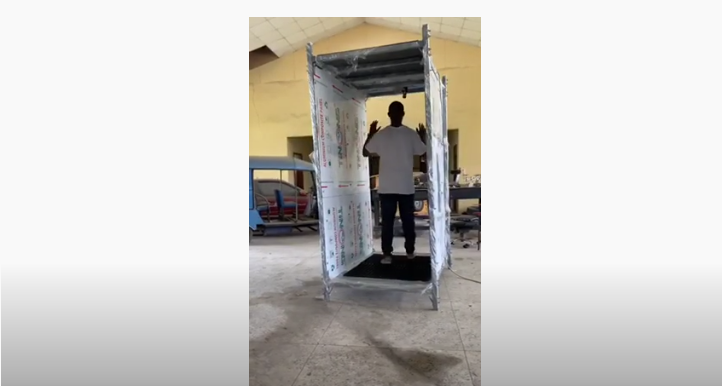
The Walk-through Disinfection Machine

The walk-through disinfection machine invented by this Nigerian Engineer minimizes and controls the spread of the coronavirus. It can serve as a COVID-19 prevention screening point at the entrance of public places. I got curious about the technology behind the invention and asked Abraham to explain it in a lay man’s term.

According to Abraham, a metallurgical and materials engineering graduate from the University of Lagos, the machine contains a non-contact body temperature reader that gives off an alarm for high body temperatures and an automatic hand sanitizer dispenser.

“There’s a sanitizer spray that is automatically activated when a person enters the chamber. The sanitizer liquid is carefully prepared to perfectly suit all types of skin. It’s not alcohol-based to eliminate the risk of fire hazard and it’s not chlorine-based to eliminate bleaching cloth or irritate the skin” he explained.

I asked him about the safety of the disinfectant liquid. He explained that the disinfectant liquid is 100% safe and recommended by the World Health Organization (WHO) and it can effectively kill coronavirus and other viruses, bacteria, fungi and other germs. The machine also has an automatic refilling system that refills when the liquid is finished. On the power source, he says the machine uses a common domestic single-phase electricity and a plug and play low energy consumption.

The disinfection machine is actually not a new invention, some companies in India and China have made prototypes of this machine. However, what stands this out is the disinfectant liquid which is specially formulated to contain an essence that is known to cure the common cold when inhaled and has a soothing effect on the skin. There is also an automatic refill system that directly supplies the feed from a bigger reserve to avoid frequent refills.

“Most other disinfectant liquids are either chloride-based which has some carcinogenic effect or alcohol-based which has the risk of a fire hazard because of the high alcohol content. Furthermore, the sanitizer liquid reserve is made to last a long time as long as 3 to 4 months depending on the frequency of usage” Abraham says.

Support for Nigerian Innovators

Responsive and decisive leadership is needed in the fight against COVID-19. Despite the imminent economic hardships that will result from the pandemic, Africa innovators will play a critical role in the fight against the pandemic and the ultimate recovery of the continent’s economy.

If we are to flatten the curve, then all hands must be on deck to support Nigerian innovators like Abraham who are pushing out great ideas to combat the deadly pandemic. Nigeria and indeed the rest of Africa must explore the potentials and capabilities of the Fourth Industrial Revolution to fight COVID-19.

Dayo Ibitoye is a communications and Public Policy Specialist. He writes from Abuja. 

Myths and Realities Surrounding Upward Economic and Social Mobility

0
Lagos Yellow Cab

The beliefs surrounding one’s ability to attain upward social and economic mobility is quite numerous and, sometimes, daunting. Some of them have been in existence for so long that we don’t even know their origin. Some are practical while others seem so unrealistic. But then, it is hard to determine the ones that are real and those that are myths.

It is the desire of every human to achieve economic and financial stability and independence. We all want to belong to the upper class. Some people were born into that class while others worked their way up. There are those that had wealth thrown their way while there are others that achieved it. The dream of everybody is to be among the decision makers in the society.

However, social and economic mobility is not an easy feat to achieve. In most cases, the ability of a person to move up the scale depends on the culture of his society. If it’s in a society where democracy is practiced freely, the son of nobody can become a king tomorrow. But in an aristocratic community, it is almost impossible for a person to change his social class unless certain circumstances warranted that.

That notwithstanding, many ideologies surrounding a person’s ability to move up the social ladder are in existence. As mentioned earlier, it is hard to determine whether some of these beliefs are factual or not because empirical studies are yet to be conducted on most of them. However, people already believe in these ideologies and have been applying them in their pursuit for better living.

Some of these ideologies are:

Children from working class homes cannot move into the upper class: This philosophy is refuting the belief that nobody can become a king tomorrow. Well, in as much as sociologists believe so much in this philosophy, they need to understand that it is not attainable everywhere. In Igbo communities for instance, children of paupers can become presidents of the country tomorrow. People that believe in this ideology already have it in them that they can’t move higher than where they are; they always settle for less because they never envision themselves attaining higher heights.

Associating with the upper class automatically brings about an upward mobility: This ideology is true, but it does not work in all cases. It is actually true that the type of people you associate with influences you but when it comes to wealth and class, the formula changes. I will do my best to explain this.

There are some rich people that are willing to pull others up and there are those that want everybody to serve them. The people in the first category type are mentors while those in the second category are, well, godfathers and “masters”. A mentor will help you to grow while a godfather wants you to forever remain his ‘boy’. If you find yourself in the midst of mentors, and they belong to the upper class, just know that your bread has been buttered. But if the people you mingle with are those that want you around because you fan their ego, just know it that you are not going anywhere.

Savings make people rich: Savings doesn’t make people rich; but lack of it can make people poor. Savings only saves people on a rainy day. Saving is actually there to save you from trouble. It is there to keep you away from begging. It does not increase your income because it involves keeping a part of your income. If a person’s income is small, his savings will reflect that; if his income is huge, his savings will be huge. However, his income has not increased. So if his income didn’t place him among the rich, his savings won’t do that. And if inflation steps in, it will attack whatever amount he left in the bank.

This is not to discourage people from saving from their earnings because it helps a lot. But it will be good if people realised that they should consider how to increase their income by finding better sources of income than believing that the money they put away in the bank will make them rich. But then, investing their savings can change the game plan.

Social class and economic status are preordained: In Igbo tradition, it is believed that people cannot get wealthy if their “chi” did not destine it – that is, wealth comes from divine intervention. It is believed that no matter how hard you tried, if it is already destined that you will remain poor, or that you and your “chi” are not in good terms, you cannot run away from poverty. This is why you hear statements like “O nwere ajo chi” (he has an ill fate but literally meaning that “he has a bad chi”), “chi m ekwero” (my chi did not agree with the decision), “chi na-enye aku” (chi gives wealth), “aku si na chi” (wealth comes from chi, that is wealth is preordained) and so many others. This ideology may have worked in the past because people were expected to work hand in hand with divine beings in whatever they do in the world (in other words, they worked hard and still consulted the oracle for guidance and permission). But from what we can see these days, a lot of people use this as excuses to remain unproductive.

No one can make it in Nigeria by staying legit: This ideology is borne out of the high rate of corrupt and illegal practices in Nigeria. This, sometimes, makes people believe that the reason they’re not moving up that social class ladder is because they’re doing honest jobs. This ideology is difficult to dispel because many Nigerian rich men and women have stories of illegal dealings trailing them. However, there are still some out there that must have made their money in a clean way, I believe.

There are so many other myths out there concerning wealth creation. But what matters is that you need to sieve through what you heard to be able to differentiate the myths from the realities. Wealth creation, as far as I know, is a skill. And to acquire any skills, you have to learn from those that have it. There are two ways of achieving that: finding a mentor and participating in training that will expose you how others have been doing.