DD
MM
YYYY

PAGES

DD
MM
YYYY

spot_img

PAGES

Home Blog Page 634

Best Cryptos to Buy: Pepe Coin (PEPE) and Little Pepe (LILPEPE) on the Rise, Which Meme Coin Will 10x First?

0

Pepe Coin (PEPE) has held the top spot lately, impressing everyone with its soaring price and eye-catching rallies. Now, though, newcomers are grabbing attention, and Little Pepe (LILPEPE) is the latest star.  Its presale just blasted off, and the numbers are turning heads everywhere in crypto. Both coins are attracting investors, and among both PEPE and LILPEPE, which are set to be the best cryptos to buy now, which has the potential to 10x first?

Pepe Coin (PEPE): Strong Momentum and Bullish Signs

Pepe Coin (PEPE) is now sitting above both the 20-day and 50-day EMAs, which is a solid confirmation of its short- and mid-term strength. Technical charts are looking positive overall, and a bullish MACD crossover hints at new buying interest. Open interest in PEPE futures has jumped by 111%, hitting $636 million. This big increase shows that both retail and institutional investors are getting back in the game. When we see a wave of new derivative positions like this, it often paves the way for a big move in the actual spot price, so eyes are on PEPE for a possible breakout. PEPE’s recent 5% rise within 24 hours to $0.000012 highlights resilience after months of consolidation.

Analysts now expect PEPE to target 10x if momentum continues. With whale accumulation increasing and exchange balances declining, supply pressure is easing—often a precursor to sustained rallies. Support levels remain firm around $0.00001078, adding to the belief that PEPE is primed for its next major leg up. History has shown that PEPE recovers quickly from dips, making it one of the best cryptos to buy for investors seeking established meme coins with upside potential.

Little Pepe (LILPEPE): The Fastest-Growing Meme Coin

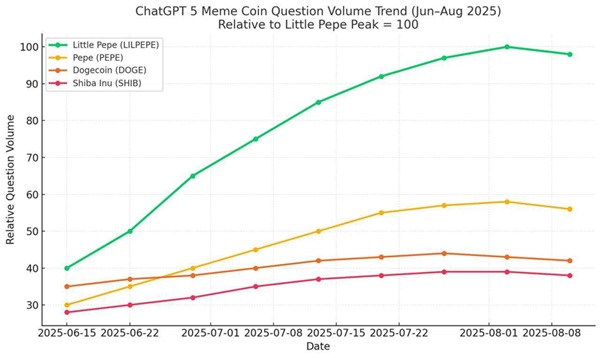
While PEPE is gaining traction, Little Pepe (LILPEPE) is quickly making a name for itself as the meme coin with the most momentum in 2025. Its presale performance has been nothing short of extraordinary. Stage 10 sold out ahead of schedule, raising over $19.32 million. Stage 11, priced at $0.0020, has already secured more than $2.66 million in under a week—evidence of high demand and investor excitement. The Little Pepe (LILPEPE) team is celebrating this presale success with a massive $777k giveaway. Ten winners will each receive $77,000 worth of LILPEPE tokens. To qualify, investors need a minimum $100 presale allocation, with more than 246,000 entries recorded so far. Little Pepe (LILPEPE) has already delivered a 2x price increase since its first presale stage. Analysts forecast that it could achieve a 10x jump, going for exponential gains. Among the top meme coins, Little Pepe (LILPEPE) stands out in terms of question volume, surpassing Shiba Inu, Pepe Coin, and Dogecoin, according to ChatGPT-5.

The project has branded itself with playful messaging, describing its roadmap as being in the “cryptowomb” with “Mumma Pepe cooking up a baby on the way.” The project underwent an audit by CertiK, securing an impressive security score of 95.49%. In an industry where scams have burned investors, this audit gives LILPEPE a credibility edge. Furthermore, Little Pepe (LILPEPE) has already secured a listing on CoinMarketCap, ensuring visibility ahead of its official launch. Plans are also in motion for listings on two major centralized exchanges immediately after the presale, with an ultimate goal of landing on the largest global exchange. This roadmap highlights the team’s strategy to maximize exposure and liquidity for investors.

Comparing PEPE and LILPEPE: Which 10x Comes First?

Both PEPE and LILPEPE have a clear path toward major price gains, but their timelines may differ.

  • PEPE: With strong technicals and whale accumulation, PEPE is showing resilience and could hit $0.00044 by 2026.
  • LILPEPE: With explosive presale momentum, exchange listings on the horizon, and a community-centered approach, LILPEPE could hit 10x much sooner—by Q4 2025

Conclusion

The meme coin sector continues to surprise, and 2025 looks set to be dominated by two names: Pepe Coin (PEPE) and Little Pepe (LILPEPE). While PEPE shows signs of maturity with its bullish chart signals and whale interest, Little Pepe is creating its own wave with record-breaking presale numbers and a roadmap that promises community-driven growth. Ultimately, Little Pepe might just win the race to 10x.


For more information about Little Pepe (LILPEPE) visit the links below:

Website: https://littlepepe.com

Whitepaper: https://littlepepe.com/whitepaper.pdf

Telegram: https://t.me/littlepepetoken

Twitter/X: https://x.com/littlepepetoken

Best Crypto Ad Networks in 2025: A Practical Crypto Marketing Guide

0

TL;DR

  • With mainstream platforms like Google, Meta, and X restricting crypto ads, specialized networks have become the go-to solution for Web3 marketing;
  • Top networks—Cointraffic, Coinzilla, Bitmedia, Mintfunnel, and A-ADS—enable crypto payments, precise geo and wallet-based targeting, and implement robust anti-fraud safeguards;
  • Entry costs vary: Cointraffic starts at €20, while larger-scale campaigns on Coinzilla require around $500. Available ad formats include banners, native content, video, and push notifications;
  • Real-world campaigns show that splitting budgets across multiple networks and running A/B tests improves CPA and conversion rates;
  • A well-balanced strategy allows crypto marketers to reach genuine audiences, scale campaigns confidently, and maintain ROI even in volatile markets.

The Evolution of Crypto Ad Industry: Beyond Traditional Barriers

The crypto advertising ecosystem for crypto project promotion has rapidly evolved out of necessity. As Google (often seen as a replacement for traditional Google Adsense or Google Ads), Meta, and social media platforms tightened their policies, often without clear guidelines or consistent enforcement, crypto project owners found themselves in a bind. This led to the emergence of ad network options that specialize in crypto ad, offering several key advantages for crypto advertisers:

  • Compliance & Stability: these crypto ad networks understand the regulatory landscape for crypto ad, providing a more stable environment for your marketing campaigns, reducing the risk of unexpected bans;
  • Targeted Audience: they connect you directly with individuals who are already interested in or actively involved in the crypto space, ensuring higher relevance and engagement for your crypto ad. They excel at reaching relevant audiences;
  • Crypto-Friendly Payments: most crypto ad networks accept payments in popular cryptocurrencies, simplifying transactions for blockchain-based businesses;
  • Specific Ad Formats: they offer ad formats and placements tailored to the crypto ecosystem, including unique integrations within wallets and decentralized applications (DApps) and sometimes even mobile apps.

Methodology: How We Compared the Networks

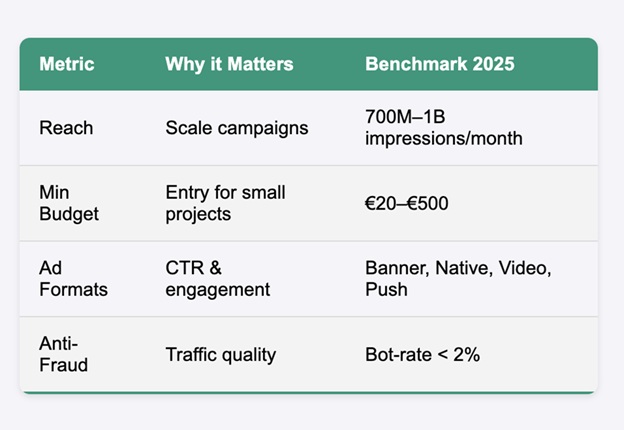
We evaluated networks based on 4 key metrics, using public sources and case studies:

  1. Reach: Total monthly impressions and audience relevance;
  2. Minimum Budget: Entry cost for small projects;
  3. Ad Formats: Banner, native, video, push notifications, and PR;
  4. Anti-Fraud Measures: Bot detection, manual vetting, AI or on-chain verification

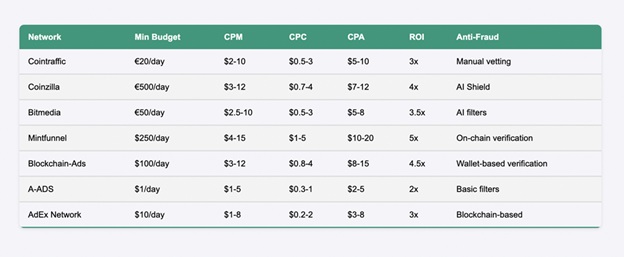
Criteria Table 2025
Overview of Top Crypto Ad Networks for Your Brand

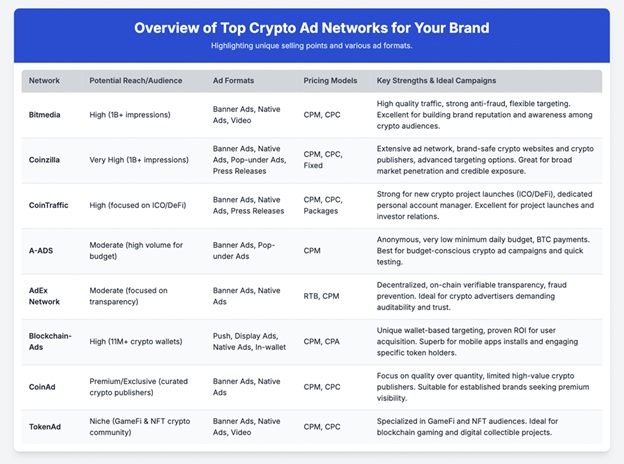
Here’s a look at some of the best crypto ad network options available, highlighting their unique selling points and various ad formats:
A Closer Look at Prominent Crypto Advertising Networks
Bitmedia

Bitmedia has earned its reputation as a leading crypto ad network due to its commitment to providing high quality traffic from a vast network of reputable crypto websites. It offers advanced targeting options, allowing advertisers to precisely reach their desired target audience based on geo targeting, device targeting, and specific interests within the crypto space.

With strong anti-fraud measures in place, Bitmedia ensures that your crypto ad spend translates into genuine impressions and clicks. It supports various ad formats, including banner ads, native ads, and video, making it a versatile choice for building brand awareness and driving qualified high quality traffic.

Coinzilla

Coinzilla stands out for its massive reach and robust platform, connecting crypto advertisers with a broad vast network of brand-safe crypto websites and crypto publishers. It provides a comprehensive suite of ad formats, including display advertising (like banner ads), native ads, pop-under ads, and options for press releases distribution.

Coinzilla is highly regarded for its robust anti-fraud measures and sophisticated targeting capabilities, ensuring crypto advertisers connect with a relevant audience and that campaign performance is strong. Its diverse pricing models (CPM, CPC, and fixed packages) offer flexibility for marketing campaigns of various sizes and objectives, making it a go-to choice for extensive brand exposure and market penetration within the ad industry.

Cointraffic

Cointraffic has earned its reputation as a top crypto advertising network, particularly well-suited for ICO and DeFi projects looking to make a significant impact during their launch campaign phases. The ad network offers personalized service, including a dedicated personal account manager who provides guidance and support throughout the crypto ad campaign.

Cointraffic rigorously vets its crypto publishers inventory, guaranteeing high quality traffic and placements on legitimate crypto websites. With support for banner ads, native ads, and press releases, Cointraffic is an excellent option for new crypto project ventures aiming to build early momentum and foster a strong crypto community.

A-ADS (Anonymous Ads)

For crypto advertisers whose priority is a low entry barrier, anonymity, and cost-effectiveness, A-ADS is an ideal choice. A-ADS campaigns can be launched with minimal personal information and a very minimum daily budget (some starting as low as $1), primarily paid in Bitcoin. A-ADS operates on a CPM model, focusing on delivering high volumes of impressions quickly, making it excellent for budget-friendly marketing campaigns or initial testing.

While A-ADS might not offer the deep targeting capabilities of more premium ad network options, its simplicity and accessibility make it perfect for rapid testing, niche campaigns, or extending crypto ad reach without a significant financial commitment.

AdEx Network

AdEx is a pioneer in decentralized crypto advertising network solutions, built on blockchain industry technology to ensure unparalleled transparency and combat bot traffic and ad fraud at its core.

Every crypto ad impression and click is recorded on-chain, providing verifiable proof and eliminating the need for intermediaries. This focus on trust and auditability makes AdEx highly appealing to crypto advertisers that prioritize transparency in their crypto ad spend. It supports banner ads and native ads and uses a Real-Time Bidding (RTB) model, allowing advertisers for efficient and fair crypto ad placements. AdEx is an excellent option for those who value verifiable results and a strong stance against fraudulent activities.

Blockchain-Ads

Blockchain-Ads offers a cutting-edge approach with its wallet-based and on-chain activity targeting, allowing advertisers to reach crypto users based on their actual crypto holdings and interactions. This innovative targeting method ensures hyper-relevance and highly engaged crypto audiences.

The ad network provides diverse ad formats, including highly effective push notifications, display ads, native ads, and unique in-wallet ad formats. Blockchain-Ads has demonstrated strong ROI, particularly for user acquisition and mobile apps installations, making it a powerful platform for crypto project initiatives focused on measurable campaign performance. It often receives praise for its exceptional service.

Anti-Fraud & Compliance

  • Manual vetting (Cointraffic);
  • AI-powered fraud shield (Coinzilla, 2024);
  • On-chain verification & wallet checks (Mintfunnel, Blockchain-Ads);
  • KYC for publishers, MiCA/FinCEN compliance for EU/US projects.

Crypto Marketing Strategic Considerations for Your Crypto Ad Campaign

To ensure your marketing campaigns are successful, keep these practical tips in mind:

  • Align with Your Goals: Before selecting a crypto advertising network, clearly define your crypto ad campaign objectives. Are you focused on brand recognition (CPM), driving website traffic (CPC), or achieving conversions (CPA) like sign-ups or token purchases?
  • Start with a Test Budget: Don’t commit a large sum initially. Allocate a small test budget (e.g., $500 – $2,000) to experiment with different crypto ad networks, ad formats, and targeting strategies. Analyze the data to see what performs the best crypto ad network.
  • Monitor and Optimize: Regularly review your campaign performance analytics, which provide detailed insights. Pay attention to click-through rates (CTR), conversion rates, and the quality of high quality traffic. A/B test your crypto ad creatives, landing pages, and calls to action to continually improve campaign performance.
  • Combat Fraud: Always prioritize ad network options with strong anti-fraud measures. Bot traffic can drain your budget without delivering any real value. Look for transparency in fraud detection to protect advertisers.
  • Consider Niche Networks: If your crypto project targets a very specific segment (e.g., GameFi, NFTs), specialized crypto ad networks like TokenAd might offer more concentrated access to your desired target audience. You might also explore influencer marketing to complement these efforts.
  • Leverage Case Studies: Look for leading crypto ad network providers that provide real-world success stories or case studies, as these can offer valuable detailed insights into their effectiveness for crypto project promotions similar to yours.

Step-by-Step Launch Guide

  • Create an account on selected network(s);
  • Upload creatives (HTML5 ?120 KB);
  • Set geo, device, and interest targeting;
  • Start with test CPM: €0.20–0.60 (Cointraffic avg);
  • After 48h, pause sites with CTR <0.2%;
  • Monitor KPIs: CTR, CPA, D7 retention;
  • Run A/B tests to optimize creatives & targeting

Common Mistakes

  • Overpaying for above-the-fold banners on low-traffic sites;
  • Ignoring frequency capping – banner blindness;
  • Buying only CPM without UTM tags – impossible to calculate CPA;
  • Launching one network instead of testing multiple.

Key recommendations:

  • Small test budgets: Cointraffic or A-ADS;
  • Large reach/brand awareness: Coinzilla;
  • Wallet-based/on-chain targeting: Mintfunnel or Blockchain-Ads;
  • Launch two networks with different strengths, monitor CTR, CPA, and D7 retention

Conclusion: Empowering Your Crypto Brand’s Growth

Specialized crypto ad networks empower Web3 projects to reach highly relevant, crypto-native audiences. By leveraging networks with AI anti-fraud, wallet-based targeting, and diverse ad formats, advertisers can maximize ROI, manage risk, and scale campaigns effectively. Testing multiple networks with different strengths ensures optimized campaigns, better CPA, CTR, and retention.

How Monitoring Tools Can Strengthen Business Infrastructure

0

Maintaining a strong and efficient infrastructure is more critical than ever. Companies face constant pressure to optimize operations, reduce downtime, and enhance performance across multiple departments. One of the most effective ways to achieve this is through the implementation of monitoring tools. These tools provide real-time insights, streamline processes, and enable data-driven decision-making that strengthens the overall business infrastructure.

Enhancing Operational Efficiency

Monitoring tools allow businesses to keep a close eye on daily operations, identifying inefficiencies before they become significant issues. From tracking employee productivity to managing resources, these tools offer a clear picture of how each component of the business functions. By analyzing the data provided, management can make informed decisions that reduce waste, optimize workflows, and ensure that projects are completed on time. A well-monitored infrastructure means fewer bottlenecks and a smoother, more predictable operation.

For companies with a fleet of vehicles, a vehicle tracker can be particularly valuable. It enables real-time tracking of assets, ensuring that deliveries, service calls, or transportation tasks are executed efficiently. This not only reduces fuel and maintenance costs but also improves customer satisfaction by providing accurate timing and updates.

Improving Risk Management

A robust business infrastructure must be resilient against potential risks, ranging from technical failures to human error. Monitoring tools play a crucial role in risk management by providing early warnings about potential problems. For example, IT systems can be monitored for unusual activity that might indicate a security threat, while equipment can be tracked for signs of wear or malfunction. Proactive monitoring allows businesses to respond quickly, mitigating risks before they escalate into costly disruptions.

Additionally, monitoring tools help in compliance management by tracking operational procedures and ensuring that standards are consistently met. This can prevent legal issues, safeguard the company’s reputation, and support long-term business stability.

Supporting Data-Driven Decisions

One of the most significant advantages of monitoring tools is the wealth of data they provide. Access to accurate, up-to-date information empowers management to make decisions based on evidence rather than assumptions. This can include optimizing supply chains, managing inventory, or allocating resources more effectively. By leveraging data insights, businesses can adapt quickly to changing market conditions and maintain a competitive edge.

Monitoring tools also help in identifying patterns and trends that may not be immediately visible. For instance, recurring delays in a certain part of the process can be pinpointed and addressed before they affect overall performance. Over time, this continuous feedback loop strengthens infrastructure by ensuring that processes are continually refined and improved.

Enhancing Communication and Collaboration

Strong infrastructure is not only about systems and processes; it also relies on effective communication across teams. Many monitoring tools include features that facilitate collaboration, such as dashboards, alerts, and shared reporting. When team members have access to the same real-time information, decision-making becomes faster and more coordinated. Departments can work together more effectively, reducing misunderstandings and enhancing overall productivity.

Building a Resilient Future

Investing in monitoring tools is an investment in the resilience of your business infrastructure. By providing transparency, improving operational efficiency, supporting data-driven decisions, and enhancing collaboration, these tools create a foundation for long-term growth and stability. Businesses that embrace monitoring solutions are better equipped to navigate challenges, seize opportunities, and maintain high standards of performance.

In a world where efficiency and responsiveness are critical, monitoring tools offer a tangible advantage. From tracking vehicles to analyzing operational data, they strengthen every aspect of business infrastructure, ensuring companies remain agile, informed, and resilient in the face of change.

Health in the Age of Search: Insights for Nigeria’s Care System

0

In Nigeria today, the internet has become one of the first places people turn to when they have health concerns. Search engines are no longer just tools for quick answers. They have become windows into what people worry about, what they are curious about, and where they feel gaps in knowledge. Looking at how Nigerians searched for health information between 2020 and 2024 reveals a story that is both striking and insightful.

Between 2020 and 2021, there was an explosion of interest in health-related searches. This was the time of the pandemic, when fear and uncertainty were at their peak. Searches about diseases, treatments, and diagnoses rose sharply as people sought clarity about what was happening around them. By 2022 and 2023, this interest reached its highest point. In 2024, the numbers dipped slightly but still remained far higher than before the pandemic. This shows that Nigerians have developed a lasting habit of using the internet to explore health questions.

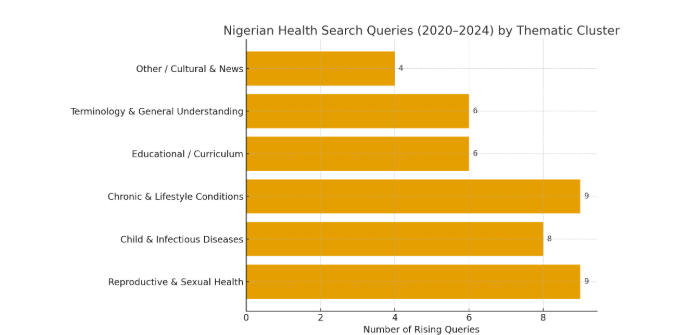
When we look at the specific searches that people made, a few clear themes stand out.

Source: Google, 2020-2024; Infoprations Analysis, 2025

The first and most prominent theme is reproductive and sexual health. Nigerians searched extensively about pelvic inflammatory disease, asking about antibiotics, treatment options, and whether infertility could result from it. People also searched for terms such as sperm leakage treatment, toilet infections, and white discharge. These searches suggest that many people prefer to look for private answers online rather than consult a doctor, especially when it comes to sensitive health issues.

The second theme is child and infectious diseases. Malaria, typhoid, and measles remain top of mind for many Nigerians. Searches about typhoid injections and the Widal test show how widespread these concerns are. Even local terms like “Apollo eye disease,” which refers to conjunctivitis, appear in the data. At the same time, global outbreaks such as Marburg virus also found their way into Nigerian search history, showing how international news can shape local health curiosity.

Another growing area is chronic and lifestyle conditions. Nigerians are increasingly searching for information about illnesses such as dementia, Alzheimer’s disease, Parkinson’s disease, kidney conditions, and thyroid problems. On a lighter side, people are also concerned about skin and hair issues, with searches for eczema, hyperpigmentation, and dandruff treatment. This shift signals that more Nigerians are paying attention to conditions linked to aging and lifestyle, not just infectious diseases.

Education also plays a surprisingly strong role in shaping health searches. Many queries come directly from schoolwork. Students typed in questions like “pyorrhoea is a disease of,” “seed treatment is done to control,” and “chlorine is used in water treatment.” At the university level, nursing students searched heavily for information about nursing diagnoses, community health terms, and lists of conditions. Clearly, search engines are now doubling as textbooks for students across the country.

Another interesting cluster of searches revolves around basic medical understanding. Many people looked up the meaning of common words such as diagnosis, prognosis, and symptoms. They searched for the difference between diagnosis and diagnoses, and for other ways of expressing the same terms. This shows that while people are curious about health, there are still gaps in how easily they understand medical conversations.

Our analysis also reveals cultural and news-driven searches as another cluster. Local nicknames for illnesses appear often. “Sweetie disease” is commonly used to describe diabetes, while “Goloria disease” seems to be a misspelling of gonorrhea. On the global stage, searches like “King Charles diagnosis” gained attention, showing that international headlines can drive local curiosity. Even phrases like “the royal treatment,” unrelated to healthcare, surfaced because of their popularity in everyday conversations.

Together, these patterns indicate that Nigerians are using the internet to fill gaps in access to health information. They are trying to understand both everyday issues and complex diseases. Students rely on online searches for their academic work, while adults use them to find private answers to sensitive questions. Chronic illnesses are gaining more attention, but infectious diseases remain a constant worry.

For health leaders in Nigeria, this digital trail is not just data. It is a guide. Policymakers can see where education campaigns are needed. Doctors and nurses can prepare for patients who arrive already influenced by what they have read online. Educators can integrate digital resources more deliberately into classrooms. Above all, it shows that clear, simple, and accessible communication about health is more important than ever.

The internet does not just record curiosity. It records need. In Nigeria, the searches people make between 2020 and 2024 reveal a population eager to learn and take charge of their health. To truly improve health outcomes, leaders must pay attention to this digital pulse. The future of Nigerian healthcare will not be shaped only in clinics and hospitals. It will also be shaped in search bars.

Klarna Revives U.S. IPO Plans at Sharply Lower Valuation After Workforce Cuts and Market Jitters

0

Swedish fintech giant Klarna is set to revive its long-awaited initial public offering (IPO) in the United States next month, targeting a valuation of between $13 billion and $14 billion, Reuters reports, citing two people familiar with the matter.

The move marks a significant step forward for the buy-now-pay-later (BNPL) pioneer, but at a valuation far below the $50 billion peak it once commanded during the pandemic-era boom.

The company, which had paused its listing plans in April after President Donald Trump’s sweeping tariffs rattled global markets, appears emboldened by the recent resurgence in U.S. equities and a string of blockbuster IPO debuts that have rekindled investor appetite. Klarna had previously considered going public in 2021 but opted to wait.

Shares sold in the offering could be priced at between $34 and $36 as early as this week, one of the sources said. The company is expected to raise close to $1 billion through the IPO.

A Leaner Klarna Ahead of Market Debut

A major backdrop to Klarna’s renewed listing attempt is its sharp workforce reduction, which has fundamentally reshaped the company. In May, Klarna revealed that it had cut nearly 40% of its workforce, attributing the downsizing to a mix of artificial intelligence integration and natural attrition.

Chief Executive Officer Sebastian Siemiatkowski, speaking on CNBC’s Power Lunch, confirmed the scale of the cuts.

“The truth is, the company has shrunk from about 5,000 to now almost 3,000 employees,” he said. “If you go to LinkedIn and look at the jobs, you’ll see how we’re shrinking.”

While Klarna described the reductions as part of a broader technological shift, analysts believe the cuts are also linked to the company’s IPO preparation, aimed at presenting a leaner, more profitable profile to investors after years of rapid but costly expansion.

Valuation Slide

The anticipated $13–$14 billion valuation marks a steep decline from Klarna’s once lofty heights. At its peak in 2021, amid a global surge in e-commerce and BNPL adoption, Klarna was valued at close to $50 billion, briefly making it Europe’s most valuable startup. Even earlier this year, its valuation exceeded $15 billion before recent market recalibrations.

The scale of the drop underscores the sobering reality for many fintechs that soared during the pandemic but have since faced investor skepticism about long-term profitability, regulatory scrutiny, and rising competition from traditional banks and tech giants expanding into payments.

IPO Tailwinds

Despite the lower valuation, Klarna’s timing may be favorable. Equity markets have shown strength in recent months, buoyed by robust earnings and an improved risk appetite. The IPO window, which had been largely frozen during much of 2022–23, has reopened with notable success stories.

Design software maker Figma and stablecoin operator Circle have delivered extraordinary gains since their listings this year, with shares peaking 333% and 864% above their IPO prices, respectively. Data compiled by LSEG shows that the 20 biggest U.S. IPOs this year have averaged a 36% first-day share price rise, fueling optimism for upcoming offerings like Klarna’s.

Operationally, Klarna has continued to show resilience even amid restructuring. Earlier this month, the company reported that its second-quarter revenue rose 20% year-on-year on a like-for-like basis to $823 million, while adjusted operating profit climbed to $29 million, up by $1 million from the prior year.

Customer growth has also been strong. Active users rose 31% year-on-year to 111 million, signaling continued global demand for its BNPL services, particularly among younger consumers seeking flexible payment options at checkout.

Klarna’s revival of its U.S. IPO plan highlights a balancing act between investor confidence, market conditions, and its own restructuring. The workforce cuts suggest an effort to realign its cost structure with profitability goals, especially as AI-driven efficiencies reduce the need for human labor. Yet the steep drop in valuation illustrates how fintech optimism has been tempered since 2021, when cheap capital and booming online shopping fueled sky-high valuations.

The company’s ability to raise close to $1 billion, if achieved, would provide fresh capital to support expansion and fend off intensifying competition from rivals such as Affirm in the U.S. and PayPal’s BNPL services. But investor sentiment may hinge on whether Klarna can sustain profitability without sacrificing growth. However, the confluence of stronger equity markets and robust IPO performance gives Klarna a much-needed tailwind.