DD
MM
YYYY

PAGES

DD
MM
YYYY

spot_img

PAGES

Home Blog Page 6342

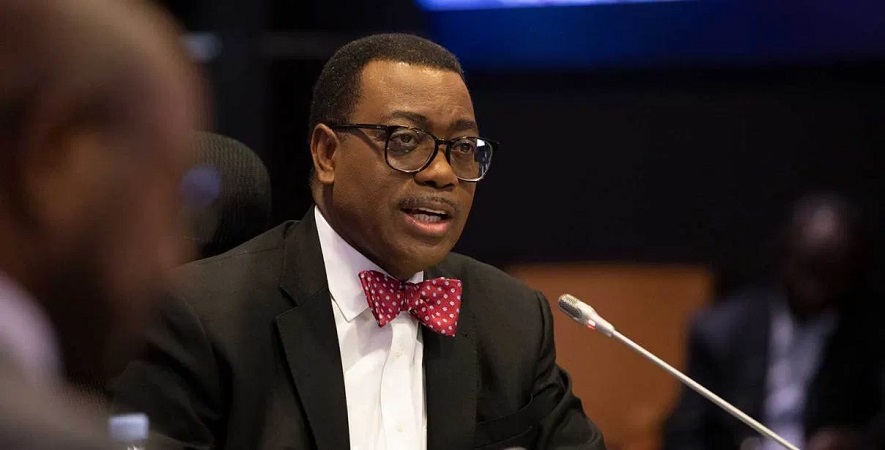
Akinwumi Adesina: AfDB Board Approves An Independent Review (Full Text)

3

As expected, the Board of the African Development Bank (AfDB) will appoint an independent attorney to look at the Ethics Committee report on complaints against the Bank President, Akinwumi Adesina. They just issued a communique today (Thursday, see below). This independent overview is close to what the U.S. had asked for.

There are no surprises, I wrote a few days ago thus: “Many here have written that African Union and AfDB should just ignore the U.S. and carry on. That would be a momentous stupidity because if the U.S. treasury classifies AfDB as a “corrupt institution”, rightly or wrongly, the bank will crash.” You do not mess up with America when it comes to banking ordinance because the U.S. dollar and its banking institutions run the world. 

However, based on the views of some Governors on the matter and the need to carry every Governor along in resolving it, the Bureau agrees to authorize an Independent Review of the Report of the Ethics Committee of the Boards of Directors relative to the allegations considered by the Ethics Committee and the submissions made by the President of the Bank Group thereto in the interest of due process.

Even the AfDB President will not fault the conclusion of the Board as he does know the implications of going against the wishes of the U.S Treasury. His meeting with Nigerian President would have fixed his problems, but unfortunately, Nigeria is a spoke in the wheel of global banking – and the U.S. owns the whole wheel. I had commented on that Mr. Buhari  meeting thus: “President Buhari makes his support to Akinwumi Adesina, African Development Bank (AfDB) president, evidently public. Ideally, that should do it for the AfDB President on the allegations leveled against him”. But America has different ideas.

Now, game on, this may be the best outcome for Adesina. If an independent attorney clears him, he would be cleared indeed! Yes, even though the independent review will focus on reviewing the Ethics Committee decision,  there is a clear correlation here: if the committee has done a good job, Adesina smiles. But if the Review says the committee did not do a good job, it becomes an issue, and a new investigation may be needed. So, why the Review is not probing or investigating the direct allegations, its conclusion remains a matter that will affect the President’s interests. When you review a report of a probe, you are indirectly “probing” the original incident!

And those African ex-presidents who wrote that letter, making a case against an independent attorney,  should now understand how their lack of visioning  has denigrated the standing of Africa in the global arena. The African Development Bank is a cash center for the United States in Africa, not even a full bank branch!


The full statement

Communique of the Bureau of the Boards of Governors of The African Development Bank Group following its Meeting of 4th June 2020 regarding the whistle-blowers’ complaint against the President of the Bank

  • The Bureau reiterates that it agrees that the Ethics Committee of the Boards of Directors performed its role on this matter in accordance with the applicable rule under Resolution B/BG/2008/11 of the Board of Governors.
  • b)The Bureau also reiterates that the Chairperson of the Bureau of the Board of Governors performed her role in accepting the findings of the Ethics Committee in accordance with the said Resolution.
  • c)However, based on the views of some Governors on the matter and the need to carry every Governor along in resolving it, the Bureau agrees to authorize an Independent Review of the Report of the Ethics Committee of the Boards of Directors relative to the allegations considered by the Ethics Committee and the submissions made by the President of the Bank Group thereto in the interest of due process.
  • d)The Independent Review shall be conducted by a neutral high caliber individual with unquestionable experience, high international reputation and integrity within a short time period of not more than two to four weeks maximum, taking the Bank Group’s electoral calendar into account.
  • The Bureau agrees that, within a three to six month period and following the independent review of the Ethics Committee Report, an independent comprehensive review of the implementation of the Bank Group’s Whistle-Blowing and Complaints Handling Policy should be conducted with a view to ensuring that the Policy is properly implemented, and revising it where necessary, to avoid situations of this nature in the future


Comment from LinkedIn Feed

Comment #1: Just to be clear, what have been authorized is “an Independent Review of the REPORT of the Ethics Committee” and not a look at the whistleblower complaints against the President. There is a clear difference.

Comment #2: Prof, please fact-check. The Board will allow an “independent review” of the approved report, not an “independent investigation” into the matter. US can have its say but the AfDB Board will have its way.

My Response: I think the title of this piece is Independent Review. There is no confusion there. However, when you probe a report, you are also probing what the report looked at. Everyone is an adult and we understand. While there is a difference, it is an independent person doing it. The key word is “independent”.

Covid-19 Is Redesigning Global Payments, Killing Cash

1
Nigeria Naira US Dollar

Across America, Covid-19 is bringing a new ordinance in one small piece which travelers experience daily: paying toll gates with cash. As the virus dislocated market systems, making touching cash a dangerous decision, state governments moved quickly to digitize toll payments. It seems very simple but it is a momentous decision because a few years ago, some activists went to courts to protest their rights to pay for things, with cash. Yes, even if you digitize your restaurant payments, you must still have a mechanism to collect cash from customers.If you do not do that, you are breaking the law of the land. But now, paying tolls in most locations would be all electronic. Only Covid-19 made that possible. Companies like Chipotle, an eatery chain, have eliminated cash payments. Either you pay with a card or you go hungry.  

That takes me to what is happening across East Africa. Rwanda now requires people to pay through digital means in Kigali. Uganda wants the informal okada riders to join e-hailing companies which have better tools for digital payments. And Kenya has taken it all the way: “Kenya’s National Transport and Safety Authority (NTSA) wants privately-owned minibuses involved in public transportation to start using cashless payments to collect fares”.

Kenya’s National Transport and Safety Authority (NTSA) wants privately-owned minibuses involved in public transportation to start using cashless payments to collect fares. When in force, customers will be required to make payments with their phones while boarding ‘matatus’ as the minibuses are called in Kenya. To achieve this, the NTSA has reportedly called for bids from tech companies who will take up the task of installing necessary software on the matatus.

While the immediate motive appears to be linked with limiting COVID-19 spread, the move ties into a noticeable wave in East Africa to digitize payments in the transport sector. In Uganda, the government wants informal motorcycle drivers to join e-hailing companies, while the Rwanda Utilities Regulatory Authority recently directed all motorcycle taxi operators in Kigali to have meters and collect payments using only digital means. (TC Daily newsletter)

You know the implication? These cities and nations are advancing and will possibly formalize their largely informal economic systems.  Most of these redesigns would not have happened without Covid-19 as some activists would have mounted ferocious challenges. But with the virus ravaging things, those counter-calls have been muted. Why? If you think collecting cash is the way to go, governments will ask you to go and mount the toll gates and be paid for doing that job. 

Covid-19 is evil. Yet, it has provided opportunities for some economies to reform. I do hope Nigeria takes actions across our market sectors and territories. There are many positive things the government can do now with no opposition in the name of Covid-19. Call this moment a generational opportunity to bring reforms in markets and economic structures.

Are Women Truly Afraid of Men?

0

Some days ago, the Nollywood actress, Genevieve Nnaji, took to her Twitter page to condemn the murder of Tina Ezekwe and Vera Omozuwa. While lamenting their demise, she said that women “live in constant fear of men”. This comment has raised dusts all over the social media platform and beyond as both men and women questioned, rejected or agreed with her. It was indeed a deep recognition of what many women pass through, or believe they pass through.

But the key question here is, “Are women really afraid of men?”

Many women in the world can attest to the fact that they were raised to see men as the stronger sex. Women were taught to stay away from men so they don’t get hurt. Women were taught that they are no match to men in physical fight. And the majority of them have experienced that feminine “lack” of physical strength. But does that mean that women live in constant fear of men?

Maybe Genevieve Nnaji made that comment without knowing how deep it will cut. Her statement caused women to reflect on why they avoided men, especially in dark and lonely places. She caused men to wonder if there is an impending gender-war brewing. From all I could see, men do not understand the reason why women should be afraid of them and women couldn’t tell exactly why they are afraid of men.

Some women may be fast to say that they are truly afraid of men forgetting that they have male colleagues with whom they work comfortably with. Many women are not afraid of interacting and relating with their male relatives, friends and neighbours. So, it will be out of place to say that women are afraid of men.

But that notwithstanding, there is a deeper reason behind Genevieve’s statement. Truth is that what women are afraid of are not men, but what men represent. Women are not afraid of the male gender; they are afraid of what men are capable of doing. Put simply, the problem is with the action and not with the doer. In other words, women are cautious around men because they wouldn’t want to experience those actions.

Now you may ask, “What is it that men do that women don’t do?” And to that I will tell you, “Nothing”. I will explain this with these three major vices attributed to men folk – physical assault, robbery and sexual harassment.

Physical Assault

Experience taught women that they cannot fight men, at least not physically. People like me tried that severally and failed woefully and bitterly. So deep down women know that they wouldn’t want to challenge or stand to experience any physical attack from any man. So women are not afraid of the man but of the pain he will cause them.

Note that men are not the only ones that physically attack people. Women do that too, a lot. And theirs are quite deadly. But then, a woman doesn’t run away from another woman. Even if she’s being attacked by many women at the same time, she will stay back and fight it out because somewhere at the back of her mind she believes she will not be injured by a woman as she would have been hurt by a man.

Robbery

Someone said that if she’s jogging and sees a man behind her, she will move faster. She’s not the only one here; many women can attest to that. If you ask why they do this, they might tell you they suspected that the man was a thief that wanted to snatch their phones or purses. And sometimes, they’re right.

For some reasons, it is hard to attach a feminine face to robbery. Most robbers are men. Even our folktales represent stealing with male characters. This explains why people hardly feel uncomfortable when they find themselves on lonely roads with a woman. Some of us do not enter public transports when it is occupied by only men even though we know that many deadly robbers are women. This is just to say that when women think about thievery, they think about men; it is not the other way round.

Sexual Harassment

This is the height of it. Every girl-child is constantly warned by her parents to avoid being alone with men because she might get raped. This same child hears stories about girls being sexually harassed by men or she might even experience it. So women actually live in constant fear of rapists. Unfortunately for men, the face of a rapist is the face of men. So when women fear rapists, they actually fear men.

I think it is extreme to say that women are afraid of men. No, women are not afraid of men; they are only afraid of vices committed by hoodlums. They are afraid of dangers that will put them through pains. The only crime committed by men here is that many hoodlums are men (though this is not scientifically proven). It is therefore left for the men folk to sanitise their gender so as to get rid of the bad eggs among them.

But we should not forget that all vices do not bear men’s faces. Women do have their own areas of specialty when it comes to heinous crime. But that doesn’t make us afraid of women. In other words, we don’t need to tag faces to crime as that will be deceptive. Rather, we should focus on how to eradicate crimes.

A Microsoft Business & Tech Leader Will Teach Cloud & AI In Tekedia Mini-MBA

0

He is a business and technology leader with deep financial and business acumen derived from close to two decades in the IT industry, covering sales, technology consulting and advisory. He worked with leading technology and telecommunications companies like Allied Computers, Resourcery Limited and MTN Nigeria. He holds a Bachelor’s Degree in Computer Science and Engineering from the prestigious Obafemi Awolowo University Ile-Ife.

Wale Olokodana, a Microsoft Azure Business Group Lead, will handle our Cloud and AI session during the Tekedia Mini-MBA. Cloud computing has become exceedingly critical in today’s business sphere, and AI is already emerging to architect a new paradigm in the mechanics of global commerce and industry. 

Come and understand cloud and AI, for your business innovation & growth, at Tekedia Mini-MBA; REGISTER.

https://www.tekedia.com/mini-mba-2/

Embracing the New Normal with Coronavirus: PPE Enhancement and Societal Awakening

0

In a bid to proffer solution to the corona virus pandemic ravaging the whole world, G.Okewih designed a two-pronged approach comprising of ‘A medical Personal Protective Equipment (PPE) enhancement jacket’ and ‘A Continuous Mass Sterilization Program (CMSP)’.

The PPE enhancement jacket focuses on providing extra measure of protection to health workers and frontline covid-19 respondents, while the CMSP puts humanity on the offensive against covid-19. While physical distancing and the use of general protective equipment like face masks is a good measure, they are quite passive. A combination of CMSP, physical distancing and protective equipment is a more active approach to combating the menace called SARS-CoV-2.

A successful deployment of this approach would require a high degree of cooperation between adopters, and adequate sensitization and enlightenment of health workers, frontline respondents and the general public.

The nature of the corona virus pandemic has to some extent dampened globalization and has forced all nations of the world to look inwards and provide solutions for themselves in the short to midterm. Nigeria is no exception, and we shall surely prevail.

INTRODUCTION

The corona virus code named ‘Covid-19’ has shaken the very core of human civilization, it literally declared war on humanity as a social being; targeting our freedom, lifestyles, economies, health and even our lives. It ushered in a different kind of warfare, very different from WW I and WW ll, a kind that our fierce tanks, missiles, fighter jets, nuclear weapons and soldiers are powerless against; a kind of warfare that unites all mankind against a common enemy.

This new kind of warfare isn’t fought by soldiers, but by medical practitioners, frontline respondents, medical scientists, paramedics and health sector workers. However, as more of these frontline respondents get infected with the virus, their numbers reduce and their confidence diminishes. Though conventional medical PPE (Personal Protective Equipment) protects health workers to some extent, they don’t entirely prevent health workers from mistakenly infecting themselves with the virus by either their own gloved hands or from the PPE itself.

In a bid to defeat a common enemy, the G.Okewih two-pronged approach aims to better protect our frontline workers from contracting the virus from patients, and to collectively put humanity on the offensive against the virus prior to the emergence of a vaccine.

THE APPROACH

The two-pronged approach includes:

  1. A PPE Enhancement Jacket.
  2. Continuous Mass Sterilization Program (CMSP).
  • PPE Enhancement Jacket

The PPE enhancement Jacket is a multipurpose waistcoat suited for reducing the rate of exposure of health workers and other frontline respondents, when attending to persons infected with covid-19 and other contagious diseases. A pictorial sketch representation is given below.
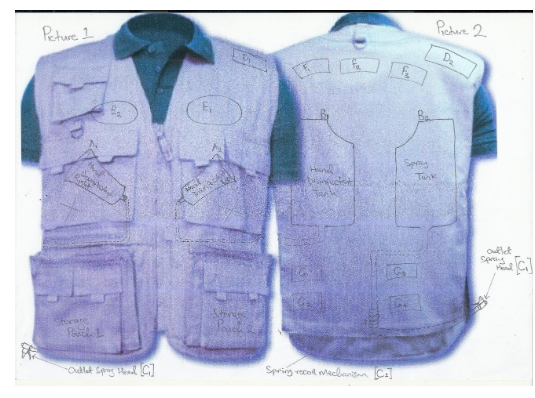
From picture 1 [front facing] above,

  • Pockets A1 and A2 are hard plastic cases, sewn into the fabric at the front of the Jacket, both with openings, that can simultaneously accommodate the left and right hands of a health worker or frontline respondent, for instant automatic or manual hand sanitization, before reaching out to touch personal items, other items or scratch.
  • Storage pouches 1 and 2 are convenient and easily accessible front pockets for storing essential and personal items for the health worker or frontline respondents. These pouches are waterproof and prevent the passage of vapour.
  • Outlet spray head C1 is a small retractable hose, capable of spraying disinfectant at moderately high rates. This hose can be pulled out from the bottom of the Jacket, and used to spray the entire PPE (including the Jacket) of the health worker or frontline respondent, as well as surrounding areas at regular intervals. It could also be used to spray patients exhibiting symptoms of a contagious disease prior to handling by the health practitioner. Persons wearing the Jacket should have their hands sanitized prior to handling C1.
  • D1 is a badge bearing a unique code for each Jacket. This code would prove useful for the second phase of the approach – The Continuous Mass Sterilization Program.
  • E1 and E2 are badges bearing logos of primary companies or organizations associated with the Jacket and program. While one would bear manufacturers logo, the other would bear the logo of partnering company or organization. 

From Picture 2 [rear facing] above,

  • C2 is a recoil mechanism embedded inside the Jacket that ensures C1 is retracted after being pulled out for use.
  • B1 and B2 are portable disinfectant storage tanks capable of holding between 1 – 2 litres each of disinfectant, depending on Jacket size. The tanks are located on the back of the Jacket, but sewn into its fabric, and are durable enough to withstand compression forces. While B1 would contain disinfectant for A1 and A2, B2 would contain disinfectant for C1.
  • D2 just like D1 would hold the same unique code but on the rear side of the Jacket.
  • F1, F2 and F3 are badges at the rear of the Jacket bearing the name, logo and/or details of the supervising Government body and location of operations of that specific Jacket. These come in useful in the second aspect of this approach.
  • G1, G2, G3 and G4 are badges of the logos of secondary companies or organizations associated with the Jacket and program; these could include sponsors to the program.

Relative to health workers and frontline respondents, the PPE Enhancement Jacket is most effective when used with conventional medical PPE.

Conventional Medical PPE          
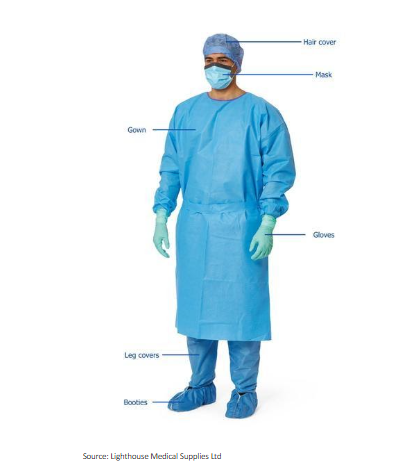
                    

                 Source: Lighthouse Medical Supplies Ltd

  • Continuous Mass Sterilization Program (CMSP)

Continuous mass sterilization is a program that seeks to utilize the services of at least 10% of the people in a geographical area or community at any given time as ‘Covid-19 Exterminators’, using the PPE enhancement jacket for the continuous sterilization of every area of that community that they ordinarily get to, while going about their daily lives. This could carry on for a 2 or 3 year period.

The program could have voluntary and compulsory exterminators, who are either ‘self sponsored’ or ‘program sponsored’. Individuals, companies, organizations and governments could provide jackets and disinfectant refills for registered ‘program sponsored’ exterminators at filling stations, on public transportation systems as well as in stores for easy accessibility. The goal would be to make disinfectant refills easily accessible to exterminators after jackets have been provided.

The compulsory exterminator services would be on a rotational basis over a period of time, amongst people within every geographical area, as a civic duty. The utilization of corps members of the National Youth Service scheme in Nigeria and its equivalent program in other countries could be considered. Also to be considered is the inclusion of paid exterminator services in certain areas.

A chart of the entire public transportation system and network in a geographical location, as well as areas prone to large gatherings should be mapped out, for easy assignment of exterminators to routes and areas.

Some of the possible high risk germs transmission areas could include but not limited to:

  1. Public transport systems: these must have exterminators on them at all times.
  1. City and local buses along the exterminators’ regular commute axis (front seats could be reserved for exterminators in local buses).
  2. Metro trains. A few minutes would have to be spared for the sanitization of every area of the train at each stop. Also, continuous sanitization of the Metro station by commuting and/or paid exterminators all day long.
  3. Motor parks/Bus stations/Bus stops
  4. Ferries and boats used for mass transportation
  5. Airplanes on local and international routes.
  1. Markets, Malls and Stores
  2. Street corners, Parks and public gardens
  3. Offices and office complexes – every office and business should have a specific number of exterminators available at all times depending on the size of the office and number of staff.
  4. Eateries, Restaurants, Lounges, Pubs and Bars
  5. Hospitals, Clinics and Pharmacies
  6. Banking halls and ATMs  
  7. Local and International Airports, as well as air cargo ports.
  8. Seaports, 
  9. Primary, Secondary and Tertiary schools – to include classrooms, lecture and assembly halls, sit out areas, gardens, hostels and general areas. 
  10. Police stations, prisons, military and paramilitary bases.
  11. Salons, studios and workshops
  12. Cinema halls and gymnasiums. 
  13. Occasions, Events and ceremonies venue. 

Relative to ‘physical distancing’, continuous mass sterilization is much more of an active approach to tackling contagious pandemics; when combined with physical distancing and protective equipments like face masks, continuous mass sterilization becomes quite formidable to flatten the ‘rate of infection’ curve.

Requirements from Adopters

Prior to getting the G.Okewih two-pronged approach fully functional in Nigeria, the PTF, NCDC and FMoH would be required to:

  1. Thoroughly vet the workability of both aspects of the approach.
  2. Intimate Federal and State governments on the approach.
  3. Sensitize and enlighten medical workers and the public on both aspects of the approach.
  4. Place purchase orders for PPE enhancement jackets – after necessary verifications.
  5. Outline a detailed framework for the deployment of the CMSP.
  6. Ensure adequate training of medical workers and frontline respondents on the functionality of the PPE enhancement jackets.

Notes, Comments and Conclusion

  • To some extent, the effectiveness of the G.Okewih approach in any given country would be determined by: Centre for Disease Control (CDC), Health practitioners, Government and General public.
  • A prototype PPE enhancement jacket would be made as sample.
  • The PPE enhancement jacket can be used multiple times for the CMSP and can be cleaned when dirty.
  • The disinfectant used in B1 and B2 should be effective against SARS-CoV-2, and could be alcohol based, chlorine based or some other base chemical. Though, due to the dangers of chlorine poisoning and the ‘Haram effect’ of using alcohol based disinfectant in the midst of Muslims, as well as the dangers associated with fires, an environmentally friendly disinfectant that is neither alcohol nor chlorine based, but still very effective against SARS-CoV-2 would be preferable.  
  • In Nigeria, for a more rapid deployment of this approach and to reduce hiccups caused by bureaucracy, portions of this approach could be deployed by the Private Sector Coalition Against COVID-19 (CACOVID).
  • The PPE enhancement jacket could conveniently be worn with other clothing without much discomfort to the exterminator.
  • Everyday people that are neither healthcare workers nor exterminators could purchase and wear the PPE enhancement jacket for increased protection against covid-19.
  • Closed national and inter-state boarders could hinder the sourcing of materials for mass producing the PPE enhancement jackets and certain aspects of the CMSP.
  • Under pressure to reopen the economy, the CMSP in conjunction with physical distancing and the use of face masks can prove quite effective against community spread of covid-19. The ‘G.Okewih Economic Restoration Model’ could also be considered for a rapid economic jumpstart.
  • To incentivize healthcare practitioners and frontline respondents in this battle against covid-19, life insurance packages could be opened for them. More importantly, there might be need to redeploy health workers to other places that are in short supply or deemed to have higher risks of contracting the virus. In such situations, cash bonus packages could be made available to them (1 – 2 Million Naira) and paid directly into their accounts such that it reflects on their account balance, but held frozen and inaccessible for the period of time they’re expected to be in those regions (3months, 6months, 1 year etc), until the expiration of their tours. These bonuses are different from their monthly salaries.
  • Owing to disruptions caused by the Covid-19 pandemic, nations of the world are currently too preoccupied with proffering solutions to their own problems to spare much thought for other countries. Each country is now saddled with the responsibility of providing its own solutions for itself, without the luxury of over dependence on the international community or WHO. Should treatments and vaccines be developed, the host country would be sure to cater for itself first.

In conclusion, to avoid a situation whereby our already inadequate healthcare system gets totally overwhelmed by the corona virus pandemic in Nigeria and Africa, it is paramount that frontline respondents get ahead of the situation as against current approach of ‘attempting to catch up’. This can be achieved by reinforcing frontline respondents, safe guarding healthcare practitioners and deploying active preventive measures. 

Nigeria and Nigerians are capable of providing solutions for themselves and exporting some of those solutions.