DD
MM
YYYY

PAGES

DD
MM
YYYY

spot_img

PAGES

Home Blog Page 6353

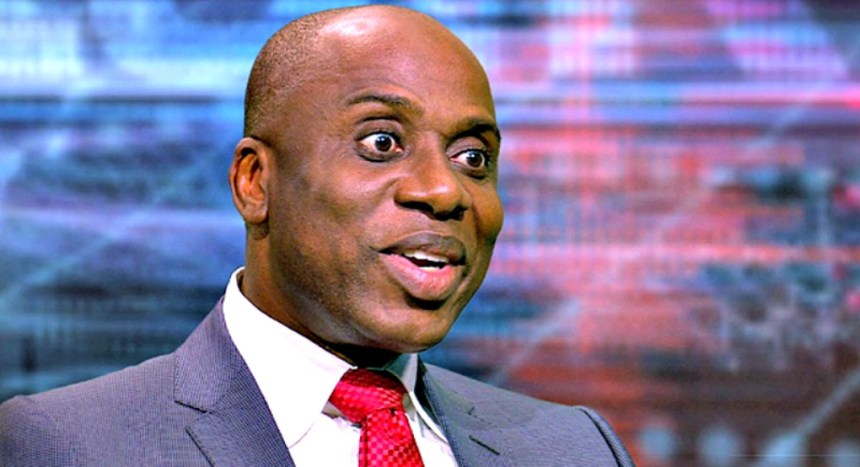
The Rotimi Amaechi’s Confession!

0
Nigeria's minister of transport

One of those accidental confessions that help us to understand! Interestingly, not many can claim they planned perfectly what they are doing today [I did not, still trying to understand why one is living outside Nigeria!). Politics to many Nigerian politicians is an industrial sector, never a call to service.  Amaechi studied English Studies and Literature in UNIPORT and might have struggled with unemployment.  So when the opportunity came via politics, he took his chances.  We hope his incentives have changed by now.

“I didn’t join politics because I wanted to be a leader or because I wanted to solve Nigeria’s problems. I joined because of unemployment. I also believe there is a part that grace played in it,” Rotimi Amaechi, Minister of Transport, Nigeria

Mr Amaechi, a graduate of English Studies and Literature from the University of Port Harcourt, had his first major political break in 1999 when he was elected as a member and then speaker of the Rivers State House of Assembly under the platform of the Peoples Democratic Party (PDP). He was re-elected to the position in 2003.

In 2007, he contested and won the party’s governorship ticket even though Celestine Omehia was declared the party’s flagbearer. The PDP won the election and Mr Omehia was sworn in as governor.

Mr Amaechi challenged Mr Omehia’s candidacy before a court and was eventually declared the rightful candidate of the PDP and winner of the April 2007 governorship election in Rivers State. He served twice as the state governor under the party before his defection to the All Progressives Congress (APC) in 2013

Your Job Title Matters

1

I left this comment on a feed on LinkedIn; I am sharing here. Yes, people do write that job titles do not matter. I will say please it does matter, and if you can get a better one, invest in it – and get it. Those days in Diamond Bank, I admired my entry level job title – Banking Executive. When they promoted me and gave me the Banking Officer title, it was very unfortunate for one to move from “Executive” to “Officer”.

In an engineering firm I worked in the U.S. post-PhD, there was no written policy on job title. You make up whatever you want for your business card. You do not blame the workers because you can be hired as Analog Design Engineer II, if you stay there for 30 years, you can end up, officially, with Analog Design Engineer XIII. Good luck explaining what the I, II, etc mean to friends. To fix that problem, leave the official title for paygrade, and pick anything you want for the outside, and feel happy.

LinkedIn does not have an option for Village Boy. Many of us would have gone for it. Simply, titles do matter especially in Africa. Many companies will make time for someone with a title Chief Marketing Officer when compared with a Sales Officer. As one of our faculty members discussed in Tekedia Min-MBA, sales management and marketing work on perception. And the messenger matters.  Yes, invest in that title and make sure they give you a good one in office. Titles are like ladders to higher titles and they directly or indirectly showcase responsibilities. 

It is a big illusion to think people do not pay attention to titles: who wants to meet the deputy managing director when the managing director is also available?

Leading and Managing Teams – A Shell Manager To Lead Session

0

Good People, I am very happy to share that Dr. Chisom Ezeocha, a Project Delivery Manager with Shell will lead a season on Leading and Managing Teams for Tekedia Mini-MBA which begins June 22. Like Chidi Nwosu, who trades oil (lol) for Nigeria in NNPC (he will handle a session on “Global Energy Mix and Energy Economics “), and Nnamdi Onyebuchi, CEO of ICT leader, Weco Systems Group (he will lead a session on “Execution – Business Objectives and Technologies”), Dr. Ezeocha brings excellence which all of us shared as classmates in FUTO.

Chisom has managed global technical teams in Africa and around the world. He served as the Head of Offshore Field Engineering for 6 years in Brunei Shell Petroleum. He will be sharing with us how to lead and manage global  teams. I invite you to join him and other business leaders from MIT, Flutterwave, Deloitte, Schlumberger, Nigerian Breweries, BUA Group, Sherwin Williams, American Tower, Afrinvest, Coca Cola, GIG Logistics, etc.

Tekedia Mini-MBA is a community service from the non-profit African Institution of Technology..

https://www.tekedia.com/mini-mba-2/

TSMC to Build a $12 Billion Semiconductor Factory in U.S.

0

On Friday, Taiwan Semiconductor Manufacturing Co (TSMC) announced that it will build a $12 billion semiconductor plant in the United States. The announcement came amidst growing tension between China and the US that is threatening to disrupt its Asia-based supply chain.

TSMC said the project will commence in 2021, and will have the capacity to employ 1,600 workers as the factory focuses on the production of the latest in semiconductor technology, the 5-nanometer chips.

“This project is of critical, strategic importance to a vibrant and competitive U.S. semiconductor ecosystem that enables leading U.S. companies to fabricate their cutting-edge semiconductor products within the United States and benefit from the proximity of a world-class semiconductor foundry and ecosystem,” TSMC said in a statement.

The long battle of technology supremacy between China and the US took a new dimension earlier this year, when the Trump administration ordered TSMC to halt its business relationship with Huawei. The US’s quest to stop its dependence on China for semiconductors saw a cutting edge with this development.

The US Secretary of States, Mike Pompeo says the development bolsters the country’s national security.

“The U.S. welcomes TSMC’s intention to invest $12B in the most advanced 5-nanometer semiconductor fabrication foundry in the world. This deal bolsters U.S. national security at a time when China is trying to dominate cutting-edge tech and control critical industries,” he wrote on Twitter.

It has been a battle for supremacy between the two economic powers to control critical tech industries in the world. Last year, the U.S. warily kicked Huawei out citing national security. Huawei was in the forefront of the 5G roll out and was exerting global dominance that the U.S. saw as a threat and an easy way to compromise its national security.

With Huawei out of the way, focus was redirected to other areas where China has been exerting dominance. In 2017, the U.S. government stopped a $1.3 billion Lattice Semiconductors takeover deal by China backed Canyon Bridge. The acquisition attempt was blocked on concerns over national security. The Trump administration was wary that if Canyon Bridge acquisition became successful, it would increase the chances for the Chinese government to steal U.S. tech ideas.

“Today, consistent with the administration’s commitment to take all actions necessary to ensure the protection of U.S. national security, the president issued an order prohibiting the acquisition,” a statement from Treasury Secretary Steven Mnuchin said then.

The U.S. determination to minimize Chinese products in its tech developments has been intensified recently. In February, the U.S. tech manufacturers were barred from supplying Huawei with tech related items as a way to undermine the Chinese company’s global influence.

Currently, the United States accounts for 13% of the world’s total semiconductor production, a capacity it has held since 2015. Martin Chorzempa, a research fellow at the Peterson Institute for International Economics said that China has moved its production capacity from 8% to 12% at the same period.

China has obviously been pushing its semiconductor capacity to a cutting-edge since 2015 while the U.S. remains stagnant. The Trump administration believes that the best way to have the cutting-edge is to establish home based semiconductor factories.

The U.S. has been working with leading chip-making companies to expand its semiconductor capacity. TSMC is the world’s third largest chip maker, after Intel (INTC) and South Korea’s Samsung (SSNLF) according to IC Insights, a semiconductor research company.

TSMC is the major supplier of chips to leading tech companies like Apple (AAPL), Huawei Qualcomm (QCOM) and Nvidia (NVDA). Recently, the Taiwanese company was forced to choose between its relationship with the United States and Huawei, its choice has resulted in the move to open a new semiconductor company in Arizona. It has also consolidated its already existing factory in Washington, as it becomes its second manufacturing site in the United States.

However, the progress that has been made so far is not enough to close the existing semiconductor capacity gap between the U.S. and China because TSMC also has factories in China, with a range of Chinese companies on its supply chain.

The Positive Side of Remote Working

0
Virtual event or meeting has gone mainstream, benefiting Zoom

Everything your eyes can see is subject to change. Well, how do we know if this is true. We can by simply looking at how human civilization has changed things and invented new ways of living. 

Nothing we have today was there in the beginning. Change brought what we have today, every man made things came as a result of discomfort in our old ways of living.

When I was young I used to see some palm trees that had existed for more than 100 years.

A particular one which has been around for quite some time, fell during a stormy rain.

That’s how I came to realize that everything is subject to change, as such what is seen is truly temporal.

This has been proven to humankind and organisations more than several times now. Businesses have seen innovations displacing another product in the market thereby changing the taste of consumers. Through competition in the marketplace, great changes had brought innovation.

More to that is the changing effect of the coronavirus. This has changed the way organizations conduct their businesses. It is making us know that disruption can occur even to innovative business models like Airbnb and Uber.

It has made us adjust the ways teamwork from physical to a virtual world. It has made the world run on digital infrastructures and business to run on digital waves.Even the government has accepted that those that can save a country in times of crisis are entrepreneurs.

More to all this is the pivoting of the way we work into a remote working model that places emphasis on working from home. This is a change in working culture being caused by Covid19 that may become the new normal in the corporate world because it has become important to stay in business while cutting down some cost.

The purpose of this article is to let you see the beautiful sides of remote working and how startups can explore it in this economic wave.

What are the Good Sides of Remote Working to Businesses

What can we see with the rise in remote working. Here is how this concept can help businesses to solve some important managerial problems.

The Office Space Reduction Effect

Since this pandemic started many businesses have been working remotely and it has made us to see that enormous office space may not be needed in the post covid 19 workplace, because all employees should not be in the same place at the same time. 

As some employees will start to work remotely, it’ll make it possible for businesses to reduce their office space size. The new office space will be for staff that can not work remotely and must be in the office to carry out their functions.

This is one of the ways to cut costs for businesses in this period of the coronavirus pandemic. A good manager must learn to optimize cost for his business at this time…While we innovate and market the innovation, we must learn to keep costs low according to Peter Drucker.

Risk of Mobility Effect

One of the risks that employees face as they commute to work daily is the risk of life, being on the road on a daily basis. There are many questions of probability to ask in the transiting of workers  from home to work and from work to home everyday.

What if in the process he has an accident?

What if there is an attack or kidnapping on his way to work?

What if something happened and he died on the way to work?

But, remote working is here to solve some of the above questions. When you work from home, you don’t face the above risk associated with travelling everyday.

Productivity Effect

Remote working can be more productive than working from the office. This is because the time  taken to commute from home to work will no longer be needed as there won’t be commuting any longer.

So, when a team member wakes in the morning, he prepares to work without having to commute to work. So, that time can be used by him to complete more tasks.

Though, there are some distractions at home too but when you learn to work in a disciplined way you could achieve more.

Employee Cost Reduction Effect

This is key to start-up employees and businesses. Most employees who don’t have personal cars spend a lot on transportation. Some workers that use Uber for their mobility spend more than those that use public transport.

So, working remotely will help the employees to save this expenditure which will increase their disposable income at the end of every month. Every employee’s cost will be reduced and income will increase at the end of every month.

The same is applicable to businesses, businesses will spend less when people work from home than when people come to the office to work. While knowing this is important but knowing how to achieve productivity while working from home is more important. This we shall consider in my next article on remote working.