Two weeks ago, we examined stimulating new markets through perception demand. This week, Moby Onuoha of Queen’s University Canada will take us on Sales Management, Marketing & Growth. He breaks the Selling Process for us: preparation, pitch, close and the review, and takes us to the big battle of cola. Yes Bigi Cola and Coke in Lagos. As always, 12 noon Lagos time Monday in the Board.
Notes: We have an entry in the Webinar section Next week, we will have LIVE sessions for the review week. Learn more here. Tekedia plans a Career Week in November 2020. Our Career Week is not designed for finding jobs. Rather, it is structured to TRANSFORM workers, founders & entrepreneurs into business leaders and champions […]
I am happy that a trading & energy analyst will be joining us from the Nigerian National Petroleum Corporation (NNPC) to lead a session on “Global Energy Mix and Energy Economics” in the second edition of Tekedia Mini-MBA. Chidi Nwosu will help businesses understand crude oil and the economics of energy. If you do business in Nigeria, you need to understand what happens therein because everything there affects everything. We have updated the Tekedia Mini-MBA Faculty list accordingly.
Mr. A: We were classmates. I came up with the idea but I did not have money. I shared with three of my classmates who brought money and we started the company. I got 30% share and we registered the company in CAC, Abuja. But on profit, they now insist I get only 20% since all I provided was an idea while they brought money.
My Response: Unlike the old industrial age world of Adam Smith and AO Lawal ( the author of an Economics textbook for secondary schools), we have a new factor of production: Knowledge. Just as people have valued capital (money), Knowledge is even more important. Do not be diminished in any agreement if what you bring is solid knowledge when others are dropping cash. Yes, the 30% ownership means 30% on profits, liabilities and assets. That does mean, you deserve that 30% profit share unless there is another agreement, not typical, you have with them.
In the second edition of Tekedia Mini-MBA, we have two sessions to help people understand contracts, agreements, and business law: Contracting, Negotiation & IP; and Business & Commercial Law. One of our faculty members is a Harvard Law graduate, another is licensed to operate in the U.S., Nigeria and European Union.
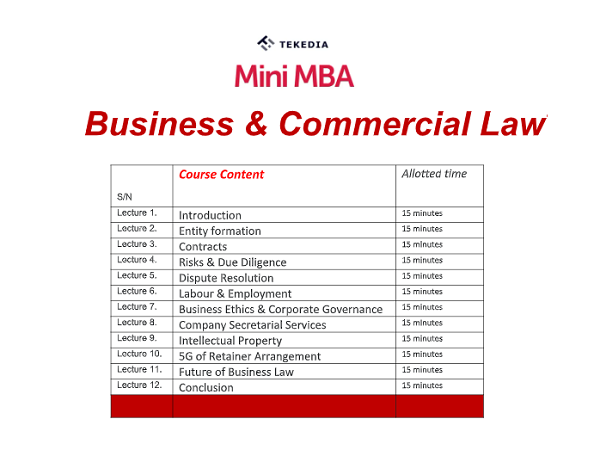
Course Outline of our Business & Commercial Law session
Dear Sir/Madam
(If registered already, please help us forward)
Tekedia offers an innovation management 4-month program, optimized for business execution and growth, with digital operational overlay. It runs 100% online. The theme is Innovation, Growth & Digital Execution – Techniques for Building Category-King Companies. All contents are self-paced, recorded and archived which means participants do not have to be at any scheduled time to consume contents. Class begins June 22. There are many reasons to register for the second edition of Tekedia Mini-MBA. Here are some:
Experts from global and local brands like Microsoft, MIT Boston, Deloitte, and Flutterwave are joining to lead different sessions.We are covering 32 areas in business from Innovation to Strategy, Business Law to Operations, Supply Chain to Sales, and beyond, with practicing faculty.
All participants of Tekedia Mini-MBA in 2020 will attend a virtual Career Week. Our Career Week (coming in Nov) is not designed for finding jobs. Rather, it is structured to TRANSFORM workers, founders & entrepreneurs into business leaders and champions of innovation in their companies.The sub-theme is Career Planning & Resilience During Disruption. Learn more here. Within the week, at least 10 HR leaders will provide guidance to workers and companies on how they can buildproductivity.
Joining Tekedia Mini-MBA second edition comes with two free ebooks – Africa’s Sankofa Innovation, and The Dangote System: Techniques for Building Conglomerates.
You also receive a complementary Certificate cybersecurity course from First Atlantic Cybersecurity Institute. Visit facyber.com and select your course on Cybersecurity: Policy, Management, Digital Forensics and Technology.
We continue to offer installment payments
Join us for $140 or N50,000 by registering via (bank transfer, Flutterwave and Paypal) – https://www.tekedia.com/pay
Source: Google Trends, 2020; Infoprations Analysis, 2020
Since COVID-19 became a pandemic, keeping cases and mortality rate low has been the priority of global leaders. From government to business, leaders have taken and still taking a number of measures. Governments have been flexible and rigid in the implementation of some of the measures such as lockdown and social distancing. Businesses have come to the rescue of governments and individuals through some palliatives, especially donating to the war against the containment and possible vaccine development for total elimination of the virus that has infected million of people and killed thousands.
Despite positive outcomes in some countries, public affairs analysts and citizens believe that political leaders are using the pandemic to further enshrine their dictatorial rules on people through strict measures. This piece examines this and other issues in the race to full containment of the virus. The piece is not in support of dictatorial administrations or trampling upon fundamental human rights of global citizens at this critical time. Instead, it takes a critical look at how unequal power-driven measures are helping some countries in slowing the speed of transmission and emerging cases of the virus.
Power Distribution: What Does it Mean?
Several researches have shown that people accept power distribution and respect authorities differently. In a country with high respect for authority, people are expected to accept an unequal, hierarchical distribution of power and understand what is expected of them in terms of duties and roles towards personal and societal development. In the country with low respect for authority, people do not accept situations where power is distributed unequally. These positions have been popularised in the last two decades through researches and industrial applications in line with Geert Hofstede’s beliefs.
What does this mean for COVID-19 containment? The answers lie in the fact that governments would do everything possible to stop the spread of the virus. In the course of doing this, stricter and lighter measures would be deployed. When the measures are stricter, our analysis suggests that the governments that deployed the measures played high power culture game. On the other hand, lighter measures place some governments within the low power culture game.
In high power culture game, we found that citizens and residents of the countries that played the game between January and April, 2020 followed the measures. This is largely due to some strict penalties put in place by authorities to enhance the enforcement. For the low power culture game, analysis suggests that people still had their way. They devised means of not following the measures as expected. When they adhered to the measures, analysis reveals that they were afraid of the likely consequences to personal life not to everyone.
How Public in High Power Countries See COVID-19
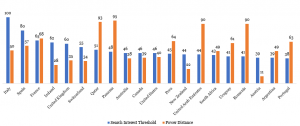
Our first point of analysis was the interest of citizens and residents in Coronavirus globally. We examined the interest through searching for specific information about the virus. Our analysis reveals over 50 countries where people had significant interest in the virus between January and April, 2020. From these countries, we concentrated our resources on the top 20 countries. The second analysis was done with the examination of scores recorded by the countries within high versus low power component of Geert Hofstede’s assumptions about culture. We found France, Qatar, Panama, Peru, United Arab Emirates, Uruguay, Romania and Portugal as places where people need to respect authorities and abide by rules without much inquisitorial. The remaining 12 countries are nations where people are not expected to respect authorities absolutely.
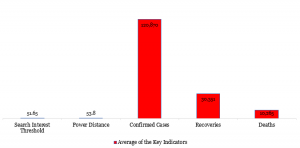
As at May 9, 2020, all the 20 countries have had a total of 2,417,390 as confirmed cases, while recoveries were 607,024. We equally discovered 205,309 as total deaths for the countries. The volume of public interest through the Internet search about the virus was 995, while the total scores of all the countries within the Hofstede’s component is 1,076. Looking at the threshold of interest (0-100) and individual score for high and low power context-nation (0-100), public interest in the virus and understanding that France is a high power context country is clearly established as the scores show 3 score difference. Portugal also exhibits similar outcome as the public interest threshold score in the virus is more than half of the score recorded for being a high power context country. In order of highest scores, Panama, Qatar, Romania and United Arab Emirates are high power context countries than France and Portugal [see Exhibit 1]. What do these scores mean for COVID-19 containment through government’s measures or policies?
Exhibit 1: Public Interest in Coronavirus and Unequal Power Distribution Scores
Source: Google Trends, 2020; Hofstede, 2020; Infoprations Analysis, 2020
High Versus Low Power Distribution: What Does it Mean for COVID-19 Restraint?
Both have positive and negative consequences on the extent of taming the speed of transmission of the virus and possible treatment of the infected persons. A recent survey reveals that “63 percent of French people indicated coughing, sneezing and spitting into disposable tissues in order to protect themselves from catching COVID-19. Furthermore, 90 percent avoided handshakes with people they know and almost 10 percent indicated wearing a protective face mask when leaving their home.” Beyond the public practicing of these measures or directives, in his government’s readiness to contain the virus after the first case and an understanding of how the virus is spreading globally, French President said “nationalism is not the answer to the coronavirus outbreak.” He followed this statement with a number of strict measures, which range from total lockdown of Paris, the country’s capital to strict processes for essential movements within the country. In an effort to enforce social distancing and the use of masks, the French government deploys video surveillance cameras that monitor how many people are wearing masks and staying at least a metre (3ft) apart. France is also one of the countries that has considered a fine for violating confinement; from €135 ($147) to €1,500 ($1,630) for recidivism within 15 days; in the event of four violations in 30 days, a fine of €3,700 ($4,021) and six months in prison is imposed.
Like France, Qatar has also introduced a number of strict measures and policies with severe penalties for the violators. The Qatari government has refined and re-refined its measures and policies on many occasions to align with the speed of transmission in the wider population beyond the worst-affected groups where tests had been targeted. In areas where construction works are ongoing, government officials are carrying out inspections to ensure businesses adherence to the measures and policies. Report has it that the Qatari government is deploying its resources to the construction sites because it remains impossible to close sites due to ongoing infrastructure development and upgrade for 2022 World Cup. Public places such as schools have been closed while the travel ban on travellers from many countries remains.
Panama and Peru are the countries that have one of the most controversial approaches to the effectiveness of people’s movement and social distancing. The two countries want people to move out based on gender. Some days are for men. The days men are outside, women are not expected to be outside. A report says “In Peru, women can leave their homes on Tuesday, Thursday and Saturday and men on Monday, Wednesday and Friday. No one can leave their homes on Sunday. The days that women and men are allowed to leave their homes are the opposite in Panama.” In Panama, security agencies have been instructed to check identity of people to find out their real gender class. This has been described as a violation of people’s fundamental human rights, especially the rights of transgender citizen. Despite the criticism, some people believe that it has helped the country to be an outlier in Latin America’s COVID-19 severity.
The deployment of civil-military approach for effective enforcement of measures and recent introduction of criminal penalties for the dissemination of false information about the virus in the United Arab Emirates aligns with the country’s high power context position [see Exhibit 1]. The measures taken by France, Qatar, Panama, Peru and the United Arab Emirates are not quite different from what Uruguay, Romania and Portugal have also been carrying out.
Strategic Option
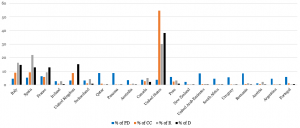
Though, public analysts, human rights activists and civil society organisations are condemning approaches for the enforcement of measures of the countries, it is obvious that positive results are being recorded in these countries. They are having fewer cases and high recoveries relative to some low power context countries [see Exhibit 3]. Regardless of the positive outcomes, our analyst observes that the few cases could be that the countries with high power context are not carrying out enough tests like countries with low power context. This is premised on the fact that countries where people can challenge authorities freely, government officials are more likely to deploy more resources for testing when citizens put them (government officials) on their toes on the need to have adequate testing.
Exhibit 3: High Versus Low Power Distribution and Coronavirus Management