DD
MM
YYYY

PAGES

DD
MM
YYYY

spot_img

PAGES

Home Blog Page 6375

Tekedia Mini-MBA Career Week Coming Nov 2020

0

Our Career Week (coming in Nov 2020) is not designed for finding jobs. Rather, it is structured to TRANSFORM workers, founders & entrepreneurs into business leaders and champions of innovation in their companies. The sub-theme is Career Planning & Resilience During Disruption. It will be packaged under the Tekedia Mini-MBA theme of Innovation, Execution & Growth.  

In November 2020, we will run an online Career Week as part of Tekedia Mini-MBA, for graduating classes of rainfall and harmattan editions. In other words, this is designed for editions of Feb and June, free. (Registration for the edition starting June 22 is ongoing). We do believe that when you work hard to create your future, you can predict it better. So, we are bringing more than ten eminent HR leaders and directors to lead us on this. 

Some of these experts lead HR departments of MNCs, banks, FMCGs, consulting firms, and startups. You will learn every aspect of career planning, career development, and how you can become a leader in the company you work. Yes, we want to raise Champions in African companies and help others have capabilities to rise.

Our focus is Innovation, Growth and Digital Execution: we think those encapsulate what the moments require in companies. 

https://www.tekedia.com/mini-mba-2/

Due to the virus, this replaces the Tekedia Innovation Summit.

How Companies Can Maintain Social Distancing, Optimising Office Space After COVID-19: An Interview with Olufunke Sorinwa, TSL’s Facilities Manager

0

Editor’s Notes

This is the continuation of our interview series on COVID-19 and Real Estate and Facilities Management Industry. In the first interview, Ukeme Peters, Head of Planning, Enterprise and Management System (PEMS) at Alpha Mead Group, one of the leading total real estate solution company in Nigeria, walked us through coping strategies being implemented by his company to ensure  continuous service delivery to the clients and what the future holds for the industry. In this edition, Olufunke Sorinwa, Facilities Manager at the Transport Services Limited, speaks with us on the approaches being taken by her organisation towards mitigation of the virus impacts and what industry players and professionals can do to cope with the consequences of the virus within workplaces.

Excerpts

Tekedia: Coronavirus as a global pandemic has changed and shaped many industries, especially those in the built environment. As a facilities and workplace manager, what have been the impacts on people and businesses in Nigeria?

Olufunke: The impact of current reality as a result of this pandemic is unprecedented. I would take it in two folds; For professionals working from the contractor’s side (FM Service providers) – what this will result into is that clients/customers may scale down on FM service scope but on the other hand there will be an increase with some services such as cleaning because it may just be the short term solution to give them the confident of a safe workplace. However, one critical question remains; will businesses/contracts resume to business as usual? The answer is NO.

With Covid-19 fast tracking us into the future of leveraging technology, the need for physical office may soon become a thing of the past and of course may be not completely, but the need for space will be scaled down. Existing square areas will be reduced to only require spaces by companies as the resolute to remote working will be on the rise. Now, the impact of this effect on people within the built environment is that there will be redundancy/job loss- from the cleaners, tea girls, maintenance team- numbers will be reduce once the service scope is scaled down, and even the admin staff providing support offsite.

A classic example of this, we are beginning to experience with the banking industry. Hence, this will call for a lot of job re-evaluation. And as I mentioned earlier, this will directly impact on the service providers within the built environment and also in other industries as well. It is also a wake-up call.

Tekedia: Now, let us examine the impacts from the fact that you are not a facilities management solutions provider but a professional in the industry, who manages workplace for other employees to function optimally. What are the key things the virus had brought that change the way you are managing your workplace before? What are the possible changes to the way you will manage the workplace after the total containment of the virus?

Olufunke: As an in-house FM/workplace management, one of the profound elements the covid-19 pandemic has brought to bear is the optimum use of technology. With the reality, the FM team have been forced to leverage technology therefore collaborating more with the IT team to develop applications that will help foster the measures put in place at the workplace to contain the virus and protect our people.

For example; We created a space booking application which we never thought of having prior covid-19 as we all work from the office. The application which was developed to help regulate the number of employees who are allowed into the office space per time thereby promoting the recommended social distancing measure (6feet apart) and this aligns with our space management data to determine and communicate new space capacity. This way, we can totally control the amount/quantity of office items required on a daily basis.

Raising the level of hygiene at the office is another critical area we are working on by increasing the frequency of cleaning and ensuring to communicate the new guideline with all stakeholders. (This validated the first consideration that some industries may even need to scale up the frequency of cleaning in order to ensure workplace hygiene is maintained as ascribed in each organisations peculiar situations).

The “No visitors” measure is another way we are ensuring to keep our people safe. In the first 4weeks of easing the lockdown, no visitor will be allowed within our office space and subsequently, as the numbers of visitors are reviewed the guidelines for accepting visitors will be communicated with our employee who in turn are expected to cascade this information across to their various contact.

Communication through signage. Signage will be affixed at critical areas especially high traffic and common areas. This will constantly remind employees of what is expected of them per time to keep themselves and people around them safe at all time.


Tekedia: Agreed that coronavirus has impacted workplace, especially moving most companies to remote work approach. When the virus stops its spread, which area of office management and building do you believe facilities and workplace managers need to improve on through innovative processes and solutions for maximum benefit for the users?

Olufunke: If there is one thing the virus have brought to light is that fact that we can leverage technology in conducting various aspect of the business. While I understand that the need for physical contact cannot be totally eliminated but this will now be based on priority having also looked through the risk assessment of exposure.

For some, the need for space will be totally eliminated as it will be convenient to work remotely, while for others the space reduction will come to bare based on the arrangement various arrangement now deployed like shift plan for employees. Once businesses realize that remote working is cost effective then the need for space will reduce.

For most part, retrofitting the spaces or building to incorporate sensors thereby reducing the level of touch of surfaces e.g. door knobs, fixtures- plumbing etc., especially in common areas.

In summary, reducing cost on space and leveraging use of technology to within the buildings and digitization office management processes (applications that provides seamless approach to carrying out work) will provide profound benefits.

Tekedia: Why did you believe the area is critical to the survival of businesses after the virus?

Olufunke: Today and more than ever, the need to leverage technology is critical to business survival even after the virus. Covid-19 is the impetus that has accelerated the adoption of digital solutions and this will profoundly make us all embrace the fourth Industrial Revolution sooner than anticipated. We are now in the age of applying artificial intelligence, big data and robotics.

This is evident in disruption of global supply chain. A typical example is China, whose industrial output contracted at the sharpest pace in 30 years, as workers were told to stay home, falling by 13.5% in January and February 2020, according to Reuters. On the other hand, companies who provide digital solutions are recording all time record revenues at this time. The need to switch to use of smart technologies is one of the route to keep essential services running.

Tekedia: There is no doubt the previous normal wouldn’t be normal for many businesses in the built environment after covid-19. What should real estate and facilities management solutions providers do in the new normal regarding office management, especially space management considering the fact that social distancing will take center stage while working?

Olufunke: Of course, the pre-Covid 19 era is history now! The Real estate & facilities management professionals need to reimagine the industry and service offerings to chart forward. More than ever before, real visible value will be demanded from our clients. And one of the areas where professionals can commence helping clients deliver this value especially as it speaks to their bottom-line is space management.

It is our job now to provide expert advice on space management supported with real data. This will involve evaluating current space use, plan new designs, move employees or entire departments and improve workplace technology with minimal disruption business.  For some client, they may be advised to shrink their space requirement supported by data; while for some other clients it is advising them to shrink space and redesign to fit current requirement; for some other, it may require them moving out of their current space to see desired value based on data available.

By and large, space redesign in consonance with the 6 meters barrier considerations as a temporary measure to reduce the spread of the virus through the air will be considered more than before. Here, specially made materials that can aid visibility but yet can be used to partition workspaces may come handy in some office needs.

Other considerations are the redesign of the HVAC systems to avoid the spread of the virus through the administering of treated air via the Air Handling Unit (AHU). For most offices that uses window units and split units cooling systems, a consideration for a high level multi V cooling systems that allows fresh air ingress to the workplace will be highly needed now.

Information gathered from this space planning exercise will help facilities professional provide clarity to clients on what they need to do and how they need to do it.

Tekedia: How do you expect professionals and players in the built environment to respond after the containment of the virus?

Olufunke: Professionals within the built environment must remain proactive and continue to leverage on technology. Also, research is another area professionals within the built environment need to harness more effort thereby bridging the gaps for more innovative ways of conducting our activities.

Tekedia: It is glaring that provision of Facilities Management knowledge and skills is low in Nigeria. How do you think players and concerned government establishments can enhance acquisition and use of the two after the virus has been checkmated?

Olufunke: Bridging the knowledge gap in facilities management is largely dependent on ensuring that the industry continues to produce seasoned innovative professionals who thoroughly understand the profession and are ready to advance it. Mentorship is another key prong that is missing in the FM industry. Mentorship needs to be developed for sustainability purpose. On the other hand, the need for synergy between the FM industry and the academic environment cannot be overemphasized.

Tekedia: Your advice to facilities users during and after the pandemic?

Olufunke: My advice for facilities users remains the same- We all must act responsibly to protect each other and our loved ones. Adherence to all safety guideline is a must at this time.  And above all, facilities management professionals are advocate of safety and we must propagate it anywhere we find ourselves.


Open Letter to Herbert Wigwe, Access Bank’s CEO, Staff: Why My Accounts Should Be Whitelisted

5

Since February 2020, I have been having issues with my saving and current accounts. The first issue was the inability to send and receive money. The second issue was the inability to use digital platforms such as USSD for transactions. After several requests and conversations, it is imperative for me to use this medium to ask Herbert Wigwe, the Chief Executive Access Bank and staff to whitelist my accounts.

The failure of the staff, who have responded so far regarding my complaints, to resolve the issues have impacted my financial responsibilities. During the conversations that trailed the issues, I have noted that the idea of going to one of the branches to resolve the issues cannot be effective. This is largely due to my experience with the branch close to my present location and current coronavirus pandemic. Beyond that, it is absurd that issues that resonated with digital platforms cannot be solved through digital processes or approaches.

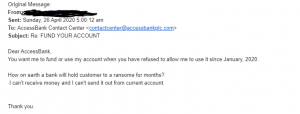
Email Conversation

Facebook Conversation

MAR 20, 2020, 3:20 PM

Me: It has been more than 5 days that I sent an email to your contact centre over the inability to use transaction code on my accounts.

Till now, I have not received concrete answer than sending us your phone number. What is really happening? It’s necessary this is resolved on time because I can’t access my money for essential needs.

MAR 22, 2020, 10:11 AM

Access Bank: Hi Mutiu Iyanda, we are sorry for this experience. Please confirm the last error message you got when you attempted the process ?^NI.

MAR 27, 2020, 7:18 AM

Me: The error is that “you have been denied access to this service. Contact your bank for details.”

MAR 27, 2020, 8:33 AM

Access Bank: Hi Mutiu Iyanda, we apologize for the discomfort experienced, kindly visit any of our branches to be white-listed on the USSD platform or give us a call on 07003000000 to be advised on how to access the mobile application. ???^GI

Me: After you have requested for the phone number associated with the account. At this period, you still want me to go to your branch…

Me:  I just also discovered that I can’t receive money into current account and withdraw from it.

MAR 27, 2020, 11:36 AM

Access Bank: Hi Mutiu Iyanda, kindly provide us with a screenshot of the error message while trying to receive or withdraw from your account to enable us advise further. ???^GI

MAR 27, 2020, 12:52 PM

Me: It is not possible to do the screenshot. I have stated the error message in my previous message. Please check it again. Thanks

MAY 4, Mon 5:31 PM

Me: Hello. Since March, there is no response to my needs here and through email messages. It clearly shows how cares is your bank. Thank you.

Update on Conversations

Update One: At exactly 3:19 pm (May 5, 2020), one of the employees reached out to me via email message still requesting for what one of her colleagues had requested for despite sending the documents via email (as noted) since Sunday 3, May 2020. Can Herbert Wigwe tell his employees that online complaints do not need to take months to be resolved? We are in a global village with a lot of means of tracking email messages among others.

Poor Online Customer Engagement and Complaints Management

My experience in the last few months have shown that Access Bank needs to work on its online response platforms. This is essential as the state and federal governments expect every citizen to follow necessary medical measures for the total containment of coronavirus. Doing the rights on the platforms would also go in long way of helping the bank in securing the right place in 2020 Consumer Digital Banking Satisfaction Index Report having failed to be named top bank within digital banking space in 2019.  Finally, the Chief Executive Officer and staff should know that evidences have shown that there is a strong link between customer engagement and customer loyalty.

The Time Is Now To Correct The Interest Rate – By BOLA TINUBU

0

The economic fallout from the coronavirus may present the best, most pressing case for revising the CBN’s high interest rate policy. The undue rates penalise domestic investment and consumer borrowing. This reduces both aggregate domestic supply and, to a lesser degree, aggregate domestic demand. The chronic gap between domestic supply and demand has been filled by bloated levels of imports and encouraged an overvalued exchange rate that the high interests have helped produce. In normal times, the high interest rates also attract significant foreign financial speculation, the ever-ominous hot money. While in the short-term, the foreign speculation boosts financial inflows. Over time, as compound interest payments become due to these foreign investments, the nation will lose an ever-increasing amount of money to satisfy foreign debt obligations. In the short run, high rates seem to attract foreign capital and spur the economy while giving it discipline against inflation. In the longer-term, all of this is untrue. High rates give us the worst of both worlds. They stifle domestic investment and incomes while pushing up inflation and exposing an ever-increasing share of our financial system to foreign manipulation and dependence. Put another way, if you take a single picture early in the process, the high interest rate policy looks good at that moment in time. However, if you view the entire movie, you will see an ending that is both painful and unnecessary. 

The Central Bank of Nigeria has demonstrated its financial agility by establishing a growing number of special financing programs for various industries and sectors of the economy.  While these programs look good at first glance, they also expose important contradictions in the CBN’s position. The special schemes are an implicit admission that normal rates stifle investment borrowing and thus suppress the economy. The extraordinary schemes would not be required if the general interest rate was at a proper level. By establishing the special programs, the CBN attempts the impossible. On one hand it defends the general rate as prudent. On the other, it proliferates special exceptions in order to spur investment borrowing that the general rate has heretofore stifled. 

This complex CBN rear-guard action does not serve a greater purpose. It merely prolongs the inevitable: We must retreat from high-interest rates if we want investment borrowing to attain levels that actually increase private-sector growth and job creation. 

This point bears repetition. If the financial sector functioned properly, servicing the needs of the economy in general, there would be no need to constantly resort to specialised sectoral plans (one for this industry, another for that industry, and so on) for concessionary lending below regularly available rates of interest. Each such scheme is evidence that the overall financial system is fragmented in a manner that artificially reduces investment and the positive consequences increased investment has on growth, production, and employment. The schemes are akin to a homeowner who, confronted with severe structural damage, commissions a fresh coat of paint to obscure the obvious structural flaws. Just as the homeowner should focus on fixing the core problem to prevent the house from crumbling, the Bank should do the one great thing it can do to free the economy from an unpayable burden. It should reduce interest rates. 

The modern global economy is built on credit. Prosperous nations have built success based on the sustained ability to use credit to generate high levels of domestic investment as well as allow for significant consumer financing. Unlike two centuries ago, most business investment is not derived from the self-generated funds of the businessman or investor. The investment comes mainly from bank loans. However, the current rate of interest in Nigeria prohibits most normal business investment. Thus, the productive sector stagnates as innovation and creative endeavour are discouraged. Employment and aggregate demand are dragged down. The economy becomes a slave to a negative, impoverishing dynamic.  

THE STORY THUS FAR 

The current form of our financial system is antithetical to growth. Our financial system was originally structured to serve the colonialists who wanted a highly centralised system that provided little chance of prosperity for indigenous businesses beyond that which the colonial master would allow. Though the years have passed since the end of the colonial era, the basic structure of that old financial system remains intact. The system has not kept pace with the needs and challenges of our evolving nation. 

After national independence, the system was but slightly modified to fit the requirements of highly centralised military rule. Broad and diffused growth was not the goal. Such growth contravened the underlying tenet of military rule – tight, centralised control of political power and economic resources. 

Only those allied to the power core were enabled to access credit and favoured to prosper in business. A high interest rate regime was integral to this centralised and closed system. High-interest rates prevented the growth of independent businesses. One had to seek the alliance and friendship of the government of the day to overcome the strong impediments that high rates caused. This rendered business an appendage of government, dependent on government favour to survive. There were no nodes of power truly independent from the centre. Nor did this situation foster creative and innovative economic thinking leading to sufficient business start-ups that might have grown and diversified the economy. 

All things were thus reliant on the goodwill of those at the core of national power. There were few successful businesses that did not have a patron seated in the high ranks of government. In many nations, prosperous businessmen can rightfully claim they know no one in government. In Nigeria, such claims were nigh impossible.  Genius was declared upon those who could get close to the men in uniform and did not always depend on whether a person could efficiently organise an enterprise or invent a useful device. 

Thus, the banking system became one intended to bar most businesses and people from access to sufficient commercial and consumer credit, a system constructed to suppress large-scale independent economic activity unless expressly sanctioned and approved by arbitrary power. Thus, it suppresses wealth and job creation. It keeps the economy on crutches so it cannot run too fast as to get beyond the grasp of whosoever wields that arbitrary power. As such, we are in a situation where the banking system is not sufficiently governed by the rational dynamics of economic maximization.  As a result, the system sputters and fails to reach full throttle. Without optimal financial sector support, the productive economy has failed to grow as it should. We all suffer, especially the poor man who would have been employed and earning enough money to take care of a family and contribute to national wealth if only sufficient levels of investment had been attained. 

In decades past, this model could survive because our economic situation was more benign than it now is. Oil prices were such that the nation gained enough revenue given its then existing population. The nation could stay afloat and even record modest growth rates when oil prices climbed to their highest levels. Yet, this economic model was never meant to last as it risked all based on the price of one commodity. 

This model led to an overvalued currency, which has caused Nigeria long-term harm. It undermined the global competitiveness of local producers. It also made imports cheaper. We became an import-reliant nation with a dwindling productive capacity. Over the long haul, such a position is high risk. Underlying economic fundamentals have become more adverse over time. Oil revenues, in real terms, have not and cannot keep apace population growth. 

As oil revenues lose their potency to carry the economy, this financial model becomes an increasingly heavier albatross impeding economic growth. We remain too import reliant even though our supply of funds to buy imports dwindle. We seek to maintain a strong currency because of this import reliance and because of national pride. However, this reliance drains funds to support the exchange rate that could be better invested in strengthening our productive capacity. Moreover, pride is fleeting for who can maintain pride in a weakening economy with a stubbornly high incidence of abject poverty. 

At this moment, we need business and industry to take up the slack generated by the weakening of the oil sector. However, the productive economy is barred from this needed increase in activity because the high interest rates, along with an unreliable power supply, combine to form a steep obstacle to sufficient real-sector investment, growth, and productivity. 

The high interest rate financial model runs contrary to the ideals of a progressive democracy to which Nigeria aspires. A nation cannot become a genuine democracy while access to credit remains under a semblance of authoritarian lock-and-key. Lending schemes under which a central bank has sole authority to prescribe lower interest rates may appear to open the system. In truth, they do no such thing. Instead, they merely move the discretionary power to give financial concessions from where it formerly resided (the military in times past) to the central bank. 

LONG TERM POSITIVE RELATIONSHIP BETWEEN HIGH RATES AND INFLATION 

Over time, high rates cause more inflation than they prevent. In the initial phase, high rates might lower inflation. However, an economy is dynamic not static. Feedback loops created by the initial high rates will eventually encourage inflation. First, the suppressed levels of private sector activity will result in higher levels of government borrowing than otherwise would be the case had private sector incomes and productivity been unhindered by the high rates. This means that the government must spend an increasing sum merely on interest charges. This places more naira in circulation without a corresponding increase in goods and services. This is inflationary. 

Second, to the extent domestic firms can borrow, they must charge high prices in order to achieve profit levels sufficient to repay their high interest loans. This too is inflationary. 

Third, we attract initial dollar inflows as private loans or investments in government bonds because of the high rates. Yet, the interest payments on the underlying bond, being computed as compound interest, compels us to pay an increasing percentage of our dollar intake through oil sales just to service the interest charge on the foreign debt. Consequently, we must engage in all manner of tricks to cover the widening gap between ever-increasing foreign debt calculated at compound rates and foreign currency revenues which tend to remain flat and linear, if not decline during times of economic weakness. Debt servicing as a percentage of overall public and private sector spending will increase, causing more naira to be misdirected; exchanged into dollars instead of being used for productive economic discourse that would create wealth and jobs on these shores. This not only is an unproductive way to use the extra naira, such practices are historic drivers of inflation in any nation that measures inflation. Such practices are avoided by the best central bankers because their abuse courts ruin. This is why the best managed developing economies shy from the heavy borrowing of foreign currency. 

However, we have become too reliant on foreign borrowing. In our case, we have created a highly imbalanced and imperfect economy. On one hand, high rates are used to scare domestic investment borrowing thus undermining income, production, and consumption. On the other hand, high interest rates are used to attract foreign creditors who must be repaid with an increasing percentage of our intake of dollars. This indifference to domestic investment yet open encouragement of foreign financial speculation is a rather odd mis-arrangement that makes little sense if the true objective is to grow the overall economy. 

Given the inescapable dynamics of compound interest, a dollar borrowed today will have to be repaid with 2 dollars at some point in the future.  This drains our reserves to the benefit of foreign creditors. If we must borrow dollars better to first borrow from our own people, then the DFIs (World Bank, etc.) at concessional rates. We should only borrow from the foreign private sector as a very last resort.  

EXCHANGE RATE AND THE ECONOMY 

If we went to a freely floating exchange rate, the naira would devalue. This means our currency is overvalued in terms of our trade with the outside world. 

This overvalued exchange rate is buoyed by high interest rates. Yet to maintain both interest rate and exchange rate levels simultaneously over time requires that money be siphoned from use in the productive economy in order to prop up both rates. High rates drain liquidity from the system. However, here the multiplier effect works terribly against us. For every naira drained from the system, we lose more than one naira of productive wealth, activity, and income. 

This provides a higher exchange rate but a shrunken domestic economic base. This combination of a high exchange rate and a diminished domestic productive base gives strong impetus to high import levels. In a well-functioning economy, import levels should shape the exchange rate. In our economy, the exchange rate determines import levels. Our demand for unnecessary imports is much too high. This unhealthy appetite drains or limited the supply of foreign currency. We are again relegated to placing more and more naira in circulation in the futile chase of the dollar, the pound and the euro. Again, this is the most unproductive way to use our currency. Had or currency issuance power been used to fund domestic infrastructural development, the economy would be much improved. 

To maintain the exchange rate, we must sacrifice both naira and dollars that could have been invested in strengthening our productive capacity and job creation. Instead of bolstering the economy, we give these financial resources to international finance arbitragers who care little for our well-being, who invest little in our productive economy and who gain too much influence over our national economy as insensitive creditors. We have to progressively pay them increasing amounts just to sate their demands while giving our population relatively less. 

CORONA VIRUS AND THE OPPORTUNITY TO LOWER INTEREST RATES   

To stimulate their economies, the central banks of all major economies have driven their prime interest rates below 1 percent and nearer to zero percent. These central banks are lending vast amounts at low rates just to support their industries and firms. 

My position has always been one of reticence to foreign-denominated debt due to repayment challenges. However, if we need foreign currency to buy items essential to protecting the nation from the coronavirus now is the time to borrow. The World Bank and other DFIs have said they will grant loans at concessionary rates. We should hold them to their word and demand a renegotiation of existing loans or debt relief. 

While we are not yet inundated with the medical fallout of corona, we too suffer gravely from the economic and financial effects of the contagion. The rest of the world understands the imperative of lower interest rates. We should not pretend to be blind to that which every other major nation sees. 

If this crisis is to have any positive economic aspect, let it be that we used this moment to drive down interest rates. To apply the rate reduction only to future loans would be prejudicial to current bank debtors. Thus, the financial authorities should consider formulating regulations that banks must reduce the high interest rates on existing business loans to the new lower general rate. This can be achieved through regulations requiring banks to automatically roll-over existing loans at the lower rate or regulations stating this must be done if the borrower so requests. 

Any such change will alter the profit structure of most banks. To help moderate the change, the government should provide generous tax relief to the banks. Additionally, the government should institute a special bond-purchasing program where banks can purchase interest-bearing government bonds at a significant discount or even on credit for a period of years. The central bank should give banks liberal access to its discount window in order to participate in such programs. These programs are intended to be transitional and thus will sunset in 3-5 years. During the transitional period, banks will have time to alter their lending practices. They must begin to earn profits from higher volumes of business and consumer lending at much lower profit margins per loan. In this way, our banking system will finally advance into the modern banking practices that have served as the linchpins for growth in any prosperous nation one can name. 

There will be some initial jitters and anxiety. In the end, this will materially help us by sparking much needed private sector investment borrowing and encouraging suitable levels of consumer borrowing. Such borrowing will complement and thus lessen the amount of direct fiscal stimulus the government must provide. The lower rates will be politically popular as well as economically benign at this time. Lower rates might dissuade some foreign speculators, but most speculative money has returned to its host nation at this point. So, the effects of lower rates will be muted. For those speculators still sensitive to arbitrage opportunities, our rates, albeit lower, will still be visibly above those obtained in any Western economy.

Yes, the lower rates will put pressure on the exchange rate. However, much of that pressure has already been priced into the exchange rate due to capital flight and lower oil prices caused by the viral outbreak. Moreover, shipping and the import-export business are at a minimum. With trade at a minimum, this is again an opportune moment to allow downward pressure on the exchange rate; the practical effects will be minimised since trade has already been materially reduced. 

Another consideration we must weigh regarding interest rates is how lowering rates along with other innovations may unlock the potential for real estate to be a catalyst for economic growth at this moment.  The global economy will not rebound for several months if not longer. We must seek ways to inject liquidity into the economy and foster activity. Should the CBN lower rates as well as allow for longer-term mortgage notes, real estate would become a better functioning collateral for investment borrowing not only for the housing industry, but for the general economy.  Reform of government mortgage agencies and policies will further allow us to deepen both the primary and secondary mortgage markets in ways that increase liquidity and spur economic activity independent of what may be happening in the outside world.

CONCLUSION 

High interest rates are a fundamental drag on national economic growth. Only our unreliable power supply may loom as a bigger impediment to national prosperity.

Lower rates will spur domestic investment and production. This creates both jobs and wealth.  High rates serve only to suppress these vital factors. Lower rates will have some negative short-term impact on inflation and the exchange rate. However, in a twist of irony, the economic dislocations caused by the coronavirus serve to mitigate those temporary negative consequences. If there is a time to reduce interest rates, that time is now.

  Bola Tinubu, APC National Leader writes in from Lagos

Why Nigerians are Angry with Access Bank

0

Maybe Herbert Wigwe, Access Bank CEO, was wrong to come out and broadcast that workers’ salaries will be slashed and that staff may be sacked. Maybe he should have done it silently and it will all be treated as a rumour. Maybe his mistake was sacking staff without prior notice. Maybe he should have just slashed salaries and retained the workers. Maybe…. just maybe.

No matter how we look at the “pandemic” that just happened in Access Bank, where it is rumoured that over 800 workers were sacked, Nigerians are not happy with the bank. And they are afraid too. Afraid that other banks will follow suit and dislodge their staff. Afraid that many companies will let go of their workers if something is not done. The recent action of the management of Access bank plc truly released the bottled up emotions of many Nigerians, especially the youths.

But one may ask why Nigerians reacted this way to the sack of Access Bank workers when they knew the state of the economy since the onset of COVID-19 pandemic. In their overtly emotional states, Nigerians gave the following as their reasons for calling out the management of Access Bank Plc and attacking anyone that attempts to defend them.

  • Donation to COVID-19 Task Force

I think this is their greatest sin. According to many people, why would the bank donate N1bn to the Presidential Taskforce on COVID-19 when it is quite aware that it cannot pay its workers? They insinuated that the bank used its staff’s salaries to buy favour from the federal government. However this may be assessed, Access Bank truly made a mistake by giving out what it didn’t have.

  • Declaration of Profit

Some weeks ago, Access Bank announced a profit of N40.9bn in the first quarter of 2020 that ended on March 31, 2020. It then came as a surprise to Nigerians that a company that amassed so much profit could not afford to pay its staff within weeks of announcing its wealth. The question people now asked is, “Why wouldn’t Access Bank pay its staff out of its profit?”

  • Insensitivity towards the Dismissal Approach

It is in situations like this that hidden truths surface. The recent use of more “contract” workers by Nigerian banks is resulting in a lot of service abuse by employers. They outsource jobs to recruiting agencies that underpay their workers. Who the owners of these agencies are and how much they are paid for each staff are questions people have not bothered to ask. But because of this sort of employment arrangement, workers are easily thrown out of their jobs without any entitlement and without prior notice. The affected staff of Access Bank, most of whom were contract staff, were said to receive the news that they are about to lose their jobs over the media. And like a joke, they received their sack letters on the day workers all over the world celebrated their active employment status. The worst thing here is that these staff are called “contract” staff but they are just “ad-hoc” staff who could be easily dispensed with. However, if Access Bank has shown a little empathy towards these workers’ welfare, it would have given them a 30-day notice of termination, or paid them severance fees. But from what we’ve heard so far, they just handed these people their sack letters and bade them goodbye.

  • Current Situation of Things

If the COVID-19 pandemic has not happened, people would have overlooked the massive sack and wished those affected good-luck as they struggle through the labour market once again. But as things are, it is difficult to find jobs right now because a lot of people have been dislodged. Thinking how these people, majority of who are bread winners, will survive the current situation of things is quite disheartening. To be honest, Access Bank chose the worst time to sack its workers.

  • Angry with the Government

If Nigerians get angry at a situation without turning to blame the government, just know that they haven’t started yet. This time they blamed the government for allowing a private organisation to sack its workers. They blamed the government for failing to make provisions that will buffer job losses. They blamed the government for the failed judiciary that would have given the sacked workers the chance to seek justice. They even blamed the government for accepting the N1bn given by Access Bank to the Presidential Taskforce without first finding out if it has paid its staff.

Indeed, Nigerians are angry, not only at Access Bank, but at every organisation that may decide to relieve its workers of their duties. It is better that salaries are slashed while these organisations find their footing through this pandemic, than sending out workers, that helped to build up the company, when they are truly in need.

But there is one thing that nobody has truly considered about the recent massive sack in Access Bank. Who are the people sacked? Is it the easily replaceable workers that earn the least pays? Or were those “Big Ogas” that earn salaries that can pay 50 workers also affected?