DD
MM
YYYY

PAGES

DD
MM
YYYY

spot_img

PAGES

Home Blog Page 638

Nvidia Bets on “Robot Brains” with $3,499 Jetson Thor as Robotics Market Accelerates

0

Nvidia has officially put a price tag on its latest gamble in robotics: $3,499 for the new Jetson AGX Thor developer kit. Dubbed by the company as a “robot brain,” the module is now available for pre-order, with shipments slated for next month.

But beyond the sleek branding and early partnerships, the launch underscores Nvidia’s wider strategy to dominate the computing layer of next-generation robotics — positioning itself as the infrastructure backbone, not the maker of machines.

For companies that move from prototyping to commercial deployment, Nvidia will sell Thor T5000 modules at $2,999 apiece, with discounts kicking in for bulk orders above 1,000 units. That pricing reflects Nvidia’s calculated move to make the upfront cost attractive enough to lure startups and research labs while ensuring scalability for industrial production.

Jensen Huang, Nvidia’s CEO, has repeatedly flagged robotics as the company’s most promising growth engine outside artificial intelligence. In the past two years alone, AI demand has tripled Nvidia’s overall sales, cementing its position as the world’s most valuable chipmaker. Robotics, though still small — just 1% of Nvidia’s revenue — is now seen as the next logical frontier.

Deepu Talla, Nvidia’s vice president of robotics and edge AI, framed it bluntly: “We do not build robots, we do not build cars, but we enable the whole industry with our infrastructure computers and the associated software.”

In other words, Nvidia isn’t chasing Tesla’s humanoid robot dream or Boston Dynamics’ acrobatics. It’s selling the “brains” to anyone willing to build the bodies.

Technically, the Jetson Thor is a leap. Built on Nvidia’s Blackwell GPU architecture — the same backbone behind its data-center AI chips and gaming processors — the module is 7.5 times faster than its predecessor. With 128GB of memory, it’s capable of running generative AI, large language models, and advanced vision systems, all critical for humanoid robots and autonomous systems that must interpret and react to the world in real time.

That matters for customers like Amazon, Meta, Agility Robotics, and Boston Dynamics, all of whom Nvidia says are testing or deploying Jetson-based solutions. Nvidia has even invested directly in robotics startups such as Field AI, signaling that it wants a financial stake in the ecosystem its chips are powering.

The company’s restructuring also highlights the bet. By merging its automotive and robotics units into a single reporting line, Nvidia is effectively grouping all edge AI and real-world machine intelligence under one growth banner. That unit booked $567 million in revenue in May, up 72% year-on-year, proof that momentum is building even from a small base.

However, Nvidia faces a paradox. Robotics is a long-tail market — fragmented, capital-intensive, and prone to hype cycles. The sector has produced more spectacular demos than sustainable revenue streams, and while Nvidia’s Jetson chips are powering impressive prototypes, few have reached meaningful commercial scale. Investors will be watching whether Jetson Thor can push robotics beyond pilot programs and into mass deployment, the same way Nvidia’s H100 GPUs turned generative AI from research labs into a trillion-dollar business.

There’s also a geopolitical angle. Nvidia said the Jetson Thor can be used for self-driving cars, particularly from Chinese automakers. That matters because U.S. export restrictions have already squeezed Nvidia’s AI chip sales to China. Positioning robotics and automotive AI as less politically sensitive export categories may offer Nvidia an escape valve — even if Washington later revisits the rules.

The Thor launch ultimately distills Nvidia’s broader playbook: dominate the computational core of every emerging machine intelligence industry, whether it’s data centers, cars, or humanoid robots. The chips themselves may only account for 1% of revenue today, but as history with gaming GPUs and AI accelerators shows, Nvidia has a knack for turning small bets into category-defining monopolies.

The question is whether robotics will follow the same trajectory.

U.S. Commerce Department Strips Natcast of $7.4 Billion Chip Research Role, Calls It a “Semiconductor Slush Fund”

0

The Biden administration’s handling of America’s semiconductor strategy has been thrown into controversy after the Commerce Department declared that the nonprofit entity it set up to manage billions in chip research funding was never legally authorized to exist.

On Monday, officials said that the National Institute of Standards and Technology (NIST) will now take direct operational control of the National Semiconductor Technology Center (NSTC), sidelining the National Center for the Advancement of Semiconductor Technology (Natcast), which had been entrusted with the role.

At the heart of the storm is $7.4 billion in taxpayer money tied to the NSTC, a central piece of the $52.7 billion Chips and Science Act. Commerce officials said the arrangement with Natcast is invalid, describing it as a clear violation of restrictions that prohibit government agencies from creating private corporations.

According to the department, Natcast — created under Biden to manage and disburse the $7.4 billion — was an “effort to skirt clear legal restrictions prohibiting government agencies from establishing corporations.” Officials said the administration “stacked Natcast with former Biden officials” and shielded it from oversight, essentially turning it into a vehicle for distributing taxpayer dollars to political loyalists.

“From the very beginning Natcast served as a semiconductor slush fund that did nothing but line the pockets of Biden loyalists with American tax dollars,” Commerce Secretary Howard Lutnick said in a scathing statement.

The Commerce Department confirmed it will now reform and directly oversee NSTC operations as required under the $52.7 billion CHIPS and Science Act. That law was passed in 2022 to bolster U.S. semiconductor manufacturing and research in the face of fierce competition from China.

Natcast and the Commerce Department did not immediately disclose how much of the $7.4 billion has already been spent. Natcast, for its part, did not respond to fresh requests for comment. But just last week, the organization insisted it remained closely aligned with White House priorities, describing itself as “a linchpin to realizing a more prosperous, competitive, and secure leadership position for America,” according to Reuters.

The criticism of Natcast highlights an undercurrent of political and legal tension. Some Republican lawmakers have long accused the Biden administration of bypassing Congress in creating the non-profit, while critics say the model opened the door to favoritism and waste.

The Biden administration had announced ambitious plans for the NSTC, including a $7 billion research and development facility in Tempe, Arizona, expected to open in 2028, and another in Albany, New York, which opened in July. These facilities are meant to ensure the U.S. remains competitive in advanced semiconductor technologies.

The episode underscores how central semiconductors have become to Washington’s economic and geopolitical strategy. Chips power everything from smartphones to fighter jets, and as the U.S. looks to curb China’s technological rise, ensuring leadership in this space has become a bipartisan priority.

The tussle over Natcast also reflects a deeper debate about how America should structure its push for semiconductor dominance: whether through traditional public agencies with clear oversight, or through flexible public-private hybrids that critics warn can easily be co-opted.

What the N58.9bn Could Have Done for Osun

0
political structure of Osun government for administrative purposes

In recent weeks, the debate around local government administration in Osun State has intensified. At the center of the conversation is the revelation that over ?58.9 billion in federal allocations, meant for the 30 local government areas in the state, has been withheld between February and June 2025. The funds, confirmed through records from the office of the Accountant General of the Federation, remain inaccessible due to the prolonged closure of council secretariats.

The amount in question is not just a line in government accounts. It represents real opportunities that could transform communities, create jobs, and lift thousands of people out of poverty. In this piece, our analyst notes that the failure to put these resources to work raises difficult questions about governance, accountability, and the very purpose of local government in Nigeria.

The Role of Local Government in Grassroots Development

Local governments are designed to be the closest tier of government to the people. They are supposed to provide essential services such as primary education, healthcare, rural roads, water supply, sanitation, and community development. When councils are shut down or denied access to resources, these responsibilities remain unmet, and citizens at the grassroots suffer the consequences.

In Osun, the prolonged political and legal crisis has created a vacuum in service delivery. Council offices have remained closed, and by extension, the flow of development projects has been stalled. Yet, while the political arguments drag on, the people are denied the practical benefits of the N58.9 billion that should have been invested in their welfare.

What N58.9bn Could Have Achieved

To put the withheld allocations into perspective, consider the transformative potential of such an amount if it had been directed toward real needs.

In education, building and equipping a standard secondary school costs around N150 million. The withheld funds could have delivered nearly 400 schools across the state. Alternatively, existing schools could have been renovated, with provisions for digital learning tools and scholarships for students.

In healthcare, a functional primary healthcare center requires between N50 and N70 million. Osun could have built at least 800 such facilities, ensuring that even the most remote villages have access to doctors and nurses. Hospitals could also have been equipped with modern facilities to reduce maternal and infant deaths.

For roads, rural communities often struggle with isolation, especially during the rainy season. The cost of constructing one kilometer of rural road is around ?200 to ?300 million. The allocations could have provided 200 to 250 kilometers of new roads, connecting farmers to markets and children to schools.

In water and sanitation, a motorized borehole costs about N10 million. Osun could have drilled almost 6,000 boreholes, ensuring safe drinking water for nearly every community. This alone would have drastically reduced cases of waterborne diseases.

In job creation, N1 billion could establish an agro-processing or vocational training center. The withheld funds could have financed 50 to 60 such centers, offering skills and employment to thousands of young people. If disbursed as N500,000 loans or grants to small businesses, over 117,000 entrepreneurs could have been empowered to expand their ventures.

Housing also presents a compelling opportunity. At a cost of N5 million per low-cost housing unit, the allocations could have produced more than 11,000 new homes. This would have reduced slum conditions in urban areas and provided affordable housing for working families.

The Human Cost of Inaction

Beyond the numbers lies the real human cost of the withheld allocations. Each day of delay in resolving the political deadlock means that a mother must still walk miles to access healthcare, a farmer must still struggle to move crops from farm to market, and a child must still learn in a dilapidated classroom.

When grassroots development stalls, poverty deepens, and trust in governance erodes. Citizens begin to see government as distant, uncaring, and ineffective. Over time, this disconnection weakens democracy itself, since people lose faith in the promise that governance should improve their lives.

Rethinking Governance and Accountability

The case of Osun should prompt broader reflection on the state of local government in Nigeria. The constitutional ambiguity around local government autonomy has allowed state governments to exercise overwhelming control over council finances through the State Joint Local Government Account. This structure often undermines transparency and accountability, and Osun is only one of many states where grassroots governance has been crippled.

What is urgently needed is not only the resolution of the immediate leadership crisis but also a structural reform that guarantees financial and administrative independence for local councils. Civil society organisations like the Insight Initiative for Community and Social Development have already raised their voices, reminding all stakeholders that governance should be about service to the people, not partisan battles.

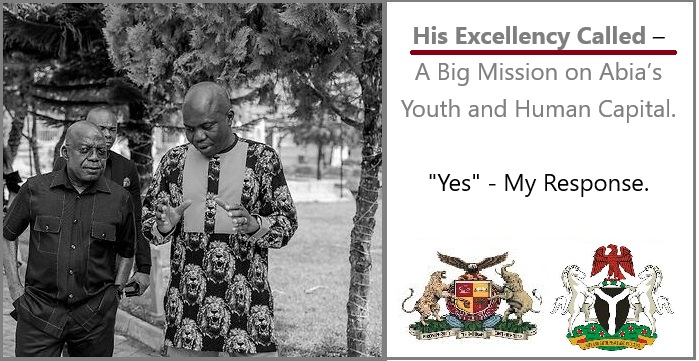
A Greater Abia And Call to Service from His Excellency – “Yes” to His Excellency

0

At 2.11pm on Sunday, His Excellency, Governor Alex Otti, called. He asked me for the availability to coordinate a very important mission in our State. Quickly, I accepted and thanked him for his bigger “answers” to the Abia people. The government will be announcing later next month. Once that is done, I will share here and get all Abians and the world ready to execute. Abia Youth, great things are coming as His Excellency works to ensure that “everyone is ready and prepared for the future”.

Our state works on three core pillars: the People, the Processes, and the Tools. Many reforms have taken place to improve the processes, making it possible to efficiently organize and reorganize critical factors of production and governance systems. For example, in pension, the processes have been streamlined that the state will not owe a decade-long arears anymore. In education, the leaders have changed things to ensure better students-outcome.

When it comes to tools, the businesspeople and citizens need platforms of markets. And those are better roads, electricity, clean water, security, etc. The state is doing everything to ensure those catalytic enablers are available across Abia. Aba, the industrial city has received special attention because a working Aba will fund other parts of Abia. We do expect the tools of healthcare to come to live with the unveiling of the medical city.

On the People part, Abia needs evolutionary and revolutionary investments therein. A village boy like me will possibly not be writing here without that heritage. But when Abia decided to provide me with great teachers, Abia anchored my future. During my time in Secondary Technical School Ovim, I had the best teachers any state could offer its students: Shorthand, French, Automotive Tech, Woodwork Tech and the typical. Mr Onyezewe – Physics (UNN), Mr Aham – Math (UNN), Mr. Bobo – Biology (UI), Mr Udeagu Jr – Chemistry (OAU), Mr. Ukene – Further Maths (UNN), Mazi Oji – Geography (UNN), Mr Eke – English (UNN), Mr Onyeachu – Automotive Tech (Russia), Mrs Aduanya – Agric Science, Mrs Odumuko – Igbo (UNN), Mrs Ikeji – Agric Science (Jr), Papa Iyke – Igbo (ABSU), and other brilliant tutors.

Abia wants to deepen the capacity and the capability of the People. From primary to secondary, from vocational school to university, from special programs like Abia Leadership Academy to what is coming which I will be working on. We will serve; I will reach out here to many as you support Abia to serve Abians, Nigerians and the world.

#AbiaIsWorking #InvestInAbia #Believe


*Ndubuisi Ekekwe has never and will never charge my state for any service because Abia paid for everything when it funded and made those great teachers available. And Ndubuisi does not do contracts and does not know how to send invoices.

Osun Councils’ N58.9bn Allocation Withheld Amid Prolonged Shutdown

0

Local government councils in Osun State have been denied access to over N58.9 billion in federal allocations within the past five months due to the prolonged closure of council secretariats, according to official figures.

Data from the office of the Accountant General of the Federation show that between February and June 2025, the 30 local governments in the state received combined allocations of N58,918,119,222.8. However, the money has remained effectively frozen as the councils have not been in operation following a leadership crisis that has crippled grassroots administration for months.

A breakdown of the allocation reveals that councils in Osun Central Senatorial District received N19.52 billion, those in Osun West got N19.16 billion, while councils in Osun East were allocated N20.23 billion. At the local government level, Ife East recorded the highest share with N2.37 billion, while Ede North received the lowest with N1.42 billion.

Civil Society Raises Alarm

The Insight Initiative for Community and Social Development (IICSD), a non-partisan civic group, has raised fresh concerns over the prolonged stalemate and renewed its call for an immediate resolution.

“We condemn the continuous shutdown of council secretariats in the state, due to the protracted leadership crisis. We appeal for calm and a meticulous approach to resolving the dispute, with a view to enable our councils return to full operations in no distant time,” said the organisation’s Executive Director, ‘Jare Tiamiyu, in a statement on Tuesday.

The group said it had launched a daily reminder campaign to highlight the number of days council offices have been locked up, warning that residents at the grassroots are the ultimate victims of the deadlock.

“As a non-partisan entity, we will continue to demand transparency, accountability, and the delivery of good governance to the masses through our Osun Open Local Government (OsunOpenLG) Project,” Tiamiyu stressed. “This cannot be achieved when allocations expected to be used to initiate programmes and policies for the benefit of the masses are withheld.”

Background to the Crisis

Local government administration in Osun has been plagued by disputes since late 2022, when controversies over council elections escalated into legal battles. The administration of former Governor Gboyega Oyetola conducted local government elections in October 2022, but the exercise was challenged in court and declared unlawful.

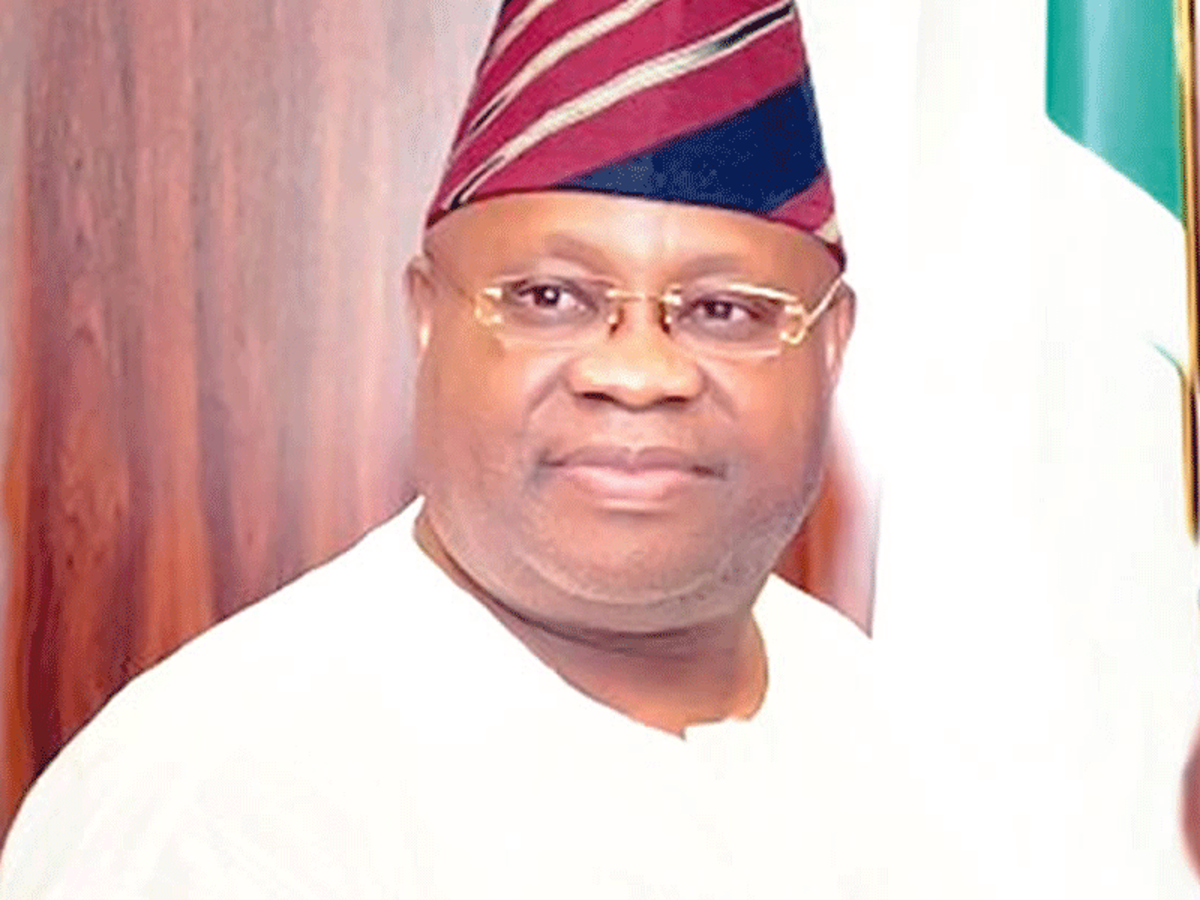
When Governor Ademola Adeleke assumed office in November 2022, he dissolved the elected councils and appointed caretaker committees, citing the court judgment that nullified the poll. This move, however, triggered protests and counter-lawsuits from opposition parties and ousted council officials, deepening the crisis.

As a result, council offices have remained under lock for much of Adeleke’s tenure, with both political disagreements and litigation preventing any form of structured administration at the grassroots. Analysts say the situation has created a governance vacuum, as critical services such as sanitation, community healthcare, and rural development have stalled in many parts of the state.

Stakeholders Urge Quick Resolution

Observers have warned that the prolonged shutdown could worsen poverty and underdevelopment at the grassroots, particularly as local governments are meant to be the closest tier of government to the people.

“The withholding of nearly N59 billion meant for local governments is a major setback for the state,” said a political analyst in Osogbo. “These funds could have been used for roads, markets, schools, and health centres, but instead they are locked in political limbo.”

The IICSD has called on both the state government and the opposition to prioritise the welfare of citizens over partisan interests. It also urged traditional rulers, civil society organisations, and community leaders to intervene in order to break the deadlock.

A Test for Governance

For many residents, the crisis has raised deeper questions about the future of local government administration in Nigeria, where state governments often exercise control over council funds through the controversial State Joint Local Government Account.

Activists argue that unless there is constitutional reform to guarantee financial and administrative autonomy for local councils, grassroots governance will continue to suffer political interference.

In Osun, the fate of the N58.9 billion allocation remains uncertain, with no clear timeline for the reopening of the council secretariats. For now, residents in towns and villages across the state continue to wait for essential services that only functional local governments can deliver.

“The councils belong to the people,” Tiamiyu said. “They must be reopened for the greater good of all.”