DD
MM
YYYY

PAGES

DD
MM
YYYY

spot_img

PAGES

Home Blog Page 6389

How the Zoom Business Model Fits the Coronavirus Economy

0
Zoom

Everyone has a shining and a Christmas day. A day that your usefulness will be at the top in ranking and order of importance.

That is how two friends came to prove a fact to each other to demonstrate their individual usefulness. One is a medical doctor while the other one is an electrical engineer.

These two professionals have always argued about who is more important. The doctor’s argument is that because he is needed to sustain life so he is more important. The electrician argument is that light is life, and therefore its absence there is sadness in life.

One day, as these two friends were at home a call came in and it was an emergency situation that the doctor was needed urgently. He rushed to the hospital to rescue that life.That has proven his point already.

To the electrician, there was a certain day,the hospital light developed an electrical problem. No doctor could work if it is not fixed. Then the electrical engineer was called to fix it. That also demonstrates his importance.

At the end of the day, it is time and events that show how important we are. It shows how important a business is and your skill is also.

The Coronavirus has clearly shown to the world the unarguable importance of some digital products, tools and businesses. It has shown how important the video conferencing product called zoom is. It is now solving many workplace market frictions created by the pandemic.

In this article we shall consider how the Zoom business model fits this kind of economy that the market share and user base is rising daily.

 What is Zoom Video Conferencing?

The zoom video conferencing is a digital or software tool that helps professionals, individuals and organizations to hold video meetings. It helps to keep work flow going in an organization.

It makes it possible for staff of a company to have a meeting similar to an offline meeting but in a video form. The zoom, which is an app and can also be accessed on the website has features for webinar, chatting and other helpful communication and collaboration features.

 How Business Model fit into the Coronavirus Economy?

According to Eric Yuan, the CEO of Zoom said in a webinar hosted by the zoom team On April 21st to address some security issues with the platform said more than 300 million people used Zoom’s flagship video conferencing app, up from about 200 million on April 1.

 In a Feedough article, they stated that Zoom’s shares rose about 5% Wednesday to $150.25 at the close of New York trading. The stock has more than doubled so far this year.

 The reason for this growth and successes is simply because of the coronavirus pandemic. The following are how it is suitable for this period.

 Remote Work Solution

Since the Coronavirus pandemic became national and global issues that led many nations to order all companies and organizations to close down except essentials ones, establishments resorted to remote working.

The coronavirus has succeeded in locking people down but it has not locked up entrepreneurs and managers of companies. So, working remotely will ensure that businesses maintain their usual operations. In order to do this they will need some digital tools to keep in touch while working from home. One of such digital tools is zoom.

 Social Distancing measure

Coronavirus can be contracted through the air droplet of human beings. This was why medical experts came up with the measure of social distancing. With social distancing people will stay out of touch physically. 

But, professionals, teams and staff need to keep in touch in order to continue work. The way to stay in touch virtually and not physically is through zoom.

 The Freemium Marketing Strategy

One of the immeasurable values of the digital business is from the freemium business model that provides very great value to target audience at no cost. Zoom is working on a freemium model, it has a basic plan which is free. 

The plan allows users to have access to 48 minutes of video calls for 100 participants while unlimited time for 1 to 1 meetings.This alone will help organizations with less teams to work remotely and hold meetings at a minimal marginal cost.

 The Cost Effectiveness of Paid Zoom Packages

We have three paid packages which form the subscription revenue model of zoom ; the pro package, the business package and the enterprise package.

 The pro package offers 100 participants with 24 hours video calling duration at $14.99. The business package offers 300 participants and other mind blowing features at $19.99. The enterprise package offers 500 participants with other great features at $19.99.

These make this product cost effective compared to the cost of physical meeting for organizations.

 That is simply how business works. An economic wave which is caused by factors such as trends, nature etc can shift attention from one product to another and that will be the time for such product or business’ success.

 The same is true for professionals. Whatever your dream and skill is, keep working on it for time shall reveal its immense importance one day.

This trend has also skyrocketed Amazon key business metrics as shown in this article.

The Nigerian Governors’ Inter-state Lockdown

1

The 36-state governors under the aegis of Nigerian Governors Forum (NGF) have reached a decision to support a total lockdown of inter-state movement as a measure to contain the spread of COVID-19. The governors reached the consensus in a meeting held via video conferencing on Wednesday.

This is coming in the eve that Nigeria recorded 873 cases of coronavirus that has resulted in 28 deaths.

Chairman of the NGF, Kayode Fayemi of Ekiti State, said in a statement said the increasing number of cases spreading to states has necessitated the decision of the governors.

Fayemi said that among other decisions made by the governors is to set up regional COVID-19 committees that will be headed by health commissioners.

So far, 13 states in Nigeria have confirmed cases of coronavirus, and the way it is going, more states are going to be affected in no time. The director of the Nigerian Center for Disease Control (NCDC), Dr. Chikwe Ihekweazu has earlier warned that the pandemic will touch every state in the country. He said on Monday that president Buhari will make a very difficult decision next week. That and the recent rate of spread have prompted the governors to converge and decide on the next line of action.

The federal government initiated lockdown about three weeks ago, covering the Federal Capital Territory (FCT), Lagos and Ogun states, with exemption of movement for those handling essential services. Some states have also shut borders and restricted inter-state movements.

The number of new states affected in three weeks suggests that inter-state movement across the country is fueling the spread, though the governors said essential services will be allowed.

The WHO has seriously advocated lockdown as one of the best ways to quell the virus.

With Nigeria poorly prepared to take on the pandemic, her best shot is to stop the spread. While the governors appear to have taken the right step, there is doubt they have what it takes to keep the people at home.

Governor Benedict Ayade of Cross River State had earlier said that further extension of the lockdown will give room for uncontrollable youth restiveness.

“With prices of oil falling, locking out is far better than locking down because another two weeks of lockdown will find this country under siege by young people. There is no way you can hold down these young energies for too long.

“It is demographic, it is statistics. 65% percent of the population is below the age of 35 and the virus itself does not have penetrative force in such demography and that is what we have to recognize as a country,” he said.

Apart from governor Ayade, who has shown consistency in distribution of palliatives in his state, others have woefully fallen short. The Cross River State governor has given an emergency employment to 8,000 youths in the state who he placed on N30,000 monthly salary, as part of efforts to cushion the hardship effects the pandemic will bring on Cross Riverians. Other than that, he has distributed tons of food items to over 140,000 households in the state.

But in his opinion, that is not enough. Other governors apparently are not prepared for what has come, and lack the funding, and infrastructure capacity to confront the exigencies.

In Lagos, Babajide Sanwo-Olu’s effort to provide relief to the people in state has been something Lagosians don’t want to reckon with. Last week, Sanwo-Olu said the State Government will be serving a square meal per day to 100,000 youths in each Local Development Council (LCDA) in the State. Reports from residents of the LCDAs said the feeding program has been everything short of what the governor promised.

In other states, though they have lower or no cases of COVID-19 yet, their financial capability to remedy the implication of inter-state travel is close to none. The Federal Account Allocation Committee (FAAC) has drastically reduced due to plummeted crude oil price. In March, the federal government, states and Local Governments shared N780,926 billion which appears to be the highest amount that will be shared in months from now as Nigeria is currently paying consumers to buy its oil. With the states, apart from Lagos, totally dependent on FAAC, paying workers will be difficult not to talk of providing palliatives for their citizens.

A large number of businesses are going to be severely affected, including those in inter-state transport services. with no little or no hope for revenue generation in the coming months, Nigerians have been advised to prepare for the worst.

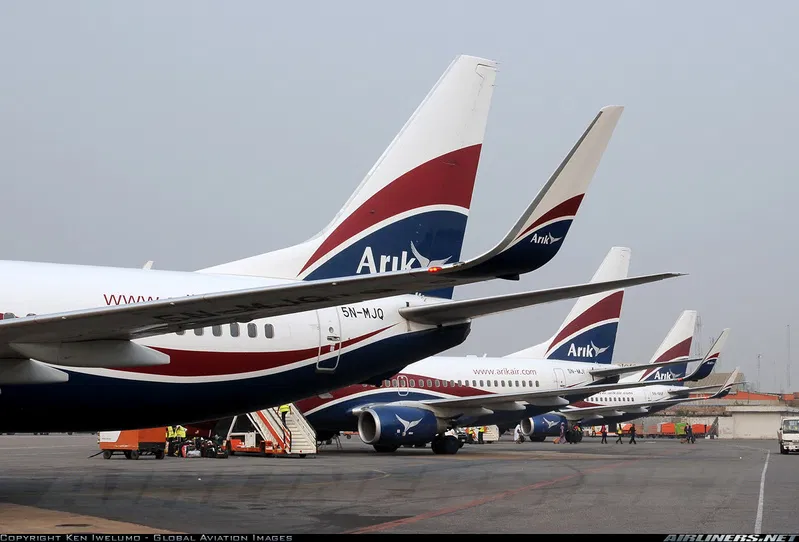
What Next for Arik Air?

1

Poor Arik Air, it is possibly going out of business or exceedingly diminished. Air Peace is also on life-support. While America prints dollars sharing with defenders of good-time capitalists – agents of share buybacks and big dividend payers to crony disciples – but messengers of bad-time decadely socialism, Air Peace and Arik are on their own in Nigeria. Yes, men who make $43 million per year because they “deserve all the pay” as they are building great companies, but quickly return to those they cannot pay $23k for help via bailouts, we see the paralysis in this world. Yet, as Arik cuts 90% of staff and reduces by 80% the pay of the remaining, I become jealous of the American model.

“With the current observed trend of events, it is prudent to lean on the assumption that the situation is likely to persist for a while longer. Of huge significance to us is that we have suffered a sharp decline of over 98 percent in our revenue streams since the suspension of our scheduled flights almost four weeks ago.

“Added to this is the rapid decline in the value of the naira by over 35 percent against the benchmark and with oil prices now falling well below $15 per barrel, it is evident that we must, without further delay, take decisive action to preserve our organization,” he said.

He added that the welfare of staff has always been paramount to the organization, but recent events have made these measures unavoidable.

“Our focus as management has always been hinged on the well-being and safety of our staff, managing our liquidity as an organization and creating the opportunity to ride out of inclement circumstances such as the one we are faced with today.

“Pursuant to this, recently, we reached out to our suppliers, specifically negotiating reduced rates on all our contracted services and mitigating operational expenses due to changes in demand. We also implemented contingency plans for staff and introduced operational support flexibility,” he said.

Nigeria will walk backwards without Arik and Air Peace. Unfortunately, Nigeria is looking for its own bailout from IMF, China, etc and cannot pick their phone calls. I am indeed confused, and ask “What Next for Arik Air?” Nigeria needs logistics and supply chain players – and something needs to happen, urgently. Arik and Air Peace should not fail!

As the airline industry across the world continues to take a beating following the suspension of most local and international flights, Nigeria’s largest commercial airline, Arik Air, on Thursday informed staff it would cut the salaries of its employees by a whopping 80 per cent.

In an internal memo obtained by PREMIUM TIMES the airline’s Chief Executive Officer, Roy Ilegbodu, informed employees that the management of the company has also decided that at least 90 per cent of its workers will proceed on indefinite leave without pay from May 1. 2020.

When reached for comment, spokesperson of airline, Ola Banji, succinctly confirmed the decision but declined to give further details

The memo below.

WhatsApp Image 2020-04-24 at 10.23.10 AM

WhatsApp Image 2020-04-24 at 10.23.09 AM

Source: Premium Times images

What Happens To Air Peace?

Innovate and Drive Organizational Transformation With Our Global Faculty

0

Invent, innovate and drive organizational transformation, performance, and growth. Capture emerging opportunities in changing markets while optimizing innovation and profitability. Digitally evolve your business or functional area, turning digital disruption into a competitive advantage. Master the concepts of building category-king companies, and thrive. Tekedia Institute offers an innovation management 4-month program, optimized for business execution and growth, with digital operational overlay.  Classes begin June 22, 2020, online. Click & Register Today.


https://www.tekedia.com/mini-mba-2/


Strategies Adopted by Enugu Traders to Survive the Lockdown

0

The Igbos have an adage that says that when hills learn to break an old woman’s waist, old women learn to take breaks every now and then as they climb hills. This adage is the same thing as saying that when the going gets tough, the tough gets going. I found these sayings appropriate enough to describe what Nigerian traders, especially those in Abakpa Market, Enugu, are doing to sustain themselves during this lockdown.

The worries of every Nigerian at the onset of this lockdown were focused on how Nigerians, especially those that live out of daily incomes, will survive. People complained and cried out bitterly even though they knew the lockdown was for the good of everybody. With time, everywhere became quiet as if people had accepted their fate and gone into starvation. But that was not the case. The truth is that people have discovered how to survive within this lockdown, though they might be endangering their lives and that of those around them.

One of the fears of the numerous Nigerians that went into panic-buying before the lockdown order took effect was that markets will be shut down completely. Even the broadcast of the president that essential services and foodstuff selling will continue did not quell this fear. It was total madness in Enugu on Monday, 31 March, 2020 as people rushed to markets to buy everything they see, even the ones they will not use in the next four months. ATMs also received their share of the madness because some people withdrew money as if ATMs will also be on lockdown. But a few days into the lockdown taught those of us in Enugu the difference between lockdown and shutdown.

The lockdown order issued by Enugu State government affected some traders. Those that do not sell foodstuff were compelled to close shops. This means that buyers cannot go to markets to buy non-edibles and sellers of these goods are banned from operating within this period. But did they obey that instruction? Well that is the essence of this article.

Kindly understand that this essay does not have the intention to witch-hunt anyone. Its sole purpose is to reveal how traders here in Enugu are surviving the lockdown. Hopefully the information will help some people who might need to adopt their methods. So here are these traders’ ways of observing the mandatory lockdown order:

  • Renting Out their Shop Fronts: Most of these traders that couldn’t sell within this period rented the fronts of their shops to food stuff sellers. The good thing about this is that as the shop owners make little money from renting their shop fronts, those that rented them saw where to sell their wares. Some of the people that sell things at these shop fronts are not career traders, but people displaced from work because of COVID-19. So in essence, they have found the means of keeping body and soul together until this is over.
  • Hanging Around: This was the first thing I noticed when I went to market within this lockdown. I was surprised to see some of my “customers” that were not supposed to be in the market sitting in front of their locked shops and chatting with their neighbours that were also seated at the front of their own shops. It was later that I realised that these people did not come out of their houses to look around and chat; they were waiting for customers. What they do is that if you need something they have, they will unlock their shops, hand it to you and then lock up again. The only thing here is that price haggling takes place before the customer sees what he’s paying for.
  • Selling Early in the Morning and Late in the Evening: Some of these shop owners open their shops very early in the morning and late in the evening to sell. Immediately they settle their customers early in the morning, they lock up their shops and then sell in trickles until evening.

It is true that non-compliance with the lockdown order will increase the spread of COVID-19, but people need to eat and take care of other necessities. Since the government cannot provide those things for them, the citizens have to go out to fend for themselves. However, it should be understood that Enugu has no active case of COVID-19 presently. Maybe that is why people still move around despite the lockdown.