DD
MM
YYYY

PAGES

DD
MM
YYYY

spot_img

PAGES

Home Blog Page 6389

The Choices As Covid-19 Lockdown Debate Continues

0

It has become a debate before the American people – to open or not to open? The lockdown has crippled the economy, businesses are dying, workers are losing their jobs and the government is running out of intervention funds. On the other hand, people are dying, more people are getting infected by coronavirus and hospitals are getting overwhelmed.

The debate hangs on these two situations. Those on each side of it have reasons to believe that it’s time to open the economy or extend the lockdown.

Over 24 million Americans have filed for unemployment benefits since March, as more companies apply for a government bailout, meaning more workers are going to be laid off in coming weeks. They will struggle to pay their bills and live up to some other financial responsibilities – a nightmare many don’t want to have on a broad day.

On the other hand, over 800,000 Americans have tested positive for COVID-19, pushing toward the 1 million mark. Over 50,000 people have died, and the way it is going, many more are going to die in the coming weeks as the world searches for cure.

So to the American people, the choices before them are more like choosing between the Devil and the deep blue sea. And their choice depends on the side of the situation they find themselves in.

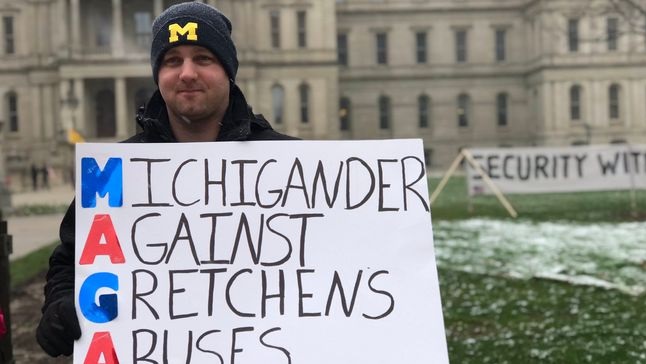
Last week, conservative backed protests erupted in some states against the lockdown. They were calling on the governments to lift the locks and allow people to go back to work. The US president Donald Trump who has been itching to open the economy amidst the escalating health crisis threw his weight behind the protesters. The economy needs to be open – but at what cost?

Doctors, nurses and medical staff took to the streets in a counter-protest that calls on the people to stay at home. It is a divided country fighting a mutual enemy, and each side of the divide is making huge sacrifices, though some are paying a higher price for the battle.

Everyone’s reason is genuine – if you don’t work how would you earn a living? But if you are not living, how would work?

Divided mostly through party lines, Republican led states like Georgia and Tennessee are calling for opening, stating that the lockdown is doing more harm than good. While Democratic led states like Virginia, Michigan and New York are more restrictive. In this tumultuous time of health crisis in the American history, everyone has got something to sacrifice; it’s just a question of – on what altar?

While the push to open the country garners momentum across Republican led states, health officials are concerned that the defiance will blow the pandemic into larger proportions and undermine the progress that has been made so far – and they are equally right.

The argument causing the divide.

The New York Times asked for opinions on the “to open or not” debate, and they pour in with different reasons that can’t be excused in entirety.

“I work at a hospital in the Fairfield County. People I see ignoring the guidelines on the news or in my travels have no idea of how bad the coronavirus is. Sometimes there is very little we can do to save these patients. Even the ones we send home from the E.R. are really sick and can take 2-3 weeks to recover. While the surge is diminishing there are still patients who are really slow to recover. I know everything seems fine wherever you look, but watch some hospital footage and listen to some registered nurse interviews, then decide if you want to skip the mask or congregate together,” said Sean Vigneau, from Fairfield, Connecticut.

One of the major concerns of lifting the lockdown is people forgetting that the world is in the middle of a pandemic and living life like it is 2019.

“Our much-less than enlightened mayor, who clearly drinks the Trump Kool-Aid daily, opened our beaches last Friday and earned national coverage. That has unwittingly given permission to folks to do horribly stupid things. The most egregious? I actually saw parents removing the yellow tape that the police had wrapped around the public park playground equipment – a playground that had signs on it saying that the equipment was not sanitized – and allowed their young children to play on it. I am so deeply angry that these shortsighted, selfish men are making decisions that put my health in danger, and that I have no control over it at all,” Lizanne Bomhard said from Jacksonville Beach, Florida.

People appear to be running out of patience, the government’s social programs seem not enough for them at home for a prolonged period of time – and some of them don’t like house arrest.

“I am a divorced single mother trying to live on disability insurance, child support and the under-the-table hustles I do while my daughter is at school. Well, they closed the schools so I can’t work! Now they will be closed all the rest of the year too? That is wrong! This is a form of house arrest and I did not do anything! I have been a “yellow dog Democrat” my whole life and I have voted in every election since I turned 18, but this time, on this issue, I have to say that I agree with the conservatives! I have the right to work and the government is taking it away! I can’t pay bills and already had to borrow from a friend for my car payment this month. We are hitting the food pantries and the pet food bank. If this doesn’t stop soon, my daughter and I will be homeless. It is just a fact of math. And right now, the math looks really bad,” Joyce Chandler, from Columbus, Ohio said.

From the young and old perspective, everyone has got a view that represents and at the same time contradicts a common view. The aged are worried about their freedom to play golf and enjoy the rest of what life has left for them. While the young are worried that their life could be cut short by this thing – and they will never live to grow old.

A crowd is gathering on the corridor of freedom, job security and the economy, and another crowd is gathering on the platform of health and life. In the fight for survival, these two factors are key. But the present predicament has made it a dilemma. As the push comes to shove, reality beckons with different strokes for different folks’ kind of situation, but in the end, there is a huge price to pay for the choices.

We Will Appreciate More The Freedom We Used To Enjoy After COVID-19 War – Dr. Jibril AbdulMalik

0

Dr. Jibril AbdulMalik is a mental health professional with not less than 15 years in practice. The Senior Lecturer at the Department of Psychiatry, University of Ibadan shared insights on the emotional impact of COVID 19 on frontline workers such as health personnel and journalists. He also shared coping strategies and his expectations of life after the pandemic. The excerpts of his interview with Rasheed Adebiyi are  as shared here. 

Tell us about yourself

My name is Dr Jibril AbdulMalik I am a consultant psychiatrist with the University College Hospital, Ibadan. I am also a Senior Lecturer with the Department of Psychiatry,   College of Medicine, University of Ibadan. I am the founder of Asido Foundation. Asido Foundation is a not-for-profit mental health advocacy organization that was launched last year in 2019 with the aim of promoting better understanding and awareness around mental illness, reducing the shame and stigma that is usually associated with it in our society as well as helping individuals and the affected families and their caregivers to be able to access the care and the support they need. Our hope and motivation is to have a society that is mentally healthy. A society that is free from shame and discrimination for any individual who has a mental health problem as there is none for physical health conditions. That is ultimately what we aim to do. Through our website and social media handles, we engage with the youthful and literate population to push out a lot of positive messaging to encourage people, to inform people and humanize the experience of mental health challenges. That is what we do.

Could you tell us more about Asido Foundation? What motivated its establishment?

In the course of over my one and a half decade of working in mental health across the country, it’s become very clear to me that the biggest challenge we have is that of ignorance, stigma and discrimination. A huge proportion of our population still do not understand what  mental health or mental illness is all about, there is still a lot of superstitious beliefs and on account of this many affected individuals are taken to prayer houses, to traditional healing homes and so on and so forth where unfortunately a lot of human right abuses take place. Last year, the Human Right Watch presented a report on the state of mental health services in Nigeria. Shortly after that there were a lot of police arrests in Oyo State and Kaduna State where illegal treatment facilities where hundreds of people were chained in very inhumane situations and circumstances.

So this is the reality of what we are dealing with in the context of our society that people do not have access to the right information and so therefore those who are affected with mental health problems suffer a lot of abusive practices, disregard of their human rights and lack of access to quality mental health service even when it is available. In a nutshell, a lot of suffering is going on. And we feel that if we just remain in the teaching hospital and wait for those who know to come to our clinics, the number of patients we see is pitifully small. Even though, we are busy as we are. It is still pitifully small compared to the magnitude of the burden within the society itself. And so what that means is that I would estimate roughly that we see less than 20 percent of the burden. The remaining 80 percent are in traditional healing homes, religious homes or they are locked up and chained in the villages so that they will not embarrass their family members. So, our motivation therefore was to try and put out the right information out there so that people would be armed with information and they can seek the right treatment so that they can get better and also to reduce the stigma, the embarrassment and the shame as well as the human right abuses. So this is the motivation. We started by writing weekly articles for The Tribune on Thursdays for a column titled Your Mental Health and You. That has been running consistently since August, 2016. Launching the Asido Foundation last year was to amplify the impact of what we have been able to do with the weekly column we have been writing so that we can pool more resources and get volunteers and together all of us can have a more impactful change in our society at large and the entire continent in the long run.

As a mental health professional, what are the likely mental issues that may arise as a result of the COVID-19 pandemic?

As a mental health professional, the mental issues that may arise from the COVID-19 pandemic stems from the fact that as human beings there is a lot of fear associated with the pandemic; fear of being infected, fear of losing loved ones, fear of losing income as well as the uncertainty because the situation is so drastic now and nobody can say for sure how long this is going to take and  when it’s going to be over and so can that we can plan.  And for us as human beings when we lose that sense of control over our life and we feel helpless and we are constrained because of the lockdown to stay at home and so on and so forth. That feeling of vulnerability, the uncertainty we have to deal with, the fear of infection, the anxiety over challenges that are coming up, the loss of income, the restrictions, all of these place a lot of stress on individuals that are coping with their emotional wellbeing. There are likely to be cases of anxiety, depression especially for those who are previously vulnerable, even new people are developing these problems. Some people are turning into alcohol and drug abuse in other to cope with it which again is harmful to their mental wellbeing. We should know that prolonged anxiety and stress is harmful to our immune systems and the immune system is our best option to fight against the Coronavirus as there’s no treatment at the moment.

The immune system is the best option to fight against it and when you’re stressed and anxious for a long time it weakens your immune system which makes you more vulnerable to developing this. Some individuals have Post Traumatic Stress Disorder (PTSD) because of the trauma of being infected, or seeing someone who has been infected, losing someone who is a loved one dying from it. All of these things are mental health challenges; anxiety, stress disorder, depression, substance use problems and disorder especially PTSD are the most common mental health problems that we may see resulting from the isolation, the loneliness, the loss of control and the difficulties, loss of income, and so on that is associated with the lockdown.

For those at the frontline of the battle against the virus- health workers, journalists, security personnel- what are the mental health issues they could be exposed to while on duty?

For those at the front line, the health workers, the journalists, the security personnel, they are more likely to experience a higher degree of the problems I had listed earlier. For a health worker for instance, who has to wake-up, dress up and go to work everyday not knowing whether the patients they are going to see have corona virus because it is not written on the forehead. Some patients are asymptomatic, they will not have the symptoms of corona virus. They may have come to do something else at the hospital. At the same time, so while taking all the precautions and wearing the protective equipments where it is available. It is still not possible to guarantee that you won’t get infected. They go to work every day with a lot of anxiety and worries, they are stressed because they are trying as much as possible to be careful and then when they go to work and interact with patients, they still have to come back home to their families and there is also the risk that they may bring the infection to come and infect their family members. So this places a lot of stress on the health workers and that all health workers would have to show up, I mean other offices can shut down. Health workers still have to show up, they can’t shut down, so that’s the situation.

Of course, journalists have to report the COVID19 pandemic because it’s topical because they have to report on the number of new cases, number of deaths, number of total infected and so on, what causes it and also report the human angle side of people who are suffering, on admission, how they are feeling, and those who have recovered, how it works for them. These are very intimate details of the pandemic that may also increase their own anxiety, predispose them to developing depression and other mental health problems including Post Traumatic Stress Disorder because they are like indirectly experiencing what is going on and having to write it up and report on it, so they are also going through it. And also the security personnel that have to be at the forefront of ensuring that implementing the lock down and so on and so forth. They are also at the front line of exposed risk.

Experts have continued to hammer on drastic changes post COVID 19. What are your expectations after the war against the virus might have be won?

My expectations after the  COVID19 pandemic is over is  that it will help all of us to take a second look at our life and re-strategize.  For instance, we need to get our priorities right. If  you previously thought that you couldn’t do without travelling for vacation every summer outside the country, now there is lockdown and there is no vacation. You can’t even travel outside your state or city or outside your town, yet you will not die because you cannot travel for summer.

So if you like wearing, buying plenty of shoes and other things and I know that this experience has shown us that when push comes to shove, we need very minimal things to be content and to live a happy life. We don’t need all the things we previously used to love. If you used to love going to the cinema, you can’t go to the cinema now. If you used to love watching premiership matches, there are no premiership matches to watch. If you can’t do without watching the Champions League, there are no matches to watch. There is no sporting activity that you say I must not miss as all sporting activities are cancelled. Even the Olympics has been postponed for one year and so on. So, in essence the point is that there is nothing that we can’t do without. So we need to re-strategize our life and reappraise our priorities to see what are the aspects of my life after the pandemic I want to resume and which aspects do I need to delete because they’re not really helpful and they’re not contributing to my life. That is number one.

Number two, the different approaches to doing business. Many universities are doing online courses.  Many jobs and offices are now having to work from home and offline. What all this means is that life as we knew it before the pandemic is likely to change after the pandemic and we have to be ready to embrace new models of doing business, new models of social interactions and so on and so forth

And for us as human beings too, we are likely to appreciate more the liberty and the freedom to go out and interact with other human beings at social events freely without fear unlike now that we are practicing social distancing when you can’t shake hands, you can’t gather together in mosques or churches for any ceremony and all of that so this is going to transform how we relate for us to appreciate the value of being able to interact and mingle freely with other human beings.  It is something to savour, treasure and be grateful for. We also need to be grateful for good health. I also hope that our government at all levels will begin to pay more  attention to fundamental things like our healthcare services to ensure that our healthcare services at primary care level, secondary care level and tertiary level are all invested in. Our government has not been investing in our healthcare services as well as education.

We hope that this will be a wake-up call that would encourage them subsequently to pay attention. Now nobody can travel abroad for any treatment. And we have to use the services we have in our country. These services have previously been neglected. This is a wake-up call. I hope that all Nigerian citizens would make sure that it is on the front burners so that we do not go back to business as usual after all of this and forget to save for the rainy days so to speak. This is because it is not until the pandemic comes that we begin to run helter skelter. It is before it that we should struggle to invest in our health care services and strengthen it. Even well developed countries are struggling despite the level of their quality healthcare systems hitherto. For us, we are at sub optimal capacity which makes us more vulnerable. Our prayer is that we do not have a significant level of community transmission that would put us under distress.

What coping strategies do you suggest?

We shouldn’t just talk about the problems without providing solutions to them as to how to cope with them. Some of the things that are helpful to make us cope including  ensuring that we stay calm  and we control our anxiety. There are so many pieces of fake news on social media and anxiety provoking messages that we have to ensure that we avoid. If watching news network and reporting of the event is becoming too much for us to swallow, then we should switch off from them. Also, we should rely on reliable sources of information such as the WHO, the NCDC or any official government organs responsible for disseminating accurate and responsible information. Even though we are locked down at home, we can deploy technology, we can have video calls with family, friends. We can call friends we have lost touch with for a long time, create time to reconnect with them and find out what’s going on, now that we have the time, we can deploy that time to invest in social relationship and build our networks. We should also not be involved in spreading fake news and sharing alarming information unless we verify it to be true. We can try to use this opportunity to acquire new skills. If there’s a book you have always wanted to read, you always wanted to use Microsoft word, Excel , PowerPoint and you didn’t have time, now you have the time, anything you want to learn there are YouTube videos that are very helpful, this is the time to improve yourself, invest in your self-development and acquire new skills.

We should also most importantly comply with the preventive strategies: wash your hands regularly,  stay at home except it’s absolutely necessary to go out. And observe social distancing.  It’s also helpful to exercise regularly, it doesn’t mean you have to go to the gym. You can dance for 30 minutes, jog or use skipping rope and do many things within your home or around your compound. That’s helpful. When you do that, when you exercise your muscles, it causes them to relax which reduces your stress and anxiety. It also releases feel good chemicals or hormones in our body that make you feel better and lift your mood and then it helps to sleep better when your muscles are tired.

So exercise is a very positive thing to do. It’s important to bond with our family. Many families have become strangers sleeping under the same roof. This is the opportunity for couples to rekindle their relationship, strengthen it, spend time with the children. Siblings too should spend time with each other and strengthen their ties of family of bonding. That is something that is positive that we can use this opportunity to do very well.

Lastly, it’s important to eat healthy diets, drink plenty of water, rest well and don’t forget that our biggest weapon is our immune system okay and to nurture the immune system, you need to get a balanced diet. You should do things that make you happy. Anything that makes you happy, create time for it. If you like watching movies, reading, reading different types of novels and so on, please do them. This is so that you can stay positive and optimistic. Have fun, play games. You savour each moment so that you look at the glass not as half empty but as half full.

Thank you for your time

You are welcome


When Software Is Not Enough – And Not Eating The World

3

Marc Andreessen is the father of the techie philosophy – Software is eating the world – and has cleverly posited that everything would fall to software, from agriculture to logistics, healthcare to education, and beyond. Some of us trained in electrical engineering would laugh; I always tell people that before you can run any software, someone has to build a microprocessor. Of course, we get the big picture of Marc’s point – and it remains valid that software creates leverageable positioning which cannot be found in any other sector, enabling scalable advantages which are unbounded and unconstrained across many metrics.

My own theory is that we are in the middle of a dramatic and broad technological and economic shift in which software companies are poised to take over large swathes of the economy. More and more major businesses and industries are being run on software and delivered as online services — from movies to agriculture to national defense. Many of the winners are Silicon Valley-style entrepreneurial technology companies that are invading and overturning established industry structures. Over the next 10 years, I expect many more industries to be disrupted by software, with new world-beating Silicon Valley companies doing the disruption in more cases than not.

Why is this happening now?

Six decades into the computer revolution, four decades since the invention of the microprocessor, and two decades into the rise of the modern Internet, all of the technology required to transform industries through software finally works and can be widely delivered at global scale. Over two billion people now use the broadband Internet, up from perhaps 50 million a decade ago, when I was at Netscape, the company I co-founded. In the next 10 years, I expect at least five billion people worldwide to own smartphones, giving every individual with such a phone instant access to the full power of the Internet, every moment of every day.

On the back end, software programming tools and Internet-based services make it easy to launch new global software-powered start-ups in many industries—without the need to invest in new infrastructure and train new employees. In 2000, when my partner Ben Horowitz was CEO of the first cloud computing company, Loudcloud, the cost of a customer running a basic Internet application was approximately $150,000 a month. Running that same application today in Amazon’s cloud costs about $1,500 a month.

With lower start-up costs and a vastly expanded market for online services, the result is a global economy that for the first time will be fully digitally wired — the dream of every cyber-visionary of the early 1990s, finally delivered, a full generation later.

But his new piece – It’s Time to Build –  makes the  investing philosophical “movement” even more fascinating. Yes, Marc now thinks that we need to build – houses, roads, factories, etc. These are things software has struggled to eat! And I can give a cheat sheet here: software has a marginal chance because you actually have to build roads, houses, factories, etc.

You see it in housing and the physical footprint of our cities. We can’t build nearly enough housing in our cities with surging economic potential — which results in crazily skyrocketing housing prices in places like San Francisco, making it nearly impossible for regular people to move in and take the jobs of the future. We also can’t build the cities themselves anymore. When the producers of HBO’s “Westworld” wanted to portray the American city of the future, they didn’t film in Seattle or Los Angeles or Austin — they went to Singapore. We should have gleaming skyscrapers and spectacular living environments in all our best cities at levels way beyond what we have now; where are they?

You see it in education. We have top-end universities, yes, but with the capacity to teach only a microscopic percentage of the 4 million new 18 year olds in the U.S. each year, or the 120 million new 18 year olds in the world each year. Why not educate every 18 year old? Isn’t that the most important thing we can possibly do? Why not build a far larger number of universities, or scale the ones we have way up? The last major innovation in K-12 education was Montessori, which traces back to the 1960s; we’ve been doing education research that’s never reached practical deployment for 50 years since; why not build a lot more great K-12 schools using everything we now know? We know one-to-one tutoring can reliably increase education outcomes by two standard deviations (the Bloom two-sigma effect); we have the internet; why haven’t we built systems to match every young learner with an older tutor to dramatically improve student success?

Of course, I understand his pains: how can we have Silicon Valley  and American cities begging for masks, gloves, etc? How can we have Silicon Valley and doctors and nurses are dying because of protective gowns?  And how can small Chinese firms be serving the world with masks, gloves, etc during this Covid-19 pandemic? Yes, doctors have refused to fight even when equipped with gadgets running software unless they have a mask!

There is no confusion – Marc’s big picture is clear and his message applies to all of us: unless you build, your position is nothing by transient, software or no software. Nations that build win – and lead. It applies to America, Nigeria and everyone!

COVID-19: Can Africa Afford Lockdowns? By Chukwuma Charles Soludo

22

This piece summarizes my contribution to an African debate. From Johannesburg to Lagos, Cairo to Dakar, Kinshasa to Kigali, Nairobi to Accra, etc the debate on how Africa should respond to the global coronavirus (Covid-19) pandemic is raging. At an African regional policy platform, I had expressed some of these (personal) views some weeks ago but have been encouraged by most members to circulate them in Africa beyond the platform.

This year 2020 begins a new decade that promises to be one of dreadful disruptions, with Africa holding the weakest end of the stick. In 2008/09, the global “great recession” was triggered by financial crisis in the US (world’s largest economy). Then, much of Africa was said to be decoupled from the crisis and muddled through without severe devastation of its economies. This year, a global health pandemic that has paused the global economy and certain to rail-road it into synchronized recession (if not depression) was triggered by the second largest economy, China. Unlike before, multilateralism and global coordination framework are at their weakest. National (local) self-defence is the rule. As before, the rich world with its generous welfare system and huge financial war chest, is taking care of itself (the US alone has US$2.2 trillion stimulus package). Africa is left to its fate.

Covid-19 caught the world totally unprepared, and with no proven and available medical response. Ad-hoc cocktails and learning-by-doing constitute the strategic package. In most western countries, the cocktail of response has included a coterie of defensive measures including: border closure; prepare isolation centres and mobilize medical personnel/facilities; implement “stay at home” orders or lockdowns except for food, medicine and essential services; campaign for basic hygiene and social distancing; arrange welfare packages for the vulnerable; and also economic stimulus packages to mitigate the effects on the macro economy.

Many African countries have largely copied the above template, to varying degrees. Piece-meal extensions of “stay at home” or lockdown orders as in many western countries have also been copied in Africa. But the question is: can Africa really afford lockdowns, and can they be effective? Put differently, given the social and economic circumstances of Africa and the impending ‘economic pandemic’, can Africa successfully and sustainably defeat Covid-19 by copying the conventional trial-and-error template of the western nations? In confusion and desperation, the world seemed to be throwing any and everything at the pandemic. Recall President Trump’s assertion that hydroxychloroquine “might help”? The evidence so far (from limited sample) is that it probably actually worsens the disease. The trial and error have left huge human toll and economic ruins, and there is still no solution.

Let us be clear: no one can blame African policymakers for the initial panicky copy and paste response some weeks ago. No public officer wanted to be blamed for doing nothing or not doing what others were doing. After these initial pilot schemes, it is now time to ask the deep question: Is this the right approach for Africa?

All lives matter and African governments must do everything to protect or save every life from the pandemic. The challenge is how. Africa faces two unsavoury options: the conventional template, including lockdowns versus heterodox (creative local) approaches without lockdowns. Both have risks and potential benefits. Sadly, people will still get the disease and die under both approaches. People will differ on the choice, depending on what is on their decision matrix: data, resources, subjective preferences, and interests, etc. I focus on which option (on a net basis) is achievable in the short to medium term, consistent with our social and economic realities.

Our thesis is that lockdowns in Africa suffer time-inconsistency problem without a credible exit strategy; is unaffordable and could potentially worsen the twin pandemic—health and economic—in Africa. We call for Africa to press the reset button now, mainstream its collective, simple, smart learning-by-doing solutions that could, in the end, be the African solutions for export to the world. Covid-19 won’t be the end of techno-economic disruptions or health pandemics even in this decade: this is an opportunity to think without the box—to engender greater self-confidence in our capacity to think through our problems, with authentic sustainable solutions.

Let me illustrate why I believe that a strategy that includes lockdowns/border closure is the worse of the two options given our social and economic realities. (Recall that China isolated Wuhan, and kept Shanghai, Beijing, and other major economic engines open, and today, China supplies the world with medical equipment, face masks, etc and raking-in hundreds of billions of dollars). The idea of a lockdown (and border closure) implies that you will continue to do so (with extensions) until such a time that you are satisfied that the spread of Covid-19 has been arrested or on the decline (with the possibility of imposing another round of lockdown if new infections surge). That is the catch: lockdown for as long as required to stem the spread. The length of time required for such lockdowns to ensure “effectiveness” in arresting the spread would make it near impossible in much of Africa. If the strategy is to lockdown until infections stop/significantly decline or so, then we would have a suicidal indefinite waiting game.

First, monitoring the spread requires effective testing, and Africa cannot afford effective testing of its 1.3 billion people. New York State, with a population of 20 million and a budget of $175 billion, is pleading with the US Federal Government to assist with testing kits and facilities. Check out the number of testing centres and facilities in each African country relative to their populations. A joke in the social media narrated that the health minister of Burundi was asked to explain the miracle in his country whereby the number of infections was reported as zero. His response was: “it is simple: we don’t have any testing kits”. Besides, there is stigma associated with the infection, and on the average Africans only go to the hospital as the last resort. There are also asymptomatic cases, and only the critically ill ones will report. So, there will always be massive under-testing, and gross under reporting.

Furthermore, social distancing in most parts of Africa will remain impractical. From the shanties in South Africa’s townships to the crowded Ajengule or Mararaba in Abuja/Nasarawa, or Cairo or Kinshasa to the villages and poor neighbourhoods in much of Africa, social clustering, not distancing, is the affordable, survivalist culture. Communal living is not just about culture, it is a matter of economic survival. Hence, the statistics on infections will be coming in fits and stats: shall we be locking down and unlocking with each episode of surge as there may probably be several such episodes (unless and until a cure is found)? Even with over four weeks of “stay at home” or lockdowns in some African countries, the reported daily infections continue to rise. Some may argue the counterfactual that without the initial lockdowns, the number of infections could have been multiples. It is a reasonable conjecture or anecdote, albeit without any proof. The question is the end game for a poor society such as Africa? New infections have re-emerged in Wuhan, and both Singapore and South Korea are going back to the drawing board. Since we cannot sustain lockdowns indefinitely or even until the spread stops/declines, it means that we would sooner or later remove the restrictions. What happens then? There would still be infections, which can still spread anyway. Why not then adopt sustainable solutions early enough without weeks of avoidable waste and hardship? Let us think this through!

Next, African states cannot pay for lockdowns. Many countries depend on budget support from bilateral and multilateral donors, and with acute balance of payments problems. They do not even have leg rooms to simply print money. Most are now begging for debt relief and applying for urgent loans from the IMF and the World Bank. In Africa, both the governments and the people are begging for “palliatives”. The most that African states and their private charities can do is “photo charity”— with much fanfare, drop a few currency notes or grains here and there for some thousands when millions are in desperate need, just to be seen to have “done something”. At a fundamental level, most African states do not have credible demographic data to identify and target the most vulnerable. In the western societies from where we copied the lockdown/border closure, their citizens are literally paid to stay at home (by silently dropping monies into their accounts plus other incentives). Check out the trillions of dollars, Euros, and pounds in support to the vulnerable and stimulus packages. Despite these, check out the restiveness/protests in several of these countries and the unrelenting pressure to eliminate the restrictions (even in countries where thousands are dying each day due to Covid-19). Given that no government in Africa can seriously pay for lockdowns, over one billion Africans are left to survive if they can or perish if they must.

Without government support, no more than 5% of Africa’s 1.3 billion people can possibly survive any prolonged lockdown on their own finances. Most of the others have no assets or savings to live on for any prolonged period, and there is no social insurance (welfare system). Without the pandemic, the African economic space is already in dire straits, with unacceptable unemployment rate (especially youth unemployment) as well as endemic poverty. In 2007, I evaluated the structure of deposits in Nigerian banks and found that only 8% of the bank accounts had balances of N300,000 (over $2,500 then) and above, and these accounted for 95% of the total deposits. The remaining 92% of bank accounts had 5% of total deposits. I understand that a recent study showed that only 2% of bank accounts had N500,000 (about $1,300) and above. Also imagine the dependency burden on this 2%. The dearth of infrastructure (basic electricity is deficient) makes compulsion to stay at home hellish for most people. We have lockdowns in Africa but without pausing several pressures for private expenditures on the people: monthly house rents; banks’ interest payments for micro, small and medium enterprises (MSMEs), electricity charges, etc.

With some 80% of Africa’s population living from hand to mouth on daily toil and hassle, complete lockdown would never be total, almost impossible in our social settings. In most cases, the orders simply create opportunities for extortion for the security agencies: those who pay, move about! Attempts to force everyone into a lockdown for extended period may indeed be enforcing a hunger/stress-induced mass genocide. More people could, consequently, be dying out of hunger and other diseases than the actual Covid-19. In normal times, thousands die every day in Africa due to other illnesses and communicable diseases—cholera, malaria, lassa fever, lower respiratory infections, diarrhoeal diseases, tuberculosis, heart diseases, stroke, HIV/AIDS, yellow fever, zika virus, measles, hepatitis, typhoid, small pox, Ebola, Rift valley fever, monkey pox, chikungunya virus, pregnancy and child-birth related deaths, renal failure; pneumonia, etc.

Lockdowns worsen these as many of the victims of these now have little or no cash to attend to themselves. Soon the pharmacy shops will run out of imported drugs. Even local pharmaceutical manufacturing firms need imported inputs but cannot efficiently source them under lockdowns/border closure (even more so with restrictions in China and India). Soon local, adulterated ones may fill the gap. A summary point is that the millions of persons in the street, who are struggling between life and death each day with numerous other challenges do not, and will never, understand why so much additional hardship is being foisted upon them because of the novel coronavirus. For most of them (wrongly though), it is an elite problem since for them, the “hunger/other disease virus is more dangerous than corona virus”. The hungry and desperate millions may be forced to take desperate actions to survive, and little surprise that crime has spiked in several African countries with lockdowns.

What many do not seem to appreciate is that African economies are facing their worst economic condition in decades. Commodity prices have fallen dramatically, and for oil producers, the situation is precarious. IMF predicts that aggregate Africa will fall into a recession this year (the first in over two decades) but possibly rebound next year. For oil producers, it all depends on what happens to oil prices in the coming months and how they creatively craft a plan to transition to the world with little or no oil. If appropriate measures are not taken quickly, some oil producers may slide into depression. But border closures/lockdowns that dramatically affect the labour market and supply side (as well as demand side) of the economy will only worsen the situation, especially with little or no room for effective fiscal/monetary stimulus. Government revenues will be severely affected.

Thousands of MSMEs will die under the weight of formal and informal loans, bills (rents, electricity, wages, interest, etc) that continue to accumulate under lockdowns as well as low demand for their goods and services. Some countries are busy “announcing” fantastic figures of helpline for the MSMEs (and much of it will end at the announcements) but without a clear path to address the legacy burden on the firms— the persisting bills! Most of the owners of the MSMEs will probably consume their business capital during the lockdowns, with no clear helpline afterwards. The US Senate just passed a bill for $484 billion “More Small-Business Stimulus”, including a $320 billion “Paycheck Protection Program” to enable small businesses pay their staff salaries for two months. This follows the exhaustion of earlier $350 billion for small businesses under the $2.2 trillion stimulus package. The above is just an example of what western countries from whom we copied the lockdown strategy are doing for their MSMEs—which Africa cannot afford.

Millions of poor farmers will be hard hit. Their perishable products that need the informal public transport to reach the cities will be wasted; while millions that need transport to their farms cannot do so. Agriculture in Africa is rain-fed and seasonal. Lockdowns during the planting season could threaten food security in months ahead. Inflation will shoot up in many African countries, and with critical food shortages later. Manufacturing firms need imported inputs, machinery, and spare parts. Countries under lockdowns are consuming their old stocks. Even after lifting the lockdowns/border closure, it may take months for normalcy to return in some countries.

Each day that any of the major African economies stays under lockdown costs Africa billions of dollars in lost income but with debatable benefits. Given its financial and structural weaknesses, Africa does not have the luxury of using the same “conventional tools” of the western countries in the face of the twin pandemic. At the minimum, Africa needs its full population (its most important asset) working at full throttle to have any chance of defeating the impending economic catastrophe.

What should Africa do?

We should think African but act locally and opportunistically to survive and prosper, and exploit the global opportunities offered by the crises. Every shock or pandemic presents opportunities. Solutions need to be multidimensional, far beyond economics and western medicine. Ad-hoc response will be a wasted opportunity. Africa needs a package for creating sustainable prosperity in a world of continuous techno-economic-health disruptions. Such disruptions will become the new normal in the decades ahead, and we should better get used to that. Only societies that anticipate and plan for such disruptions will opportunistically exploit them, while others mourn and blame the shocks. The way we work, socialize, meet etc will not be the same after these crises. Welcome to the decade of rapid creative destructions!

As a first step, African countries should urgently dismantle the border closures as well as the stay at home/lockdown orders. Hopefully, some useful data were gathered, and lessons learnt that will help in crafting simple, smart, and sustainable heterodox responses. Africa cannot afford lockdowns that will prove ineffective anyway.

Opening Africa does not mean abdication of responsibility by the governments. Governments should lead in the mobilization, education, and possibly equipment of the people to take personal responsibility for their safety; mainstream the African spirit of community/collective action by mobilizing the churches, mosques and civil society organizations to lead in the public education and mobilization; and finally for the government to do its utmost best in providing public healthcare.  An enduring lesson of this pandemic is that African countries must take public healthcare seriously. There will be future health pandemics and we should better get ready today. Professionals, religious leaders, CSOs and community leaders should be mobilized to agree on simple, smart solutions consistent with our financial and social realities. Our western and local (herbal) medical experts and research institutions should all be mobilized to come up with solutions. Those with pre-existing conditions might receive special treatment. The president of Madagascar is reported to have announced that his country has found its own cure for Covid-19 and has ordered schools also to reopen. The west is still on a trial-and-error mode, and why shouldn’t we experiment as well? Africa fought and survived Ebola without lockdowns and we can do even better this time.

Our model should be learning-by-doing while mainstreaming basic common-sense tips such as: mandatory wearing of masks in public, basic hygiene, disinfection of all open markets every early morning and all places of public gatherings, practical social distancing tips, provision of hand washing facilities in public places, production and use of hand sanitizers, gloves, etc.  For example, all public transport vehicles—taxi, buses, trains, airplanes might require disinfection of the vehicle before use, and for all passengers to wear masks and with hand sanitizers. Can you imagine the thousands of jobs to be created in producing face masks, hand sanitizers, gloves, etc for 1.3 billion people? But this cannot happen under a lockdown. New opportunities! Everyone wants to live, and Africans will learn and adapt quickly. Staying at home will become a choice, not a compulsion. The slogan could be: “stay at home if you can, or smartly go to work if you must”. We can only defeat the challenge by confronting it, and not by playing the Ostrich only to still confront it the day after.

Every African society has some local herbs that, to use President Trump’s phrase, “might help”. While the UK and others are experimenting with vaccines, you never know if an Africa herb might be the cure. Necessity is the mother of invention, and only those who dare, succeed! With enough education and mobilization, the infection rate will be drastically reduced without pausing the lives of 1.3 billion people.

The real challenge is the potential economic catastrophe that many African economies face. How policymakers respond depends on how they interpret the shocks: as temporary or permanent structural shifts. But howsoever they choose to see it, one thing is certain: several more similar shocks (not necessarily in exact form) are on the way.

What is evident so far is that most African policymakers (typically) think of the shocks as temporary, and consequently seem to believe that they can just stimulate their way out of it and wait for the next one. African multilateral financial institutions (e.g. AfDB and Afreximbank) have announced packages to assist Africa ride over the shocks. The World Bank and the IMF have provided quick disbursing windows for us to borrow. African finance ministers have called for moratorium on debt servicing, and most have applied for the cheap loans from Washington. Several African countries have “announced” intervention funds that, at best, constitute a drop in the ocean relative to need. The buffers and institutions for dynamic adjustments are weak or absent. In most countries, subnational governments are pleading for bailouts from their cash-strapped central governments. Many of these subnational governments will soon realize that they are basically on their own, and many could become fiscally insolvent.

After most African countries empty all their piggy banks now, and borrow their full tranches at the Fund and the World Bank, secured moratorium on existing debt etc, what happens with the next disruption in a few years’ time? Or like the African musician, Oliver de Coque sang: “let us enjoy life today, and after that we can worry about tomorrow”? But that tomorrow is a few hours away. Because of these crises, many African currencies (especially the oil producers) might likely depreciate significantly. Servicing these external debts tomorrow with the exchange rate then, would require heavy lifting. But it is difficult to see how a competitive real effective exchange rate regime will not be a critical component of their comprehensive strategy for diversification and global competitiveness.

Politicians with short-term electoral cycles typically have short time horizons or suffer policy myopia. This is not just an African problem. It is a typical problem of multiparty democracies with short term electoral cycles and term limits. However, extreme cases abound in some African states especially because the civil service (that ought to ensure longer term continuity) is very weak. With eyes on the next election, opportunistic populism wins. Rather than confront the underlying structural dysfunction, the easiest escape is to pile up debts and contingent liabilities. This is the circularity that has brought Africa to the present embarrassment whereby barely some years after massive debt cancellations/reliefs from our creditors, we are again pleading for “debt relief”. But several future shocks are on the way. When and how can African countries escape this circular trap? This is a short question but with a long answer. Each country’s economic/development team should get to serious work.

For the countries that see the shocks as signalling structural shifts (which it largely is), the focus should be on exploiting the opportunities offered by the crises to press the re-set button. It requires a realistic diagnosis and admission that the existing business model has been rendered obsolete. Crafting a new business model that encompasses the whole range of institutional, technological, structural, macroeconomic, and even politico-governance arrangements takes time and demands for disruptive thinking. It would require mainstreaming creative non-debt-creating financing options and new forms of economic partnerships. But these require longer-term perspectives and a form of inter-generational planning. There lies the conflict versus the opportunity and points to what separates politicians from statesmen. Politicians think of the next election, while statesmen think of the next generation. We pray for Africa’s political statesmen (a seeming contradictory combination—be a politician and statesman at the same time). That is why I strongly support the re-opening of all of Africa urgently, and let all hands get to work to help them succeed.

© Soludo is a former governor of the Central Bank of Nigeria (CBN)

COVID-19 Impact: Arik Air Suspends 90% of Staff Without Pay

0

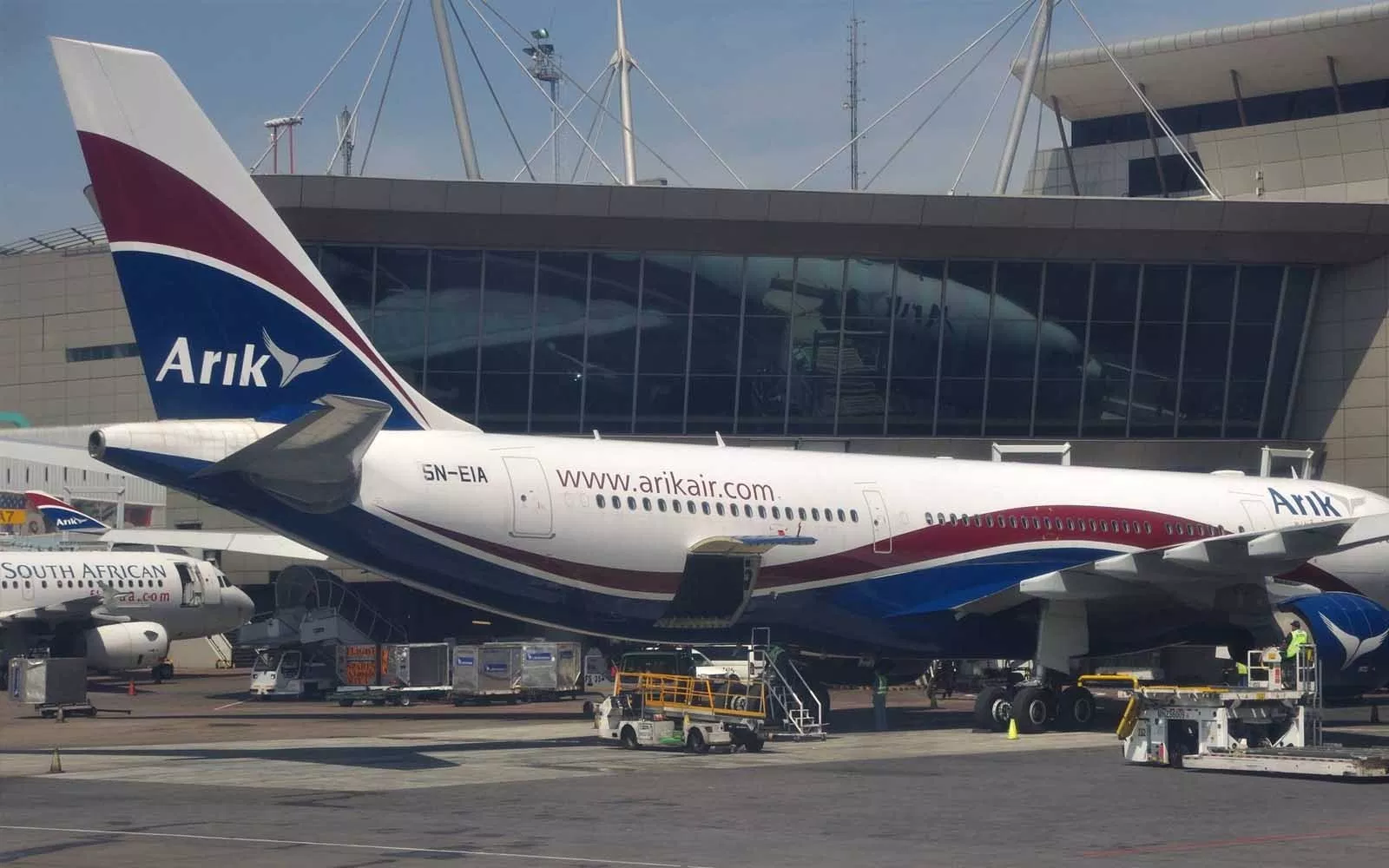
Arik Air, one of Nigeria’s major airline companies has ordered 90% of its staff to go on leave until further notice. This is as a result of lockdown that has paralyzed commercial activities in many states in Nigeria, and put aviation transportation to a halt.

The aviation company has also implemented an 80% pay cut for its personnel while the rest of its workforce has been sent on leave without pay.

In March, the federal government announced that all international airports in Nigeria had been shut down to restrict entry of people from countries with high rates of COVID-19. Following the lockdown order that affected the Federal Capital Territory (FCT), Lagos and Ogun States, the aviation ministry restricted local flights as more states implemented a “no flight” rule.

On Tuesday, Aviation Minister, Hadi Sirika announced that following the extension of the lockdown, airspace and airports will no longer be open for normal activities.

“As a result of the extension on lockdown by Mr. President it is no longer possible for us to open our airspace and airports for normal operations by the 23rd April, 2020. They will remain closed for a further two weeks. This is subject to review as appropriate,” he said.

This development instigated by the coronavirus pandemic has forced Arik to suspend 90% of its staff. But in an email sent to staff, the Chief Executive Officer of the airline, Captain Roy Ilegbolu promised that the decision will be reviewed monthly.

“After careful deliberation and analyses, management has decided to implement an 80 percent pay cut for all members of staff across the entire organization for the month of April 2020. Furthermore, commencing from May 1st 2020, no less than 90 percent of our staff will proceed on leave without pay until further notice. This position will be reviewed on a monthly basis and communications on further developments will be shared by our HR department as the situation evolves,” he said.

Ilegbolu said Arik has suffered 98% decline in revenue streams in about four weeks following coronavirus’ spurred economic turmoil, leaving the company with no option than to cut the workforce.

“With the current observed trend of events, it is prudent to lean on the assumption that the situation is likely to persist for a while longer. Of huge significance to us is that we have suffered a sharp decline of over 98 percent in our revenue streams since the suspension of our scheduled flights almost four weeks ago.

“Added to this is the rapid decline in the value of the naira by over 35 percent against the benchmark and with oil prices now falling well below $15 per barrel, it is evident that we must, without further delay, take decisive action to preserve our organization,” he said.

He added that the welfare of staff has always been paramount to the organization, but recent events have made these measures unavoidable.

“Our focus as management has always been hinged on the well-being and safety of our staff, managing our liquidity as an organization and creating the opportunity to ride out of inclement circumstances such as the one we are faced with today.

“Pursuant to this, recently, we reached out to our suppliers, specifically negotiating reduced rates on all our contracted services and mitigating operational expenses due to changes in demand. We also implemented contingency plans for staff and introduced operational support flexibility,” he said.

The CEO noted that Arik Air has managed to preserve its limited resources by taking these measures. He added that more steps will be taken in accordance with unfolding events.

“For this reason, to safeguard the survival of our organization, we are constrained to introduce additional measures to curtail our costs, as dictated by the turn of events,” he added.

More companies in the aviation industry are expected to follow the steps of Arik in the coming weeks as there is no special intervention fund by the federal government for the Nigerian aviation industry. The 50 billion Target Credit Facility of the Central Bank of Nigeria, for businesses and households fall short of what is needed to keep airline companies in business and save people’s jobs.

Aviation companies can only access not more than N25 million from the fund, which is insignificant to the exigencies of the aviation industry.

In many countries around the world where there has been substantial intervention from the governments, airline companies are still struggling to keep their staff. It is believed that the lack of sufficient social intervention programs by the Nigerian government is going to result in more layoff of staff in the coming weeks.