He is a happy man* because recession is coming! He has been praying for one since 2015. Yes, without recession, the door of owning a house would be locked for him. But with one coming and prices dropping, the chance is finally here!
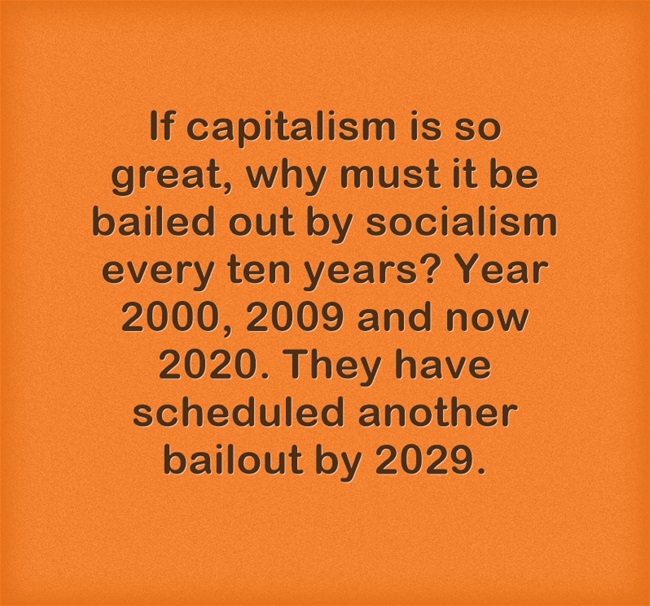
He has mocked capitalism because he believes that it is rigged for the big boys. Yes, while governments will always bail out big corporations, only recession will bail him out by making things cheaper and affordable. His thinking is thus: if capitalism is so great, why must it be bailed out by socialism every ten years? Year 2000, 2009 and now 2020. They have another scheduled bailout by 2029.
It is a hard call – privatizing success (profit sharing, bonuses, etc) but socializing economic pains (markets have crashed, we need cheap government money). I still believe capitalism is the best model but there was one they taught me in FUTO in GST 108 ( Polity and Economy of Nigeria). They called it the Mixed Economy System. I am not sure even that one works! But this morning, a commenter left a really nice one on a piece on Igbo Apprenticeship System in Tekedia; he called it Communalism (note, that is not communism)!
Lastly, we need to factor in the metaphysical worldview of the Igbos that favors individualism and a type of capitalism mixed with communalism (not communism) as opposed to the American capitalism that favors individual wealth accumulation, which could explain the centralized, conglomerate model. The Igbos believe that a single tree no matter the size cannot make a forest. But, for the purpose of building scale, it is more of mindset rather than the system.
Yet, I will still vote for capitalism. In the midst of its imperfection, it is well ahead of other options on accelerating innovations and productivity.
Like other industries in developed and developing countries, the Nigerian Facilities Management industry is also feeling the impacts of the Coronavirus outbreak that has killed thousands of people and infected millions. The resultant effects of the virus on businesses have been disruption in operational activities and management of finances using innovative approaches to satisfy the clients’ needs and delivering value to owners.
Since the first case was reported in Nigeria, on February 27, 2020, a number of facilities management professionals and business owners in the industry have been expressing mixed feelings on the consequences of the virus on the industry in the short, medium and long terms. Already, players have been forced to change operational strategies in order to continue delivering services to their clients without hitches. Some have asked workers with the non-essential tasks and responsibilities to work from home to support the government’s directive on lockdown. This is more pronounced in Lagos, Abuja and some states in south-south and south-eastern regions, especially in Port-Harcourt.
“The significant part of Q1 has been impacted by the COVID-19, funny enough, it’s only had little effect on FM. Most essential companies still work online; wastes are still generated and life keeps running. FM is all about people. Therefore, wherever the people go, Facilities Management follows, some company adopts different strategies in managing their facilities and assets. Some locked down the company and its maintenance team to ensure business continuity. Some operate virtually, when issues arise, they mobilize to the location and fix the issues,” Abdullah Abdullah Oladipo, Project Team Lead at Green Facilities, said in a recent interview.
As businesses and people look forward to total containment of the virus and possible vaccines, our analyst believes that operational cost reduction will continue to be FM companies’ narrative as the main strategy of getting more clients and having sustainable revenue after the virus. Telling a cost reduction story means that FM companies’ success rate is premised on how to get more for less using cost-cutting.
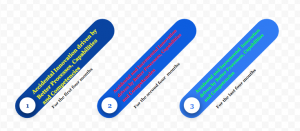
Exhibit 1: Innovation Choices for the Nigerian Facilities Management Industry after COVID-19
Source: Infoprations Analysis, 2020
With this, players are in two different great ponds. They have to offer services or solutions that reduce clients’ operational cost and also improve their efficiency without compromising standards. This, according to some professionals and one of the players in the industry, the virus has put both the players and professionals in a situation that requires accidental and incremental innovation within processes, people and technological components.
In her post on a professional medium, Olunfunke Soriwa says “the bulk of the job lies in our hands now to get it right and do it right. What does this mean for the industry as a whole?” Joining her, Alice Omisanya, a Facilities Service Manager, notes that “the question that comes up is how do we add value as FM supports many industries?” How can we help shape the new normal for companies on the winning and losing sides post COVID 19.”
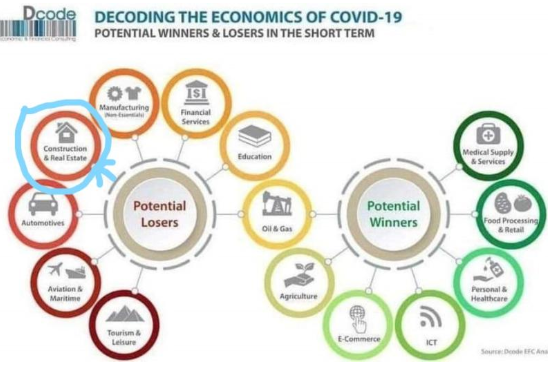
Our analyst observes that Looking at this pictorial guide, it is obvious that the Facilities Management Industry is on both sides. Remember, cost reduction and operational efficiency are the key value propositions of FM players. Navigating the water successfully, will now depend on the people, processes and technologies that will ensure the delivery of promised value. Of course, other industries are sneezing, the FM industry must definitely catch cold. But, changing strategies and tactics will determine who belongs to the loser side more than the winner side.
“But mostly, how we navigate this post Covid 19 era is greatly important,” one of the professionals asked. Responding, Olumide Aina, the Chief Executive Officer, Green Facilities, notes that “ The world will not remain the same again after the COVID-19 saga because of the new realities that will come our way. The pictorial representation may be a reality of things already happening and others that will come during the post-covid 19 era, but it’s up to all of us who can stand as the game changers and also serve as influencers. We as the Corporate Real Estate and Facilities Management professionals are at the fulcrum of things that will decide where the seesaw swings through innovation, creativity and teamwork. These are the qualities that are required at this critical time to ensure our relevancy and in turn save the world.”
Good People, Week 10 materials have been posted in the Board. Dr. is leading the session which focuses on business leadership for us. I must confess that you would not read better flash cases on what he did on Mayo Clinic (USA) and Access Bank (Nigeria). Dr is working on a new book on leadership and he has some postulations, sharing some elements with us. This is my introductory video which I am making public here.
Delta, United, Emirates, KLM, etc would all have bailouts from their respective home countries. I am not sure Air Peace which suspended operations on 27 March 2020 in Nigeria due to Covid-19 will be lucky. In short, it is Nigeria that needs bailouts, practically implying that it cannot help many firms. Just a few days ago, the government called the Sovereign Wealth Fund for some cash – go figure, we need to survive today before those future generations!
This paralysis looks really frightening because most fintechs will struggle also. Yes, if your code powers payments for hotels, airlines, etc and they are not in business, your revenue goes.
Air Peace is West Africa’s largest airline. And if we agree that supply chain is the heart of business, we can extrapolate that Air Peace is strategic to the Nigerian economy. The question then is this: what happens to Air Peace if it cannot get a bailout from losses? And what happens to the Nigerian economy if other airlines (Aero, Azman, etc) follow along on the struggle path?
SUSPENSION OF OPERATIONS
Air Peace announces the suspension of all flight operations come Friday as part of concerted efforts being made to stop the spread of the pandemic, Coronavirus.
It is with a great sense of responsibility that we have decided, in the best interest of our nation, our passengers and workforce, to suspend scheduled flight operations for 23 days effective 23.00hrs on Friday (an hour before midnight on Friday) the 27th day of March, 2020 as a result of the COVID-19 pandemic.
This difficult decision was reached in order to support the efforts of the Federal Government and other stakeholders in curbing the spread of this virus in our nation, while also protecting our esteemed passengers and staff from becoming victims of the pandemic.
This is for the webinar. Please also read this article. Notes: You can read this book – Africa’s Sankofa Innovation – as complementary We made this video on restarting business operations after the lockdown due to Covid-19. Leadership in Business & Process for Success in Business This week, we are focusing on leadership […]