


In 33 Days: 1.3 million Internet Users Seek Information about Coronavirus Symptoms in Nigeria
Information is the blood and water of human beings and legal entities. For the two to thrive in various situations, Information seeking and sending must be prioritised. The priority, however, should not overcome verification of sources such as individuals or organisations before devouring the information.
In a crisis like disease outbreaks, people are more curious and eager to know specific information about the disease. Such information might include possible strategies and tactics for containment, treatment and vaccines or drugs. The report of Coronavirus in Wuhan, China, has changed people’s ways of seeking knowledge about health-related issues or needs in that last few months.
Various sources have been used for seeking and disseminating information about the virus. Medical experts, public affairs analysts and social commentators still believe that post-COVID-19 would strengthen the use of sources such as social networking sites and interpersonal channel by the people to express what they think, feel or experiment about different diseases as long as the media increase their attention through news to the diseases.
For instance, a recent study shows that people respond to the first report of COVID-19 by immediately seeking information about COVID-19. The study notes that they searched coronavirus, coronavirus symptoms and hand sanitizer using the Internet. This is not quite different from what happened in Nigeria on February 27, 2020. Immediately, the National Centre for Disease Control and the Lagos State Government announced the first index case in Nigeria, people’s attention shifted to understanding of the virus and how they could protect themselves from contracting it on February 28, 2020, a day after the announcement of the case.
Searching Symptoms Information
As at April 18, over 500 cases have been recorded, while more than 100 people have recovered. The trend is not limiting the people’s knowledge seeking about the virus through the Internet, especially among the people who access the Internet through mobile phone. In its latest report, the National Bureau of Statistics notes that “a total of 126,078,999 subscribers were active on internet as against 123,163,027 in Q3 2019 and 112,065,740 in Q4 2018. This represented 2.37% growth in internet subscriptions Quarter on Quarter and 12.50% Year on Year. Lagos State has the highest number of subscribers in terms of active internet per State in Q4 2019 and closely followed by Kano and Ogun States respectively, while Bayelsa and Ebonyi States have the least number of subscribers.”
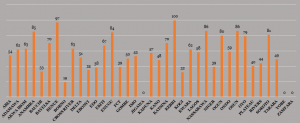
With these data, our analyst believes the subscribers must have searched specific information about the virus from February 27 to April 17, 2020. This is 33 days. According to the NBS, the total number of Internet users as at Q4, 2019 is 126,078,999. Using percent of normalised searches (0-100 threshold), we determined samples of the Internet users who sought knowledge about coronavirus symptoms between February 27 and April 17, 2020 [see Exhibit 1]. Our sample is 73,408,452. Out of this, we found 1.82% of the samples as the users who searched for coronavirus symptoms during the period. This represents a total of 1,336,033 people in 33 days [see Exhibit 2].
Exhibit 1: Coronavirus Symptoms Search per State
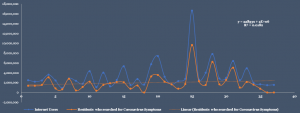
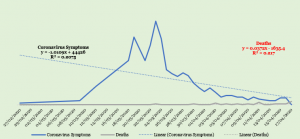
This is not encouraging considering the number of the Internet users (through mobile phones) per state, according to the NBS. Further analysis shows that the interest in coronavirus symptoms, confirmed cases and deaths grew at different degree of measurement. Our analysis establishes that the public interest in coronavirus symptoms and deaths followed the linear growth pattern, while confirmed cased grew exponentially. Our analysis suggests 20.7% linkage of interest in coronavirus symptoms with the examined 33 days. This implies that in each day, at least one search interest about coronavirus facilitated interest in coronavirus symptoms by 20.7%. It was 21.7% for deaths, indicating that report of death by the concerned authorities ensured public interest in coronavirus symptoms by 21.7% each day [see Exhibit 3 and 4].
Exhibit 3: Linear and Exponential Growths of Cases and Public Interest in Symptoms of the Virus
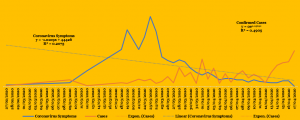
Exhibit 4: Linear Growth of Deaths and Public Interest in Symptoms of the Virus
Going Forward
During this period, our analysis suggests 5.6% growth in the number of cases with the implication that about 49 cases could be recorded from an infected person in the next 21 days. The insights from this piece indicate that concerned stakeholders, most especially the National Centre for Disease Control and National Orientation Agency need to intensify efforts on the containment of the virus through strategic public enlightenment messages. It is also important that contact tracing effort increases, while social distancing and lockdown approaches should not be abandoned by the government at state and federal levels.
Contact-tracing App, the New Approach to the Fight Against Covid-19
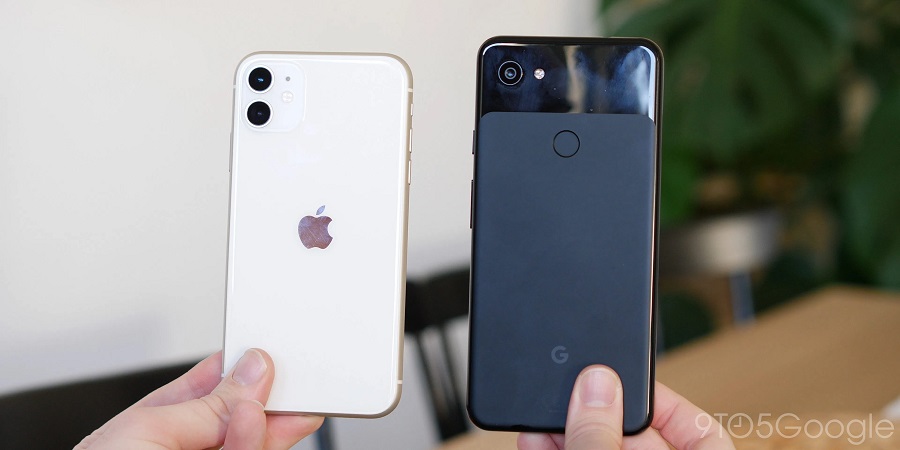
Contact-tracing App seems to be a new perspective that may offer an alternative to how coronavirus cases are being traced. Google and Apple have teamed up to develop a new app for iPhones and Android phones.
The new app offers interoperability that has been lacking in the government’s methods of tracing. Google and Apple’s collaboration has helped to develop the app to its first phase, and so far, it appears promising as its features beat the common challenges in contact-tracing.
According to them, it is designed to function logistically and technologically effectively. The app uses Bluetooth Low Energy. Every smartphone with the app spots when another phone is close, and the two phones exchange identifier beacons anonymously. While there is data exchange between the two users, no one has access to it or can use it. The data exchanged by the app can only be used when it is needed.
To break it down, when one comes in contact with another person who also has the app, and their phones do the exchange thing. If any of the contacts tests positive for coronavirus, they enter this information in the Public Health Authority’s app. The phones that have come in contact with the person who tested positive will be alerted with the information, and instructed on what step to take. That’s the making of phase 1.
Phase 2 is where the magic lies. The tracing app function is inbuilt, there is no need to download the app. All a user needs for the contact-tracing to work is the function in his phone. But there is a challenge. The iOS supporting the function is from 13, from iPhone 6S or similar apple devices released from 2015. The Android version is compatible with marshmallow phones – OS phones released from 2015. So the inbuilt version of the contact-tracing app will not be widely in use.
Phase 1 will be available next month while phase 2 is expected in two months to follow.
The privacy issue is developed in a way that phone users don’t have access to any information. The data collected is only accessible by health authorities.
It is hoped that the app will help in making contact-tracing easier and cut the amount of time and resources that governments are investing in tracing suspected cases.
Already, many countries are considering the use of contact-tracing app as cases of COVID-19 spread around the world. It is hoped even, that using the app will result in lifting lockdowns.
Singapore is using TraceTogether, an app using Relative Signal Strength Indicator (RSSI), which reads between devices across time to approximate the proximity and the encounter between two users. The proximity and information is stored on one’s phone 21 days on a rolling basis, and deletes after.
If a person tests positive for COVID-19, the Ministry of Health will work with them to map out their activity for the past 14 days. And if the person has the app on his phone, he can allow the MOH to access his phone and check the TraceTogether Bluetooth proximity data. That makes it quicker for the MOH to trace suspected cases.
Australia is thinking in that direction, Prime Minister Scott Morrison said on Thursday the government is working with the Australian Signals Directorate, to develop something similar to the TraceTogether app. While the app offers faster alternatives in contact-tracing, it poses many questions that would-be users are interested in. They are mainly about privacy, battery life and if it will be compulsory that everyone download it.
Morrison said that the government will ask people to download the app to hasten the efforts to curtail the virus, comparing it to buying bonds during war.
“In the war, people bought war bonds to get in behind the national effort. What we’re doing in fighting this fight is we’ll be asking people to download an app which helps us trace the virus quickly and the more people will do that, the more we can get back to a more liveable set of arrangements,” he said.
Following Apple and Google’s announcement earlier that they plan to release APIs – or ways in which programmers can access applications and data that will make it easier for them to build contact-tracing apps; many countries have indicated interest in developing their own tracing apps.
So far, France, the UK, the United States, China, Singapore, South Korea and a pan-European group are all working to develop their own app, while some have already developed theirs.
While the contact-tracing app offers hope of speedy tracing of contacts, there is skepticism that the apps will offer any other thing beyond that.
“The virus doesn’t care about technology. The virus only cares about transmission,” said Phil Booth, co-coordinator of Medconfidential, a medical data-protection lobby firm. “The thing that keeps us safe is lockdown. The thing that reduces the reproduction number of the virus is the extent and severity of its lockdown. No-one has shown that contact-tracing apps by themselves have anything like that effect.
Lockdown: Quickteller Fuses Social responsibility with Marketing Public Relations
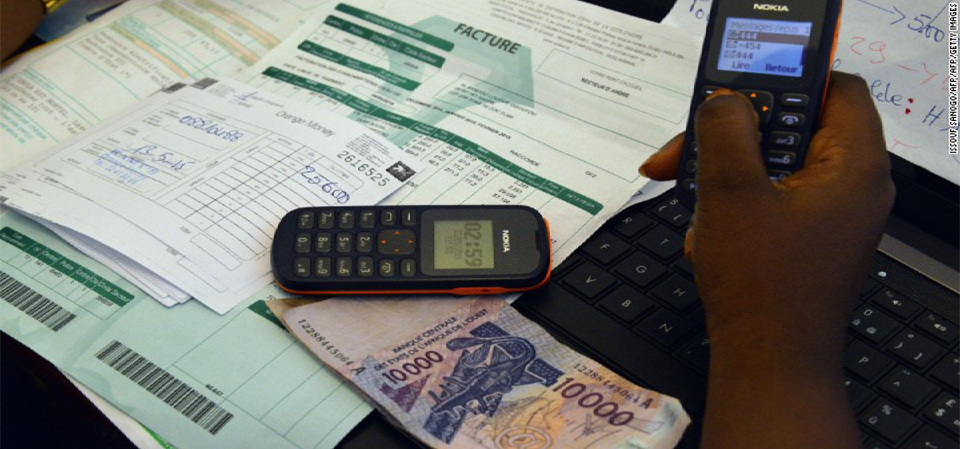
Amidst the battle to contain the spread of the Coronavirus pandemic, efforts were made by individuals, groups and corporate organizations to support the government’s drive for people to stay indoors. These efforts manifested in communication aimed at encouraging the citizens to key into the government’s campaign. Many of them made social adverts and campaigns to urge Nigerians and their customers to comply with government directives.
One firm that seems to have caught my attention as a strategic communication expert is Quickteller. The financial solution company has been sending out highly creative direct messages that not only fit in their services to the current situation but also preach social distancing and safe health practices. One of such is the email sent on March 26 during the first half of the lockdown in Lagos, FCT and Ogun States. The message titled Hello Rasheed, Are you Home?, the company seeks to know how their customers have been doing and fulfilling their basic needs such as electricity, entertainment, information and remote social, work and financial needs. A part reads:
No! We were not planning to visit you, just checking to know that you’re taking all precautions.We’ve been working from home as well and it’s not been easy, but as you know, staying safe is priority right now.
The safety of your loved ones is more important than anything that might be tempting you to go out. Just to tell you how we’ve been coping with the compulsory isolation. We preloaded our electricity, it’s a bad time not to have power. And every time we are tempted to go to the cinema, we stream movies instead.
With an active data bundle and airtime, everything is possible, including virtual meetings, video calls and chats to keep in touch with colleagues, friends, and family.
It’s important that you stay informed, so we recommend renewing your cable TV subscription too. You might also want to stay away from cash as much as possible. If you must exchange money with anybody, transfer it online.
The direct marketing message achieves its main objectives. It pitches the company’s services and also calls for the observation of health directives to curb the spread of the disease.
Again on 18 April, 2020, when the second half of the lockdown is on, Quickteller again came up with another personalised email urging its customers to brace up and that it has got their back. The email titled It’s Another 14 Days reads:
It’s another 14 days of the lockdown and while we can’t tell you when the lockdown will be over we can tell it’s more expenses for you.You’ve probably run out of foodstuff and will have to stock up more, you’re consuming more data than you usually will, you’re burning more power and there’s a high chance it’s telling on your pocket.
Well, we’ve got some good news; Quickteller Loans has got you. With only a few clicks, you can access our loans and get credited within minutes.
We also understand another 2 weeks at home might be quite boring, but you can make your stay at home worthwhile by subscribing and catching up with your favourite shows on DSTV. Of course, you will have to pay for electricity to enjoy this to the maximum.
And don’t worry, if you need to catch up with the news online or reach out to loved ones, you can always buy data and airtime here.
While we hope that the lockdown will be over soon, please remember to wash and sanitize your hands and stay safe.
The message is reassuring. The offerings from the company were clear. Loans, offer of data, airtime and subscription opportunities are well captured. The direct messaging technique employed is a fusion of marketing and public relations. While calls to action were made, a call to responsibility was as well included. The marketing team has a good strategy of scanning the environment and generating messages that resonate with the situation at hand without neglecting marketing needs of the company. It is a thumbs up for the company. It is easier to conclude that the firm could pull this feat simply because the situation readily keys into its niche of business. But, there are a thousand ways available to say the same thing differently.
Editor’s Note: The content analysed was pulled from the Quickteller’s email to the author.
COVID-19 Pandemic: Where Are the Friends of Lagos Journalists?
On April 11, 2020, the Chairman of the Lagos State Chapter of the Nigerian Union of Journalists, Dr. Qasim Akinreti sent out a write up calling attention of the public to the deplorable and dehumanising conditions under which journalists in Lagos State are working to provide timely, relevant and up-to-date information on the fight against the COVID 19 pandemic in Nigeria. It is believed that the save our soul call was done on behalf of Nigerian journalists using Lagos as a focus.
In the open letter, Dr. Akinreti first reminded the public of the nature of the job that is done by journalists. He said “journalists, like health workers, soldiers, Policemen, and other Security Agents, are integral part of essential service providers globally.” He further pointed to the essential products that are outcomes of journalists’ activities. He said they provide daily reports, analysis, interviews, public messages, documentaries and breaking news sometimes live at scheduled times on terrestrial, satellite and even social media platforms. In the fight against the novel virus, journalists make sure the information yearning of people is fulfilled by gathering, processing and making such available on the pages of newspapers, websites and even social media platforms.
However, he lamented the conditions under which journalists work especially during this pandemic. He said “despite these sacrifices, journalists in Lagos are hounded, harassed and disgraced by the security agencies. A studio manager of Voice of Nigeria was arrested on his way to the broadcasting station in ikoyi and later released after my intervention through the assistance of the police hierarchy in Lagos.”He further narrated “the Judiciary Correspondents were harassed during the coverage of Funke Akindele and his group arraignment in Court. The Journalists were even denied coverage of the court trial of Mr Gbadamosi and others. I was inundated with a series of harassment of my members and I also had a dose of high handedness of the security agents on my way to and from Seme Border and Badagry town.” As posited in the earlier paragraphs, that situation is not limited to journalists in Lagos alone. It is national. In Akure, a member of staff of NTA Akure was brutalized by men of 32 Artillery Brigade, Owena Cantonment, Akure in Ondo State. There were reports too of other harassment and even torture on the course of duty.
Despite the harassment, he decried the deliberate exemption of journalists from palliative efforts distributed to vulnerable Nigerians. To this, Akinreti said “it is rather unfortunate that the following people and corporate organisations have contributed the following to COVID – 19 pandemic taskforce across the country and forget the Journalists who announced and published the huge sums.” He then called to action veteran journalists such as Chief Segun Osoba, Gbolabo Ogunsanwo, Lade Bunuola , Ayo Akinkuotu, Dr Okey Ikechukwu, Dr Reuben Abati, and Prince Uthman Shodipe. He appealed that these senior journalists should come to the aid of the suffering Nigerian journalists.
One saddening thing in the open letter is the appeal to state governors across Lagos, Ogun, Kaduna, Kano, Rivers, Oyo, Akwa Ibom and Enugu to extend their philanthropic hands to journalists. The question is that if those who are supposed to keep these governors on their toes are beneficiaries of their largesse, will public trust in the journalists and their platforms not be jeopardised? He highlighted the meagre efforts of the Lagos NUJ to feed members in the newsrooms and provide sanitizer. Again, the question is if journalists in Lagos are having this kind of experience, how much more of others in Abia, Anambra, Osogbo and Zamfara. The neglect of journalists is across board and on a national scale.
What could be more pathetic and dehumanizing than the refusal of media organisation and owners to pay salaries of the journalists. According to him, “available statistics have shown that in Lagos, media owners, Specifically from The Champion, Vanguard Newspapers, This Day Newspapers, including DAAR Communications have failed woefully to pay salaries as at when due and fulfilled basic economic rights of Journalists.” What a way to treat those expected to say the truth and consider the public interest at all times? Specifically, Akinreti identified the culprits who are fond of owing salaries. “The Champion newspapers owner , Chief Emmanuel Nwayanwu, a leading political figure and an industrialist is owing journalists in his stable over 64 months of salaries and other emoluments.
Very disturbing, after he sold the “The Champion house”, he could not pay off our members. Her daughter equally has the effrontery to carry on the newspaper business secretly in the Ajao Estate without paying salaries too. She organized a media award sometimes last month to deceive Nigerians of social services, the Lagos NUJ was there to disrupt the event.”, he revealed. He further noted “we are even shocked that one of the best union friendly newspapers in Nigeria, The Vanguard could not pay salaries for about 6 months now. The management has continued to engage the union on resolving the problem.” He observed that “the story of This Day Newspapers will shock everyone, with huge profits made by the company and expansion to other areas of the media, salaries are not paid regularly until it is accumulated for months and later cleared.”
He was disappointed “despite the huge profits from political coverage in the time past, currently, DAAR Communications cannot meet basic economic needs of our members. Today, some retired members of the DAAR Communications are in court to claim their entitlements.” If this horrendous practice is thought to have been limited to private media owners, one would be surprised to also learn that “many Journalists have become veterans of poor status and suffering in silence. The retirement benefits of members in the Radio Lagos/Eko FM and Lagos Television are yet to be paid.” Yet again, the experience is not localized to Lagos alone, it is what journalists experience across the nation. This is a complete disregard for the respect and self-dignity of those that are manning the information superhighway. How could we justify the maltreatment being meted out to the men of the Fourth Realm of the Estate?
What will be the fate of ethics in the face of hunger and deprivation? How would they be able to defend the rights of the downtrodden when their own economic rights are marched upon. What justification do we have to condemn them for taking bribes and brown envelopes? What kind of watch dog do we think we are breeding under this kind of dehumanizing conditions? More needs to be done to address the problems of journalists in Nigeria. The national body has to come up with more creative ways to ensure journalists are insured against the vagaries of life.