DD
MM
YYYY

PAGES

DD
MM
YYYY

spot_img

PAGES

Home Blog Page 6400

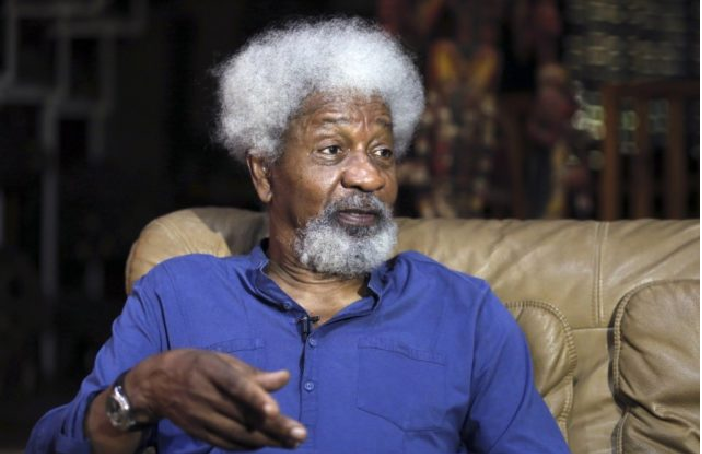
Nigerians React as Wole Soyinka, Garba Shehu lock horns over Buhari’s Lockdown Order

0

Nigerians have been sharply divided across camps in the recent spat between Nobel Laureate, Prof. Wole Soyinka and Senior Special Assistant to the President on Media, Mallam Garba Sheu. Prof. Soyinka had earlier condemned the presidential directive to Abuja, Lagos and Ogun States to totally restrict movement of people and business activities in order to curtail the spread of the novel virus. Soyinka in a statement had said the presidential directive is illegal and unconstitutional. He said “The worst development I can conceive is to have a situation where rational measures for the containment of the Corona pandemic are rejected on account of their questionable genesis. He further noted that “this is a time for Unity of Purpose, not nitpicking dissensions. So, before this becomes a habit, a question: does President Buhari have the powers to close down state borders? We want clear answers. We are not in a war emergency.”

In his reaction, the SSA to the President on Media and Publicity, Garba Shehu, has said “Yesterday, the esteemed Nobel Laureate, Prof. Wole Soyinka made comments on the legal status and description of 14-day lockdown announced by President Muhammadu Buhari. Professor Soyinka is not a medical professor. His qualifications are in English Literature, and his prizes are for writing books and plays for theatre. He is of course entitled to his opinions- but that is exactly all they are: semantics not science. They cannot- and should not- therefore be judged as professional expertise in this matter in any shape or form.”

In reacting to the spat between the Nobel Laureate and the SSA on Media to the President, Nigerians have been divided on whose side to stay. While many believed that Mallam Garba overstepped his boundaries, others were of the opinion that Soyinka should not have queried the government decision. In responses monitored on Facebook, Nigerians were neither here nor there. In a Facebook post by Dr. Abdulkadir Oba Laaro, a lecturer at the Department of Mass Communication, University of Ilorin, an attempt was made to mediate between Garba Shehu and Prof. Wole Soyinka. The don wrote :

Garba Shehu overreached himself. That release of Prof Wole Soyinka is over. Some language should be below presidential engagement. Though, Prof Wole Soyinka too needs some discretion in his intervention on national issues

Responding to Laaro’s assertion, one of the early commenters, Kunle Akogun, in support of Garba, wrote: “Some people should stop playing God even in matters about which they know nothing. Indeed, Coro is science not fiction! And fiction writers should stop politicising and trivialising the government’s effort to stem its spread! I’m with Garba Shehu on this.”

In a counter response on this and in an apparent support of Soyinka, another Nigerian, Naeem Balogun, opined “I believe Garba Sheu is not that knowledgeable to know and understand that those who write fiction really have to study the real knowledge before adding their actual expertise. He ought to have understood that, this is not journalism that “framing” is required to take people in another direction. Even though the fiction writers are not left out in that aspect. Knowledge, fiction and reality work hand in hand. My assertion.”

A counter narrative also emerged from another participant in the discourse. The commenter, Olatunde  Oketumbi who argued “ Let’s call a spade a spade. Soyinka goofed in his criticism of the government lockdown order when he, in his supposedly superior wisdom, did not suggest a more practical alternative action that the government could take to combat the Coronavirus pandemic in our collective interests. I’m therefore totally in support of Garba Shehu’s rejoinder to Wole Soyinka. After all, Shehu’s freedom of speech is no less guaranteed by the same constitution that guarantees Soyinka’s.”

In her own response, Chinedum Ikogwe faulted Garba for his comment. She said “Hahahahaha.he only displayed the arrogance that the APC Central Government is known for since 2015. So, please leave Mallam Shehu Garba alone. Joseph Kay, in a seemingly angry tone posited that Wole Soyinka got what he deserved. In his own post, he said “Wole Soyinka got what he deserves. He should know better with his exposure. Other countries are taking stringent measures. The French Parliament passed a law to enable the Prime Minister rule by decree for two months. In the Philippines, President Rodrigo Duterte ordered the security agents to shoot down anyone that defies the stay at home order. More and more countries are locking down cos that is working at the moment…”

Karounwi Adini agrees with the post but did not accept the fact that Soyinka should exercise discretion. He probed “ I agree with the post, except the side of Kongi having discretion on his statements. Which discretion exactly with this Government?

As the argument goes back and forth, with people taking sides, it is instructive to note that the president in his special broadcast to Nigerians earlier in the week has said “In Nigeria’s fight against COVID-19, there is no such thing as an overreaction or an under reaction. It is all about the right reaction by the right agencies and trained experts.” This should have been the bedrock of Garba Shehu’s response to the erudite professor’s concerns.

Nigeria Orders Customs to Release Seized Rice for Covid-19 Humanitarian Distribution

3

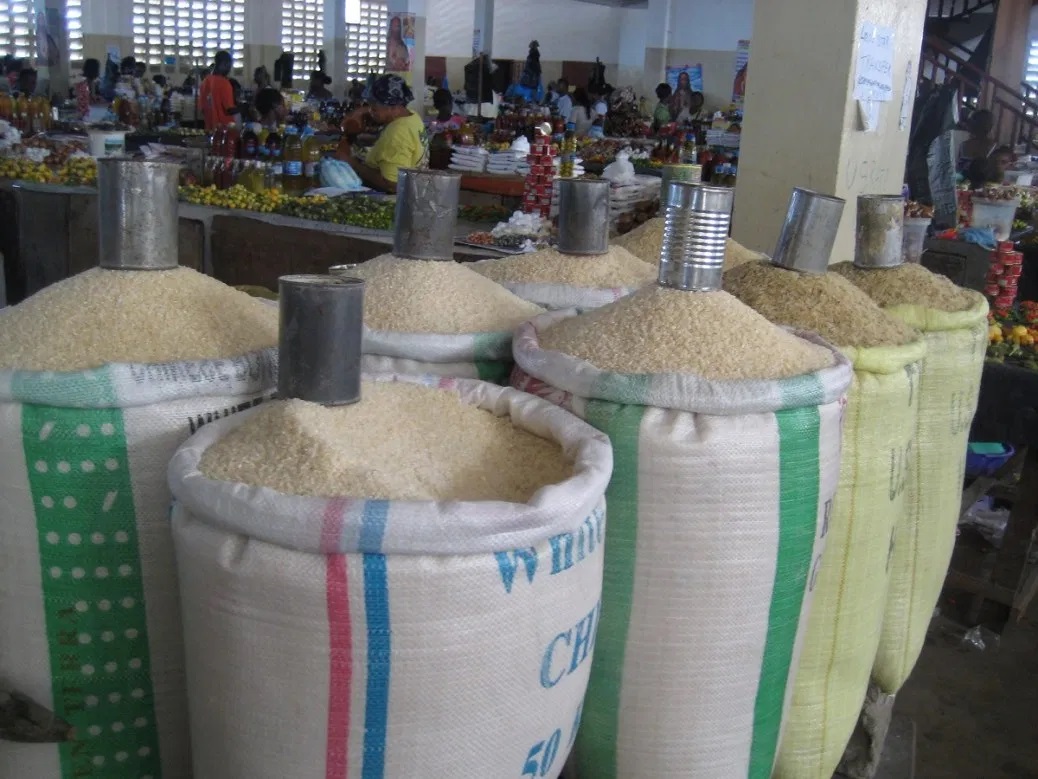
President Muhammadu Buhari has ordered the distribution of 150 truckloads of rice seized  by the Nigeria Customs Service. The Minister of Finance, Budget and National Planning, Mrs. Zainab Ahmed, disclosed this on Monday in Abuja, while talking to newsmen.

She said the rice will be distributed across the 36 states of the federation as part of the government’s social intervention programme aimed at cushioning the effects of coronavirus pandemic.

The Minister said that the 150 truckloads of rice have been handed over to the Ministry of Humanitarian Affairs for distribution. She added that the president has approved the distribution of grains from strategic grain reserves across the country.

The Federal Government of Nigeria has been seeking ways to alleviate the hardship emanating from the outbreak of coronavirus. Efforts to contain the virus have resulted in curfews, total lockdown of some states and other measures that have restricted the general freedom of Nigerians and keep many at home.

Before now, the Nigerian Customs Service was notorious for destroying rice seized from smugglers.

But as the situation is breeding hunger due to the inability of Nigerians to stock food, the government is desperately looking for ways to provide for the people before hunger forces them to defy the stay-at-home order. And the seized truckloads of rice have come handy, and at the same time, it is believed to have exposed how poor the decision to shut the borders, and to place a total ban on rice importation is.

In October 2019, when Nigerian government decided to shut its borders totally, it was in a bid to stop rice smuggling into the country. The initial ban on rice importation had limited the quantity of foreign made rice coming into the country, but didn’t stop it totally, especially from the borders.

The federal government was determined to take that bold step as it was seen as a way to boost local production of rice and the whole agricultural sector. Gradually, the tons of rice coming into Nigeria reduced to almost zero, rice became contraband, and the price skyrocketed. Nigerian rice farmers got the overwhelming burden of producing more than twice their farming capacity.

At that time, the Rice Farmers Association of Nigeria (RIFAN) could only boast of 3.7 million tons of rice annually, when the consumption demand is 7.9 million tons. There was a huge demand gap and a little infrastructure to fill it.

The United Nations’ Food and Agriculture Organization (FAO), had earlier pointed at some of the challenges facing Nigerian farmers that need to be addressed to ensure food security. They range from the outdated land tenure system that constrains access to land, a very low level of irrigation development, limited adoption of research findings and technologies, high cost of farm inputs, poor access to credit, inefficient fertilizer procurement and distribution, inadequate storage facilities and poor access to markets and post-harvest losses.

These challenges were not addressed before the ban took effect, leaving farmers with inadequate mechanisms that has hindered the chances of bridging the demand gap. Hunger ensued, as the reality of it all hit home.

However, Nigerians pushed through it and adapted through continuous murmuring of half-filled stomachs.

Though as time passed, there were indications of improvement in rice farming. In 2019, the production was said to have moved up to over 4 million metric tons, an addition that was barely felt by the people as demand also moved up along.

There have been governments’ initiatives aimed at augmenting farming through some schemes designed to help farmers in the country, such as the Anchor Borrowers Scheme, a Central Bank of Nigeria’s programme designed to provide financial help to farmers. This among others has boosted rice production in the country. A number of big companies in Nigeria like Coscharis and the Dangote Group have also joined farming.

Nigeria’s rice demand in 2019 was just over 7 million tons. According to RIFAN, Nigerian farmers are now producing 8 million tons of rice which is enough to feed the nation, except that the reality at homes is telling a different story.

A 50kg bag of rice costs about N23,000, which is unaffordable in a country where the majority live below $2 per day. The current coronavirus pandemic has exposed the depth of food insecurity in Nigeria. The government’s resort to use loads of rice seized by the Custom shows that Nigeria is still far from food sufficiency, and the production of rice, the country’s staple food is yet to meet the demand gap.

The Roles of the Media in Crisis Situations: Are Nigerian Journalists and their Platforms Rising to the Occasion?

1

The media in any society are expected to play fundamental roles of educating, informing, entertaining and providing warning as well as societal integration. This is why the media are considered as the fourth estate of the realm. In crisis situations, the media have more roles to play. They are as burdened as the society they seek to serve. The information needs of the people become high and the media are the major sources of fulfilling them. Therefore, the media assumes the mandate to fill the information gap that exists during such crises. They do this by providing relevant and accurate information in a timely manner.

In a developing democracy such as operated in Nigeria, and during the health crisis like the COVID 19 pandemic the world is currently experiencing, the media are expected to operate within the framework of educating, informing, helping to popularize coping strategies, warning and charting a course for relief and recovery. And importantly, the media set an agenda for the citizens. They provide direction for what people say about the pandemic. They throw in light where there is confusion. They manage the vehicle of discourse of the disease. The more the media focus attention, the more the citizens pay attention to the issue.

Within the context of the current global health situation, the Nigerian media are under trial for their roles in the reportage of the disease currently ravaging Nigeria and the rest of the world. Media researchers are already expressing fears on the direction of the reportage of the disease. They question the intent of the reportage prevalent in the Nigerian media landscape. Are they over-focusing on the disease? Are their platforms giving hope with the reports or are they over hyping the pessimism that such occurrence are likely to evoke?

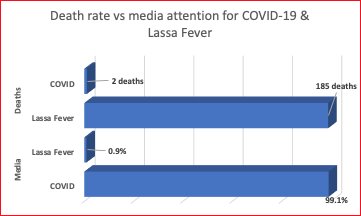
While querying the agenda that the media seem to be giving to the novel virus at the expense of Lassa Fever which preceded the Coronavirus, a professor of Development Communication at the University of Ibadan, Ayo Ojebode, asked a rhetorical question on his Facebook page – “Why are we talking much more about what is killing us much less… and talking much less about what is killing us much more?”  This all important question is accompanied with a chart displaying the irony that surrounds the reportage of the COVID 19 side by side with Lassa Fever. Since its outbreak again last quarter of 2019, the disease has claimed not less than 185 deaths as against the 2 deaths recorded through the novel virus at the time of the analysis. However, the COVID 19 has got 99.1% of the media attention while Lassa Fever had 0.9% of the reportage. Is this a pointer to the lopsidedness of the reportage in the Nigerian media landscape?  This is a question that needs further empirical investigations.

Source: Ojebode, 2020

Another pointer to the perceived worrying nature of the media  reportage of the virus is the outburst expressed by another university teacher, Dr. Obasanjo J. Oyedele, an environmental and risk communication expert who is a faculty at the Department of Mass Communication, Bowen  University, Iwo. He raised concerns through a post which did an evaluation of the media reportage of the virus so far. He posted:

This is not a good time to watch TV or listen to the radio. The mass media magnify existing narratives of fear, hopelessness, deaths and collapse of the health system worldwide, with negative psychological effects on people’s perception, behaviours and self-efficacy. Yesterday, during the media briefing organised by the Presidential Task Force on COVID 19, the NCDC Director tasked the media in Nigeria to reduce this heightened tension among Nigerians on COVID 19. Journalists can decide to set a new agenda of providing information on those who are recovering from the virus, the low-level of deaths from the virus, need for people to believe in prevention, and our collective resolve to overcome the virus in Nigeria. We have magnified COVID 19 and framed it as an absolute death sentence and this is not true. Even with those worrying statistics from America and the United Kingdom, there are positive stories on recovery and containment worldwide. It all depends on the story we want to give prominence and the factors behind our reportage. It is true that we are getting new cases (since contact tracing is ongoing and those who returned from foreign countries and their contacts are being monitored), it is also true that some people are recovering. As we cover COVID 19, let us balance our stories, report this other side and present facts capable of raising hope instead of despair. Thank you.

In the post are important questions on the roles of the mass media in crisis situations. According to the university teacher, the media have not done well with the early response coverage of the Coronavirus as the reports are inducing more fear than hope. The Nigerian media have been indicted for poor framing of the stories and giving attention to issues that raise tension than those that defuse it in the land.

In an earlier interview, Prof. Ojebode had pointed accusing fingers at the Nigerian media for pressing the panic button before settling down to education and information. In times like this, the media needs to do more and chart a recovery path for people out of the dust raised by the pandemic all over the world. In Nigeria as it is all over the world, the race out of the COVID 19 pandemic is a marathon. The Nigerian media landscape needs to pay more attention to education, information and analysis that give the citizenry the hope and the boost to survive. Or else, more people would die from fear rather than the actual disease which has been found not to be a death sentence.

Nigerian Government to Borrow N500 Billion ($1.2bn) from Designated Accounts

0

On Saturday, the Federal Government (FG) approached the leadership of the National Assembly with a proposal of a N500 billion ($1.2 billion) crisis intervention fund that will help cushion the effects of coronavirus in Nigeria.

The Minister of Finance, Budget and National Planning Zainab Ahmed, presented an executive proposal to establish a “N500 billion COVID-19 fund” as part of efforts by the federal government to ease the economic pains that are unfolding as the fight to contain COVID-19 continues.

The federal government is also prioritizing the rehabilitation of healthcare facilities around the country as coronavirus cases keep rising daily.

“Our general view is that this crisis intervention fund is to be utilized to upgrade healthcare facilities as earlier identified. The Federal Government also needs to be in a position to improve healthcare facilities not only in the states but to provide intervention to the states,” Mrs. Ahmed said.

The Minister highlighted some other programmes that the fund will be invested in including special work programmes currently being implemented by the National Directorate of Employment (NDE).

However, it became necessary for the executive to seek the approval of the legislature because funds will be drawn from various special accounts of the government to make up the N500 billion. The government also hopes to make an equalization from grants and donations from corporations, institutions and NGOs.

The Minister asked the lawmakers to approve taking loans from some designated accounts, promising to return to the legislative chamber with a proposed bill in that regard that will define what the fund will be used for.

“We know that there will be a need for the parliament to agree and approve the taking of loans from these special accounts and we will be coming back with a proposed bill in that regard that will define what the fund will be used for,” she said.

In response, the senate president Ahmed Lawan said the emergency health situation in the country has called for the consideration of such loans.

“So, we must work as expeditiously as possible to ensure that we place the request before the National Assembly,” he said.

The senate president also faulted the method of distribution of palliatives aimed at cushioning the effects of economic hardship emanating from coronavirus outbreak. The federal government had early this week, through the office of Humanitarian Affairs, commenced the Social Intervention Programme, distributing N20,000 to some Nigerians identified as poorest across the country.

“I think time has come for us to redefine the implementation of the Social Intervention Programme. Probably going out to communities to give them N20,000 person might not be the best way to go. It is still an effort, but I think we need a better approach that will be more efficient,” Ahmed said.

Over N10 billion has been pledged by individuals and organizations to support the government’s relief effort in Nigeria, and many have questioned the method that the government has adopted in administering its palliatives, raising concerns that donated funds may not be used for the intended purpose.

The federal government’s move to borrow from designated accounts has heightened the suspicion that there is ulterior motive. A reason the national assembly has requested a proposed bill detailing how the fund will be used.

In February, the federal government made a move to borrow N2 trillion from the pension fund as it was seeking funds to implement many of its programmes. The attempt was met with fierce opposition so that it backed down. The pension fund stood at N10 trillion and was a center of interest to the executive as oil revenue dwindled and put the government in economic hardship.

The coronavirus crisis appears to have aggravated the woes of the already broke FG, narrowing its options to funds in designated accounts as external borrowing seems difficult at this time.

Given the circumstances, the Excess Crude Account (ECA) would have come to the rescue. But regular visitation by the government to the account has reduced it to $71.81 million. And with oil price wobbling between $20 and $34 dollars, the Foreign Reserve doesn’t offer any option.

Left with little or no option, the national assembly is likely going to approve FG’s request to invade some designated accounts. The fear remains that it will result in more hardship than the government is trying to alleviate soon after.

For A Better Place, Covid-19 and Maslow’s Hierarchy of Needs

2

 “Is this the way you want it to be, is this the way it’s gonna be…trying to make a living out there but it’s so hard.”

This lamentation is an excerpt from a song by the late reggae legend, Lucky Dube. The song always plays in my mind everyday. I have to wake up before the rising of the sun and return home after its setting. Day after day and week after week I see my life (and yours too) pass before me with the speed of a supersonic jet. I see dejected old men in the streets, and I ask myself, where has their time gone? I see women with babies strapped on their backs hawking soft drinks and water in the scotching African sun and I ask myself, where is their hope? I see my beautiful sisters clad half naked seeking patronage, and I ask myself, who took away their dignity? I see educated and talented young men running in traffic just to sell a commodity, and I asked myself, can their future be better? And I see the multitude of beggars, and I ask myself, could this be Your image, LORD? Just end the world now! 

If man is the crown of creation, why then should we toil everyday just to survive like animals? With our superior capabilities shouldn’t we be living beyond survival? Why is the majority of humanity still striving to meet the basic needs according to Maslow’s Hierarchy of Needs? Why should we live out our lives on these two levels of physiological needs and safety needs as if there are no higher levels of belonging and love, esteem needs, and self actualization and transcendence? 

Of course, I ask these questions in relation to my environment. I know there are climes where things are better. Citizens of these countries do not bother themselves about daily livelihood because they have responsible governments that have secured the first two basic levels. They occupy the higher levels of psychological needs and self actualization in Maslow’s Pyramid of Needs. They have the time and freedom to use their gifts, talents and capabilities to give the world a sense of direction that their focus is now more on the celestial than the terrestrial. Why should a part of the human race be so far ahead of the rest when we were all created together? 

Just what is wrong with being black?! How long shall we be called the Dark Continent? This year makes it sixty (60) years of self-governance in Nigeria; we can’t still get electricity right when we are not asked to rediscover electricity. Why do we have anti development officials in all levels of our government motivated by personal greed arresting development? You ask every Nigerian what troubles the country. We quickly use our index fingers to point at the leaders with the rest four fingers pointing at us. 

If we are in trouble with the country, how do we make her better? It’s a matter of mindset. For us to rise to our next level of better life is to individually seek to be altruistic. When we are altruistic, we will not inflate and pad budgets, we will not prevent the approval of a project because of a bribe, we will honor the elderly and vulnerable in our midst, we will not sit on somebody’s promotion, we will not fail female student for sex, we will not allocate development funds to some zones and deny another zone; in a nutshell, we will do unto others what we want done unto us. With these individual efforts, we will create the country we so much dream and talk about and achieve esteem, and self-actualization and transcendence, in other words, achieve our destinies. Let us bring this better place from the realm of imagination to reality. It is possible. 

Covid-19 and Maslow’s Hierarchy of Needs

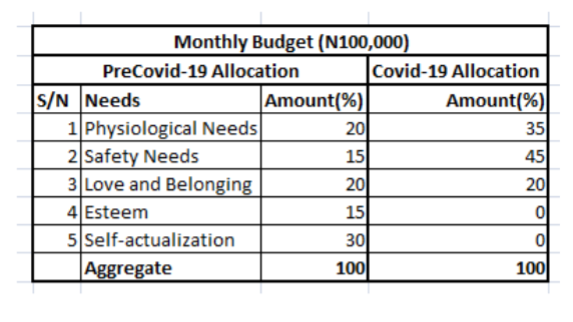
The table above shows how a particular household in Nigeria allocates its monthly consumption budget to the five aggregate needs before and during Covid-19 pandemic. We can observe a significant change, for example, item five, which is Self-actualization in pre Covid-19 got the highest allocation and during Covid-19 it got a zero allocation. I have the feeling that all I just said seems a bit abstract to you. I want you to get my logic by accompanying me to 1943 to meet with Abraham Maslow to help us understand his theory on Human Motivation. Then we will return to this time, 2020, to analyze and understand the household consumption behavior.

Me: Good day Dr. Maslow.

Maslow: God day sir. I heard you are from the future, the 21st Millennium I suppose.

Me: That is correct Doctor. It’s a perilous time. We are facing an alien virus nicknamed Covid-19. It has snowballed into a pandemic. We need your help in understanding your thesis on human motivation and behavior. With this knowledge we will be able to fix the economy after we have defeated the invader.

Maslow: Oh my, that is awful news! Let’s get started. I published my study of how humans intrinsically partake in behavioral motivation; by motivation I am talking about the satisfaction of human needs that are innate. I termed it the Hierarchy of Needs, arranged in the form of a pyramid with the largest and most fundamental needs at the bottom and the need for self-actualization and transcendence at the top. In other words, individuals’ most basic needs must be met before they become motivated to achieve higher levels of needs. This is what the pyramid looks like.

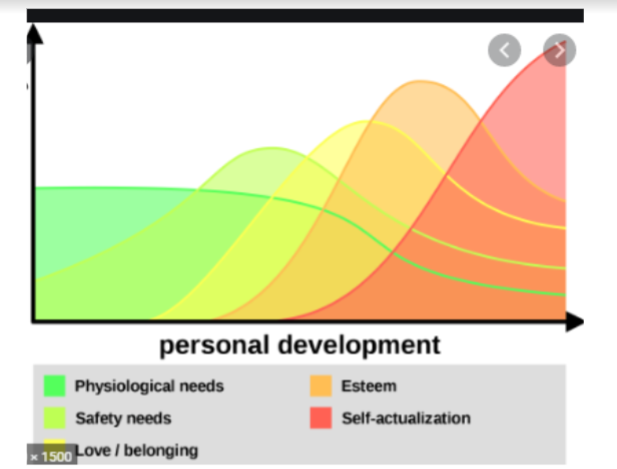
I acknowledge the likelihood that the different levels of needs could occur at any time in the human mind because the human brain is a complex system and has parallel processes running at the same time, thus many different motivations from various levels of the hierarchy can occur at the same time. I focused on identifying the basic types of motivation and the order in which they will tend to be met. However, scholars who critique my work prefer to think of these levels as continuously overlapping each other. This means that the lower levels may take precedence back over the other levels at any point in time. We are actually saying the same thing in different words, you know. It looks like this…

Me: Absolutely Doc! This is my own motivation. I realized that the hierarchy could change by circumstance. The higher-order (esteem, and self-actualization) and lower-order (physiological, safety, and love) needs are not universal and may vary across cultures, class, political system, age groups due to individual differences and availability of resources in the region or geopolitical entity/country.

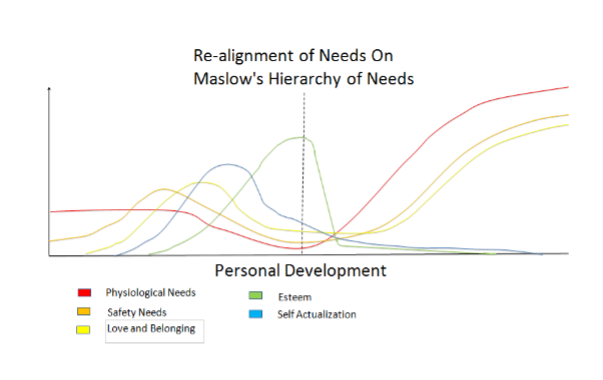
Maslow: More true, your world is now embroiled in the same pandemic; consequently, I see a common human motivation and behavior, and a realignment of the overlapping needs as depicted by the curves below

Me: This is unbelievable Doc. The changes in the slopes of the curves is uniform with the changes in the monthly consumption budget on the five needs of an individual household in my country Nigeria, and by extension, the whole world. Before Covid-19 became a pandemic, the household in the penultimate month disbursed a budget of N100, 000 as follows: 20% (Physiological needs), 15% (Safety needs), 20% (Social belonging), 15% (Esteem), and 30% (Self-actualization). And in the pandemic era both Esteem and Self-actualization got 0%. Safety got the highest allocation of 45% trailed by physiological needs with 35%. And the least allocation of 20% went to Love and belonging.

Maslow: You see son, these changes in the allocations reflect the most dominant need in your world currently. Safety needs that include health and well-being got the highest allocation, making its curve to rise above others from the second most bottom position. It is followed by the curve representing physiological needs that include food, shelter and warmth because of the stay at home and social distancing order. The third curve representing love and social belonging with an allocation of 20% is the last rising curve just under physiological and safety curves. Just as I expected, man cannot be striving for esteem and self actualization under this circumstance. These needs got zero allocation causing their curve to nose-dive.

Me: It’s a pleasure meeting you Dr. Maslow. Your thoughts will prove invaluable to us. We must return to the future now to share this insight with everyone. It will deepen our understanding about our behavior under circumstances like this and also guide our decisions during and after the pandemic.

Maslow: Glad I could help. Good luck lad!