DD
MM
YYYY

PAGES

DD
MM
YYYY

spot_img

PAGES

Home Blog Page 641

Simsinos Casino: Table Games, Roulette, Blackjack and More

0

Introduction

Step into the thrilling world of casino gaming with Simsino casino, where the click of chips and the spin of the wheel create an electrifying atmosphere. Forget your everyday routine, because here, you can dive headfirst into a dazzling array of table games designed to thrill and challenge players of all skill levels.

Simsinos Casino isn’t just another online casino; it’s a carefully crafted digital playground where classic games get a modern makeover. Whether you’re drawn to the strategic depths of Blackjack, the unpredictable excitement of Roulette, or the sophisticated charm of Baccarat, Simsinos delivers an immersive and user-friendly experience that will keep you on the edge of your seat.

Beyond the games themselves, Simsinos sweetens the deal with unique promotional offers and a rewarding loyalty program tailored for table game aficionados. Get ready to explore proven strategies and insider tips that can potentially boost your odds and elevate your game. Welcome to the expert’s guide to dominating the tables at Simsinos Casino!

Understanding Table Games Basics

Table games are the heart of any casino, offering a blend of strategy, luck, and social interaction that slot machines simply can’t match. Unlike their solitary, screen-based cousins, table games unfold on felt-covered surfaces, managed by skilled dealers who guide the action.

What makes a game a “table game?” It’s simple: it’s played on a table! But beyond that, it’s the dynamic interplay of players, the dealer, and the game itself. Some games, like blackjack and poker, lean heavily on skill and strategic decision-making. Others, like roulette or craps, rely more on chance, though even these offer opportunities for savvy bettors to influence their odds.

The allure of table games extends beyond the potential for winnings. It’s about the shared experience – the camaraderie around the table, the thrill of a close call, the satisfaction of a well-played hand. This rich history, evolving from European parlors to Vegas casinos, is a testament to their enduring appeal.

Roulette: Spin to Win

Roulette, a casino game of French origin, revolves around a spinning wheel and a small ball. The wheel is divided into numbered pockets, and players bet on which pocket the ball will land in. Mastering Roulette involves understanding the wheel layout, betting options, and associated odds.

The Roulette table reflects the wheel’s layout, displaying numbers and various betting sections. Players place bets on these sections, predicting where the ball will stop. There are two main categories of bets: inside bets and outside bets.

Inside bets are placed on specific numbers or small groups of numbers. These bets offer higher payouts but have lower odds of winning. Outside bets, on the other hand, are placed on larger groups of numbers, such as odd/even, red/black, or high/low. They have lower payouts but higher odds of winning.

While luck plays a significant role in Roulette, some players employ betting strategies to manage their bankroll and potentially increase their winnings. One popular strategy is the Martingale system, where players double their bet after each loss, aiming to recover previous losses with a single win. However, it’s crucial to recognize that Roulette is ultimately a game of chance, and no strategy can guarantee profits. Understanding the odds and payouts associated with different bets is essential for making informed decisions.

Types of Roulettes

Roulette comes in several variations, each with its own nuances. The most popular versions are American, European, and French Roulette.

American Roulette features a wheel with 38 pockets, including numbers 1-36, a zero (0), and a double zero (00). The presence of the double zero increases the house edge compared to other versions.

European Roulette has a wheel with 37 pockets, including numbers 1-36 and a single zero (0). The absence of the double zero lowers the house edge, making it a more favorable option for players.

French Roulette is similar to European Roulette but includes two additional rules: “La Partage” and “En Prison.” La Partage means that if a player makes an even-money bet, and the ball lands on zero, the player only loses half of their wager. With En Prison, the player has the option of taking the half of the bet or leaving the bet “in prison” for another spin. If the subsequent spin results in the winning number, the player’s bet is returned; if not, the bet is lost.

Blackjack: Strategy and Skill

Blackjack, a casino staple, isn’t just about luck; it’s a game steeped in strategy. The objective is simple: beat the dealer by having a hand value closer to 21 without exceeding it. Face cards count as 10, Aces count as 1 or 11, and number cards retain their face value. A crucial rule to remember is that the dealermust* hit on a soft 17 (a hand containing an Ace valued as 11) – this single rule significantly impacts your strategy.

Enter basic strategy. Forget hunches and gut feelings! Basic strategy is a mathematically derived set of optimal plays for every possible situation at the Blackjack table. It tells you exactly when to hit, stand, split, or double down, based solely on your hand and the dealer’s upcard. Using basic strategy dramatically reduces the house edge, giving you a much better chance of winning.

Mastering basic strategy is your foundation, but some players delve even deeper. Card counting, the most famous advanced technique, involves tracking the ratio of high to low cards remaining in the deck. This information allows you to adjust your bets and playing decisions, giving you a slight edge when the deck is “rich” in high cards. However, it’s important to be aware that card counting requires intense focus, excellent memory, and the risk of being detected by the casino. Not every casino and not every time it is possible to play with card counting.

Blackjack is full of key decisions. Should you split those eights when the dealer shows a six? When is it right to double down on your eleven? Basic strategy provides clear answers. Splitting pairs, for example, is often advantageous with Aces and eights. Doubling down, typically on hands of ten or eleven, maximizes your winnings when you have a strong starting position. If the table has a good atmosphere, then you might have so much fun that you don’t care about splitting, doubling or even winning.

Blackjack Strategies

Improve your blackjack skills with these tips: Know When to Hit or Stand based on basic strategy, which dictates the optimal play in every situation. Understand Basic Strategy and commit the basic strategy chart to memory to minimize the house edge; Manage Bankroll to play responsibly and avoid chasing losses. Keep in mind that, playing longer, you need to make more accurate bets.

Other Table Games at Simsinos

Beyond the spinning reels of slots and the strategic depths of blackjack and roulette, lies a treasure trove of other captivating table games at Simsinos, each offering a unique blend of chance, skill, and excitement. Prepare to expand your gaming horizons with a quick tour of Baccarat, Craps, and various Casino Poker options.

Baccarat: Elegance and Simplicity

Baccarat, often associated with high rollers, is surprisingly simple to learn. The game revolves around betting on which hand – the Player or the Banker – will have a point total closest to nine. Two cards are dealt to each hand, and the values are added. Tens and face cards count as zero, and if the total exceeds nine, only the last digit is considered. With straightforward rules and minimal decision-making, Baccarat offers a sophisticated yet accessible gaming experience.

Craps: The Thrill of the Dice

Craps is a high-energy dice game that’s as exciting to watch as it is to play. The game centers around betting on the outcome of a pair of dice. The “shooter” rolls the dice, and players wager on various possible outcomes, such as the total rolled, specific numbers, or combinations. Craps offers a multitude of betting options, making it a dynamic and engaging game for those who enjoy a fast-paced and social atmosphere. The camaraderie around the Craps table is infectious!

Casino Poker: Strategy and Skill

Casino Poker encompasses a variety of games that pit players against the house rather than each other. Three Card Poker is a popular choice, offering fast-paced action and simple rules. Players aim to form the best possible three-card hand. Caribbean Stud Poker adds a progressive jackpot element, offering the chance for a substantial payout. Pai Gow Poker blends elements of poker with the Chinese game of Pai Gow, involving setting two hands (a five-card hand and a two-card hand) to beat the dealer’s hands. These Casino Poker variations offer strategic depth and exciting twists on traditional poker gameplay, attracting players who enjoy testing their skills and making calculated decisions. The blend of luck and strategy makes them a consistently popular choice.

Responsible Gambling at Simsinos

At Simsinos, the thrill of online gaming is best enjoyed responsibly. Recognizing that a minority of individuals may face challenges with problem gambling, Simsinos is dedicated to fostering a safe and enjoyable environment for all players. Responsible gambling is not just a policy; it’s a core value.

One way to ensure responsible play is by setting personal gambling limits. Before diving into the excitement, determine how much time and money one can comfortably spend. Simsinos offers tools to help players set these limits, ensuring that gambling remains within affordable means.

For users who feel they need to step away from gambling, Simsinos provides a self-exclusion option. This allows players to temporarily or permanently restrict their access to the platform. To initiate self-exclusion, contact the customer support team, who will guide you through the process.

Simsinos provides you some tools, such as deposit limits, spending limits, time alerts, and self assessment test.

Gambling should be fun, not a source of stress or financial strain. If you or someone you know is struggling with problem gambling, remember that help is available. Resources like the National Problem Gambling Helpline (1-800-GAMBLER) offer confidential support.

Elevating Your Simsinos Experience

Want to take your Simsinos Casino experience to the next level? It’s all about smart play and maximizing enjoyment. Before diving into real money games, take some time to explore the free play options. Getting familiar with the rules and nuances of each game will boost your confidence and increase your chances of winning.

Responsible gaming is key. Set time limits for your sessions to ensure a balanced lifestyle. Simsinos offers a wide variety of games, and understanding casino bonuses can significantly enhance your playtime. Research available promotions and see how they can extend your funds and provide more opportunities to win. By following these tips, you can make your time at Simsinos Casino more enjoyable.

Conclusion

Simsinos Casino offers a thrilling gateway into the world of table games, from the spinning allure of Roulette to the strategic depths of Blackjack. Whether you’re just starting your journey or already a seasoned player, the diverse range of games provides endless opportunities for excitement and skill development. Remember that mastering basic strategies can significantly enhance your gameplay and enjoyment.

Simsinos Casino is inviting you to discover your favorite table games. Dive in, explore the possibilities, and let the games begin! But as you immerse yourself in the excitement, always prioritize responsible gambling. Set limits, stay informed, and remember that the goal is to have fun. Play smart, play safe, and let Simsinos Casino be your destination for thrilling and responsible entertainment.
Secure Your Spot in the Hottest 1000x Meme Coin – Labubull Whitelist Countdown Has Begun

0

Have you ever wished you had jumped into Dogecoin or Shiba Inu before they exploded? That same chance might be here again with Labubull ($LXB), a meme coin with 1000x potential that is turning heads in 2025. The whitelist is officially open, giving early investors the rare opportunity to grab tokens before prices climb with each stage.

With juicy ROI projections of up to 10,000%, 80% APY staking rewards, and community perks like Mischief Drops and Rage Burns, Labubull is shaping up to be one of the most exciting ways to invest in top meme tokens this year.

Why the Whitelist Is Creating Buzz

In crypto, the biggest winners are usually the ones who get in early. Right now, Labubull ($LXB) is being called a meme coin with 1000x potential, and its whitelist is the ticket to early access. With 16 presale stages, every stage unlocks a new collectible Labubull and raises the token price. That means the earlier you join, the bigger your ROI potential.

This isn’t just another meme coin launch. Labubull offers up to 10,000% ROI projections, 80% APY staking, deflationary Rage Burns, and surprise Mischief Drops that reward loyal holders. It’s the kind of project that combines culture, community, and juicy rewards into a single presale event. For anyone looking to invest in top meme tokens, this is one of the most exciting opportunities right now.

Why Early Access to the Whitelist Matters

Missing the whitelist means missing the lowest possible entry price. Early buyers don’t just secure tokens — they secure the cheapest stage and the rarest collectibles. Each stage makes the next one more expensive, fueling FOMO and creating upward pressure on token value.

Investors who act now get the double advantage: a front-row seat in one of the best presales in crypto right now and a chance to ride the wave before the mainstream crowd arrives.

The ROI And Staking Edge

Early-stage buyers are looking at up to 10,000% ROI by the time the presale wraps. On top of that, the Horn Lock staking system rewards holders with 80% APY, turning Labubull into more than a quick flip. Add in Mischief Drops and Rage Burns, and you have a token that evolves with every stage.

It’s this mix of short-term hype and long-term rewards that makes Labubull stand out from other meme coin launches.

How to Join the Labubull Whitelist

3 Quick Actions to Secure Labubull Whitelist Access

?       Step 1: Visit the website –  Add Your Email – Enter it into the whitelist form.

?       Step 2: Submit – One click and you’re locked in.

?       Step 3: Receive Perks – Be first to hear about updates and rewards.
That’s it. Instant access. But once the whitelist shuts, it’s gone for good.

Once you’re approved, you’ll be ready to buy tokens before the next price jump. Remember — every stage costs more, so the earlier you join, the bigger your gains.

Why You Should Be a Part of The Labubull Gang!

  • 10,000% ROI potential for whitelist investors
  • 80% APY staking via Horn Lock
  • Mischief Drops (surprise rewards and perks)
  • Rage Burns (random supply reductions for scarcity)
  • 16 collectible Labubulls tied to presale stages
  • Transparent tokenomics and community-driven hype

Labubull doesn’t just offer memes; it offers mechanics designed to reward long-term holders.

Final Thoughts

Based on the latest research, the meme coin with 1000x potential list for 2025 includes Labubull ($LXB), Dogecoin 2.0, Shiba Predator, and Pepe 2.0. Out of all these, Labubull is leading the charge thanks to its 16-stage presale, whitelist rewards, high staking APY, and massive ROI projections.

The whitelist is open now, but time is short. Join the Labubull whitelist today at Labubull.io before the next presale stage sells out — this could be your last chance to lock in the juiciest gains of 2025.

Frequently Asked Questions (FAQs)

  1. Why is Labubull called a meme coin with 1000x potential?
    Because it offers up to 10,000% ROI projections, 80% APY staking, deflationary burns, and a unique 16-stage presale model that builds value with each stage.
  2. How do I invest in the Labubull whitelist?
    Go to Labubull.io, submit your email, confirm it, connect your wallet, and wait for whitelist approval.
  3. What makes Labubull different from other meme coins?
    It combines gamified presale stages, staking, community rewards, and collectible characters, giving it more depth than typical meme tokens.
  4. What are Mischief Drops in Labubull?
    They’re surprise community rewards like airdrops, perks, or digital collectibles given randomly to active holders.
  5. Is Labubull only hype, or does it have real utility?
    Labubull offers staking, deflationary burns, community rewards, and a gamified presale structure, making it more than just hype.

Bitcoin Drops to $110K Amid Whale Selling and Heavy Liquidations, Analysts Warn of $100K Risk

0

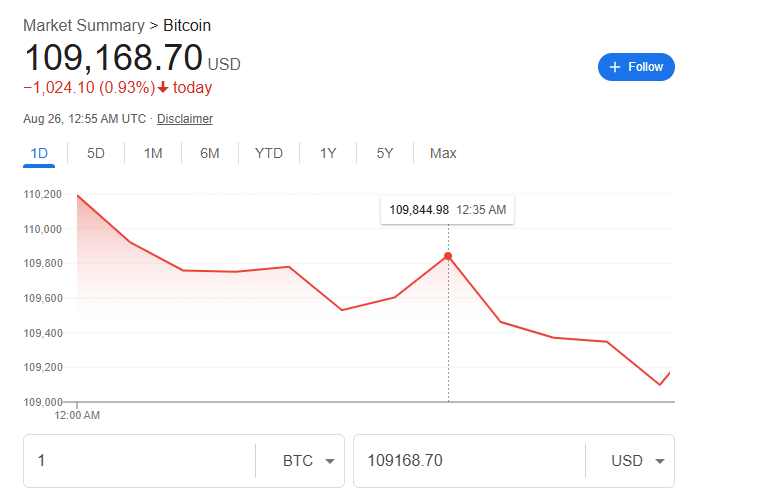
Bitcoin (BTC) sellers resurfaced on Monday, driving the price down to $110,300 and triggering massive liquidations across the cryptocurrency market.

The sharp decline followed Friday’s rally, which was fueled by Federal Reserve Chair Jerome Powell’s dovish comments at the Jackson Hole Economic Symposium, where he hinted at a potential rate cut.

Lower rates typically boost demand for risk assets such as stocks and digital assets. Still, Monday’s selloff showed that large holders or “whales” took advantage of the rally to unload substantial positions, deepening the pullback.

Whale Rotation: BTC into ETH

Data from Blockchain.com highlighted a major whale offloading 24,000 BTC ($2.7 billion) into the decentralized platform Hyperliquid over the past nine days. Of that, 18,142 BTC worth $2 billion was already sold and rotated into 416,598 ETH, according to analyst MLM.

Another whale sold 670 BTC ($76 million) to open a leveraged long ETH position last Thursday, reinforcing a growing trend of whales swapping Bitcoin for Ether. ETH has rallied 220% since bottoming at $1,471 in April, narrowing the gap with Bitcoin and Solana (SOL), which led earlier phases of the bull cycle.

The retreat extended Bitcoin’s drawdown to 11% from its August 14 all-time high of $124,500. More than $642.4 million in long positions were liquidated, with BTC traders losing $235.5 million and Ether (ETH) traders another $155 million. Across the market, liquidations totaled $806.95 million in both long and short positions.

Heatmap data showed heavy bid orders clustered between $110,500 and $109,700, with further demand building down to $108,000. This suggests Bitcoin could continue sweeping liquidity lower before a recovery attempt.

“Bitcoin is still murdering leveraged traders around the range lows, and from the looks of it, the sharks are still hungry,” trader Jelle wrote on X. He added that holding above the monthly open of $111,900 was key to avoiding a deeper correction toward $100,000.

Also speaking, Analyst Captain Faibik echoed the warning, saying support near $111,800 was “getting weak” and that a breakdown could trigger another leg lower toward $107,000–$108,000. Despite the short-term weakness, some analysts remain optimistic about BTC’s bullish price action. Gert van Lagen argued that Bitcoin’s parabolic structure was still intact, with a long-term target of $350,000. However, he warned that a structural breakdown could open the door to a fall toward $95,000.

On-chain analyst Willy Woo pointed to long-time “OG whales” as a source of pressure on the market. “BTC supply is concentrated around OG whales who peaked their holdings in 2011,” Woo explained. Having acquired Bitcoin at $10 or lower, these whales can sell at massive profits, but their activity means it now takes over $110,000 of fresh capital to absorb every Bitcoin they release.

While whales continue to reshuffle holdings, institutional demand for Bitcoin remains a powerful tailwind. David Bailey, entrepreneur and Bitcoin adviser to U.S. President Donald Trump, argued that the market is entering a long phase of adoption, downplaying a possible bear market.

He wrote on X,

“There’s not going to be another Bitcoin bear market for several years. Every Sovereign, Bank, Insurer, Corporate, Pension, and more will own Bitcoin. The process has already begun in earnest, yet we haven’t even captured 0.01% of the total addressable market. We’re going so much higher. Dream big.”

Institutional Demand Still Rising

Institutions have steadily built exposure through exchange-traded funds (ETFs) and corporate treasuries, with collective holdings surpassing $100 billion largely in Bitcoin.

Strategy, the world’s largest public holder of Bitcoin, added to its stack last week, purchasing 3,081 BTC for $356.9 million as the price fell to $112,000. According to SEC filings, the company has accumulated 3,666 BTC in August, a sharp slowdown compared to July’s 31,466 BTC purchase.

With Strategy’s buying pace cooling, markets are watching to see if the firm ramps up acquisitions again in the final week of August or opts for a more cautious approach.

Bitcoin Outlook

For now, Bitcoin sits at a crossroads. Short-term technicals warn of potential dips toward $107,000–$108,000 or even $100,000 if critical support fails. Yet long-term bulls argue institutional adoption, ETF inflows, and global interest will continue pushing Bitcoin toward new highs.

Whether Bitcoin retests six figures on the downside or breaks higher again, the coming weeks may prove decisive in shaping the next phase of the bull market.

Warren Buffett Says He Doesn’t Want to Add Another Railroad to Berkshire Hathaway’s Portfolio

0

Warren Buffett has ruled out adding another railroad to Berkshire Hathaway’s vast portfolio, but he is looking for ways to make America’s freight rail system more efficient through partnerships.

Speaking with CNBC’s Becky Quick on Monday, the legendary investor confirmed that he and Berkshire CEO-designate Greg Abel met earlier this month with CSX CEO Joseph Hinrichs in Omaha, Nebraska, to discuss possible collaboration.

The August 3 meeting, which took place without advisors present, was candid. Buffett and Abel assured Hinrichs they had no intention of making a takeover bid for CSX. Instead, they suggested the two companies could reap many of the same benefits that consolidation might bring through closer cooperation. Buffett explained that coordination between rail operators could unlock efficiencies without the upheaval or costs associated with mergers.

The market responded swiftly, with CSX shares falling about 5% to $32.81 after the news that Buffett was not interested in an outright purchase. Union Pacific dropped about 2%, Norfolk Southern lost more than 2%, and Berkshire Hathaway itself slipped less than 1%. The pullback reflected investors’ recalibration following a period of speculation that Berkshire might seek another transformative railroad acquisition.

That speculation was partly fueled by last month’s shock $85 billion takeover announcement from Union Pacific, which unveiled plans to acquire Norfolk Southern. The deal set off a wave of chatter across the industry, with CSX shares jumping 9% in July on hopes that Berkshire’s BNSF Railway could enter the fray. But Buffett’s latest remarks clarify that his strategy favors collaboration over consolidation.

Back in 2009, at the height of the financial crisis, Buffett stunned markets by spending $26 billion to acquire BNSF in what remains one of his boldest and most successful bets. He hailed the railroad then as an “all-in wager on the American economy.” The purchase gave Berkshire a permanent stake in the backbone of U.S. commerce, with BNSF now ranking among the conglomerate’s crown jewels. But that was a different era.

The shift is already visible in practice. On Friday, BNSF and CSX jointly announced a new coast-to-coast rail service designed to make freight movements more efficient by linking their networks. For Buffett, such a partnership accomplishes much of what a merger would achieve—greater reach, improved service reliability, and streamlined logistics—without Berkshire having to pay a steep acquisition premium.

While Buffett’s cautious approach bucks the wave of merger speculation in the U.S., it mirrors strategies seen among other major global rail operators. In Canada, for instance, Canadian National Railway (CN) and Canadian Pacific Kansas City (CPKC) have pursued different paths to growth: CN has leaned on selective acquisitions alongside operational discipline, while CPKC completed a historic $31 billion merger to form the first railway linking Canada, the U.S., and Mexico. That deal created sweeping efficiencies for cross-border freight but also came with regulatory scrutiny and integration risks—factors Buffett appears intent on avoiding.

In Europe, freight railroads have often turned to cross-border alliances rather than outright acquisitions to cope with the continent’s fragmented national networks. Operators such as DB Cargo in Germany and SNCF’s rail freight arm in France regularly cooperate on corridor access agreements, intermodal hubs, and technology sharing to keep costs in check while ensuring seamless freight flows across borders. Buffett’s BNSF-CSX partnership bears a resemblance to those European arrangements, where efficiency gains are pursued without the financial and political complications of mergers.

This emphasis on cooperation over consolidation also reflects Buffett’s long-standing investment philosophy: avoid overpaying for assets while focusing on long-term operational performance. Berkshire can expand its influence and achieve coast-to-coast service efficiencies by drawing CSX into BNSF’s orbit through partnerships, even as competitors like Union Pacific chase headline-grabbing acquisitions.

Buffett’s strategy underpins a divergence in the U.S. freight sector. While Union Pacific and Norfolk Southern prepare for a massive integration that could reshape the industry, BNSF and CSX are betting that voluntary collaboration will yield similar network-wide benefits.

Trump Praises Intel Deal, Pushes Sovereign Wealth Fund Vision Amid Criticism

0

President Donald Trump says he is “just getting started” in what he describes as a new era of dealmaking between Washington and America’s biggest companies.

On Monday, the administration confirmed that its agreement to take a roughly 10% stake in Intel is only the beginning of what could evolve into a series of taxpayer-funded ownership deals, effectively laying the groundwork for what Trump has long envisioned: a U.S. sovereign wealth fund.

Kevin Hassett, director of the National Economic Council and a leading contender for the next Federal Reserve chair, made the administration’s intentions clear in an interview with CNBC.

“The president has made it clear all the way back to the campaign, he thinks that in the end, it would be great if the U.S. could start to build up a sovereign wealth fund. So I’m sure that at some point there’ll be more transactions, if not in this industry then other industries,” Hassett said.

The Intel deal is remarkable not only for its size but also for how it came about. Roughly $11 billion in grants pledged under the Biden-era CHIPS Act — a bipartisan policy aimed at boosting domestic semiconductor production — were converted into 433.3 million non-voting Intel shares. Trump has argued repeatedly that his predecessor’s CHIPS subsidies gave away taxpayer money without securing enough value in return. By turning grants into equity, he says, taxpayers now “own a piece” of America’s semiconductor future.

Trump, in his characteristic style, lashed out at skeptics of the agreement. “Why are ‘stupid’ people unhappy with that? I will make deals like that for our Country all day long,” he wrote on Truth Social. “I will also help those companies that make such lucrative deals with the United States. I love seeing their stock price go up, making the USA RICHER, AND RICHER.”

Intel’s stock rose more than 2% in early Monday trading following the announcement, closing at $25.25. The U.S. government purchased its shares at a $4 discount from Friday’s closing price of $24.80.

National Security and Industrial Policy

The White House has defended the intervention as a national security imperative. Intel, once the undisputed leader in chipmaking, has lost ground to foreign rivals like Taiwan Semiconductor Manufacturing Company. Officials argue it is a strategic risk for the U.S. to rely so heavily on overseas suppliers for advanced chips that power smartphones, defense systems, and AI models.

“I said, I think it would be good having the United States as your partner,” Trump told reporters.

This is not the administration’s first corporate intervention. Earlier this year, the White House took a so-called “golden share” in U.S. Steel to secure protections for American workers after approving Japanese-based Nippon Steel’s acquisition of the company. Separately, Trump mandated a 15% remittance on high-end chip sales by Nvidia and AMD to China — a move that followed his decision to halt exports of the firms’ most advanced chips to Beijing.

Divisions Over “Corporate Statism”

Still, not everyone is convinced. The Wall Street Journal editorial board compared the Intel deal to “corporate statism,” likening it to the U.S. government’s controversial 2009 bailout of General Motors, in which taxpayers ultimately lost about $10 billion. Many fear a slippery slope in which the government grows too entangled in private industry, potentially distorting competition.

Intel itself has acknowledged potential risks. In a securities filing, the company warned that a 9.9% government stake could complicate its international business, especially given that 76% of its revenue comes from outside the United States, with China alone accounting for 29%. The filing noted that foreign subsidy laws and restrictions could be triggered by Washington’s new role as a shareholder, potentially straining global sales.

CEO Lip-Bu Tan struck a more conciliatory note, however. In a Commerce Department video posted Monday, he said: “I don’t need the grant. But I really look forward to having the U.S. government be my shareholder.”

However, the Intel agreement is effectively clearing away billions in outstanding CHIPS Act obligations, with the company’s obligations considered discharged “to the maximum extent permissible under applicable law,” except for its Secure Enclave program. But it has also raised the possibility that other government entities may demand to convert existing grants into equity stakes, reshaping how Washington does industrial policy.

That is believed to be precisely the point for Trump. By recasting subsidies as investments, he believes that he is setting the foundation for a sovereign wealth fund that could expand across industries — from steel to semiconductors and potentially beyond.

“We will do a lot more deals like that,” Trump promised.

However, only time will tell whether taxpayers end up richer, as Trump insists, or whether this gamble on corporate equity echoes past interventions where the U.S. public shouldered the downside risk while private companies reaped the rewards.