DD
MM
YYYY

PAGES

DD
MM
YYYY

spot_img

PAGES

Home Blog Page 6431

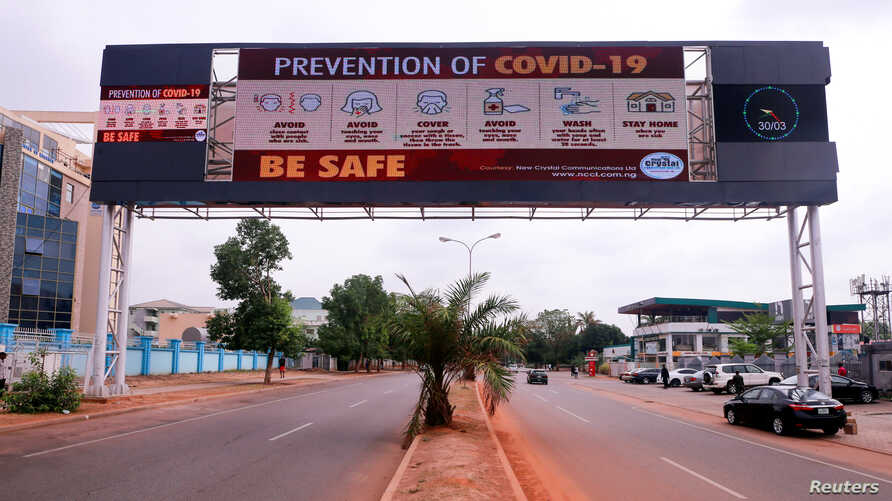
Partial or Total Lockdown: Nigerians appeal to Government for Palliative Measures

0

It is now a reality that Nigeria is undergoing or experiencing the first lockdown post-military era. What could be said to be close to this present experience was the 1993 June 12 brouhaha. Then, the major theatre of war then was Lagos and other South western states. However, the COVID 19 is no respecter of geographical locations and spread. On Monday, the President, Muhammadu Buhari announced lockdown in Lagos, Ogun and Abuja. However, some states too have announced either partial or total lockdown. Kwara State is a North Central state which shares border lines with Ekiti, Osun and Ondo states. 

It was the first state to lock down totally banning intra and inter-state transportation. This was followed by both Ekiti and Osun States after the two states recorded one and two confirmed cases of the virus respectively. As this report is collated, Osun State has recorded three more cases. For Ekiti State, the movement restrictions take effect from 11:59pm on Monday, 31 March, 2020 while Osun stipulated that a total lockdown of the state would commence on early Wednesday morning.

Expectedly, people are the ones who are going to feel the impact of the stay at home order by governments at both federal and local levels. Analysis has shown that a larger percentage of the people rely on daily income. This implies that when they do not go out, they do not have the resources to take care of their daily needs. Opinions sampled across the states on how people have been coping with the partial and the planned total lockdown. Mr. Abdurrahman Okunade is an Osogbo-based lawyer. He is the Chairman of the Nigerian Bar Association, Osogbo Chapter. For him the restriction has economic implications.He said “Many forthcoming engagements have been disrupted, thereby causing losses. And any further planning is now impossible. Being a self-employed person, staying at home is very difficult. For a salary earner, something is certain in terms of income at the end of the month, in spite of the lockdown. But for me, no. 

I have bills to pick, but I have no autonomic source of income. Yet, I fear for my health. I need to interact with my clients to earn a living, yet I need to be wary of close interaction with people in order to live.” Abolaji Khadijah is a trader. She sells at the popular Igbona Market in Osogbo. The song on her lips too is about how the lockdown would affect her in terms of her income. When asked what the lockdown means to her, she explained  “I am a trader who relies on daily income as I have a weekly contributory scheme I have to fulfil and when I do not go out to the market, there is no way to fulfil such. It will affect me greatly during and after the lockdown.”

Omolola Oluwasola is a lecturer at the Department of Mass Communication, Afe Babalola University, Ado Ekiti in Ekiti state. Her concern was majorly the artisans and those whose income is based on a daily basis. She posited “we have a problem of inadequate or no stimulus in some states at all in Nigeria unlike what obtains in the United States and other countries where palliative measures are being put in place. In the absence of palliative provisions, what happens to artisans and citizens who cannot feed daily if they do not go out?”, She asked. However, her concern was addressed by the Ekiti State Government that announced a relief package for the most vulnerable in the society. She also ruled the spike in the cost of living as she looks forward to staying at home. She said “Again, because we do not have a functional system, our staying at home means we are operating our finances at a minus, you have to power your electricity with generator by yourself to be up-to-date with global news and to take necessary precautions, store up your household with foodstuffs and other essentials.”

For Abideen Olasupo, a young serial entrepreneur in Ilorin, Kwara State, the lockdown was long overdue and he understood the government’s reluctance to declare it because of the state of the economy. He called for palliative measures for those that would bear the consequence of the lockdown especially those who operate at the lowest rung of the ladder.  He feared the increase in consumption of data used for various purposes during the lockdown.

Oyeyemi Olatunnji is a banker residing in Lagos. He is of the opinion that the lockdown is changing perception of work generally. He noted that ‘we have been asked to work from home from the office. This morning I was in a meeting with colleagues via zoom. It didn’t feel like we were at work.” He observed that the lockdown might not be easy for a larger percentage of Lagosians who stay in their large number in apartments. He said maintaining social distancing might not be an easier task.

Adedolapo Bakare is a lady painter based in Lagos. To her, the lockdown is a necessary approach by the government to be able to manage the pandemic in the country. However, it is affecting her business seriously. She said “my kind of business is such which requires my physical presence  and time meeting with clients and visiting sites for assessment and commencement of projects. Since the lockdown, my hands have been idle and this sure hasn’t been easy.” She said the lockdown is really affecting her business but since the lockdown is a necessary evil affecting all sectors of life, she has to abide.

As many of the states in Nigeria go on total lockdown, the dilemma for many decision makers in those states is what to provide the citizens as a palliative in the midst of a significant drop in productivity and oil price. Whether Nigerians would be able to weather storms is a matter of time.
Covid-19 Lockdown: Nigerian Government Makes Room for Skeletal Banking, Petty Trading

0

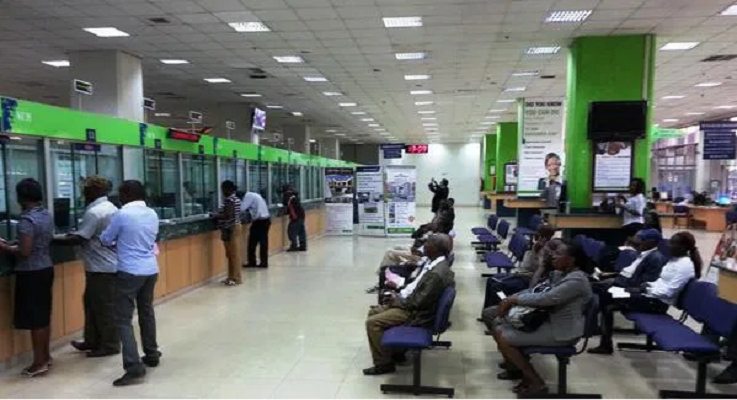
The Minister of Finance Mrs. Zainab Ahmed, and the Central Bank Governor, Godwin Emefiele jointly announced on Monday that the Federal Government has approved skeletal operations for banks and other financial services as the busiest states in Nigeria go on lockdown.

In line with our commitment to always provide excellent services and keep you abreast of regulatory directives that may affect you, please be informed that the Central Bank of Nigeria has suspended the clearing of cheques from March 31, 2020, until further notice, as part of measures to contain the spread of COVID-19.

However, settlement activities for electronic instruments such as NEFT and NAPs will continue during this period of suspension. (Source: UBA)

The federal government on Sunday, announced a 14-day shutdown of the FCT, Lagos and Ogun States, as a measure to curtail the spread of coronavirus pandemic. The effects of the shutdown touch many aspects of living, opening voids that make it difficult for people in the affected states to cope. One of them is the use of banking services, a situation that necessitated the intervention of the Central Bank of Nigeria (CBN).

On Monday, the apex bank shared a circular title: Notice to Affected Stakeholders and General Public Regarding COVID-19 and Restrictions in Movement of Persons, where it disclosed that it has obtained exemptions from the Federal Government for some banking activities:

“To ensure that Nigerians can still perform online transactions and use ATMs while observing these restrictions, we will like to inform the general public and all affected stakeholders that we have obtained exemptions from the president to allow very skeletal operations in the Financial System and Money Markets in order to keep the system in light operations during this time.

“To this end, all relevant staff of affected outfits and agencies should look out for further instructions from their immediate bosses. We are mindful of the difficulties this would bring on ordinary Nigerians and are grateful to the president for approving these exemptions, which should help ease some of the burdens. We urge all Nigerians to be patient, cooperative and united as all hands are on deck to defeat this virus.”

This intervention has brought calm to the environments as people were witnessed in panic withdrawal of funds on Monday.

The Lagos State Government has also embarked on data collection for the distribution of food items for sustenance of Lagosians during the stay-at-home period. The state has promised to make basic food provisions for all and appears keen to keep the promise.

Meanwhile, the police have said that street businesses which do not operate on major roads are allowed to function during the lockdown. The Lagos State Police Command’s Spokesman Bala Elkana made the clarification after reports emerged that some petty trading is going on in the streets.

Elkana said the restriction doesn’t include such businesses as long as they maintain the social distancing rule even though they don’t sell essential commodities as stipulated in the shutdown rules. He added that the enforcement unit of the police has been urged to show understanding and compassion as they go about enforcing the stay-at-home order.

“Well let me start by saying that this is not a conventional situation. The primary mandate of the police is to protect lives and properties and I am not sure we have found ourselves in this kind of situation where we need to enforce not the conventional law, but how to stop the spread of the virus.

“So this is a new one that requires new approach. It requires more of compassion, sympathy and you know something that is new also needs more time for people to get used to it. So, that is why the commissioner of police is leading the enforcement. We go round together, meet people, and also look at what the police are doing. We also gave out dedicated lines for people to call and register their complaints.

“The complaints we have received so far have been minimal and they are addressed as they come in. since the situation also affected the physical meetings between the Commissioner of Police and officers and men across the state, more radio communication is being used and so, once a complaint is received, the CP addresses it through the radio.

“The policemen have been given clearance that the shutdown basically affects markets and these are markets where they do not sell essential commodities. This does not include isolated shops on the streets. Only markets because markets attract a large number of people.

“Life must continue, we are not shutting down Lagos completely. The order did not shut down Lagos. The order is saying that markets that attract crowd to them should remain closed because they have high risk of spreading the virus.

“That is the clearance the CP gave yesterday very well to all the policemen and he made sure they all acknowledged and they understood it. He gave room for them to ask questions through the walkie-talkie on areas they needed clarification.

“Even if the shops on the streets do not deal in essential commodities, they are free to open up.

“The only condition is that crowd must not gather there. The shop owner must not have more than 25 persons at a time gathering there, and if people are coming into the shop, he should make sure that they have space.

“If you have a small shop, do not let it get congested, let some people wait outside while you attend to some. There has to be space so that there is no body contact. All these are guidelines to help us stop the spread of this virus,” Elkana said.

However, some are criticizing the government’s decision granting banks exemption to operate skeletal services while other corporations remain totally closed.

Former Senator Shehu Sani said it is no longer a lockdown: “If commercial banks and other financial institutions will still operate in Lagos while other people are confined to their homes, then it’s not lockdown but locksome,” he said.

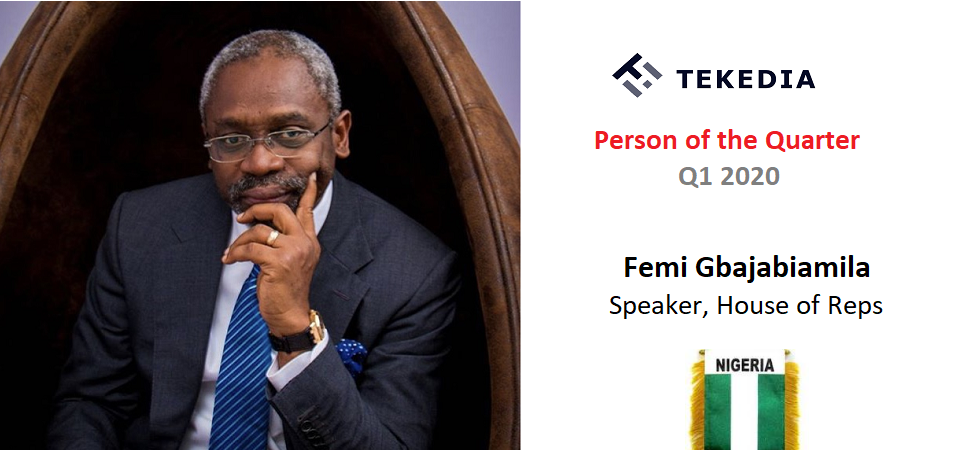
My Person of the Quarter, Q1 2020 – Femi Gbajabiamila

0

Femi Gbajabiamila: For demonstrating uncommon fairness towards a stronger Nigerian union when he declined to consider a flawed loan structured to exclude a region. By rejecting the loan, already passed by the Senate, despite concerns from the affected constituency, Speaker Gbajabiamila rose above his party and the current government, to serve his country with honor and decency. We celebrate him today, and quote his inspiring words – “Equity suggests that all zones must be carried along” – for all Nigerians, as we honour him as Tekedia Person of the Quarter, Q1 2020.

Thank You Mr. Speaker – Amazing Femi Gbajabiamila

TrustBanc Daily Stock Market Scorecard, 1st April 2020

0

“I want every American to be prepared for the hard days that lie ahead…” Trump

“The number of deaths, based on current projections, is between 100,000 and 200,000. On 15 April, for instance, 2,214 Americans are expected to die.” BBC

The outbreak’s rapid spread and projected deaths put huge question marks over when economic life in the U.S. will return to normal.

When economic life and activities will return to normal in the U.S. is the closest reality to projecting when it will globally, including Nigeria.

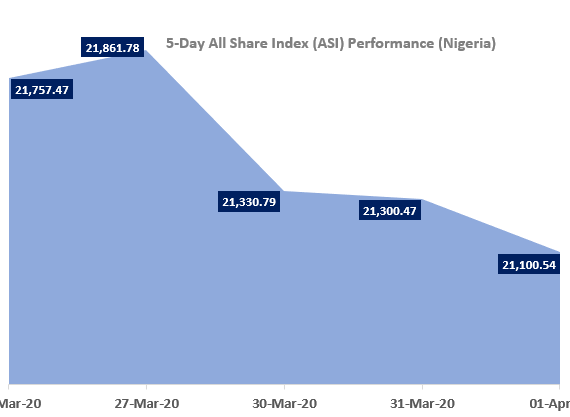
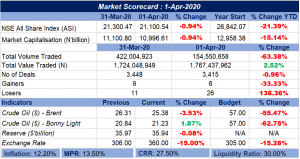
The volume of activities at the equities market dropped today while value increased as the All Share-Index (ASI) opened the new quarter with a decline of -0.94% to expand the year-to-date loss of the market to -21.39%. See the image below for a complete snapshot of market performance.

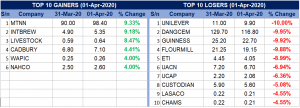
Market Breadth: The breadth of the market was weak today as the bears overwhelmed the bulls with 26 declining stocks as against 6 rising stocks. See the list of top gainers or losers below:

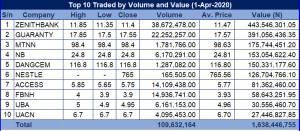
Market Turnover: Turnover declined by 63.38% in volume and appreciated by 2.52% in value. See top 10 traded stocks below:

Have a great evening.

Covid-19 And Nigeria’s Social Intervention Program

0

In a bid to alleviate the hardship emanating from the restrictions and lockdowns initiated by governments as measures to curtail the spread of coronavirus, the federal government said it has started doling out palliatives to poor households in the country.

Sadiya Farouk, the Minister of Humanitarian Affairs, Disaster Management and Social Development, said the Ministry has commenced disbursement of cash transfer to poorest households in Nigeria.

“In Mr. President’s speech, paragraph 54, he directed that the conditional cash transfer should be given in advance of two months. This we have also done. We have directed immediate cash transfer to the poorest and most vulnerable households in the country.

“Because of this COVID-19, the vulnerable groups have to be expanded because we are aware that there are people who live on daily wage. So we are also going to look at those groups of people to see how we can get this food relief intervention to them this period,” she said.

As part of efforts to reach the most vulnerable with relief supplies, Farouk said the National Emergency Management Agency (NEMA) has deployed trucks of relief materials to states affected by the coronavirus pandemic.

As at March 31, Nigeria has recorded 139 confirmed cases of coronavirus, scattered across 12 states of the country with Lagos having the highest number (82). Many states have embarked on restrictions and curfews in an attempt to quell the spread, resulting in deprivation of people’s means of income, especially those who depend on their daily income to earn a living.

President Buhari on Sunday, during his state broadcast promised to make provisions that will assuage the hardship stemming from the restrictions and lockdowns. Accordingly, the Ministry of Humanitarian Affairs has commenced cash remittance to the most affected people in the country.

According to Mrs. Farouk, over 11 million Nigerians have been identified so far as beneficiaries. She said on Tuesday during the press briefing of the Presidential Task Force on coronavirus that the government already has a social register with details of those considered as the vulnerable in the society.

She said the neediest in the society cut across 35 states of the federation in around 2.6 million households, among them, those in Internally Displaced Persons (IDP) camps, who have received two months rations of the relief supply already.

However, this development is not receiving its supposed applause because of how people see it. The question popping here and there are: “How did the government identify poorest Nigerians”? How does the government determine poorest households? Among the reasons many think the answers to the questions are relevant is that poorest Nigerians don’t even own bank accounts. But according Mrs. Farouk, the disbursement has been through bank accounts, and that has appeared fishy to many.

Lukman Olamilekan, a concerned Nigerian said the most vulnerable people in the face of coronavirus live in the most affected cities where the lockdown is currently active. And that means, the government has got all wrong going to all 35 states at the same time.

“The poorest households, which I believe are the people in the remote areas and hamlets. I don’t think COVID-19 presently affects these people, those affected are the people in the city who survive on daily earnings. They need this money far more than the villagers,” he said.

The World Poverty Clock puts the number of poor Nigerians at about 100 million people who are living below moderate poverty line ($2 and above daily), which means a staggering number of people in Nigeria live below $1.9 daily.

The Minister of Humanitarian Affairs said that the government has identified 11 million people out of about 100 million Nigerians who are living in abject poverty to be beneficiaries of the relief program.

Though some Nigerians have been sharing screenshots of their bank’s credit notification online as evidence that the government is living up to its promise, it only confirms the fear of many. It is believed that the poorest ones among Nigerians don’t even have what it takes to be on the internet, which puts a question mark on the government’s selection method of those deserving the social intervention program.

It is believed that it is “business as usual,” that nepotism must have played a big role in the selection of those who receive the cash and material support from the government, if at all it’s something anyone would believe.