DD
MM
YYYY

PAGES

DD
MM
YYYY

spot_img

PAGES

Home Blog Page 6453

How the COVID-19 is Destroying Small Businesses

0

 Imagine you are fired from your job. That means your source of livelihood has come to an end. Imagine you don’t have demand from the market anymore. That means you will record no sales either personally or as a business.

 That is exactly what the Coronavirus pandemic is turning the world into. I analyzed the worth of the COVID -19 cure to be $4.3trn in this article.

 But when two elephants fight, it is the grass that suffers much pain. That is true for the small businesses. As we know that small businesses are the backbone of most economies.

It is small businesses that grow into unicorn and from unicorn into publicly traded companies. How will these small businesses grow at this time? Think about this for a while.

 The Impacts of COVID-19 on Small Businesses

The pain started in a small way, it has grown to become a very big pain to small businesses.

The covid-19 can be contracted through respiratory droplets. This has led to closure of businesses and other physical gathering centers. Here are some of the impacts to small businesses;

  •   Close Down of Businesses.

In some countries where the pandemic had spread widely, businesses have been closed down. Workers are no longer allowed to come to work instead they work remotely. The goal is to prevent physical contact between people. What this means is a decline in the revenue of the business due to cancellation of orders. A decline in productivity in such businesses.

  •  Lack of Credit Facilities

The blood of small businesses is finance. When there is no finance for the business to keep up operations that will be the death of the business. This moment when business activities are reduced, that means no bank will like to give credit facilities to businesses. This is such a grave problem!

  •   Fixed Cost Remain Fixed.

At this moment when all business variables need to decline, some are still fixed. Business cost items like rent, salaries, insurance etc will still remain fixed. The question is this; how will the business owners pay these bills? A time when there is no cash flow. A time when there is no revenue.

 What can we do at this critical point in the history of the world? The destiny of humanity rests on the shoulders of world leaders, you and I included. Here are the solutions that great people and organizations are already providing;

 What World Leaders Should do to Help Small Businesses.

 In my article on the global worth of Coronavirus, I made a call to entrepreneurs, philanthropists, donors agencies and organizations that we could together deal with this pandemic.

 Here are some of the solutions so far;

  •   The Facebook Solution:

Facebook has taken a lead in initiating measures that will help small businesses tackle the challenges they are facing at this critical stage.

 Few days ago Sheryl Sandberg posted on her page on Facebook that Facebook has come up with an initiative to help small businesses.  The initiative is to provide a grant of $100m in cash and advert to support small businesses. This will go a long way in solving the financial problems of the small businesses at this moment.

  • The Jack Ma Solution.

Jack Ma has also come up with a great initiative in order to contain the spread of this pandemic in African countries. Jack Ma is donating masks,test kits and protective suits to all countries in Africa to help the continent in its fight against the COVID-19.

 This approach is helping to curb the spread of the viruses in developing countries. This will impact small business operations too as the spread of the virus is still small compared to other countries.

  • The Progress Ibrahim Solution.

In periods of crises what we need is solutions and not complaints. So, in my own capacity I have decided to use the power of copy writing to influence great leaders, donor organizations, philanthropists and entrepreneurs to rise and support in whatever way so we could collectively tackle this pandemic.

 This approach could lead to donations of materials, provision of grants to support businesses and other help.

  •  Suggested Government Solution.

I must commend the government of many nations that are already being proactive about the containment of this pandemic. This is what I suggest every government should do through its Reserve Banks or Central Banks. Government should earmark special funds to support small businesses in their countries. This will help such businesses to stay alive at this period.

 We know how important these businesses are to unemployment reduction in every economy. If your government knows, then come up with this bailout measure to help them stay alive.

On an individual level what are you doing to help in the containment of COVID-19? Firstly, ensure you adhere to precautionary measures like hand washing with sanitisers, social distancing etc. Contribute whatever you can do to support humanity in time like this.
Insights and Foresights of Nigerian Media’s Roles on Coronavirus

0

In the earlier piece, our analyst noted that COVID-19 is a huge story for healthcare and media practitioners. These practitioners are playing two significant roles. Healthcare professionals are caring for the infected persons. At the same time, they are giving specific and strategic messages to people on how to avoid contracting and spreading the virus. Whenever they gave information, different platforms are being used. They either apply personal communication channels such as social media or contacting media practitioners, who use both the traditional and digital media for the dissemination of the messages to the public. Much has been said about how the media practitioners and their platforms (newspaper, radio and television) reported Coronavirus outbreak globally and after the confirmation of the first case in Nigeria on February 28, 2020 in Lagos.

When it was obvious that the Nigerian newspapers were paying much attention to the virus than other diseases ravaging the country, Mr Garba Shehu, the spokesperson to President Muhammadu Buhari said “This morning’s newspapers, all of them have Coronavirus as the lead, cover story. When will they bring the spotlight to bear on 822 who are killed by malaria everyday in Nigeria? This article is not intended to juxtapose the spokesperson’s views with what the citizens and other concerned stakeholders said about the coverage after the first case was reported.

It offers in-depth analysis of what transpired, in terms of coverage of the virus by the Nigerian media and others in the world (that found the incident in Nigeria worthy of reporting), in relation to the views of experts and academic researchers such as Professor Ayobami Ojebode, University of Ibadan. Over the years, the professor of Development Communication has been searching elusive voices for sustainable development in Nigeria and Africa.  Our analysis of 86 news stories between February 28 and March 13, 2020 reveals a number of significant insights with many implications for the media practitioners in Nigeria and the rest of the world.

Dominant Messages

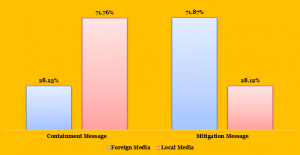
Our first data point for analysis is the dominant messages of the local and foreign media. As expected, the media performed their social responsibility roles through the news reports that established the treatment and control or containment of the virus [see Exhibit 1]. In this regard, the media exclusively discussed how the virus could be stopped from spreading and efforts made by Lagos state and federal governments towards its treatment, including level of its containment, signifying the media interest to free Nigeria of the outbreak. This performance earned the media commendation from the University of Ibadan’s Professor of Development Communication, Ayobami Ojebode. According to him, “They have done very well in encouraging preventive measures. Handwashing and so on. But no one is hammering on preparedness of government in other states beyond Lagos and Abuja.”

Looking at the coverage from media polarity view, analysis shows that foreign media reported more containment and mitigation messages than the local media [see Exhibit 2]. “Before the first case was discovered in Nigeria, there was little media attention. It ran as one-item news lines without analysis or commentary. This was understandable because (1) it seemed like a Chinese problem alone, and (2) little was known of it, so not much could have been said by the media. Social media was however already awash with all sorts of information and misinformation,” Professor Ojebode added.

Exhibit 1: Dominant Messages

Source: Google News, 2020; Newspapers and Televisions, 2020; Infoprations Analysis, 2020

Exhibit 2: Messages by Media Category

Source: Google News, 2020; Newspapers and Televisions, 2020; Infoprations Analysis, 2020

The Mood of the Media

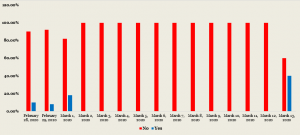
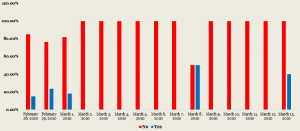
What was the mood of the media? Did the media see the past efforts of the governments on health sector as good omen for the containment of the virus? With these questions, our analyst wanted to know dispositions of the media towards the Nigerian healthcare system in relation with the recent position of the Joint External Evaluation (JEE) of the International Health Regulations, which placed Nigeria’s capacity to prevent, detect, and respond to public health threats at 46 per cent in 2019. Surprisingly, over 10% of the stories were positive to the health system out of 86 stories. More than 17% of the stories were negative to the health system, while 62 (72.1%) of the stories maintained neutral positions about the Nigerian health system [see Exhibit 3 and 4].

The low positive disposition has established the media pressing of the panic button as observed by Professor Ojebode. “After the first case was discovered, the media pressed the panic button – in my view. Before they would settle down to education and information, they first panicked in the news reports. That immediate phase was more like, “Breaking News: Corona is here and we cannot contain it.”

Exhibit 3: Positive Disposition of the Media to the Nigerian Health System

Source: Google News, 2020; Newspapers and Televisions, 2020; Infoprations Analysis, 2020

Exhibit 4: Negative Disposition of the Media to the Nigerian Health System

Source: Google News, 2020; Newspapers and Televisions, 2020; Infoprations Analysis, 2020

Who Played the Positivity or Negativity Mood Game the Most?

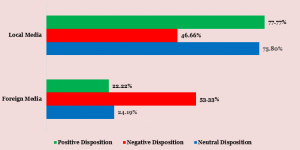
In our analysis, we understood that foreign media were more negative about the virus than local media. With this, we can say that Nigerian media dropped their hypertensive news angle about the healthcare system for social responsibility interest.

Exhibit 5: Disposition to the Nigerian Health System by Media Category

Source: Google News, 2020; Newspapers and Televisions, 2020; Infoprations Analysis, 2020

Foresights and Strategic Options

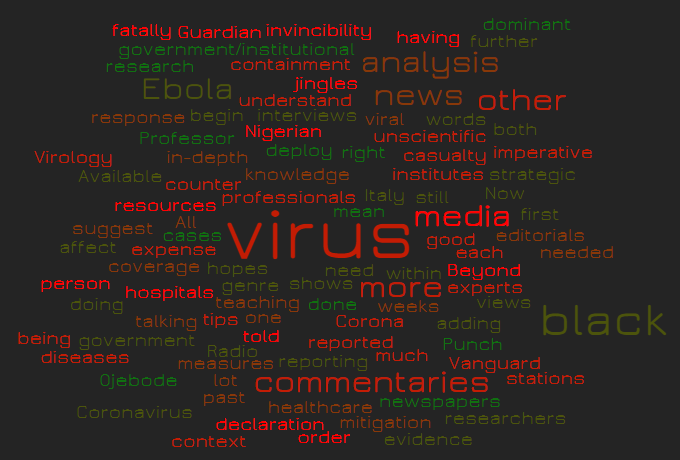
In order to suggest strategic tips for further coverage of the virus, it is imperative to understand the past within the context of Ebola Virus. Available evidence shows that government/institutional measures and response and cases of the virus were more reported by The Guardian, The Punch and Vanguard newspapers at the expense of views from healthcare professionals and other experts with the right knowledge on containment and mitigation of viral diseases. Beyond, the news as the dominant genre of reporting the virus (Coronavirus) and Ebola Virus, the media need to deploy their resources to features, editorials and interviews.

In the words of Professor Ojebode, “a lot is being done in the teaching hospitals and in the departments of Virology. However, both the researchers are not talking to each other. We are still having much more of news than commentaries and analysis. Radio stations are adding jingles. All these are good. But in-depth commentaries and analysis are needed. What are the research institutes doing? What does that mean? What should government do? For weeks, we have been told that Corona cannot affect a black person fatally. Now that we have the first black casualty from Italy, a Nigerian, one hopes that the media will begin to counter that unscientific declaration of black invincibility.”

A Risk Management Advice to Lagos State Government

1

It is no longer news that the Covid19 is now in Lagos. Building on the backdrop of medical advice on this case, it is said to transmit through contact with the droplet and touching it on the face. As a result, the fear of surface touch increases.

According to Richard Gray on BBC, droplets between 1-5 micrometers in size – about 30 times small than the width of a human hair – can remain airborne for several hours in still air. It means that the virus circulating in unfiltered air conditioning systems will only persist for a couple of hours at the most, especially as aerosol droplets tend to settle on surfaces faster in disturbed air. But the NIH study found that the SARS-CoV-2 virus survives for longer on cardboard – up to 24 hours – and up to 2-3 days on plastic and stainless-steel surfaces.

Considering that we are entering the raining season, it is important that the Lagos state government take an extra measure which won’t end at suspending gatherings.

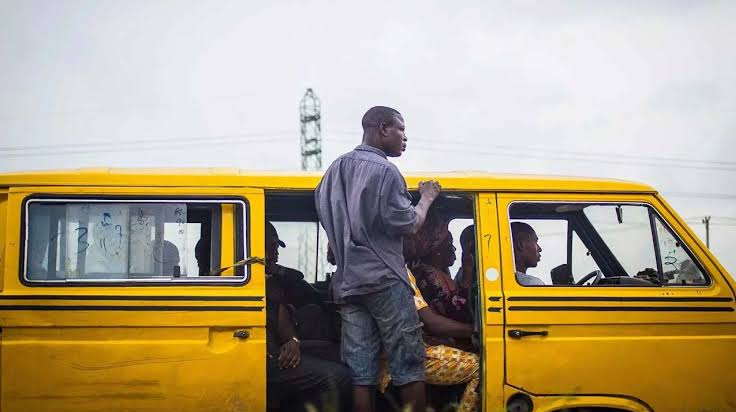
The big question is, when will the government, ask the bus and taxi drivers to start carrying two passengers per seat or at least three. As a way of curbing this virus, won’t it be wise that the government considers the permission of O’Pay, O’Ride, etc for the time being?

More so, the government should be observant enough to know that there is a scarcity of face mask for mouth and nose, and gloves.

The problem is contact and we need to do everything humanly possible to stop that.

Thank You Mr. Speaker – Amazing Femi Gbajabiamila

3

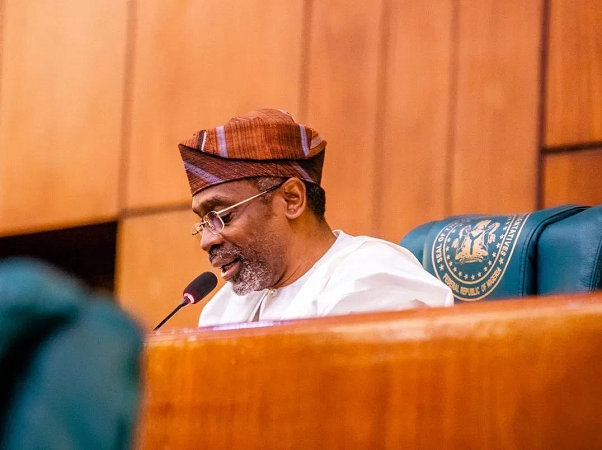
Please help me thank the speaker of the House of Representatives, Femi Gbajabiamila, who took a decision that the Federal Government of Nigeria’s $22.7 billion loan would not be passed in the House without the consideration of the South East. The House Speaker sent the message to the Finance Minister and the DG Budget that he would not work to approve that loan. Recall when I wrote that the government had suspended the loan (possibly after the Speaker pushed back). Interestingly, the real suspension was from Mr. Speaker who made the upright decision to hold the accent in the House.

“I know there has been a lot of agitation about (the) South-east not benefiting from the loan. It is one of the reasons we haven’t considered the loan in the House. I’ve discussed with the Finance Minister and the DG Budget,” the statement read.

“It’s a matter that we’re looking at seriously. I’m hoping that there will be some kind of amicable resolution so that everybody will be carried along. Equity suggests that all zones must be carried along….”

The Senate despite agitations from South East senators went ahead and passed the loan: “Amidst disagreements and arguments which forced the Senate to a closed-door session that lasted for about thirty minutes, the Senate passed the loan about a fortnight ago”. It was painful watching Senator Abaribe (Abia, PDP) begging his colleagues, and they simply ignored him, and went ahead and passed this dubious loan.

Through fake news and misinformation, many people were deceived to think that South East senators did not send projects when other senators were sending, as though any President goes around with Three Stars exercise books asking for project lists from senators. In the South East, a 10-year old boy will tell you that there are no roads there and the only airport has been taken down for repairs; so, no one needs help to find what to fund in the South East. Of course, no one has shown me the lists submitted by senators from other regions because they did not submit any!

Senate President Lawan failed Nigeria but thank God for Speaker Gbajabiamila who is amazing. I call all Nigerians to thank and commend him for leading with fairness and justice to all Nigerians. He has served not just the National Assembly but the Nigerian Constitution and the Federal Character.


https://www.youtube.com/watch?v=hGpB9g71TUU

Personally, this is about fairness. It has nothing to do with me being from the South East. I am from Ovim (Abia state) where we do not really care about the government. We contribute money and develop our community. But that does not mean we do not pay tax.

Nigeria Needs A State of Emergency on Its Finances

1
President Buhari of Nigeria

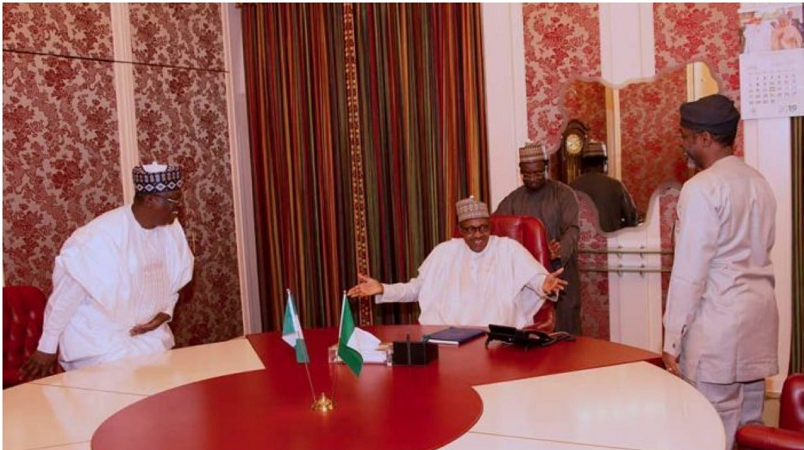
President Buhari should declare a state of emergency on Nigerian finances to activate ordinances that would help the government move numbers around and unlock some more numbers if he expects the 2020 national budget to work for Nigerians. I do think the National Assembly leadership and Mr President should hold a retreat this weekend to actionize the data Finance Minister, GMD NNPC and others have made public.

Nigeria has not recovered from 2008 market collapse unlike most parts of the world. As a student, I bought the naija big offer from First Bank of Nigeria at about N46 per unit when the exchange rate was N157 per dollar. Since that market crash, FBN shares have not exceeded N12 per unit. If you build in the dollar exchange rate (for those that imported dollars to buy), the best effective price is N5 per unit, excluding inflation. (Today, FBN is worth N142 billion at N4 per unit.)

In most companies in the Nigerian Stock Exchange, anyone that invested pre-2010 is still under waters. So, while Europe and the U.S. had recovered from that great recession, Nigerian investors are still hoping.

Now, if the avalanche of coronavirus blows and we do not move ahead to arrest the situation on time, we could have a double-whammy. That would technically cripple our capital markets, dry up capital and put the nation into depression.

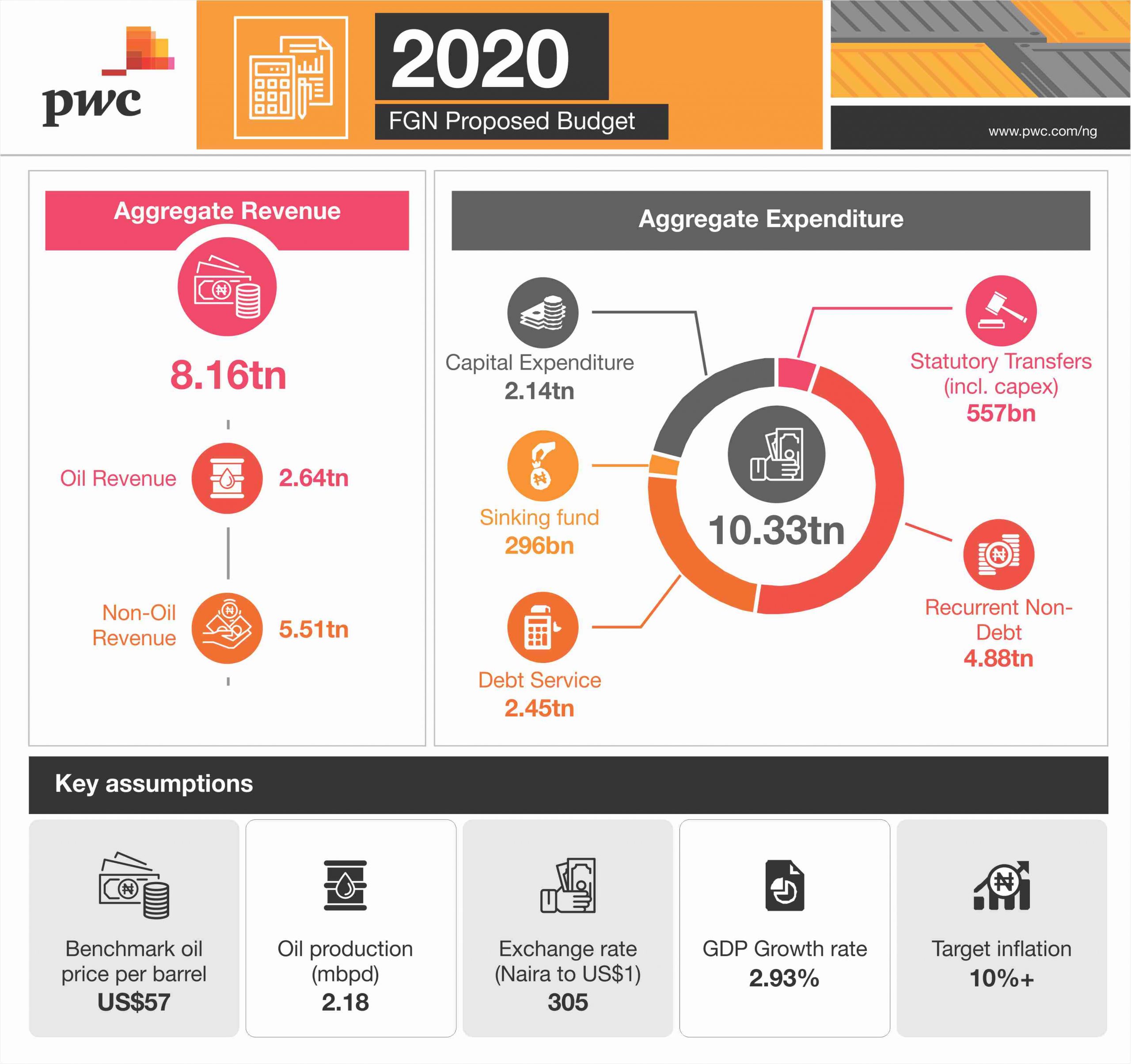
With our budget looking like $14 billion (debts servicing will take about $7 billion of that unless we renegotiate) and any hope of getting foreign loans vanishing, streamlining recurrent expenditure will be critical.  There are great ideas but I cannot write here as some would be tough choices which must be well managed to avoid breakdown of law and order. Mr President has some tools he can play to get Nigeria going. But he needs to lead and make hard choices.

There would be so much financial engineering for even that low number: the Federal Executive Council has approved reductions on capital budget by 20%, and 25% cut in recurrent expenditures. In short, I expect customs revenue to drop as import from Asia has crashed. Government’s plan to sell some assets like power systems will struggle as there would be fewer buyers; so that number has to go low in the budget.

And the big one: the government has frozen recruitment except for health services and security. I do not believe that one though, relying on past records. Tough months ahead across all sectors because this sub-$20 billion cannot be 70% executed. In other words, the real 2020 Nigerian budget is below $14 billion.

We need urgency because the private sector cannot lead this redesign. Arik just suspended flights to Ghana, Liberia and Senegal even as local airlines are battling the demon of coronavirus on passenger volume. The national assembly has frozen visitors and excursions indefinitely. If companies follow that path, Nigeria will crawl to a standstill. Governors in the northern part of the nation plans to shut down mosques to prevent spread in the nation. The impact on the private sector would be huge, and taxes would not save the nation. Yes, we expect the tax revenue to drop.

*there could be minor modifications on this proposed budget. But one signed into law was just about it.