DD
MM
YYYY

PAGES

DD
MM
YYYY

spot_img

PAGES

Home Blog Page 647

Bitcoin Drops to $110K Amid Whale Selling and Heavy Liquidations, Analysts Warn of $100K Risk

0

Bitcoin (BTC) sellers resurfaced on Monday, driving the price down to $110,300 and triggering massive liquidations across the cryptocurrency market.

The sharp decline followed Friday’s rally, which was fueled by Federal Reserve Chair Jerome Powell’s dovish comments at the Jackson Hole Economic Symposium, where he hinted at a potential rate cut.

Lower rates typically boost demand for risk assets such as stocks and digital assets. Still, Monday’s selloff showed that large holders or “whales” took advantage of the rally to unload substantial positions, deepening the pullback.

Whale Rotation: BTC into ETH

Data from Blockchain.com highlighted a major whale offloading 24,000 BTC ($2.7 billion) into the decentralized platform Hyperliquid over the past nine days. Of that, 18,142 BTC worth $2 billion was already sold and rotated into 416,598 ETH, according to analyst MLM.

Another whale sold 670 BTC ($76 million) to open a leveraged long ETH position last Thursday, reinforcing a growing trend of whales swapping Bitcoin for Ether. ETH has rallied 220% since bottoming at $1,471 in April, narrowing the gap with Bitcoin and Solana (SOL), which led earlier phases of the bull cycle.

The retreat extended Bitcoin’s drawdown to 11% from its August 14 all-time high of $124,500. More than $642.4 million in long positions were liquidated, with BTC traders losing $235.5 million and Ether (ETH) traders another $155 million. Across the market, liquidations totaled $806.95 million in both long and short positions.
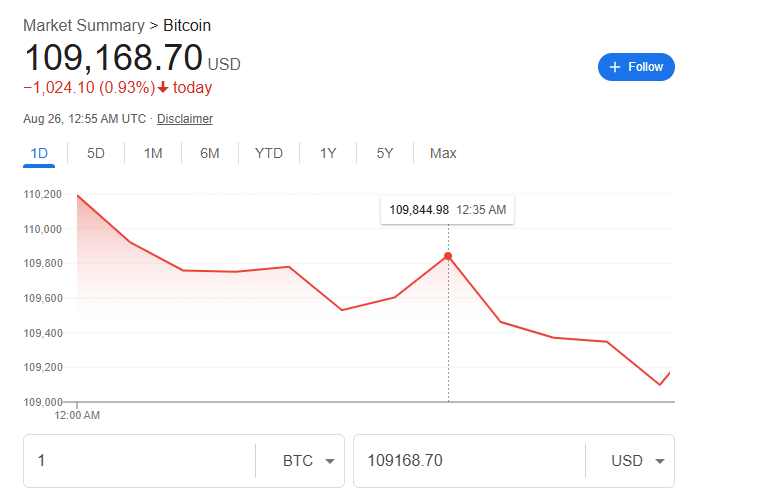
Heatmap data showed heavy bid orders clustered between $110,500 and $109,700, with further demand building down to $108,000. This suggests Bitcoin could continue sweeping liquidity lower before a recovery attempt.

“Bitcoin is still murdering leveraged traders around the range lows, and from the looks of it, the sharks are still hungry,” trader Jelle wrote on X. He added that holding above the monthly open of $111,900 was key to avoiding a deeper correction toward $100,000.

Also speaking, Analyst Captain Faibik echoed the warning, saying support near $111,800 was “getting weak” and that a breakdown could trigger another leg lower toward $107,000–$108,000. Despite the short-term weakness, some analysts remain optimistic about BTC’s bullish price action. Gert van Lagen argued that Bitcoin’s parabolic structure was still intact, with a long-term target of $350,000. However, he warned that a structural breakdown could open the door to a fall toward $95,000.

On-chain analyst Willy Woo pointed to long-time “OG whales” as a source of pressure on the market. “BTC supply is concentrated around OG whales who peaked their holdings in 2011,” Woo explained. Having acquired Bitcoin at $10 or lower, these whales can sell at massive profits, but their activity means it now takes over $110,000 of fresh capital to absorb every Bitcoin they release.

While whales continue to reshuffle holdings, institutional demand for Bitcoin remains a powerful tailwind. David Bailey, entrepreneur and Bitcoin adviser to U.S. President Donald Trump, argued that the market is entering a long phase of adoption, downplaying a possible bear market.

He wrote on X,

“There’s not going to be another Bitcoin bear market for several years. Every Sovereign, Bank, Insurer, Corporate, Pension, and more will own Bitcoin. The process has already begun in earnest, yet we haven’t even captured 0.01% of the total addressable market. We’re going so much higher. Dream big.”

Institutional Demand Still Rising

Institutions have steadily built exposure through exchange-traded funds (ETFs) and corporate treasuries, with collective holdings surpassing $100 billion largely in Bitcoin.

Strategy, the world’s largest public holder of Bitcoin, added to its stack last week, purchasing 3,081 BTC for $356.9 million as the price fell to $112,000. According to SEC filings, the company has accumulated 3,666 BTC in August, a sharp slowdown compared to July’s 31,466 BTC purchase.

With Strategy’s buying pace cooling, markets are watching to see if the firm ramps up acquisitions again in the final week of August or opts for a more cautious approach.

Bitcoin Outlook

For now, Bitcoin sits at a crossroads. Short-term technicals warn of potential dips toward $107,000–$108,000 or even $100,000 if critical support fails. Yet long-term bulls argue institutional adoption, ETF inflows, and global interest will continue pushing Bitcoin toward new highs.

Whether Bitcoin retests six figures on the downside or breaks higher again, the coming weeks may prove decisive in shaping the next phase of the bull market.

Warren Buffett Says He Doesn’t Want to Add Another Railroad to Berkshire Hathaway’s Portfolio

0

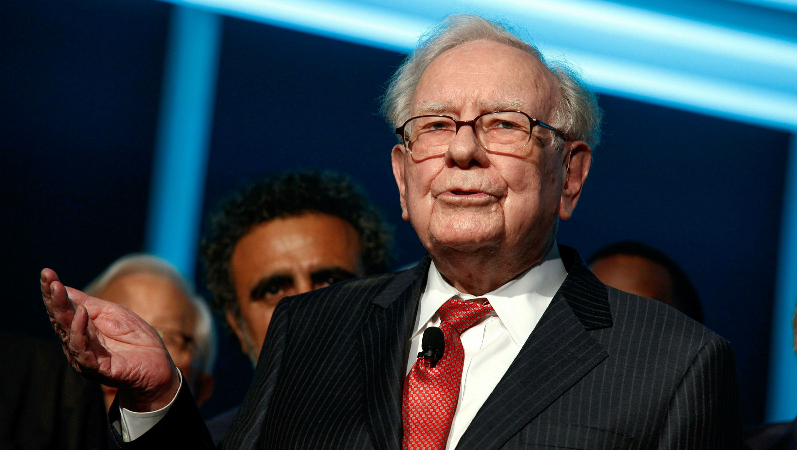
Warren Buffett has ruled out adding another railroad to Berkshire Hathaway’s vast portfolio, but he is looking for ways to make America’s freight rail system more efficient through partnerships.

Speaking with CNBC’s Becky Quick on Monday, the legendary investor confirmed that he and Berkshire CEO-designate Greg Abel met earlier this month with CSX CEO Joseph Hinrichs in Omaha, Nebraska, to discuss possible collaboration.

The August 3 meeting, which took place without advisors present, was candid. Buffett and Abel assured Hinrichs they had no intention of making a takeover bid for CSX. Instead, they suggested the two companies could reap many of the same benefits that consolidation might bring through closer cooperation. Buffett explained that coordination between rail operators could unlock efficiencies without the upheaval or costs associated with mergers.

The market responded swiftly, with CSX shares falling about 5% to $32.81 after the news that Buffett was not interested in an outright purchase. Union Pacific dropped about 2%, Norfolk Southern lost more than 2%, and Berkshire Hathaway itself slipped less than 1%. The pullback reflected investors’ recalibration following a period of speculation that Berkshire might seek another transformative railroad acquisition.

That speculation was partly fueled by last month’s shock $85 billion takeover announcement from Union Pacific, which unveiled plans to acquire Norfolk Southern. The deal set off a wave of chatter across the industry, with CSX shares jumping 9% in July on hopes that Berkshire’s BNSF Railway could enter the fray. But Buffett’s latest remarks clarify that his strategy favors collaboration over consolidation.

Back in 2009, at the height of the financial crisis, Buffett stunned markets by spending $26 billion to acquire BNSF in what remains one of his boldest and most successful bets. He hailed the railroad then as an “all-in wager on the American economy.” The purchase gave Berkshire a permanent stake in the backbone of U.S. commerce, with BNSF now ranking among the conglomerate’s crown jewels. But that was a different era.

The shift is already visible in practice. On Friday, BNSF and CSX jointly announced a new coast-to-coast rail service designed to make freight movements more efficient by linking their networks. For Buffett, such a partnership accomplishes much of what a merger would achieve—greater reach, improved service reliability, and streamlined logistics—without Berkshire having to pay a steep acquisition premium.

While Buffett’s cautious approach bucks the wave of merger speculation in the U.S., it mirrors strategies seen among other major global rail operators. In Canada, for instance, Canadian National Railway (CN) and Canadian Pacific Kansas City (CPKC) have pursued different paths to growth: CN has leaned on selective acquisitions alongside operational discipline, while CPKC completed a historic $31 billion merger to form the first railway linking Canada, the U.S., and Mexico. That deal created sweeping efficiencies for cross-border freight but also came with regulatory scrutiny and integration risks—factors Buffett appears intent on avoiding.

In Europe, freight railroads have often turned to cross-border alliances rather than outright acquisitions to cope with the continent’s fragmented national networks. Operators such as DB Cargo in Germany and SNCF’s rail freight arm in France regularly cooperate on corridor access agreements, intermodal hubs, and technology sharing to keep costs in check while ensuring seamless freight flows across borders. Buffett’s BNSF-CSX partnership bears a resemblance to those European arrangements, where efficiency gains are pursued without the financial and political complications of mergers.

This emphasis on cooperation over consolidation also reflects Buffett’s long-standing investment philosophy: avoid overpaying for assets while focusing on long-term operational performance. Berkshire can expand its influence and achieve coast-to-coast service efficiencies by drawing CSX into BNSF’s orbit through partnerships, even as competitors like Union Pacific chase headline-grabbing acquisitions.

Buffett’s strategy underpins a divergence in the U.S. freight sector. While Union Pacific and Norfolk Southern prepare for a massive integration that could reshape the industry, BNSF and CSX are betting that voluntary collaboration will yield similar network-wide benefits.

Trump Praises Intel Deal, Pushes Sovereign Wealth Fund Vision Amid Criticism

0

President Donald Trump says he is “just getting started” in what he describes as a new era of dealmaking between Washington and America’s biggest companies.

On Monday, the administration confirmed that its agreement to take a roughly 10% stake in Intel is only the beginning of what could evolve into a series of taxpayer-funded ownership deals, effectively laying the groundwork for what Trump has long envisioned: a U.S. sovereign wealth fund.

Kevin Hassett, director of the National Economic Council and a leading contender for the next Federal Reserve chair, made the administration’s intentions clear in an interview with CNBC.

“The president has made it clear all the way back to the campaign, he thinks that in the end, it would be great if the U.S. could start to build up a sovereign wealth fund. So I’m sure that at some point there’ll be more transactions, if not in this industry then other industries,” Hassett said.

The Intel deal is remarkable not only for its size but also for how it came about. Roughly $11 billion in grants pledged under the Biden-era CHIPS Act — a bipartisan policy aimed at boosting domestic semiconductor production — were converted into 433.3 million non-voting Intel shares. Trump has argued repeatedly that his predecessor’s CHIPS subsidies gave away taxpayer money without securing enough value in return. By turning grants into equity, he says, taxpayers now “own a piece” of America’s semiconductor future.

Trump, in his characteristic style, lashed out at skeptics of the agreement. “Why are ‘stupid’ people unhappy with that? I will make deals like that for our Country all day long,” he wrote on Truth Social. “I will also help those companies that make such lucrative deals with the United States. I love seeing their stock price go up, making the USA RICHER, AND RICHER.”

Intel’s stock rose more than 2% in early Monday trading following the announcement, closing at $25.25. The U.S. government purchased its shares at a $4 discount from Friday’s closing price of $24.80.

National Security and Industrial Policy

The White House has defended the intervention as a national security imperative. Intel, once the undisputed leader in chipmaking, has lost ground to foreign rivals like Taiwan Semiconductor Manufacturing Company. Officials argue it is a strategic risk for the U.S. to rely so heavily on overseas suppliers for advanced chips that power smartphones, defense systems, and AI models.

“I said, I think it would be good having the United States as your partner,” Trump told reporters.

This is not the administration’s first corporate intervention. Earlier this year, the White House took a so-called “golden share” in U.S. Steel to secure protections for American workers after approving Japanese-based Nippon Steel’s acquisition of the company. Separately, Trump mandated a 15% remittance on high-end chip sales by Nvidia and AMD to China — a move that followed his decision to halt exports of the firms’ most advanced chips to Beijing.

Divisions Over “Corporate Statism”

Still, not everyone is convinced. The Wall Street Journal editorial board compared the Intel deal to “corporate statism,” likening it to the U.S. government’s controversial 2009 bailout of General Motors, in which taxpayers ultimately lost about $10 billion. Many fear a slippery slope in which the government grows too entangled in private industry, potentially distorting competition.

Intel itself has acknowledged potential risks. In a securities filing, the company warned that a 9.9% government stake could complicate its international business, especially given that 76% of its revenue comes from outside the United States, with China alone accounting for 29%. The filing noted that foreign subsidy laws and restrictions could be triggered by Washington’s new role as a shareholder, potentially straining global sales.

CEO Lip-Bu Tan struck a more conciliatory note, however. In a Commerce Department video posted Monday, he said: “I don’t need the grant. But I really look forward to having the U.S. government be my shareholder.”

However, the Intel agreement is effectively clearing away billions in outstanding CHIPS Act obligations, with the company’s obligations considered discharged “to the maximum extent permissible under applicable law,” except for its Secure Enclave program. But it has also raised the possibility that other government entities may demand to convert existing grants into equity stakes, reshaping how Washington does industrial policy.

That is believed to be precisely the point for Trump. By recasting subsidies as investments, he believes that he is setting the foundation for a sovereign wealth fund that could expand across industries — from steel to semiconductors and potentially beyond.

“We will do a lot more deals like that,” Trump promised.

However, only time will tell whether taxpayers end up richer, as Trump insists, or whether this gamble on corporate equity echoes past interventions where the U.S. public shouldered the downside risk while private companies reaped the rewards.

Google to Mandate Developer Identity Verification for All Android App Distribution by 2026

0

Google is tightening security measures around Android app distribution, announcing on Monday that starting next year it will begin verifying the identities of developers distributing apps on Android devices — not just those on the Play Store.

The move marks one of the company’s most sweeping efforts yet to crack down on malware and fraud that have long plagued its platform.

The changes will apply to all certified Android devices once fully live, though the global rollout will be staggered. Google emphasized that Android will remain open, meaning developers can still distribute apps outside of the Play Store through sideloading or alternative app stores. But anonymity — once a hallmark of Android’s sideloading culture — will be eliminated. Developers who previously relied on alternative distribution channels to avoid disclosing their identity will now have to provide full credentials, a step Google says will help root out bad actors engaged in malware distribution, financial fraud, and theft of personal data.

The company backed the move with internal findings, stating that more than 50 times more malware entered Android devices via internet-sideloaded sources compared with Google Play, where developer verification has been mandatory since 2023.

Google will open early access in October 2025 for developers to test the system and provide feedback. By March 2026, identity verification will become mandatory for all developers. The first enforcement wave will begin in September 2026 across Brazil, Indonesia, Singapore, and Thailand, before expanding globally in 2027.

Under the new rules, developers will be required to provide a legal name, address, email, and phone number. This could push independent or hobbyist developers to register as businesses to protect their personal privacy. To accommodate such users, Google says student and hobbyist developers will have access to a separate category of Android Developer Console accounts.

The policy mirrors moves by Apple, which earlier this year imposed a similar requirement for its EU App Store to comply with the Digital Services Act (DSA). Under the regulation, app developers must disclose their “trader status” before distributing apps or updates. Apple’s earlier crackdown sparked debate among small developers who saw it as burdensome, but regulators insisted the changes were needed to protect consumers.

For Google, the shift comes after years of criticism that Android’s openness has made it a breeding ground for malware. While the company has repeatedly tried to improve Play Store vetting, sideloading has remained a weak point. In some cases, malicious apps disguised as financial tools, messaging services, or even popular games have infected millions of devices worldwide.

Analysts believe that this change will reshape the Android ecosystem, long valued for its flexibility compared with Apple’s more tightly controlled iOS. But some note that while the rules will strengthen user security, they could also deter smaller independent developers, particularly in emerging markets where sideloading is more common due to cost barriers and patchy Play Store availability.

Google’s strategy also aligns with growing global scrutiny of app ecosystems. Regulators in Europe, the U.S., and Asia are pressuring tech companies to do more to protect consumers, prevent scams, and ensure accountability among developers. With Apple already facing regulatory pressure in Europe and Google making preemptive moves, both companies are converging on stricter identity-based models for app distribution.

However, the rollout will test the balance between Android’s open-source DNA and the industry’s push for tighter security. For millions of developers, the next two years could define whether the platform remains a haven for independent innovation — or becomes more closely aligned with Apple’s walled-garden approach.