DD
MM
YYYY

PAGES

DD
MM
YYYY

spot_img

PAGES

Home Blog Page 6482

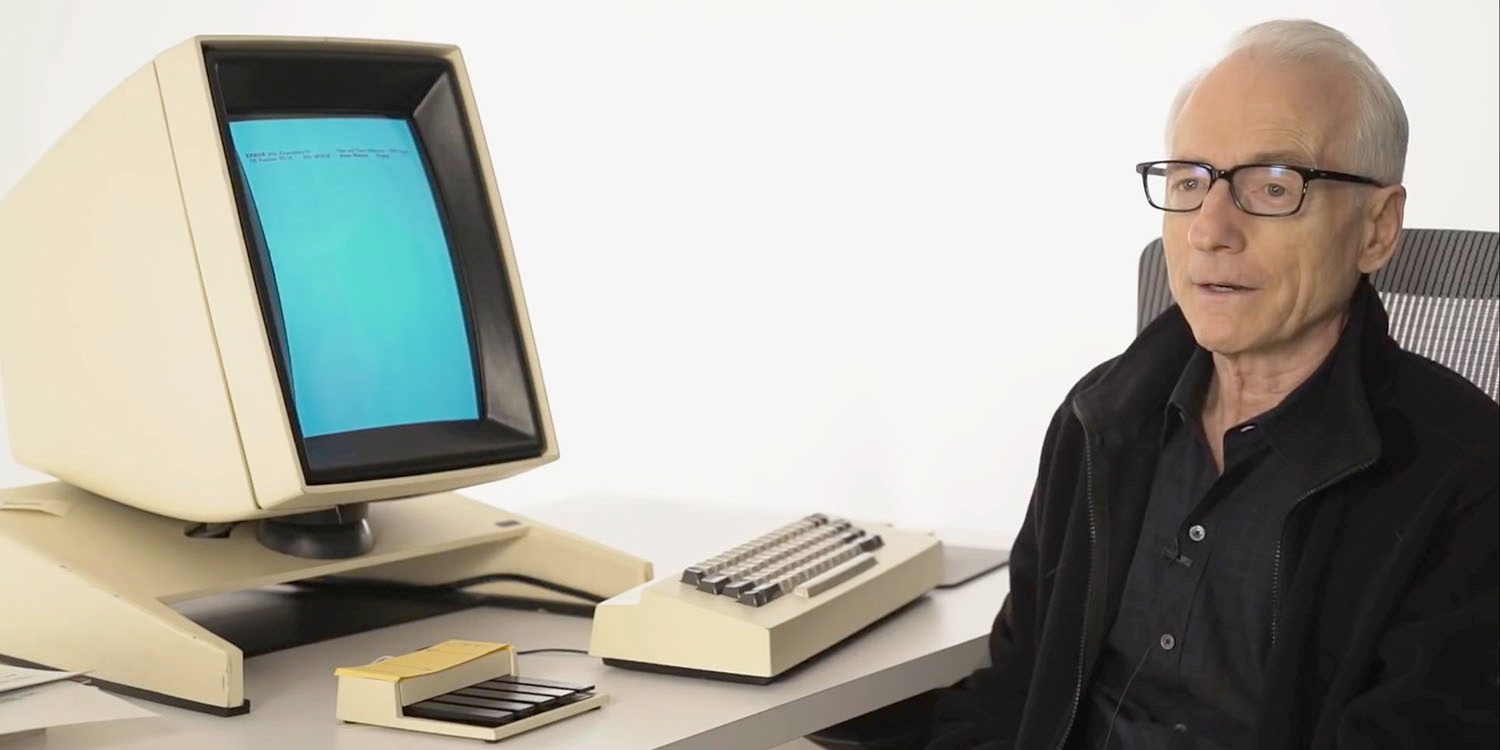
Larry Tesler, the Father of “Cut, Copy and Paste,” Dies At 74

0

“The inventor of cut/copy & paste, find & replace, and more, was former Xerox researcher Larry Tesler. Your workday is easier thanks to his revolutionary ideas.”

This tweet of Xerox confirmed the death of Larry Tesler and sent the world into mourning. Tesler  helped the computer world to get better with many of his inventions.

His vision for a work life made easier through machines started in the 60s, and he made an impact every computer user is grateful for before he bade the world goodbye.

Here is how Gizmodo told his story.

The advent of the personal computer wasn’t just about making these powerful machines available to everyone, it was also about making them accessible and usable, even for those lacking a computer science degree. Larry Tesler, who passed away on Monday, might not be a household name like Steve Jobs or Bill Gates, but his contributions to making computers and mobile devices easier to use are the highlight of a long career influencing modern computing.

Born in 1945 in New York, Tesler went on to study computer science at Stanford University, and after graduation he dabbled in artificial intelligence research (long before it became a deeply concerning tool) and became involved in the anti-war and anti-corporate monopoly movements, with companies like IBM as one of his deserving targets. In 1973 Tesler took a job at the Xerox Palo Alto Research Center (PARC) where he worked until 1980. Xerox PARC is famously known for developing the mouse-driven graphical user interface we now all take for granted, and during his time at the lab Tesler worked with Tim Mott to create a word processor called Gypsy that is best known for coining the terms “cut,” “copy,” and “paste” when it comes to commands for removing, duplicating, or repositioning chunks of text.

Xerox PARC is also well known for not capitalizing on the groundbreaking research it did in terms of personal computing, so in 1980 Tesler transitioned to Apple Computer where he worked until 1997. Over the years he held countless positions at the company including Vice President of AppleNet (Apple’s in-house local area networking system that was eventually canceled), and even served as Apple’s Chief Scientist, a position that at one time was held by Steve Wozniak, before eventually leaving the company.

In addition to his contributions to some of Apple’s most famous hardware, Tesler was also known for his efforts to make software and user interfaces more accessible. In addition to the now ubiquitous “cut,” “copy,” and “paste” terminologies, Tesler was also an advocate for an approach to UI design known as modeless computing, which is reflected in his personal website. In essence, it ensures that user actions remain consistent throughout an operating system’s various functions and apps. When they’ve opened a word processor, for instance, users now just automatically assume that hitting any of the alphanumeric keys on their keyboard will result in that character showing up on-screen at the cursor’s insertion point. But there was a time when word processors could be switched between multiple modes where typing on the keyboard would either add characters to a document or alternately allow functional commands to be entered.

There are still plenty of software applications where tools and functionality change depending on the mode they’re in (complex apps like Photoshop, for example, where various tools behave differently and perform very distinct functions) but for the most part modern operating systems like Apple’s macOS and Microsoft’s Windows have embraced user-friendliness through a less complicated modeless approach.

After leaving Apple in 1997, Tesler co-founded a company called Stagecast Software which developed applications that made it easier and more accessible for children to learn programming concepts. In 2001 he joined Amazon and eventually became the VP of Shopping Experience there, in 2005 he switched to Yahoo where he headed up that company’s user experience and design group, and then in 2008 he became a product fellow at 23andMe. According to his CV, Tesler left 23andMe in 2009 and from then on mostly focused on consulting work.

While there are undoubtedly countless other contributions Tesler made to modern computing as part of his work on teams at Xerox and Apple that may never come to light, his known contributions are immense. Tesler is one of the major reasons computer moved out of research centers and into homes.
Nigeria Close to Another Recession As the Excess Crude Account is Depleted to $70m

0
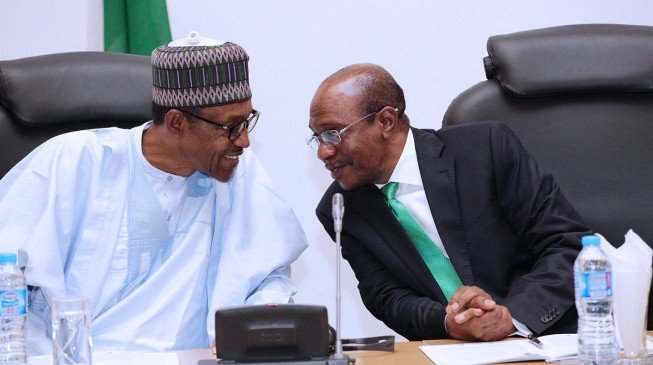
President and CBN boss

When President Obasanjo created the Excess Crude Account (ECA) in 2004, it was in a bid to save for the rainy days from the excesses of oil revenue. The idea was to remit excess of the budgeted benchmark into the account. By January 2009, the ECA was boasting of $20 billion and counting. There was hope that the status quo would be maintained, and in due time, Nigeria will have enough for many of its infrastructural projects.

It did not take long before the hope started getting pinched from stakeholders of the ECA, mainly, states and local governments. There was an incessant request for fund from the account in the name of many projects across the states and local government areas by governors. In 2012, the account was depleted of N2.07 trillion, a remarkable outflow that kicked off the push for even more.

Henceforth, the three tiers of government were struck with incessant needs for fund and there was no other source than the Excess Crude Account. The sum of N483 billion was used from the withdrawn N2.07 trillion by the federal government for fuel subsidy and N190.58 billion was transferred to a special intervention fund.

In 2013 fiscal year, N1.99 trillion was again withdrawn by the federal government. There were revenue shortfalls that needed to be augmented and about N1.08 trillion was used to fill the gap while N505 billion was used for subsidy payment and special intervention fund gulped N405.63 billion.

There was a surge in oil revenue during this period and the moral expectation was for an increase in the excess crude revenue too. But the withdrawal kept happening despite the increase in oil prices.

In 2014, the account was further depleted by N927.33 billion. Out of the amount, N400.23 billion was used to service fuel subsidy, N303.56 billion was doled out for revenue augmentation and N223.54 billion was sent to special intervention fund.

By 2015, the oil revenue was already dwindling and falling short of the budget benchmark, creating even a better alibi for the government to increase their visitation to the ECA. During this period, the government took N458.14 billion off the account. And once again, fuel subsidy took the lion share of the withdrawn sum – N359.39 billion, and the augmentation of revenue to the three tiers of government took N98.19 billion.

The government’s yearly visit to the account did not end in 2015. For the 2016 fiscal period, the government went again to withdraw the sum of N85.17 billion for the augmentation of revenue for the three tiers of government. Each year since 2012 had come with one responsibility or the other that requires the generosity of the Excess Crude Account.

In 2017, the sum of N76.25 billion was transferred to the Nigerian Investment Authority which was instituted to manage the Sovereign Wealth Fund where the surplus from oil revenue is invested on behalf of the government. Unfortunately, the establishment has been underfunded due to the use of excess crude funds for other issues by the three tiers of government.

2018 was another year of urgent national needs. The ECA suffered a huge withdrawal of $2.87 billion that was meant for so many governmental expenditures. $1.76 billion was used for the Paris Club refund to state governments. During the fiscal period, the sum of $496.37 million was also approved by President Muhammadu Buhari for the purchase of Super Tucano fighters from the United States.

Apart from these major expenses, two other significant transactions happened from the proceeds of the $2.87 billion. Presidential approval was given for the use of $380.51 million for the procurement of critical equipment for the Nigerian Army, Navy and Defence Intelligence Agency.

There was also approval for the use of $233.29 million for states matching grant to the Universal Basic Education Commission.

Though there were inflows from excess crude proceeds into the ECA during these times. A total of N2, 427.02 trillion went into the account during these six years. But it was notably deficient enough to expose the emaciation of the account. In August 2019, the balance of the Excess Crude Account stood for $274 million, and it was obvious the coming year would yield further depletion considering the downturn in oil prices and the lax revenue generation from other sources. Though there was a little increase of about $51 million between August 2019 and January 2020, it was preemptive to sustainability.

So it was not surprising when the Federation Account Allocation Committee (FAAC) announced on Wednesday that the strategic reserve account has been reduced to $71.814 million from $324.968 million recorded in January.

The Central Bank of Nigeria (CBN) has warned the fiscal authorities to build up buffers against revenue shocks by depositing more and withdrawing less from the rainy days account. But it is clear the government can’t keep its hands away from the reserved purse due to the current revenue challenges.

The federal and some state governments have been on borrowing spree for some time now, and they keep seeking for more funds, an indication that the non-oil revenue does not measure up to the expenditures. The Director General of Lagos Chamber of Commerce and Industry (LCCI) Dr. Muda Yusuf said it’s all evidence that the government of all levels in the country is broken.

“There is a strong temptation to draw down on the savings, which the excess crude account represents. One key factor is the weak oil prices.

“This naturally affects the fiscal stability of the various tiers and levels of government. These shocks would remain as long as we remain critically dependent on crude oil both for revenue and foreign exchange earnings.”

Apparently, the decline in oil prices pushed the government’s onslaught on the savings that was supposed to save the country in rainy days. The implication is likely going to instigate another recession and consequently, the devaluation of naira. The World Bank has warned that the depletion of the Excess Crude Account could easily plunge the economy into shock.

The former Executive Director of Keystone Bank, Richard Obire said that the depletion of the ECA and government’s desperate borrowing is a bad sign.

“We are still holding the exchange rate through the CBN’s weekly dollar interventions in the foreign exchange market. Today, with the level of buffer available to the economy, naira devaluation will be staring at us in the face.

“Remember we are not selling petrol at market prices due to subsidies enjoyed by the product and that has also put pressure on the fiscal side of the economy,” he said.

Experts believe that Nigeria’s economy is currently sitting on a keg of gunpowder, and if nothing is done quickly to diversify the economy and remove focus from oil, recession is going to hit Nigeria once again with unimaginable rate.

Electronic Waste Recycling in Nigeria

0

Are electronic waste recyclers in the informal sector aware of the health risks they are exposed to daily? This article answers the question. This article answers the question.

Discarded equipment such as phones, computers, refrigerators, televisions, other electrical electronics equipment (EEE) collectively referred to as electronic waste (e-waste) contain substances that are hazardous to health and environment if inadequately treated or improperly disposed of.   

Across the world, electronic or electrical devices have become indispensable in our daily lives. This growing importance and demand for electronic or electrical devices coupled with rising obsolescence due to rapid technological advancements and decreasing lifetime of EEE has led to an exponential increase in the volume of e-waste generated.  Globally, in 2017, about 45 million metric tonnes were generated, and an estimate of 52 million metric tons will be generated by 2021.  

Quantity of e-waste internally generated in Nigeria is increasing as more people use electrical electronics equipment(EEE). In Nigeria, many people own more than one information and communication technology (ICT) device such as mobile phones, computers, televisions, and other devices and their replacement cycles are becoming shorter, hence the large quantity of e-waste generated in Nigeria.

Informal work is defined as all economic activities by workers and economic units that are in law or in practice not or insuf?ciently covered by formal arrangements, i.e., beyond the reach of formal laws. Workers are casually employed, often by family members or are self-employed and do not have job security or bene?t from social protection. In addition, many of them are not aware of available protections or their legal rights. In Nigeria, the informal sector is vast and cuts across several different economic ?elds.

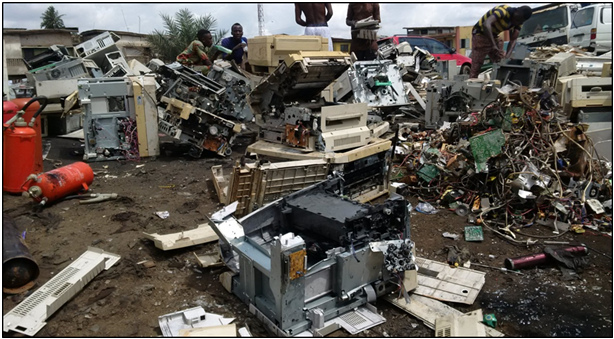
Informal e-waste recycling in Nigeria happens on a large scale by e-waste workers (scavengers, repairers, dismantlers, burners and scrap dealers). Nigeria imports the largest volume of new and used electronic and electrical equipment in Africa, being a hub for neighboring countries. About 50% of electronics used in Nigeria are imported as second-hand (used) electronics. In 2014, Nigeria generated 219 kilo tonnes. In 2016, the e-waste generated increased to 277 kilo tonnes, in 2017, it increased again to 290 kilo tonnes of electronic waste, a 170% increase from 2009, yet a lot of non-functional electronics also stockpiled in drawers in offices and homes, thus unaccounted for. A large and informal recycling sector disposes of an estimated 52,000 tonnes of brominated plastics, 4,000 tonnes of lead, 80 tonnes of cadmium and 0.3 tonnes of mercury are burned or dumped every year. An estimated additional 80,000 tonnes of plastics are burnt in the open, generating dioxins and furans.

Informal recycling involves labor-intensive manual dismantling, isolation of materials, open burning of plastics from electronics, heating of circuit boards, and the remaining are dumped at the open dumpsites or landfills.  These unsafe activities are carried out using crude methods to recover valuable materials without or with very little technology to minimize exposure to hazardous substances, thus allowing the emission of dangerous chemicals. Occupational safety and environmental protection are clearly not prioritized. These activities have negative impacts on the health of the workers and people (including pregnant women and children) around the e-waste recycling vicinity and on the environment, polluting the soil, air, dust, water, considering that 70% of water sources in Nigeria is from individual boreholes. The chemicals from the e-waste can also affect the plants and animals in the environment (soil and water). The chemicals can also bio-accumulate in the food chain and end up in fish, meat, eggs, and milk, potentially causing health problems for humans.

However, e-waste recycling is rapidly growing and has created (1) many employment and income opportunities; (2) affordable access to electronics and (3) parts used for repairs; (4) a continuous supply of raw materials to manufacturers; (5) conservation of natural resources and (6) conservation of energy required to manufacture new electronics from virgin resources.  The informal e-waste recycling is on-going because Nigeria lacks the infrastructure for e-waste recycling, there is a weak enforcement of the legislations, and people are not aware of the dangers associated with informal or unsafe recycling of e-waste.

Bearing in mind the consequences of unsafe e-waste recycling in Nigeria, we carried out a research to find answers to the following questions. Are the e-waste workers aware of these legislations and policies? Are e-waste workers aware of the dangers associated with their daily jobs? Do they know that their jobs affect their health and the environment as they struggle for livelihood for themselves and their families? Nigerians are happy people who also love quality life, but why are people engaged in jobs that are dangerous to their health? Are the workers exposed to adverse health risks?  Is the environment contaminated as a result of e-waste recycling?

 Our findings reveal that e-waste recycling in Nigeria is carried out in the informal sector in an unregulated and organized manner. A total of 279 e-waste workers were interviewed. They are mostly young men, with a mean age of 30±9 years. Most of them work for about 10 hours daily for 6 days a week. The work environment and conditions of the e-waste workers result in direct exposures to hazardous substances. informal workers often underestimate the health risks associated with their jobs. They are more concerned about making more money, and less about their health. There was a high injury prevalence of 38% in 1week. Despite the high occurrence of injury, 92% of the workers do not use any personal protective equipment (PPE) such as gloves, nose mask, boot, work cloths, helmet etc.

The main reasons for not using PPE were ‘perceived unimportant, discomfort, cost and unavailability.  The majority (88%) of e-waste workers are unaware that e-waste contains hazardous chemicals which could pose a risk to their health. The occupational Health risk awareness level of the e-waste workers were significantly lower compared with their counterparts in the same informal sector. Compared to their counterparts, the e-waste workers had poorer knowledge (88%), more negative attitudes (74%), and more unsafe practices (58%) regarding the potential health risks inherent in their jobs. Only 43% of e-waste workers could mention at least one PPE needed for their job. The majority (77%) of the e-waste workers did not know the likely illnesses they can contract as a result of their jobs and do not think that that substances they are exposed to at work can pose any health risk. In addition, they did not think that they can get ill from their jobs, but from other sources unrelated to their work or work environment.

How can this be changed?

What can we do differently to transform this situation?

Is it possible to end this problem without taking away the source of livelihood for several individuals in Nigeria?

Share your thoughts in the comment section.

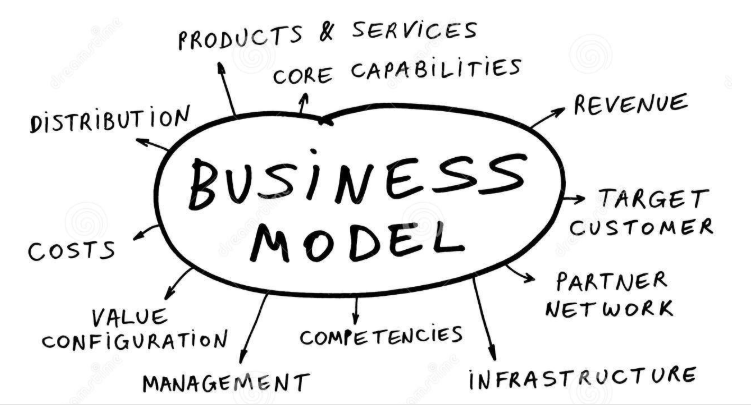
Business Model is The Central Nervous System of Business

0

Business model is the blood that enables the central nervous system of business to function. Just as the biological nervous system is made up of the brain and the spinal cord, business is built on purpose and structures to accomplish the purpose. Without the blood, the biological nervous system fatally breaks down; without a business model, a disconnection emerges between a business purpose and the resources earmarked to accomplish it.

Across markets and territories, the success of firms is entwined with their strategies, and business model is at the heart of any business strategy. If your business model is built on oscillatory pendulum and rollercoaster, with elements of guesswork everywhere, the forces of market will consume your purpose, denying you the momentum to overcome and fix the market friction – the very essence you are in business.

..writing Week 3 lecture materials of Tekedia Mini-MBA and this week bringing biology; we’ve done a lot of physics already! Join us today.

https://www.tekedia.com/mini-mba

Experts charge young entrepreneurs to seek knowledge on business development and management.

0

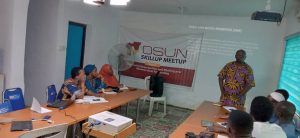
Two consultants in business and enterprise management, Lasisi Iyanda Mutiu and Dare Adeoye have charged young entrepreneurs in Osun to seek more knowledge and invest in personal development for the growth of their businesses. This advice was given in Osogbo on Saturday at the second edition of the Osun SkillUp MeetUp programme organized by the Skills, Business and Career Hub (SBC, Hub). The two professionals who are part of volunteer facilitators and mentors for the six-month business development programme said the business life should be approached scientifically rather than being built on assumptions.

Mr. Iyanda, while facilitating the first session on Creating and Reinventing Business Model towards Sustainable Value Capturing, emphasized paying attention to numbers or budgetary allocations from government on each sector. He reiterated the need for the young entrepreneurs to identify their business model in a bid to capture values for their business outfits. He posited that any business that will thrive must understand both qualitative and quantitative data that would reveal the business capabilities.  He then led the participants through the process of creating and reinventing business model for their individual businesses to capture sustainable values.

In his own presentation for the second session, Mr. Dare Adeoye, who spoke on Resource Mobilization for Small and Medium Scale Enterprises in Osun,  exposed the participants to how they could mobilize resources for their entrepreneurial activities. He identified different types of resources a business person should leverage on. He laid emphasis on both human and social capital and how they could practically utilize such to better the lot of their businesses. He charged the participants to be sensitive to policies that could make or mar their businesses. He said this would only happen if they are ready to open their minds to new and relevant knowledge.

The Osun SkillUp MeetUp is a six-month business development boot camp that intends to take the participants through the process of developing new or existing ideas into sustainable value capturing entities. The third edition comes up in March, 2020. The programme had 20 young business owners drawn from different parts of the state in attendance