DD
MM
YYYY

PAGES

DD
MM
YYYY

spot_img

PAGES

Home Blog Page 6496

How to Master Your Absence and Silence

0

With antecedents, a leader can master not only his absence but also his silence. This was the case when President Muhammadu Buharu was sworn in as the 15th Head of State of Nigeria. There was so much talk about his Body Language that abhors corruption and indiscipline. The memory of his War Against Indiscipline(WAI) during his military regime in the early 1980s made many, especially civil servants, rethink their ways.

This piece is motivated by Prof Prof Ndubuisi Ekekwe‘s Master Your Absence: how companies can become category kings. Writing from my personal experience on leadership, I share with you how a leader can master his absence and silence in becoming a category king in the art of leadership. The choice of subject matter is borne out of our major bane as a country and continent as a whole. Despite the black race starting well on leadership in the story of the Tower of Babel, we lost it.


“Man know thyself.”—Socrates


The simple meaning of this statement is that knowledge of oneself leads to a possible mastering of self and a development of self for the benefit of self, others, and the society at large. I have introspected and discovered that one of my gifts is leadership. Each person alive today has his own unique gifts and these gifts must be worked on to increase their value. Just like gold ore to pure gold. This makes me always lookout for opportunities to improve my leadership capacity knowing that there is a great demand for it in Nigeria.

My first experience of mastering my absence was during my National Youth Service year in 2014/2015 in Taraba State. The then LI (God rest his soul) , that is, Local Government Inspector (an NYSC official in charge of corps members in a local government) announced me as the next CLO, that is, Corps Liaison Officer (a corps member responsible for the welfare of his colleagues in the local government). I was surprised when one of my colleagues in my PPA (Place of Primary Assignment) told me that sometime ago a meeting was held to decide who the next Principal Corps Member, and CLO would be. In attendance were selected corps members, school principals, and the LI. They decided that ” ‘Corper Gani’ is bigger than a principal corps member, only the CLO is befitting for him.” A principal corps member is the person in charge of other corps members in the most populated school. I was humbled hearing his confession.

But how did this unanimous decision favoured me as the next CLO? My antecedents! You see, since I set my feet in Kurmi LGA, I hit the ground running. There were fundamental social dysfunctions especially with the youths. From changing the monthly CDS (Community Development Service) of monthly sanitation (an exercise with zero social impact) to weekly career guidance seminars for senior secondary school students from school to school, Ebola Seminar, free O Level tutorials anchored by corps members, provision of classroom amenities, in all classes in my PPA, proper selection and training of school prefects, etc. I built trust and demonstrated competence as a leader through influence and without my knowledge and in my absence, I was elevated as primus inter pares.

Here is another tale of how I mastered my silence and got an opportunity to serve. This happened in the Month of October, 2019. It was the third day of our training as new employees. We were twenty-three (23) trainees. One of the facilitators said it was time to choose the class governor. “If you have the ability and want to be the class governor, put up your hand”, he said. Immediately, a hand in the front seat was up and instead of herself she recommended me. The coordinator was surprised and asked, “Why didn’t you nominate yourself?” He has started it already, she answered. Then he asked the class who else is interested, but they all chorused, “We want Gani!”

That moment made goosebumps rupture all over my body. Yes, I wanted the role and was tempted to raise my hand but a voice within said, “If these folks appreciate what you have done, they will choose you.”

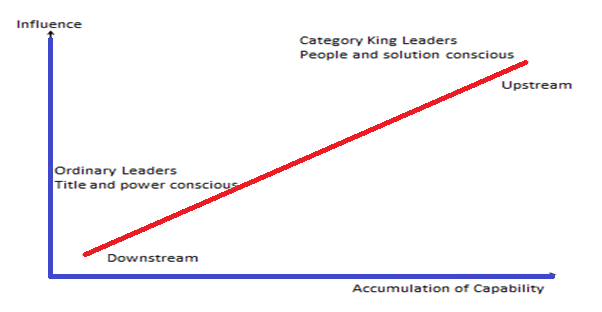
I planned to make this concise, I am sorry it’s long. I will conclude in the next two paragraphs. The diagram below depicts how a leader can become a category king in the art of leadership. The curve is positively sloped rising from left to right. The vertical axis measures a leader’s influence as he accumulates more capability on the horizontal axis. Leaders at the base of the curve, termed downstream, are title and privileges conscious while those at the upstream are people and solution conscious. To progress on this curve, a leader must nurture his abilities first by acquiring knowledge and skills and then seek or  create the opportunities to influence others towards an altruistic goal.
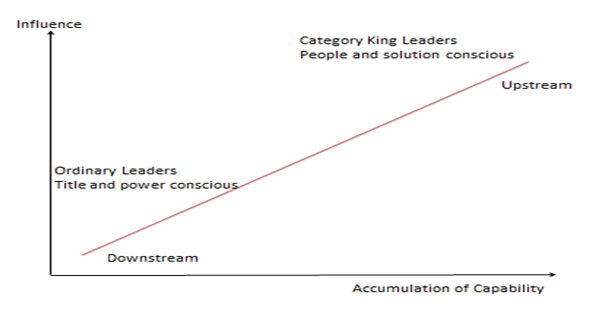
To be a category king leader, one must start as a leader without titles before men will seek you and give you a title. A leader limits his potential when he seeks and holds on to titles. For example, Tony Elumelu as the Managing Director and Chief Executive Officer of the United Bank for Africa had a limited leadership influence. He only thrived in the banking sector. Thanks to Sanusi Lamido Sanusi, the then Central Bank of Nigeria Governor who gave him wings by putting a limit to the tenure of commercial banks chiefs. Now Tony Elumelu through the Tony Elumelu Entrepreneurial Fund, TEEP, is now adjudged a global leader.

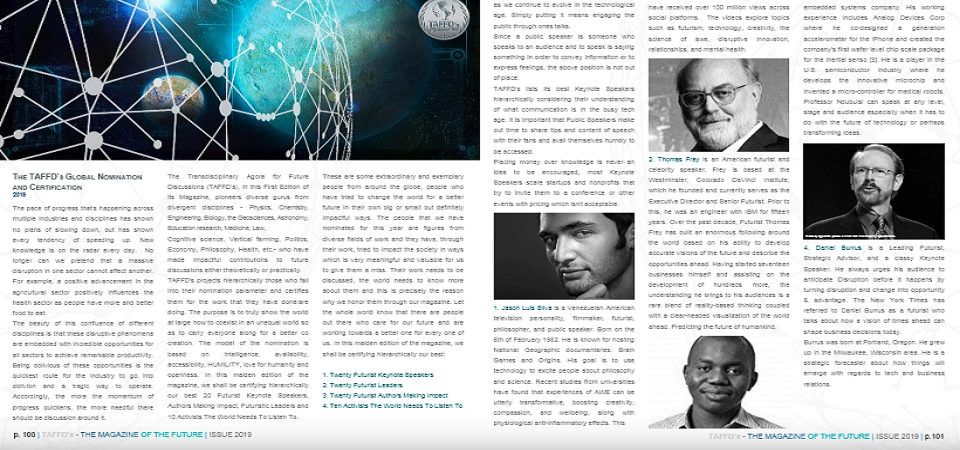
Another category king leader worth mentioning is Prof Ndubuisi Ekekwe who recently proved this principle by being honored as one of the 20 Best Futurist Keynote Speakers 2019 by TAFFD USA.

Leadership is influence, practical love for the people, passion and competence in your field of endeavor. There are lots of problems in Nigeria that will make anyone a celebrity. So, do you want to be a senator, governor, or president? Start by solving your neighborhood problems and when the time comes, the people will choose you. However, you don’t become a practical leader on social media, you can get the know-how, knowledge and inspiration from, say, LinkedIn but you must go out and work.

Don’t seek titles, seek courage!
Our Words Become Our Reality. Rebuilding Nigeria.

8

Imagine how beautiful Nigeria would be if everyone works and earns his words before he can speak the way a worker earns before spending. And immediately we speak, we get the reward whether good or bad. Put differently, what if speech is not a natural ability and free, but something bought in the market according to our different purchasing power?

Would we waste it on curses and insults? Would we convert it to hate speech? Would we use it to blaspheme? Would we use it for gossip? Would we use it for destructive criticism? No! We will speak only when necessary and after a long reflection on the effects.

However, the reality is that, speech is a free gift and an inalienable right of every man. It is the most significant creative (and destructive too) force in the world since creation. No one can deny that spoken and written words have power. Things happen when certain words are either spoken or written. Both curses and blessings take effect when pronounced either immediately or later. By this, it is apparent that there are always two opposing forces, negative and positive, keen to bring to reality spoken words.

I believe you reading this can remember some events of how your words and those of others have influenced your life. I will share with you two of my own before I address how we have destroyed Nigeria with our careless words and also how we can rebuild her, for we have no other country if we set her on fire.

Back in my secondary (high) school days, I had an Economics Teacher (May his soul rest in peace) who often made mockery of his aged mother in-law in his classes just to amuse us and win our affection. He would mimic how she talks, walks, and eats. Then he would say he didn’t want to live that long and look stupid. I was in my second year in the university when I heard of his sudden death at the age of 50. I was not moved because his words became his reality.

My second experience of the power of words is this. One morning I called the office and reported sick. It was a lie because I wanted that day work free to attend to a personal concern. My boss and my colleagues all called to wish me well. I acted so sick that I was awed by my pretense. Despite my instantaneous penitence, before noon of the same day, the exact ailment I lied about afflicted me. It was so terrible and lasted for three weeks. I suffered in silence going to work every day.

Back to my purpose for writing. The youths are said to be the leaders of tomorrow, but when the youths fail to understand that tomorrow is a function of their spoken words, they make nonsense the words of the elders. Four years ago, two of my colleagues came to meet me aside just after we had the morning devotion before work started. They said I was funny and naive. Why do I always pray for Nigeria every time I am asked to pray, they quizzed me. “How can you be praying for a useless country? A country that will soon divide. A country that has no future for the youths. A country with selfish leaders. A country led by c*ws…?” This, unfortunately, is the mindset of many Nigerian youths.

My response was, “Your parents met themselves and got married in this country. You were born and bred up in this country. You work and earn a living in this country. One of you is married with children in this country, and you also are planning and living out your destiny in this country. If your ancestors had cursed this land the way you are cursing it for your children, what would have been your fate? It is true that our leaders have failed us; must we beat them at this?.

I continued. “Our founding fathers, patriots like Herbert Macaulay, Nnamdi Azikiwe, Obafemi Awolowo, Aminu Kano, and the rest worked and bequeathed this land to us, their children. What will we leave for our children? A divided country on fault lines? Would our children say,”There Was a Country?”

In summary, my fellow compatriots, have we not doubted our unity and cursed our future enough? How long should our words be our swords? Where has it led us to? Is a garden not beautiful, nature not abundant, and the world not unique by diversity? It is said that only fools keep doing (or say) the same thing and expect different results. Let us be wise and start rebuilding Nigeria today with choice words and actions.

I love you as you are.

God bless Nigeria!

The African Development Bank Responds To World Bank’s President on Comment

1

The African Development Bank (AfDB) which I hope empties its vault to help develop Africa rebuts World Bank whose president dropped those unfortunate lines: you have a tendency to lend too quickly and in the process, add to the continent’s debt problems. The World Bank president is wrong and he should be told that: AfDB is not adding to any problem.

Africa needs to incur debts over the next two decades to have any chance of advancement because its tax credits are so small to organically fund developments.  Largely, the problem is not the debt BUT what the politicians do with the borrowed money. World Bank should focus on that second part, helping to ensure there is an improved governance.

We appreciate the World Bank; it wrote a cheque of US $20.2 billion for Africa in 2018. But that is nothing and at that rate, nothing will happen. Dangote raised close to $15 billion only for his empire a few years earlier. Time has come for respect and I expect the World Bank president to show that:AfDB is as important as the World Bank on this mission of developing Africa, and should be respected as it runs its own playbook!

The press release…

ABIDJAN, Ivory Coast, February 13, 2020/ — In several news reports, World Bank President David Malpass was recently quoted as saying some Multilateral Development Banks, including the African Development Bank (https://www.AfDB.org), have a tendency to lend too quickly and in the process, add to the continent’s debt problems.

Download Document: http://bit.ly/3btFgKW

This statement is inaccurate and not fact based. It impugns the integrity of the African Development Bank, undermines our governance systems, and incorrectly insinuates that we operate under different standards from the World Bank. The very notion goes against the spirit of multilateralism and our collaborative work.

For the record, the African Development Bank maintains a very high global standard of transparency. In the 2018 Publish What You Fund report, our institution was ranked the 4th most transparent institution, globally.

The African Development Bank provides a strong governance program for our regional member countries that focuses on public financial management, better and transparent natural resources management, sustainable and transparent debt management and domestic resource mobilization. We have spearheaded the issuance of local currency financing to several countries to mitigate the impacts of foreign exchange risks, while supporting countries to improve tax collection and tax administration, and leveraging pension funds and sovereign wealth funds to direct more monies into financing development programs, especially infrastructure.

The African Development Bank’s Africa Legal Support Facility (ALSF) supports countries to negotiate terms of their royalties and taxes to international companies, and terms of their non-concessional loans to some bilateral financiers. We have been highly successful in doing so.

These are the facts:

The World Bank, with a more substantial balance sheet, has significantly larger operations in Africa than the African Development Bank. The World Bank’s operations approved for Africa in the 2018 fiscal year amounted to US $20.2 billion, compared to US $10.1 billion by the African Development Bank.

With regard to Nigeria and South Africa, the World Bank’s outstanding loans for the 2018 fiscal year to both countries stood at US $8.3 billion and US $2.4 billion, respectively. In contrast, the outstanding amounts for the African Development Bank Group to Nigeria and South Africa were US $2.1 billion and US $2.0 billion, respectively, for the same fiscal year.

With reference to the countries described as “heavily indebted,” our Bank recognizes and closely monitors the upward debt trend. However, there is no systemic risk of debt distress.

According to the 2020 African Economic Outlook, at the end of June 2019, total public debt in Nigeria amounted to $83.9 billion, 14.6% higher than the year before. That debt represented 20.1% of GDP, up from 17.5% in 2018. Of the total public debt, domestic public debt amounted to $56.7 billion while external public debt was $27.2 billion (representing 32.4% of total public debt). South Africa’s national government debt was estimated at 55.6% of GDP in 2019, up from 52.7% in 2018. South Africa raises most of its funding domestically, with external public debt accounting for only 6.3% of the country’s GDP.

Development Banks continue to play critical roles in development efforts and in the aspirations of developing countries, most especially in Africa.

Given substantial financing needs on the African continent, the development assistance of the African Development Bank, the World Bank and other development partners remain vitally important, with increasing calls for such institutions to do even more.

The lending, policy, and advisory services of these development institutions in their respective regions are often coordinated and provide substantially better value-for-money to developing nations, compared to other sources of financing. As a result of the African Development Bank’s AAA-rated status, we source funding on highly competitive terms and pass on favorable terms to our regional member countries. Combined with other measures to ensure funds are used for intended purposes, it helps regional member countries finance debt and development in the most responsible and sustainable way.

With regard to the need for better lending coordination and the maintenance of high standards of transparency, the African Development Bank coordinates lending activities, especially its public sector policy-based loans, closely with sister International Financial Institutions (notably the World Bank and the IMF). This includes reliance on the IMF and World Bank’s Debt Sustainability Analyses (DSA) to determine the composition of our financial assistance to low-income countries; and joint institutional approaches for addressing debt vulnerabilities in the African Development Fund (ADF) and International Development Association (IDA) countries.

In addition, country economists of the African Development Bank fully participate in regional and country level IMF Article 4 missions. Contrary to suggestions, these are just a few concrete examples of historic and ongoing coordination between sister Multilateral Development Banks, IFIs, and development partners. The African Development Bank is committed to the development of the African continent. It has a vested interest in closely monitoring debt drivers and trends in African countries as it supports them in their efforts to improve the lives of the people of Africa.

We are of the view that the World Bank could have explored other available platforms to discuss debt concerns among Multilateral Development Banks. The general statement by the President of the World Bank Group insinuating that the African Development Bank contributes to Africa’s debt problem and that it has lower standards of lending is simply put: misleading and inaccurate.

TAFFD USA Honours Ndubuisi Ekekwe Among 20 Best Futurist Keynote Speakers 2019

11

The day I heard that Goldman Sachs paid Hillary Clinton $675k for a speech, I froze. But as small people, we have been climbing in this industry in America and beyond,  where thinkers are asked to inspire people by x-raying the future. Even with my Nigerian accent (working harder to keep it), the calls keep coming. Today, the highly respected Transdisciplinary Agora for Future Discussions, Inc (TAFFD), Georgia, USA selected me as one of the 20 Best Futurist Keynote Speakers 2019. I also got into their 120-page magazine. From their email informing me.

Congratulations for being certified as one of the TAFFD’s Twenty Best Futurist Keynote Speakers for 2019. Your bio and picture form part of the TAFFD’s Magazine available at – https://amp.issuu.com/visual-stories/dnk47FPTHQH or https://issuu.com/taffds/docs/taffd_s_magazine_2019. The nomination is hierarchical and our parameter brought you in as one of the best and outstanding  keynote speakers.

Great moments ahead – thank you TAFFD.

The Causes of High Poverty Rate in Northern Nigeria

2

In 2018, the World Poverty Clock estimated that about 90.8 million Nigerians live below the poverty level. That report earned Nigeria the title, “The Poverty Capital of the World”, that didn’t go down well with many Nigerians. But more light has been thrown into the report of the World Poverty Clock by the World Bank through its recently released report on the poverty rate in Nigeria.

The World Bank report, titled “Advancing Social Protection in a Dynamic Nigeria”, was based on a research conducted in Nigeria from 2011 to 2016, but it was published on 28th January, 2020. This report stated that there is geographical inequality in Nigeria because poverty is mostly concentrated in the North and in rural areas.

The reports states, “Nigeria experiences high inequality along geographical lines, with poverty mostly concentrated in the North and in rural areas.” To buttress its point, this report expresses that, “poverty in the northern region of the country has been increasing, especially in the North-West zone. Almost half of all the poor lived in the North-West and the North accounts for 87% of all the poor in the country in 2016.”

One couldn’t help but wonder why there should be such “inequality” in the poverty stratification in the country when one considers that northern part of the country is duly represented in every arm of government, federal allocations, endowments by natural resources and federal government employments. One thing everybody is sure of in this country is that no northern state is marginalised in any way. So the big question remains, “Why should the North-West be the poverty capital of Nigeria?”

Of course, the report said that northern Nigeria experiences a high rate of poverty, so North-West is not the only affected zone.

In its bid to identify the causes of poverty in the country, the World Bank reports placed blame on insurgency, conflicts, poor education system, poor infrastructure and social service delivery. To buttress this, the following excerpts are culled from the report:

  • Insurgency and Conflict as Causes

“Disasters and conflict have displaced many Nigerians, especially in the North-East. According to estimates provided by the International Displacement Monitoring Centre, there were more than two million internally displaced persons in Nigeria on 31 December, 2018.”

  • Poor Social Service Delivery as a Cause

“Social protection measures in the country are neither well-suited to respond to conflict, nor well-placed to anticipate and mitigate the risks of natural disasters caused by climate change.”

  • Poor Infrastructure as a Cause

“Poverty remains high in Nigeria due to its dire social service delivery and lack of basic infrastructures.”

  • Poor Education System as a Cause

“Nigeria has the highest number of out-of-school children of primary school age in the world with nine million children out of school.”

  • Poor Healthcare Delivery as a Cause

“There has been little change in vaccination rates over the last 25 years and Nigeria is set to overtake India as the country with most under-five deaths in the world.”

Note that the above-mentioned factors are given as the causes of poverty in Nigeria. This means that these factors affect every part of the country. But somehow, only the northern part feels the impact the more.

There is something in the report that might truly point to the major culprit. The report states, “Regionally, the North lags far behind the South in every HUMAN CAPITAL outcome.”

It is good that the World Bank realises that despite bad governance, some people from some parts of the country have been able to develop themselves and pull out of poverty. If you ask me, I will say that this is what the Northerners are yet to embrace.

Professionalism and innovations are rare in northern Nigeria. Don’t get me wrong, we have professionals from the North but there are not many. Before, I thought that the overly relaxed attitudes of the northerners towards career pursuits and self development was a result of their religion. But then, I met Yoruba Muslims and found out that religion has nothing to do with this at all. From my experiences with some of the northerners, I think the underlying causes of this include:

A different kind of mindset.

It was in the north that I found people that believe that poverty and wealth come from predestination. The poor are content with their poverty and wouldn’t want it any other way. They don’t struggle to climb even a rung up the ladder of social mobility. To them, they are where they were meant to be. This makes me wonder if the World Bank considered these people’s way of life as they carried out this research.

Talking about mindset also brings up the issue of almajiri in the north. Unless the mindset of these people is reformed, almajiri will not stop in the nearest future.

Information Underload

This might not go down well with the Northern leaders, but they need to hear this. A lot of northerners are deprived of important and life-changing information. The World Bank report talked of Nigeria not capturing a lot of young children through vaccination, but it failed to say that vaccination is hard to administer in the North because the northerners rejected it due to misinformation and information underload.

Information underload is also the reason out-of-school children are more in the north. A lot of them do not see the need to go to school; they will rather go to Islamia schools, which is only there to uplift their spiritual lives and not their social or financial well-being. Some parents believe that regular schools teach Western education and religion, and so keep their children away from them.

Let’s be honest here, most of the people living in rural areas in northern Nigeria are ignorant. Worst is they have no one to ask. Those that are curious may end up asking the wrong people that will pass on worse information to them. By the end of the day, poverty continues to permeate deep into them.

Waiting on the Government for Everything

I think this is something the northerners need to learn from the South-Easterners and South-Westerners. Depending on the government to provide everything, including employment, is also the bane of the North. For instance, an Igbo man knows he has to develop himself, build his house, construct the road that goes into his house, supply his electricity and water, and so on. He waits for no government to give him a source of living; he has to develop himself in order to become employable in the competitive world. He has to make life comfortable and easy for him. This attitude and ideology is quite foreign to Nigerian northerners, who wait for the government to do most of the things for them.

Anyway, as I stated earlier, I don’t think the World Bank considered people’s ways of life before ascertaining which zone is the poverty capital of Nigeria (because ‘poverty’ still remains a relative term). The people that are considered poor in this report may be content with what they have. However, the northern leaders can improve the living standard of their people by working on their mindsets, giving them access to important information and eradicating insurgency.