DD
MM
YYYY

PAGES

DD
MM
YYYY

spot_img

PAGES

Home Blog Page 652

Ozak AI Surpasses $2.28M Amid $4T Bull Market—Price Predictions vs Top Altcoins in 2025

0

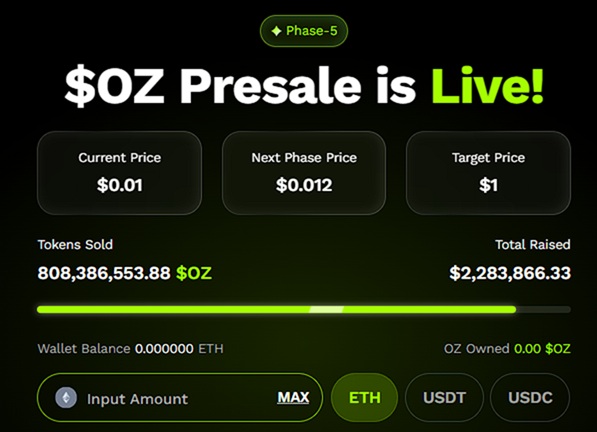
Ozak AI is swiftly gaining a reputation as one of the most promising AI-powered cryptocurrency projects in 2025. With the continued fifth presale level, the mission has effectively raised over $2.28 million and bought more than 800 million $OZ tokens, demonstrating strong network guidance and investor self-assurance.

Completing each Certik and internal audit and listing on CoinGecko and CoinMarketCap, Ozak AI has solidified its credibility, positioning itself as a contender capable of tough pinnacle altcoins, which include Ethereum ($4,344), Solana ($185), Cardano ($0.85), and XRP ($2.81).

Ozak AI Presale Momentum Highlights Growth Potential

The ongoing 5th presale has proven extraordinary investor interest, with investors taking benefit of a low access point. Raising over $2.28 million at this level displays sturdy confidence in Ozak AI’s potential, mainly because the wider crypto marketplace enjoys a $4 trillion bull run. Early adoption and presale momentum frequently predict future overall market performance, making Ozak AI a high-upside opportunity for buyers in search of exponential growth.

Comparing Ozak AI With Top Altcoins

While installed cryptocurrencies like Bitcoin ($113,045.72), Ethereum ($4,344), and Solana ($185) provide market balance and liquidity, their increase capability is constrained through excessive circulating components and market saturation. XRP ($2.81) and Cardano ($0.85) also face limitations because of adoption charges and demanding scalability situations.

Ozak AI, priced at $0.01 per token, gives early buyers the capability for 100x–200x returns, combining low entry cost with excessive utility. Its AI-powered functions, which encompass actual-time buying and selling insights, predictive analytics, and automatic choice-making, make it more than a speculative asset, setting it apart from other altcoins with confined functional use.
AI Integration: The Next Frontier

Artificial intelligence is remodeling crypto trading and blockchain innovation. Ozak AI leverages AI to offer rapid, statistics-driven marketplace signals, allowing customers to make knowledgeable selections and execute trades with unparalleled pace. This integration no longer handily adds tangible application but also aligns with the growing demand for intelligent, self-reliant structures in decentralized finance. By combining blockchain with AI, Ozak AI stands on the intersection of high-boom generation sectors.

Price Predictions and Upside Potential

While analysts predict Ethereum could reach $8,000 and Solana $500 in the coming months, Ozak AI’s early-stage pricing offers potentially larger relative gains. A $1 target for Ozak AI would represent a 100x return from its current $0.01 presale price, making it an attractive option for investors seeking high ROI while diversifying beyond traditional layer-1 holdings.

Credibility and Security

Ozak AI’s commitment to transparency is evident through its Certik and internal audits. Security is a critical consideration in crypto investing, and Ozak AI’s audits ensure that both token mechanics and smart contracts are thoroughly vetted.

Additionally, listings on CoinGecko and CoinMarketCap provide investors with reliable metrics for tracking market performance and liquidity. These factors enhance investor confidence and establish Ozak AI as a credible choice in the crowded altcoin market.

Crypto Market Implications

The combination of AI integration, robust presale traction, and a $4 trillion bull market backdrop positions Ozak AI as a high-ability altcoin in 2025. Investors looking to diversify beyond Bitcoin and Ethereum may want to find Ozak AI specifically compelling due to its early-stage upside and application-driven version. While setup altcoins offer balance, Ozak AI offers the risk for oversized returns, mainly for the ones coming in for the duration of the presale stages.

For investors searching for high-growth possibilities, Ozak AI represents a completely unique combo of credibility, innovation, and early traction. The venture’s low presale price, strong network aid, AI-powered functionality, and legitimate audits make it a standout option in 2025’s crypto market. It enhances investments in top altcoins at the same time as providing publicity to the rising AI-driven crypto area.

Ozak AI has demonstrated itself as a top project for 2025 with over $2.28 million raised, 800 million tokens sold, and strong credibility through audits and listings. Positioned amid a $4 trillion bull marketplace, the challenge gives good-sized upside potential as opposed to mounted cryptocurrencies like Bitcoin, Ethereum, Solana, Cardano, and XRP. For traders seeking to integrate innovation, transparency, and high ROI capability, Ozak AI is a presale opportunity that can’t be left out.


 About Ozak AI

 Ozak AI is a blockchain-based crypto project that provides an innovative platform that focuses on predictive AI and advanced data analytics for financial markets. Through machine learning algorithms and decentralized community technologies, Ozak AI enables real-time, accurate, and actionable insights to help crypto lovers and corporations make the perfect choices.


For more, visit

Website: https://ozak.ai/

Telegram: https://t.me/OzakAGI

Twitter: https://x.com/ozakagi
Trump Downplays TikTok Security Concerns, Says He Will Extend Deadline Again

0

President Donald Trump on Friday dismissed national security and privacy concerns surrounding TikTok and its Chinese parent company, ByteDance, as “highly overrated,” while confirming he will once again extend the deadline for the popular video-sharing platform to find a U.S. buyer.

Congress had earlier approved a law banning TikTok unless ByteDance sold its controlling stake, citing fears that the Chinese government could access the data of millions of American users. The Supreme Court upheld the legislation, setting the stage for what many expected would be a permanent ban. Yet since returning to office, Trump has granted three extensions — the latest deadline now set for September 17.

“We’re gonna watch the security concerns,” Trump told reporters, but quickly added, “We have buyers, American buyers. Until the complexity of things work out, we just extend a little bit longer.”

The first extension came on January 20, Trump’s first day back in office, after TikTok briefly went dark when the Supreme Court-backed ban initially took effect. A second extension followed in April, when a proposed deal to spin off TikTok into a new U.S.-owned company collapsed after Beijing balked in response to Trump’s new tariff announcements.

The president’s remarks came the same week the White House launched its own official TikTok account — a move that underlined the platform’s entrenched popularity in American culture.

“I used TikTok in the campaign,” Trump said. “I’m a fan of TikTok. My kids like TikTok. Young people love TikTok. If we could keep it going.”

The extensions have cast growing doubt on whether TikTok will ever actually be banned in the United States. While Trump’s decision has faced scrutiny in policy circles, his executive orders to keep the app alive have so far avoided the legal battles that have dogged many of his other directives.

Under the divest-or-ban statute, Congress set a finite compliance window for ByteDance to sell TikTok to a U.S. buyer. While the law gives the executive branch latitude to manage implementation and, in limited circumstances, to delay enforcement to facilitate an orderly sale or mitigation measures, there is legal concern about the legality of further extension. Repeated delays risk being portrayed as effectively nullifying Congress’s mandate if they run beyond the statute’s allowances or stated purpose.

If another extension pushes the timeline materially past statutory limits without concrete sale progress, it could be seen as exceeding executive authority or frustrating congressional intent; though the Justice Department would likely argue the delays fall within lawful enforcement discretion to protect national security while a divestiture is negotiated.

However, public opinion on TikTok remains sharply divided. A recent Pew Research Center survey found that support for a ban has declined, with only about one-third of Americans in favor, compared with 50 percent in March 2023. Another third said they opposed a ban, while the remainder expressed uncertainty.

Among those who favor a ban, nearly 8 in 10 cited concerns over user data security and the risk of Chinese government access. Yet the declining support reflects TikTok’s enduring popularity, particularly among younger Americans, and the difficulty of disentangling a social platform that has become deeply embedded in U.S. political, cultural, and business life.

The battle over TikTok has become one of the most symbolic confrontations in the broader tech and geopolitical struggle between Washington and Beijing. What once seemed like an imminent ban is now being reshaped by Trump’s own political calculation, the app’s massive user base, and China’s resistance to selling one of its most successful global tech exports.

TikTok Cuts Hundreds of UK Moderation Jobs Amid Shift to AI-based Automation

0
The brand is growing

TikTok has put hundreds of UK content moderators’ jobs at risk, even as tighter rules come into effect to stop the spread of harmful material online.

The viral video app said several hundred jobs in its trust and safety team could be affected in the UK, as well as South and South-East Asia, as part of a global reorganization. Their work will be reallocated to other European offices and third-party providers, with some trust and safety jobs remaining in the UK, the company said.

It is part of a wider move at TikTok to rely more heavily on artificial intelligence for moderation. The company said that more than 85% of the content removed for violating its community guidelines is already identified and taken down by automation.

The timing of the cuts has heightened scrutiny, as they come despite the recent introduction of new UK online safety rules, which require companies to introduce age checks on users attempting to view potentially harmful content. Under the Online Safety Act, companies can be fined up to £18 million or 10% of their global turnover for breaches, whichever is greater.

John Chadfield of the Communication Workers Union warned that replacing workers with AI in content moderation could put the safety of millions of TikTok users at risk.

“TikTok workers have long been sounding the alarm over the real-world costs of cutting human moderation teams in favor of hastily developed, immature AI alternatives,” he said.

TikTok, which Chinese tech group ByteDance owns, employs more than 2,500 staff in the UK. But over the past year, the company has been systematically cutting trust and safety staff across the world, often substituting human workers with automated systems. In September, it fired its entire team of 300 content moderators in the Netherlands. A month later, it announced plans to replace about 500 content moderation employees in Malaysia as part of its AI shift. Last week, TikTok workers in Germany held strikes over layoffs in its trust and safety team.

Despite the turmoil behind the scenes, business at TikTok is booming. Accounts filed to Companies House this week, covering its UK and European operations, showed revenues rose 38% to $6.3 billion (£4.7bn) in 2024 compared with the year prior. Its operating loss narrowed sharply from $1.4 billion in 2023 to $485 million, signaling a path to profitability.

A TikTok spokesperson defended the restructuring, saying: “We are continuing a reorganization that we started last year to strengthen our global operating model for trust and safety, which includes concentrating our operations in fewer locations globally to ensure that we maximize effectiveness and speed as we evolve this critical function for the company with the benefit of technological advancements.”

Comparisons with Other Platforms

TikTok’s pivot toward AI mirrors a wider trend across the tech industry, where rival platforms such as Meta, X (formerly Twitter), and YouTube have leaned heavily on automated systems to flag and remove harmful material.

Meta, which runs Facebook and Instagram, has long promoted its reliance on machine learning to detect hate speech and misinformation. Yet the company has faced repeated public backlash when violent livestreams, extremist propaganda, or harmful conspiracy content slipped through its filters. After the Christchurch mosque attack in 2019, Facebook came under fire when automated moderation failed to stop the livestream from spreading widely.

YouTube has also faced criticism for similar failures. While it boasts that the majority of harmful content is taken down by automation, researchers and advocacy groups have documented cases where extremist videos, disinformation, and child exploitation material circulated on the platform for months before being removed.

X, under Elon Musk’s leadership, has slashed human moderation teams while leaning more heavily on automation and community flagging through the “Community Notes” system. The move has attracted criticism from regulators in Europe, who say hate speech and harmful disinformation have surged since Musk’s cuts. The EU has already issued warnings under its new Digital Services Act, which carries steep penalties for non-compliance.

Experts warn that TikTok could face similar fallout. While AI can process billions of pieces of content far faster than human moderators, it struggles with nuance, context, and cultural sensitivity — areas where human judgment remains crucial.

The UK’s Online Safety Act places new and significant responsibility on tech companies to keep users safe, particularly children. Fines under the law can run into billions of pounds for a platform of TikTok’s size. TikTok risks sending a message that efficiency and cost-cutting outweigh safety concerns by cutting moderation staff at the very moment regulators are tightening oversight.

Ming Shing Group 4,250 Bitcoin Acquisition is a High-Stakes Diversification Strategy

0

Hong Kong-based Ming Shing Group Holdings Limited, a Nasdaq-listed construction company specializing in wet trades, has announced a $483 million deal to acquire 4,250 Bitcoin (BTC) at an average price of $113,638 per BTC.

The transaction, set to close by December 31, 2025, will be financed through convertible promissory notes and stock warrants, not cash. The deal involves two British Virgin Islands-based firms: Winning Mission Group, selling the BTC, and Rich Plenty Investment, which will receive half the transaction value.

Each will get a $241.48 million convertible note (3% interest, 10-year maturity, convertible at $1.20/share) and warrants for 201.23 million shares (exercisable at $1.25/share over 12 years), with a 4.99% ownership cap.

If completed, this would make Ming Shing Hong Kong’s largest corporate Bitcoin holder, surpassing Buyaa Interactive’s 3,350 BTC, and the 16th-largest globally with 5,083 BTC (including prior purchases of 500 BTC in January and 333 BTC each in February and March 2025).

CEO Wenjin Li cited Bitcoin’s liquidity and potential appreciation as key reasons, aiming to diversify the company’s assets amid financial strain (negative 3.9% profit margin, $5.35 million loss in 2025). The deal could significantly dilute shareholders, with shares potentially rising from 13 million to 415 million (3.1% current ownership) or 939 million (1.4% ownership) if all notes and warrants are exercised, requiring shareholder approval for additional shares.

The stock surged 29% to $2.15 after the announcement but closed at $1.65, up 11.5%, though it’s down 70.5% year-over-year. This move aligns with Hong Kong’s push to become a crypto hub, with recent approvals for Bitcoin and Ether ETFs and the ASPIRe regulatory framework.

The deal’s structure, using convertible notes and warrants, could increase outstanding shares from 13 million to potentially 939 million if fully exercised, diluting existing shareholders’ ownership to as low as 1.4%. This requires shareholder approval, which may face resistance due to the scale of dilution.

While CEO Wenjin Li emphasized Bitcoin’s liquidity, tying up $483 million in a volatile asset may strain cash flow for Ming Shing’s core construction operations, especially given its small $9.6 million market cap. By allocating nearly 50 times its market cap to BTC, Ming Shing is pivoting from its core wet trades business to a crypto-heavy investment strategy.

The move aligns with Hong Kong’s pro-crypto policies (e.g., Bitcoin/Ether ETFs, ASPIRe framework), positioning Ming Shing as a leader in the city’s emerging crypto economy. Holding 5,083 BTC would make it Hong Kong’s largest corporate Bitcoin holder, enhancing its visibility.

The acquisition could attract speculative investors, as seen in the 29% intraday stock surge, though the year-over-year 70.5% decline suggests sustained market skepticism. Ming Shing’s move could inspire other small-cap firms in Hong Kong and beyond to allocate to Bitcoin, especially as institutional adoption grows (e.g., MicroStrategy, Tesla).

Hong Kong’s Securities and Futures Commission may scrutinize the deal due to its size relative to Ming Shing’s market cap and the complex financing structure. Shareholder approval and compliance with Nasdaq listing rules will be critical.

The acquisition of 4,250 BTC represents ~0.02% of Bitcoin’s circulating supply (~19.7 million BTC). While not massive, it could contribute to bullish sentiment, especially if other firms follow suit. Bitcoin’s price would need to nearly double to justify the $113,638 per BTC cost, a risky bet given historical volatility (e.g., 2021 peak of ~$69,000, 2022 low of ~$16,000).

Aligning heavily with crypto may alienate conservative investors or clients in Ming Shing’s construction business, especially if losses mount. Ming Shing joins firms like MicroStrategy and Square in treating Bitcoin as a treasury asset, reflecting a growing view of it as a hedge against inflation or currency devaluation.

The acquisition is a high-stakes gamble to transform Ming Shing’s financial and strategic profile, leveraging Hong Kong’s crypto-friendly environment. It could yield significant returns if Bitcoin’s price rises but risks substantial losses, dilution, and operational strain if the market or execution falters.

TON Pushes Toward $7, OKB Rally Explodes Past $100, and BlockDAG’s 20 Listings Drive Massive Presale Momentum!

0

The crypto scene is buzzing with bold targets and solid results. Toncoin (TON) is drawing attention again as traders anticipate a push toward $7 after a key breakout coinciding with Telegram’s billion-user milestone. At the same time, the OKB price rally has caught fire following a historic $26 billion burn, with many now speculating on a jump to the $150–$160 range.

These moves highlight the speculative rush that fuels much of the market. But standing apart is BlockDAG, a project locking in real wins, $380M raised, Batch 29 priced at $0.0276, and 20 confirmed listings secured even before launch. With transparency and advanced tech backing it, BlockDAG is shaping what serious contenders should deliver.

Toncoin Charts $7 as Traders Stay Bullish

Toncoin’s (TON) latest breakout has revived bullish energy across the market. Currently near $3.48 after escaping a long decline, TON is benefiting from Telegram’s billion-user achievement, which could drive adoption on an unmatched scale.

Charts show TON consolidating between $3.29 and $3.64, with neutral RSI levels suggesting strength without tipping into overbought conditions. Analysts are watching two paths, one pointing to $5.5 and another stretching toward $7, provided TON flips its 50-week SMA at $4.22 into support.

Speculation is also swirling around potential AI integrations within the TON-Telegram framework, sparking fresh interest in future use cases. With adoption lining up alongside technical strength, the Toncoin price outlook remains firmly optimistic.

Scarcity Pushes OKB Toward $160

The OKB rally has exploded after OKX burned 278,999,999 OKB, erasing more than $26B in value from circulation. This sharp supply cut instantly reinforced demand, establishing $100 as solid ground for the asset.

Within a week, OKB rocketed from $45.62 to $148.97, an eye-catching 153% gain. Now trading near $117.28, momentum remains strong, with RSI showing overbought conditions at 86, though MACD still indicates short-term bullish strength.

Attention is fixed on the $150–$160 zone, the next battleground for bulls. A surge in open interest by more than 50% adds fuel to the rally, confirming heightened activity in derivatives. While volatility is expected, the OKB price rally stands out as one of the most striking upward moves in recent memory.

BlockDAG’s 20 Exchange Listings Ignite Buying Frenzy!

Unlike TON and OKB, which thrive on speculation and sudden burns, BlockDAG is laying down structure with measurable milestones. Now in Batch 29 at $0.0276, with $380M raised and 25B coins sold, the project has built momentum backed by fundamentals and a confirmed launch price of $0.05.

Its 20 secured exchange listings, including MEXC, LBank, BitMart, and Coinstore, are a major highlight, ensuring liquidity and market reach from day one. This move erases doubts that typically cloud presales, giving holders clear visibility on post-launch trading.

On the tech front, BlockDAG runs on a hybrid blockchain-DAG model, scaling from 2,000 up to 15,000 transactions per second while supporting EVM compatibility and low-code contract deployment. It balances speed, security, and developer accessibility.

Dashboard V4 takes things even further, mirroring a live trading exchange. It features BDAG price charts, wallet tracking, order book data, referrals, and leaderboards, all updated in real time. This transparency transforms the presale experience into something closer to live market conditions, instilling confidence through visibility and interaction.

With scalability, liquidity, and transparency already in place, BlockDAG has positioned itself far ahead of projects still leaning on hype.

Looking Ahead

This cycle is proving the difference between speculative highs and projects delivering verifiable results. Toncoin (TON) price outlook depends on whether adoption keeps pace with its growing ecosystem, while the OKB price rally showcases how supply shocks drive market energy.

But BlockDAG has separated itself with tangible wins, $380M raised, a Batch 29 price of $0.0276 with 2,660% ROI since its start, 25B coins sold, 20 confirmed listings, a scalable hybrid architecture, and a transparent dashboard that mirrors exchange-grade tools.

At a time when hype dominates headlines, BlockDAG has fused real progress with measurable momentum, giving it a decisive edge over its peers.

Presale: https://purchase.blockdag.network

Website: https://blockdag.network

Telegram: https://t.me/blockDAGnetworkOfficial

Discord: https://discord.gg/Q7BxghMVyu