DD
MM
YYYY

PAGES

DD
MM
YYYY

spot_img

PAGES

Home Blog Page 6532

4.0 – 5G System Architecture

0

The 5G network has been designed based on a new architecture which features a new air interface, called the 5G NR, which will be briefly introduced in this section. The 5G NR also presents two system architectures for migrating from 4G to 5G networks, which will be discussed in this section.

4.1 5G New Radio (NR)

The 5G NR represents a new air interface and radio access network (RAN) developed to meet the varied requirements of the 5G use cases such as high bandwidth, low latency, energy efficiency etc.

Some of the key features of the 5G NR include

  1. Radio Spectrum: As discussed and depicted in chapter 2, 5G NR would work across a wide range of frequency bands.
  2. Orthogonal Frequency Division Multiplexing (OFDM): 5G NR will use OFDM as its underlying modulation scheme [32].
  3. Beam-forming: As highlighted in chapter 2, 5G NR will support the use of beamforming to achieve higher throughput.

4.1.1 Carrier Aggregation

Carrier Aggregation is a technique applied at the physical layer (5G NR). 5G clearly requires the use of different frequencies in different bands, as mentioned in Chapter 2. Carrier Aggregation thus allows for the combination of carriers either within the same or different bands.

For example, it is common for the primary control channel to be anchored on the macro cell using a lower frequency for reliability and coverage whereas the data channel can operate from the small cell using a higher frequency to provide for higher data rate and network capacity [12]. The separation of the data and control channels would be discussed further in Chapter 5.

In the next sections, the reader will be introduced to the two architectural routes for migrating from 4G to 5G.

4.2 Non Stand Alone Architecture

In a non-stand alone architecture, the 5G NR is used in conjunction with the 4G networks. This allows 5G based radio technology (5G NR) to be used with the existing 4G networks and represents a faster route towards commercial deployment of 5G networks.
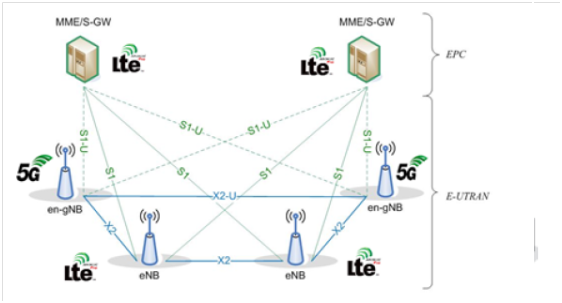
Figure 4.1: Non Stand Alone Architecture [32]
As depicted in Fig. 4.1 and as defined in 3GPP Release 15, the 5G NR (depicted as en-gNB) connects to the enhanced Node B (eNB) via the X2 interface, an interface previously exclusive for eNB connections only whereas the Evolved-Universal Telecommunication system terrestrial Radio Access Network (E-UTRAN) connects to the Evolved Packet Core (EPC) network via an S1 interface.

The Non stand alone architecture serves as a temporary step towards full 5G deployment.
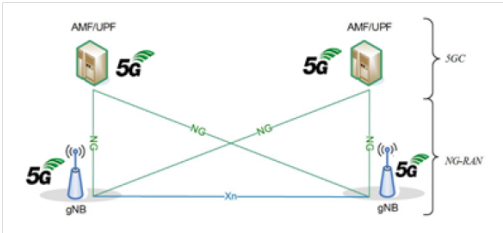
Figure 4.2: Stand Alone Architecture [32]

4.3 Stand Alone Architecture

This represents the full 5G deployment and is obviously a slower route towards commercial deployment. Here, the 5G NR is connected directly to the 5G Core (5GC) network. In essence, the 5G system is made of the UE, 5G NR and 5GC.

As depicted above in the figure, the NR (depicted as gNB) connects to each other via the Xn interface whereas the New Radio -Radio Access Network (NG-RAN) connects to the 5GC via the NG interface.

4.4 Summary

In this section, we discussed two main routes towards the commercial deployment of 5G networks. One represents a faster route and involves the use of the 5G NR on a 4G network whereas the other represents a slower route and involves the full utilization of the 5G NR on a 5GC network.
Back to Table of Contents.

3.0 – Radio Technologies for Spatial Densification

0
Figure 3.2: Heterogeneous Network [7]

In the previous chapter, we introduced readers to spectral aggregation, a technique for acquiring increased spectrum for 5G services. In this chapter, readers will be introduced to spatial densification as a way of meeting the demand for capacity in a 5G network.

In order to meet these demands, the key technologies applied at the 5G physical layer are Network Densification, Heterogeneous Networks, Cloud Radio Access Network (RAN) and Coordinated Multipoint (COMP).

3.1 Network Densification

Figure 3.1: Network Densification using small cells [7]
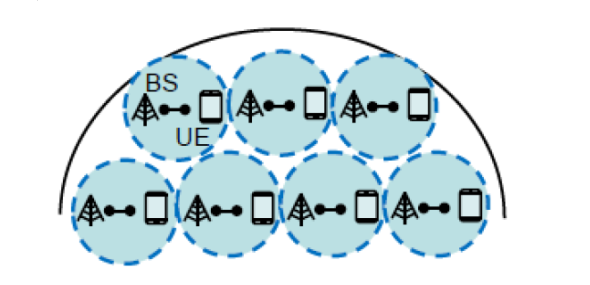
It simply involves the deployment of low power nodes (pico cells, femto cells, Distributed Antennas etc.) within localized regions of high traffic demand, as depicted in Fig. 3.1. It is anticipated that most traffic would originate from indoor areas, hotspots, public areas like stadiums, malls etc., hence it makes sense to deploy an overlay of small cells within the macro coverage area [7].

The goal is to offload some of the traffic from the base stations (macro cells) to the small cells which therefore improves the frequency reuse. This requires careful network planning to balance the load, address interference and backhaul challenges [7, 8].

Small cells require less power and cooling and can be deployed closer to the user and within existing networks; the deployment of small cells will lead to a reduction in CAPEX and OPEX incurred by operators [8].

The small cells could be deployed with self – organizing network capabilities which allows the cells to sense their environment, switch off when in idle mode (reduces energy consumption), coordinate with other base stations to deal with interference challenges within the environment [8].

3.2 Heterogeneous Network

Figure 3.2: Heterogeneous Network [7]
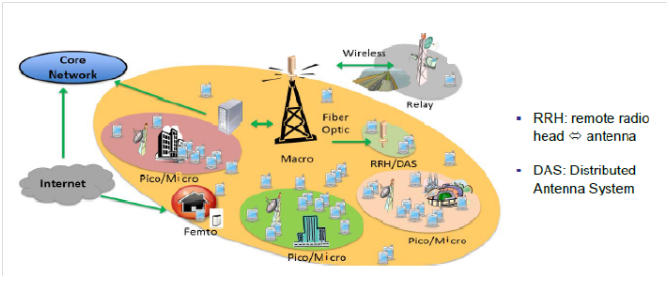
The traffic bottle neck could vary from network to network. Therefore, offloading could occur between networks of the same air interface technologies (Macro/small cells) or between networks of different air interface technologies (LTE/Wi-Fi) or between mobile operator core network and public internet.

This combination of technological solutions involving the use of network of different technologies or network of multiple layers of different sizes is referred to as a Heterogeneous Network (HetNet), as clearly illustrated in Fig. 3.2.

A HetNet consists of multiple tiers of layers of different networks of different cell sizes and/or multiple radio access technologies [7, 12].

3.3 Cloud RAN for Backhaul

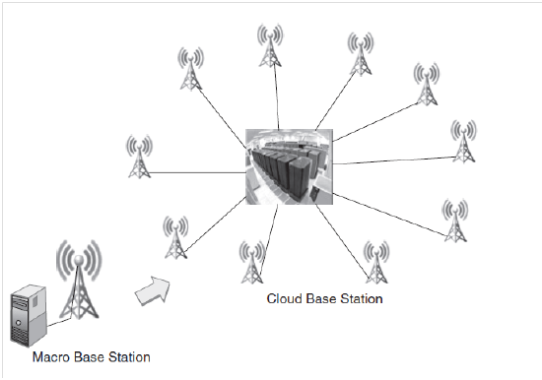
The deployment of a HetNet to increase capacity has to be complemented with a backhaul for this to translate into an enhanced user experience. The Cloud RAN has been proposed for backhaul purposes in 5G. In literal terms, it translates into Cloud Base Stations.

Cloud RAN involves relocating the signal processing from tens to hundreds of base stations to a centralized server platform (see Fig. 3.3); thus encouraging virtualization. It is especially suitable for high traffic demand areas like stadia and venues.

The Cloud RAN also reduces energy consumption by eliminating the need for air conditioning facilities at various sites. It is also able to adapt to the traffic demand within its geographic coverage daily [8, 12].

Besides Cloud RAN, Wireless backhaul can also be used within a 5G system.

Figure 3.3: The signal processing from various base stations are virtualized [12]

3.4 Cooperative Communication

Base stations can cooperate among themselves by exchanging information. Cloud RAN is a special application of Cooperation among base stations.

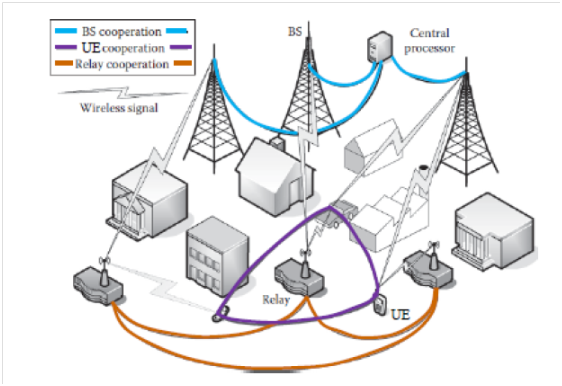
Cooperation can either be Joint Processing or Coordinated Scheduling. In a Joint Processing Cooperative Communication system, the processing of information among the nodes takes place in a central processor. The nodes could be base stations, User Equipment (UEs), relays or even a hybrid [8]. For example, the base stations in Fig. 3.4 below exchange information that is processed in the central processor.

Figure 3.4: Cooperation among information nodes [7]
A joint processing Cooperation among base stations is called CoMP. COMP involves the dynamic cooperation and coordination between/among multiple geographically separated base stations to improve spectral efficiency, address interference and reduce energy consumption [8].

Whereas, in Coordinated Scheduling, exchange of information occurs among nodes but there is no need for a central processor [8].

3.5 Summary

In order to meet the increased demand for bandwidth/data, small cells are being densed in space and laid in various configurations within macro coverage areas. Besides, other air interface technologies are also been deployed and combined in clever ways, leading to the development of HetNet to provide the much needed capacity for 5G services. Cooperation among stations is also been developed as a way to meet the increased data demand; this is thus paving the way for virtualization at the radio interface.

Interoperability is no doubt vital to allow the various air interface technologies work seamlessly and fully cooperate among themselves, when deployed within a 5G network.


Back to Table of Contents.

Some West African Countries Plot Post-Nigerian Dependency Playbook

0

“Ndubuisi – your country Nigeria is losing its position in West Africa. As a government worker here in Senegal, I have been involved in four meetings where most other West African countries gathered with no Nigerian representative. The land border closure is the root cause of the decisions. Nigeria has imagined that any West African country has the magic wand to smuggling  and can help protect its borders. Our big brother failed to understand that we are all victims at different levels. 

The post-Nigerian era in West Africa has started and everyone is looking for alternatives. It is painful that unlike before where meetings began with Nigeria, no one cares anymore. My uncle’s seven trucks are trapped in Nigeria for months, for going there to bring in legal goods, purchased from a Nigerian factory. Nigeria will not allow the trucks to return even empty. Because the goods were prepaid, and the consignments since gone bad, the man is now depressed. He wished he bought from China, not from his friend of 30 years in Nigeria.” From a friend in Senegal.

People, it should not be surprising that Abuja is reading about the UEMOA-ECO name change from newspapers. These West African countries are running new playbooks knowing that relying on Nigeria would be damaging. I do hope our government is paying attention to the disintermediation risks.

The Challenge Ahead as West Africa Quits CFA franc for Eco

Nigeria Border Closure: Winning Customs Revenue Battle But Losing War of Regional Exports Dominance

References – 5G Book

0

[1] M. Saadi, “The hidden value of 5G innovation and its impact on economic growth and consumers’ lifestyle”, {https://www.rcrwireless.com/20180103/opinion/analyst-angle-the-hidden-value-of-5g-innovation-and-its-impact-on-economic-growth-and-consumers-lifestyles}, accessed 6th Feb 2019.

[2] O. Oduwole, “5G and Vehicles”, {https://www.tekedia.com/5g-and-vehicles/}, accessed 4th Feb, 2019.

[3] Nominet, “The Oxford Flood Network”, {https://www.nominet.uk/the-oxford-flood-network/}, accessed 5th Feb, 2019.

[4] Nominet, “Nominet Smart City”,{https://internetofbusiness.com/nominet-unveils-smart-city-showcase/}, accessed 5th Feb, 2019.

[5] ITU, “AI for Good”, {https://www.slideshare.net/ITU/ai-for-good-global-summit-2017-report}, accessed 6th Feb, 2019.

[6] N. Ekekwe, “Zenvus”, {https://www.zenvus.com/}, accessed 6th Feb, 2019.

[7] P. Xiao, F. Heliot, “Advanced 5G Wireless technologies Course Note”, 5G Innovation Centre, University of Surrey.

[8] N. Bhushan, J. Li, D. Malladi, R. Gilmore, D, Brenner, A, Damnjanovic, R. T. Sukhavasi, C. Patel, S. Geirhofer, Qualcomm Technologies, Incoporated, “Network Densification: The Dominant Theme for Wireless Evolution into 5G”, 5G Wireless Communication Systems: prospects and challenges, IEEE Comm. Mag., Feb 2014.

[9] O. Oduwole, “Goodbye GSM”, {https://www.tekedia.com/goodbye-gsm/}, accessed 5th Feb, 2019.

[10] GSMA, “5G Spectrum GSMA Public Policy Position”, November 2018.

[11] Nominet, “Dynamic Spectrum Management”, {https://www.nominet.uk/spectrum-management/solutions/}, accessed 5th Feb 2019.

[12] G. Wu, Q. Li, R. Q. Hu, Y. Qian, “Heterogeneous Cellular Networks”, John Wiley & Sons, 2013.

[13] O. Oduwole, “A Letter to the EVC on 5G Trial in Nigeria”, {https://www.tekedia.com/a-letter-to-the-evc-of-ncc-on-5g-trial-in-nigeria/}, accessed 5th Feb, 2019.

[14] G. Brown, “Designing 5G-Ready Mobile Core Networks”, White Paper, affirmed, JUNIPER Networks, Sep 2016.

[15] Y. Choi, N. Park, “Slice Architecture for 5G Core Network”, IEEE, ICUFN 2017, pp.571-575, 2017.

[16] O. Oduwole, “Network Slicing paving the way for 5G Business Models”, {https://www.tekedia.com/network-slicing-paving-the-way-for-5g-business-models/}, accessed 7th Feb, 2019.

[17] O. Oduwole, “what is 5G?”, {https://www.tekedia.com/what-is-5g/}, accessed 7th Feb, 2019.

[18] F. Z. Yousaf, M. Bredel, S. Schaller, F. Schneider, “NFV and SDN – Key Technology Enablers for 5G Networks”, IEEE J. on Sel. Areas in Comms., Vol. 35, No. 11, Nov. 2017.

[19] S. K. Routray, S. K. P. “Software Defined Networking for5G”, ICACCS-2017, Jan 2017.

[20] B. G. Evans, “The role of Satellites in 5G”, ASMS/SPSC, pp. 197-202, 2014.

[21] Qualcomm, “Making 5G NR a Commercial Reality”, {https://www.qualcomm.com/media/documents/files/making-5g-nr-a-commercial-reality.pdf}, Sept 2018.

[22] Autonomous Car, {https://www.gemalto.com/review/Pages/5-benefits-of-autonomous-cars.aspx}, accessed 14th Feb 2019.

[23] Robotic Surgery, {http://htm.wikia.com/wiki/Robotic\_surgery}, accessed 14th Feb 2019.

[24] Amazon’s drone delivery: How would it work?, {https://edition.cnn.com/2013/12/02/tech/innovation/amazon-drones-questions/index.html}, accessed 14th Feb 2019.

[25] Smart Homes will change our way of life, {https://medium.com/@joshdotai/smart-homes-will-change-our-way-of-life-573399678b29}, accessed 14th Feb 2019.

[26] C. A. Balanis, P. I. Ioannides, “Introduction to Smart Antennas”, Morgan & Claypool Publishers, 2007.

[27] What is 5G Network Slicing?, {https://www.sdxcentral.com/5g/definitions/5g-network-slicing/},accessed 14th Feb 2019.

[28] Network Function Virtualization, {https://www.argela.com.tr/sdn-nfv-based-network-infrastructures/}, accessed 14th Feb 2019.

[29] B. Rong, X. Qiu, M. Kadoch, S. Sun, W. Li, “Intelligent SDN and NFV for 5G”, 5G Heterogeneous Networks Self-organizing and Optimization, Springer Board, 4th June 2016.

[30]  K. Zhang, Y. Mao, S. leng, “Energy-Efficient Offloading for Mobile Edge Computing in 5G Heterogeneous Networks”, IEEE Access 4, vol. 99, Jan 2016.

[31] Satellites for 5G, {https://artes.esa.int/satellite-5g}, accessed 14th Feb 2019.

[32] 3GPP Release 15, accessed 13th May 2019.

[33] G. Foster, “5G is demanding a new type of architecture”, { http://www.newelectronics.co.uk/electronics-technology/5g-is-demanding-a-new-type-of-architecture-one-disruptive-solution-could-be-a-flat-distributed-cloud-architecture/117023/}, accessed 14th May 2019.

[34] 5G use cases within the society, {http://www.imt-2020.cn/en/category/65591}, accessed 28th May 2019.


Back to Table of Contents.

2.0 – 5G Spectrum

0
Figure 2.1: Massive MIMO [7]

This chapter addresses the spectrum requirements anticipated for 5G networks. Spectrum is a scarce finite resource; there is however a growing demand for spectrum due to the hungry data demand of consumers who want to be able to download videos in seconds, instantly connect with friends and families from various parts of the globe, share viral videos and favourite moments with one another, hashtag a political concern or even issues at work and finalize business deals remotely.

The success of 5G applications highlighted in the previous chapter is heavily dependent on the Governments and regulators support of a timely release of affordable spectrum. Within the Industry, there are several developments geared at providing spectrum and increasing the efficiency of the existing spectrum for 5G applications, termed spectral aggregation. This chapter therefore introduces the reader to the spectral aggregation methods developed for the 5G network.

2.1 Spectrum Re-farming

In order to make spectrum available, traditionally old bands are cleared of incumbents [8]. Spectrum Re-farming involves the re-assignment of frequencies previously assigned for older generations like 2G and 3G and subsequent use for 5G. This is particularly true in countries like the US and East Asia where there are no 2G services available anymore [9]. This is a cheaper and cost effective way of acquiring spectrum.

Furthermore, the digital switchover also contributed towards freeing up some spectrum; infact the 700MHz band was cleared of incumbents to provide some bandwidth for 5G. Besides 700MHz, some other bands will be re-farmed for 5G [10].

2.2 Spectrum Sharing

Spectrum sharing, as the name implies, involves sharing spectrum among various bands.

2.2.1 Spectrum Sharing – Unlicensed bands

Unlicensed spectrum (e.g. 2.4GHz) can support offloading from licensed bands. This is very important because 5G would involve a combination of different technologies like Long Term Evolution (LTE)/WiFi etc.

However, Quality of Service (QoS) cannot be guaranteed when using unlicensed spectrum; therefore spectrum sharing (with unlicensed bands) needs to be well planned and carefully integrated with licensed bands [8].

2.2.2 Spectrum Sharing – Under-utilized bands

Bands that are under-utilised in time or geography can also be utilised for 5G services e.g. TV white spaces in the US. This has led to specialized spectrum sharing techniques like Authorized Share Access (ASA) where the ASA spectrum holder only has access to the spectrum when it is not utilized by the incumbent [8]

Furthermore, certain Organisations like GSMA are pushing for regulators to encourage voluntary spectrum sharing agreements among operators or verticals, where possible [10].

2.3 New Spectrum from mm wave band

Traditionally, frequency bands used for cellular systems were within the sub-3GHz [8]. However, the need for an increased spectrum for 5G services means that the higher frequencies (30-300GHz), termed mm wave, are now been considered for use in 5G.

These frequencies were traditionally being used for satellites and radar applications. And these frequencies are able to provide a large amount of bandwidth. As the higher the frequency, the more data that can be transmitted. The huge bandwidth/data capability of the mm wave frequencies is of utmost importance to 5G applications.

But these frequencies have different propagation characteristics and thus present numerous challenges such as large path loss, shorter transmission range, signal blocking/absorption by objects, low transmission capability etc. [8]

In order to combat these propagation challenges, base stations can be situated closer to the users (which reduces the loss) and makes a good case for citing various small cells indoors. However, an issue that could arise with citing base stations closer to the public is that it may increase the publics’ concern and worry about the impact of electromagnetic radiation on their health.

At these higher frequencies, the antennas are small due to the small wavelength dimensions (from the name mm-wave); hence the signals propagate very short distances, which is an issue for signal reception [8]. Hence to maximize the signal reception, a large number of small antennas are combined within the transmitter and receiver to provide for spatial and multiplexing gain using a technique called Massive Multiple Input Multiple Output (MIMO).

Massive MIMO simply implies that the number of antennas is far greater than the number of data streams and requires hundreds/thousands of antennas, as shown below in Fig. 2.1 below [7].

Figure 2.1: Massive MIMO (sources:, Researchgate, [7])
Furthermore, adaptive beam-forming can also be used to target the radiation towards or away from the user, thereby reducing the interference, as depicted below in Fig. 2.2 below [7,8].

Figure 2.2: Adaptive Beamforming [26]

2.4 Dynamic Spectrum Management

Previously, spectrum assignment was static and regulators simply monitor that the spectrum assigned is being utilized for the right purpose. Research has shown this is inefficient and there are better ways to maximize the scarce spectrum resource. For example, dynamic spectrum allocation (e.g.  Nominet Dynamic Spectrum Management) allows for the allocation of spectrum in real time using a geo-location database by checking for the usage, location of user and the demand [11]. This increases the efficiency of the spectrum.

2.5 Spectrum Harmonization

From the foregoing, it is clear that 5G would rely on spectrum from the low band, mid band to the high band. For this reason, a new air interface, called 5G New Radio (NR), has been developed to support these wide range of bands, as depicted below in Fig. 2.3. The 5G NR will be discussed further in the next chapter. Fig. 2.3 shows that LTE works within the sub 6GHz whereas 5G NR would operate over a wide range of bands.

Figure 2.3: Spectrum Band for LTE and 5G NR [21
The effective use of frequencies in different bands is critical to the success of 5G services and therefore places huge emphasis on spectrum harmonization as the key to minimising cross border interference, facilitating international roaming agreements and reducing the cost of mobile devices [10].

2.6 Summary

It is clear from this chapter that the spectrum needed for 5G would be realized in different bands: Sub-1GHz for widespread coverage and Internet of Things (IoT) services, 1-6GHz for coverage and capacity and mm wave band for higher capacity; hence spectrum harmonization will vital in delivering the huge promises anticipated from 5G applications [10].

Furthermore, it has been noted that spectrum pricing in developing countries, are on average more than three times higher than in developed countries, after taken into considering the income levels within the country, in order to maximise revenues. This therefore leads to slower broadband services and worse coverage. These costs are often transferred to the consumers which therefore widens the digital gap. In order to accelerate the adoption of 5G services, regulators are advised to set affordable spectrum prices based on the market forces [10, 13].


Back to Table of Contents.