DD
MM
YYYY

PAGES

DD
MM
YYYY

spot_img

PAGES

Home Blog Page 655

From SEO to GEO (PEO): Designing Effective Prompt Engine Optimization [podcast]

0

In this Tekedia Daily podcast, I provide a framework for understanding the future of digital visibility. My presentation argues that the dominance of traditional SEO (search engine optimization), while still important, is being challenged by the rise of generative AI. The core concept discussed is Prompt Engine Optimization (PEO) or Generative Engine Optimization (GEO), which is the practice of tailoring your website’s content to be cited and synthesized by large language models and chatbots.

The podcast highlights that users are increasingly turning to these AI platforms for their information, and therefore, businesses must adapt their strategies to ensure their content is discoverable and referenced in these new “search” environments.

I break this new paradigm into four key principles: getting mentioned and cited, improving overall visibility across various AI platforms, conducting competitive analysis within this new context, and paying attention to the sentiment conveyed by AI. It is important to note that SEO and GEO are not mutually exclusive; they are complementary strategies working toward the same ultimate goal: driving traffic and converting customers.

Then, how do you execute that PEO playbook for your digital platform? I provide some practical and logical actionable steps. First, businesses must conduct thorough research to understand the specific questions and needs of their audience. This allows them to create targeted, valuable content. Second, this content must be “AI-friendly” meaning it is clear, authoritative, and easy for a machine to understand and use as a source.

Finally, the physical web page itself must be optimized for speed and accuracy, stripping away unnecessary clutter to allow AI to quickly and accurately pull information. The lecture concludes by underscoring that preparing and building systems for AI is a critical, strategic move for the next phase of any digital business.


Podcast VideoSign-up at Blucera and check Tekedia Daily podcast category under Training module.

The Camp Foundation Releases ‘The Camp Airdrop Checker’, as Heaven DEX Surpasses $1M in Single Day Protocol Revenue

0

The Camp Foundation has launched an eligibility checker for the CAMP token Season 1 airdrop, as announced by Camp Network, a Layer 1 blockchain focused on integrating intellectual property (IP) and AI.

The checker allows users to verify their eligibility and complete registration by August 25, 2025, at 11:59 PM ET, using the same wallet previously engaged with the Camp ecosystem, such as the Summit Series Testnet. Eligible participants include holders of TrailHeads NFTs and verified contributors from the testnet.

Initially, a controversial 0.0025 ETH (~$10) registration fee was required, but due to community backlash, the Camp Foundation removed it and committed to reimbursing those who paid. The airdrop aims to boost the CAMP token’s visibility and attract new users, though its success hinges on smooth execution.

The CAMP airdrop incentivizes participation by rewarding early adopters (e.g., TrailHeads NFT holders and testnet contributors), fostering a decentralized community. This aligns with blockchain’s ethos of distributing ownership and governance.

Airdrops like CAMP’s aim to boost token visibility and attract new users to the Camp Network, which integrates IP and AI. This could drive adoption of its unique use cases, such as tokenized intellectual property or AI-driven applications. By targeting existing ecosystem participants, the airdrop ensures tokens reach engaged users, potentially increasing network activity and value.

Airdrops can create short-term market hype, potentially increasing token demand upon listing. However, poorly managed distributions risk alienating users and harming long-term credibility. The reimbursement of fees demonstrates a commitment to fairness, which could strengthen Camp Network’s reputation in a competitive Layer 1 landscape.

The eligibility checker and wallet-based registration process test Camp Network’s infrastructure. A smooth rollout could signal robust technical capabilities, while issues could deter users and developers. Layer 1 blockchains, like Camp Network, are foundational protocols that process and validate transactions natively.

Modern Layer 1s (e.g., Solana, Aptos, Camp Network) prioritize high throughput and low latency. For instance, Camp Network’s focus on IP and AI suggests optimized transaction processing for data-heavy applications, enabling real-time use cases like AI model training or IP licensing on-chain.

Blockchains are moving beyond Ethereum’s limitations (e.g., high gas fees, slow transactions), supporting mass adoption for applications like DeFi, gaming, and tokenized assets. Layer 1s are increasingly designed with interoperability in mind, allowing seamless interaction with other blockchains.

Camp Network’s IP focus could integrate with platforms like Ethereum or Polygon for cross-chain IP marketplaces. Cross-chain bridges and protocols (e.g., Polkadot, Cosmos) are creating interconnected ecosystems, enabling fluid asset and data transfers. Camp Network’s emphasis on IP and AI exemplifies how Layer 1s are tailoring infrastructure to niche markets.

Tokenizing IP allows creators to monetize assets transparently, while AI integration could enable smart contracts for automated licensing or royalties. Layer 1s are diversifying beyond finance into areas like supply chain (VeChain), gaming (Immutable X), and now IP/AI, broadening blockchain’s utility.

Airdrops, like CAMP’s, are a governance tool to distribute tokens and empower community decision-making. Layer 1s are leveraging such mechanisms to decentralize control and align incentives. DAOs (Decentralized Autonomous Organizations) and token-based governance are becoming standard, giving users a stake in protocol development.

Newer Layer 1s often use energy-efficient consensus mechanisms like Proof of Stake (PoS) compared to Bitcoin’s Proof of Work (PoW). This reduces environmental impact and transaction costs, making platforms like Camp Network more accessible. Eco-friendly blockchains are gaining traction, appealing to ESG-conscious developers and users.

Layer 1s are simplifying onboarding with user-friendly tools (e.g., Camp’s eligibility checker) and developer SDKs. This lowers barriers for building dApps and engaging users. Web3 is becoming more intuitive, competing with Web2 platforms by prioritizing UX and scalability.

The CAMP airdrop reflects a strategic use of Layer 1 infrastructure to build community and drive adoption. However, its success depends on execution—transparent communication, seamless user experience, and delivering on IP/AI promises. Layer 1s are revolutionizing trends by enabling scalable, specialized, and interoperable ecosystems that empower creators, developers, and users.

Heaven DEX Surpassed $1M in Single Day Protocol Revenue Trailing Only Pump.fun and Axiom Pro

Heaven DEX, a Solana-based launchpad and AMM, has surpassed $1 million in protocol revenue, with reports indicating $1.02 million generated in a single day, making it the third highest-earning protocol on Solana, trailing only Pump.fun and Axiom Pro.

Its “God Flywheel” model, which allocates 100% of revenue to buy back and burn its native token, LIGHT, has driven significant market traction, with $1.4 million spent on buybacks in its first week, burning ~2% of LIGHT’s supply.

This contributed to a 225% price surge in six days, pushing LIGHT’s market cap to $200 million. Despite capturing 15% of Solana’s launchpad market share, challenges like potential liquidity fragmentation and reliance on sustained trading volume remain.

Surpassing $1M in daily revenue, as reported, signals strong adoption and positions Heaven DEX as a top-tier protocol on Solana, trailing only Pump.fun and Axiom Pro. This can attract more users, developers, and investors, enhancing its competitive edge in the crowded DEX and launchpad space.

Token Scarcity and Price Appreciation: The God Flywheel’s buyback-and-burn mechanism reduces LIGHT’s circulating supply, creating deflationary pressure. With ~2% of the supply burned in the first week and a 225% price surge in six days, as noted in the data, this milestone amplifies the model’s effectiveness, potentially driving further price appreciation.

High revenue enables more aggressive buybacks, which can stabilize and boost LIGHT’s value, attracting more projects to launch on Heaven DEX. This creates a virtuous cycle: more launches increase trading volume, which generates more revenue for buybacks, further strengthening the ecosystem.

While the revenue milestone is positive, reliance on sustained trading volume and potential liquidity fragmentation (as multiple pools compete for capital) could strain the model. Maintaining this revenue level will be critical to sustaining the flywheel’s momentum.

Boost to the God Flywheel

The $1.02M daily revenue translates to substantial capital for buying back LIGHT tokens. With $1.4M already spent on buybacks in the first week, this revenue surge allows Heaven DEX to remove tokens from circulation at a faster rate, enhancing scarcity and supporting price growth.

Burning ~2% of LIGHT’s supply in a week significantly reduces the token supply, reinforcing the deflationary mechanism of the God Flywheel. This ongoing reduction in circulating tokens can create a perception of increasing value per token, which may attract more investors and traders, further boosting trading volume and protocol revenue.

The revenue milestone fuels the God Flywheel’s self-sustaining loop. Higher revenue leads to larger buybacks, which reduce supply and can drive up LIGHT’s price (as seen with the 225% surge). This attracts more projects to the platform, increasing trading activity and revenue, which in turn funds more buybacks, perpetuating the cycle.

The $1M revenue milestone, coupled with LIGHT’s market cap reaching $200M, signals strong market traction. This can draw more attention to Heaven DEX, increasing user participation and trading volume, which directly feeds into the flywheel by generating more fees for buybacks.

Crossing $1M in revenue strengthens the God Flywheel by providing more capital for buybacks, accelerating token burns, and reinforcing the deflationary model. This can drive further price appreciation and ecosystem growth, though sustaining high trading volume and managing liquidity risks will be key to maintaining this momentum.


Hyperliquid’s XPL Pre-Launch Market and 3x Leverage Hyperps Create a High-Stakes Environment for Traders

0

Hyperliquid launched pre-market trading for Plasma’s XPL token, which is now trading at approximately $0.40, implying a fully diluted valuation of $4 billion.

This is 8x its initial public sale valuation of $500 million, where 10% of the 1 billion XPL token supply was sold at $0.05 per token in July 2025. Hyperliquid’s “hyperps” contracts allow up to 3x leveraged positions, contributing to high volatility and trading volume of $49 million with $33 million in open interest shortly after listing.

Pre-launch markets are inherently volatile due to low liquidity and speculative fervor. Hyperliquid’s XPL-USD hyperps saw $49 million in trading volume and $33 million in open interest shortly after listing, indicating strong market activity but also potential for sharp price swings.

The pre-launch market, backed by Hyperliquid and Binance, amplifies Plasma’s exposure. The $373 million token sale and Binance’s $250 million USDT yield program (filled in an hour) highlight strong institutional and retail interest, potentially driving adoption of Plasma’s stablecoin-focused blockchain.

Plasma’s fee-free USDT transfers and Bitcoin-anchored security position it as a competitive Layer-1 for stablecoin transactions. Pre-market trading success could accelerate institutional adoption, with 40% of XPL’s supply allocated to strategic growth initiatives like DeFi incentives and exchange integrations.

Market makers like Wintermute and Flow Traders are reportedly providing liquidity for XPL, which could stabilize trading but also lead to short-term arbitrage-driven volatility, with potential 20–35% price swings in the first 30–60 days post-launch. Hyperliquid’s decentralized order book and absence of clearance fees on liquidations enhance transparency and fairness.

The 3x leverage on XPL hyperps amplifies both gains and losses. A trader with a $175,000 unrealized profit on a leveraged long position demonstrates the upside, but liquidations are a significant risk if the market turns. The XPL public sale required accredited investor status for U.S. participants, with tokens locked for 12 months.

Hyperliquid’s hyperps, which use a moving average of their own mark price for funding rates instead of external oracles, reduce manipulation risks and set a precedent for innovative pre-launch derivatives. This could influence other DeFi platforms to adopt similar mechanisms.

Hyperliquid’s low-fee, on-chain order book model, combined with Plasma’s stablecoin focus, challenges centralized exchanges (CEXs) like Binance, potentially shifting market share to DeFi platforms.

How Leverage Positions Work in XPL Hyperps

Hyperps are Hyperliquid-specific perpetual contracts that don’t rely on external spot or index oracle prices. Instead, funding rates are calculated based on a moving average of the contract’s own mark price, reducing manipulation risks. Traders can take up to 3x leverage, meaning a $1,000 deposit can control a $3,000 position.

This amplifies potential profits or losses based on price movements. For example, a 10% price increase on a 3x leveraged long position yields a 30% gain (minus fees and funding costs). Paid every eight hours, funding rates balance long and short positions. If longs dominate (as seen with XPL’s 1,200% APY funding), they pay shorts, incentivizing contrarian positions.

Traders must maintain sufficient collateral (margin) to support their leveraged positions. The maintenance margin for XPL hyperps, with 3x max leverage, is 16.7% of the position value (half the initial margin). If a trader’s account equity falls below the maintenance margin due to adverse price movements.

Hyperliquid attempts to close the position via market orders on the order book. If unsuccessful and equity drops below two-thirds of the maintenance margin, a backstop liquidation occurs through the community-owned HLP vault, with profits going to the community rather than the exchange.

Liquidations use a mark price combining external CEX prices and Hyperliquid’s book state, ensuring robustness. Traders can monitor estimated liquidation prices, though these may vary due to funding payments or cross-margin interactions. Hyperliquid recommends using isolated margin for high-risk hyperps like XPL to limit losses to the allocated collateral.

A trader deposits $1,000 and opens a 3x leveraged long position on XPL at $0.40, controlling $3,000 worth of XPL. If XPL rises to $0.48 (20% increase), the position’s value increases to $3,600, yielding a $600 profit (60% return on the $1,000 deposit, minus funding costs).

Conversely, a 20% drop to $0.32 reduces the position to $2,400, incurring a $600 loss, potentially triggering liquidation if collateral is insufficient. The 8x valuation surge reflects hype around Plasma’s stablecoin-focused blockchain, but technical indicators like Bollinger Band breaks suggest potential corrections.

The market’s success enhances Plasma’s visibility and adoption, potentially reshaping the stablecoin and DeFi landscape. Traders must manage leverage carefully, using isolated margin and stop-losses to mitigate liquidation risks, while long-term investors may focus on Plasma’s fundamentals and strategic growth initiatives.

Ozak AI Compared to Shiba Inu at $0.00001 Entry: Why This AI-Powered Presale Could Deliver Exponential ROI with a $2 Launch Prediction by 2026

0

A few projects have captured the attention of investors, like Ozak AI, which is positioning itself as a potential game-changer in the realm of AI and blockchain integration. Having a presale in progress, early investors can lock their place in a project that has the potential to reflect the meteoric success of Shiba Inu when the token was initially obtained at its price of 0.00001.

With Ozak AI making its way to the targeted $1 launch price within 2026, analysts have also made projections of the token, with some estimating that it is likely to shoot up to as high as $2 when the market is opened fully.

The Strength of Integration of AI and Blockchain

Ozak AI is not simply another run-of-the-mill speculative token in an oversaturated cryptosphere. Artificial intelligence (AI) and blockchain technology power the project, with the two combined to form a decentralized predictive platform that was tailored for real-life applications.

The project provides data processing security and scalability using its new innovation, DePIN (Decentralized Physical Infrastructure Network), and ensures the services provide tamper-proof, real-time information using the Ozak Stream Network (OSN). This is an industry-driven system applicable in the financial markets, Internet of Things (IoT) solutions, and others, and hence much more than a token.

And as AI moves to an indispensable tool in the decision-making process and financial modeling, the integrated platform that Ozak AI provides promises to deliver strong predictive capabilities, based on machine learning algorithms. The Prediction Agents (PAs) examine data streams both within and without and provide practical and actionable insights to aid in enterprise analysis, market intelligence, and trading decisions.

Steady Presale Progress and Tokenomics

Ozak AI has experienced high levels of presale as the project goes on to raise 2.1 million in Phase 4 alone. The presale will be arranged in levels; the initial price in Phase 1 will be only $0.001, and the presale will advance to Phase 4 at $0.005. This will be followed by an increase in price to the next level, $0.01, in the next phase of the target of $0.01, closer to the final launch price of $1. This slow rise in price has created momentum, and many investors are willing to join now at the current low-level price and surf the wave until the end.

The presale structure allows early investors to buy in at a low price with the opportunity for substantial returns once the token hits its official launch price. The comparison to Shiba Inu’s growth is not unfounded—with Ozak AI’s combination of cutting-edge technology, strong tokenomics, and real-world use cases, investors are eager to lock in their positions early.

Real-World Applications and Market Demand

Ozak AI is not a mere speculative coin. Due to the real-world applications of the platform, it makes it different from other blockchain projects. The OSN has the potential to stream across any other blockchain with a very low amount of latency, which makes it an extremely valuable asset to decentralized finance (DeFi) and AI-related decision-making. Also, the provision of secure data aggregation by the network stands as a potentially useful instrument to industries that need to make quick, dependable decisions.

The Prediction Agent is another feature that the platform is fitted with, as it provides market predictions, albeit relying on a significant amount of data analysis, leaving traders and companies with real-time opportunities to make informed decisions.

Giveaways, Incentives, Partnerships, and Security

Further to promote presale activity, Ozak AI is implementing a $1 million giveaway that incentivizes investors to accumulate at least $100 worth of the $OZ tokens. This referral giveaway also serves as an expansion on the same, since it rewards customers for engagement with the community. Besides such appealing propositions, the initiative is also accompanied by sound security measures, such as CertiK-audited security protocols, which would make the platform safe and secure for the investors.

Ozak AI has been rapidly expanding its ecosystem through key partnerships that strengthen both its technology and usability. Its collaboration with SINT unlocks “one-click AI upgrades,” where features like autonomous agents, cross-chain bridges, and voice tools make Ozak AI’s signals instantly actionable within smart systems.

With Hive Intel (HIVE), Ozak AI gains access to multi-chain blockchain data APIs, including on-chain analytics, NFT and DeFi insights, token performance, and wallet behavior—giving its bots sharper speed and accuracy. Meanwhile, the partnership with Weblume brings Ozak AI’s real-time signals into a no-code Web3 builder, letting creators integrate market intelligence directly into dashboards and decentralized applications without coding barriers. Together, these integrations push Ozak AI beyond just analytics, positioning it as a plug-and-play intelligence layer across Web3.

The Pursued Road

As the presale approaches its close, the future of Ozak AI is shining with the brightest prospects ever. A combination of AI and blockchain, along with the practical application, has placed the project on the course of exponential growth. A target prediction of $2 to be reached by 2026 does not feel very unattainable, and the platform is steadily developing its infrastructure and building partnerships, and incorporating new use cases.

The price of $OZ remains in early stages, but investors looking to invest now are likely to make good returns once the token reaches the 1 dollar mark. The investors might experience geometric returns as the adoption and the positioning of the Ozak AI in the blockchain and AI landscape become established, as SHIB did before.

The presale of Ozak AI presents a rare chance to invest in an AI, but one that is paired with blockchain and has real-world connections. Ozak AI is an ambitious and potentially highly profitable project of 2025 and beyond with its innovative technology, powerful tokenomics, and prospects of outstandingly high ROI.


For more information about Ozak AI, visit the links below:

Website: https://ozak.ai/

Twitter/X: https://x.com/OzakAGI

Telegram: https://t.me/OzakAGI

Solana & XRP Prices Stuck in Consolidation as Market Watches a 100x Runner in the Making

0

Solana and XRP are locked in consolidation, with both tokens struggling to break out of tight trading ranges. While investors wait for clearer signals from these established giants, attention is shifting to a new contender: Layer Brett ($LBRETT).

This Ethereum Layer 2 meme coin is being tipped as a 100x runner in the making. With huge staking rewards, community buzz, and early adoption, $LBRETT is quickly becoming the token to watch in 2025.

Solana consolidates as traders wait for the next breakout

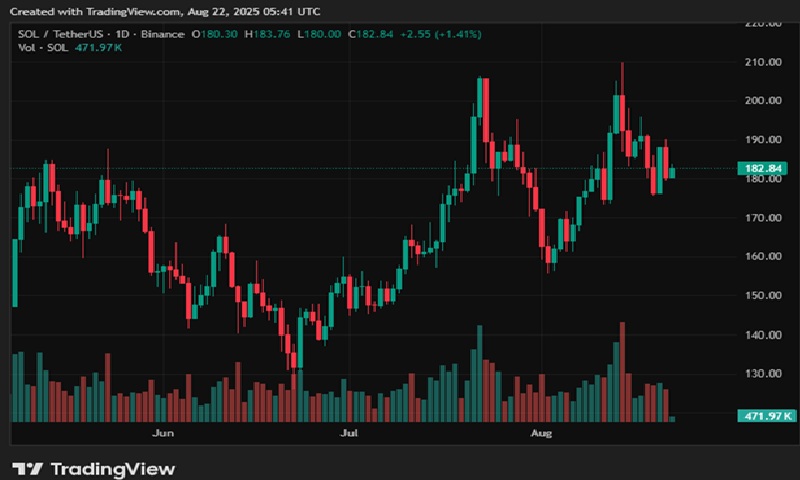
Solana has entered a consolidation zone after reaching its recent peak of $209.86. Solana now trades at $182, showing steady footing above the 30-day moving average. This suggests buyers are still defending key levels, but momentum has slowed compared to the rally seen earlier in August.

Source: TradingView

The $170–180 region has become an important support area where Solana buyers consistently step in. On the other side, sellers are active below $200, capping attempts at a breakout. This back-and-forth has tightened Solana’s range, keeping the market in check for now.

For traders, consolidation signals a period of balance before the next move. A push above $200 could open the way higher, while slipping under $170 risks deeper pullbacks.

XRP holds near $2.85 as traders eye $3 breakout

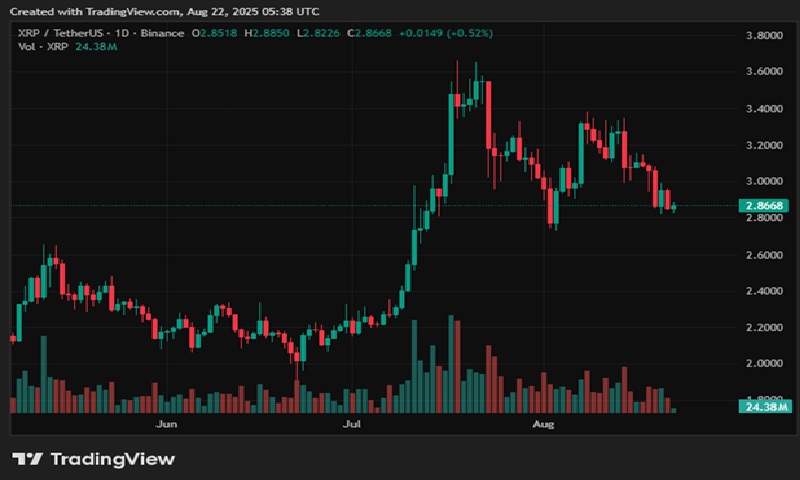
XRP is trading in a consolidation phase after pulling back from its July peak near $3.66. XRP’s price has been bouncing around this region, currently priced at $2.85, and the 60-day moving average is positioned right underneath it, giving it slight support. Buyers are standing their ground at the $2.70 level, and the sellers restrain any up-movement above the $3.00 mark,  putting XRP in the tight between-zone.

Source: TradingView

Trading volumes have been slower than previous rushes, which is an indication that traders are waiting for new developments before investing. Consolidation is likely to dominate until the next breakout.

A breakout above $3.00 may unleash fresh bullish motivation for XRP, while a drop below the $2.70 mark may open up the pathway to further losses.

Layer Brett ($LBRETT): The 100x runner in the making

Layer Brett ($LBRETT) is building momentum as one of 2025’s most ambitious meme coins with real upside. Running on Ethereum’s Layer 2, it combines speed with low fees, making it practical for large-scale use. This strong base gives $LBRETT a chance to climb far higher, with many traders pointing to its potential as a 100x runner in the months ahead.

Unlike meme tokens that rely only on hype, Layer Brett adds tangible features. It offers gamified staking, NFT tie-ins, and cross-chain support, creating more ways for holders to benefit. A no-KYC, self-custodial wallet means users keep control of their assets without depending on centralized exchanges, which adds another layer of appeal.

Staking rewards are drawing early interest, with eye-catching APY figures for those who join ahead of the crowd. Community activity is also rising thanks to a $1M giveaway that’s creating buzz around the project. With its smaller market cap and expanding reach, Layer Brett has the profile of a token capable of explosive growth in 2025.

Here are some key features of Layer Brett ($LBRETT):

  • Self-custodial wallet with no KYC requirements
  • Gamified staking system with rewards tied to community activity
  • Early staking APY opportunities reaching up to 20,000%
  • $1M giveaway driving adoption and community buzz

Layer Brett is still in its early stages, giving early movers a rare window to position before wider exposure. With momentum building fast, missing out now could mean watching one of 2025’s biggest runs from the sidelines.

Layer Brett offers a stronger entry point than Solana and XRP

At just $0.0047, Layer Brett ($LBRETT) gives investors a ground-floor opportunity that Solana and XRP can no longer match. Both established tokens trade at far higher levels, leaving limited room for exponential gains. With its low price, strong utility, and fast-growing community, $LBRETT stands out as a better entry point for those chasing the next 100x crypto in 2025.

Discover More About Layer Brett (LBRETT):

Presale: LayerBrett | Fast & Rewarding Layer 2 Blockchain

Telegram: Telegram: View @layerbrett

X: (1) Layer Brett (@LayerBrett) / X