
DD
MM
YYYY

PAGES

DD
MM
YYYY

spot_img

PAGES

Home Blog Page 656

Why Little Pepe (LILPEPE) Might be the Next 50x Meme Coin, Overshadowing Dogecoin (DOGE) and Shiba Inu (SHIB) in 2025

0

While Dogecoin (DOGE) and Shiba Inu (SHIB) have long been the top meme coins, a new contender, with its presale momentum soaring and more investors flowing in, Little Pepe (LILPEPE), is generating significant buzz as a potential 50x investment opportunity. Here’s why LILPEPE may soon outshine DOGE and SHIB.

A Presale Setting Records

Little Pepe has taken the meme coin community by storm. Its Stage 10 presale sold out faster than expected, raising over $19.32 million, showcasing the extraordinary demand behind this project.  Stage 11, currently priced at $0.0020, has already gathered over $1.5 million in under three days, signaling that the appetite for this coin is far from slowing down. Adding excitement to its presale, the team launched a $777k giveaway where 10 lucky winners will each secure $77,000 worth of LILPEPE tokens.  With more than 232,000 entries, investors are lining up for their chance to be part of this growing movement. A minimum investment of $100 is required, giving even small investors a fair shot at joining the community.

The Potential for 50x Gains

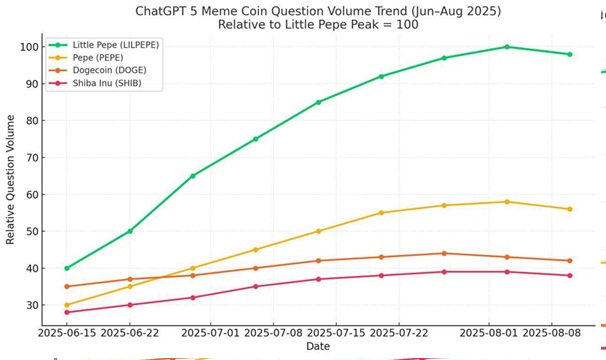
The buzz around Little Pepe is more than hype—it’s backed by strong numbers and projections. Analysts suggest that if LILPEPE follows through on its current trajectory, it could deliver returns of 50x or more.  That means a modest $2,000 investment could transform into $100,000, making it one of the most lucrative opportunities in the meme coin sector for 2025.  Even more impressive, data from ChatGPT-5 trend analysis indicates that from June to August 2025, Little Pepe is leading in question volume compared to PEPE, DOGE, and SHIB. This surge in community interest shows that the spotlight is shifting toward LILPEPE.
Little Pepe (LILPEPE) As the Next Generation Meme Coin

Both Dogecoin and Shiba Inu had their moments in the spotlight. DOGE benefited from Elon Musk’s endorsements, while SHIB drew attention with its ecosystem of tokens. But LILPEPE is positioning itself as the next-generation meme coin with unique traits:

  • No taxes – Transactions are straightforward without hidden costs.
  • No rug pulls – Investor trust is safeguarded by a fully transparent and fair launch system.
  • Community-first culture – The project thrives on hype, humor, and togetherness.

A Roadmap Full of Surprises

Unlike many meme coins that stop at hype, LILPEPE has an engaging roadmap designed to keep the community invested for the long haul. In its current “pregnancy stage,” the project playfully describes itself as “cooking in the cryptowomb with Mumma Pepe.” This creative branding sets the tone for the token’s future, where community hype is at the core of its growth strategy. More milestones are expected post-presale, including strategic listings, community rewards, and expanded marketing campaigns designed to spread the Little Pepe brand across crypto communities worldwide.

Security and Trust Backed by CertiK

One of the biggest concerns for meme coin investors is security. The team behind Little Pepe has tackled this head-on by securing a CertiK audit.  With an impressive 95.49% security score, the project assures investors that safety and transparency are taken seriously. This makes LILPEPE one of the most trusted meme tokens currently in presale.

Upcoming Listings and Exchange Plans

Visibility is key to growth, and Little Pepe is already making moves. It’s now live on CoinMarketCap and will hit two leading centralized exchanges right after the presale wraps up.   Even bigger plans are in the works: the team is pushing hard for a listing on the biggest crypto exchange in the world. With these steps in place, the post-launch trajectory of LILPEPE looks strong.

Conclusion

Little Pepe (LILPEPE) isn’t just another meme coin—it’s a project with momentum, creativity, and serious potential. With a presale that continues to break records, an active community, and ambitious plans for listings and expansion, LILPEPE could well be the token that overshadows DOGE and SHIB. For investors looking to secure a spot in what may be the next 50x meme coin, the window of opportunity is wide open. As 2025 unfolds, Little Pepe has all the ingredients to claim the throne as the most exciting meme coin of the year.


 For more information about Little Pepe (LILPEPE) visit the links below:

Website: https://littlepepe.com

Whitepaper: https://littlepepe.com/whitepaper.pdf

Telegram: https://t.me/littlepepetoken

Twitter/X: https://x.com/littlepepetoken

Thiel’s Ethereum Bets Drive Liquidity By Attracting Institutional Capital and Increasing Trading Volumes

0

Peter Thiel has made significant gains from his investments in Ethereum-focused companies, capitalizing on Ether’s 13.5% surge in August 2025.

His venture capital firm, Founders Fund, holds a 7.5% stake in ETHZilla, a former biotech company now accumulating Ether, and a 9.1% stake in Bitmine Immersion Technologies, which raised $250 million to acquire Ether. ETHZilla’s market value soared from $18 million to $741 million after Thiel’s investment was disclosed, while Bitmine’s valuation jumped over 1,000% since June, reaching $8.3 billion.

Thiel’s strategy hinges on Ethereum becoming Wall Street’s preferred blockchain for financial services, driven by its programmability, staking yields, and tokenized asset potential, unlike Bitcoin’s role as a store of value. Ethereum’s network activity hit $1.2 trillion in 2025, fueled by stablecoins and institutional interest, though some analysts question whether this reflects true adoption or speculative trading.

Thiel’s involvement through Founders Fund signals to institutional investors that Ethereum is a credible asset for portfolios. His track record with early bets on companies like PayPal and Facebook lends credibility, encouraging hedge funds, asset managers, and other institutional players to allocate capital to Ethereum-related investments.

Ethereum’s programmability, supporting smart contracts and decentralized finance (DeFi) applications, positions it as Wall Street’s preferred blockchain for tokenizing real-world assets. Thiel’s investments amplify this narrative, pushing Ethereum as a backbone for financial services.

The success of ETHZilla and Bitmine Immersion Technologies, with their soaring valuations, demonstrates market appetite for Ethereum-focused investment vehicles, potentially spurring the creation of similar funds or ETFs. The dramatic valuation increases of ETHZilla (from $18M to $741M) and Bitmine (up 1,000% to $8.3B) validate Ethereum’s growth potential.

However, some analysts question whether the $1.2 trillion in Ethereum network activity in 2025 reflects genuine adoption or speculative trading, which could introduce volatility if sentiment shifts. Ethereum’s proof-of-stake mechanism, offering yields of 3-5% annually, appeals to investors seeking passive income, unlike Bitcoin’s focus as a store of value.

Thiel’s bets highlight this advantage, potentially drawing more capital into staking pools, which locks up Ether supply and supports price stability. Thiel’s high-profile investments and the resulting price surges attract more traders to Ethereum markets.

Increased participation from retail and institutional investors boosts trading volumes on exchanges, enhancing liquidity. The success of ETHZilla and Bitmine creates new tradable assets, as their shares or tokens become vehicles for indirect Ethereum exposure, further increasing market activity.

Institutional interest, spurred by Thiel’s involvement, brings larger capital pools into Ethereum markets. For example, Bitmine’s $250 million raise to acquire Ether directly increases the circulating supply of Ether in liquid markets, as these funds are deployed. The entry of institutional players also encourages market makers to provide tighter bid-ask spreads, improving liquidity for Ether.

Growth of Ethereum-Based Financial Products

Ethereum’s role in stablecoins (e.g., USDT, USDC) and tokenized assets drives liquidity by creating a robust ecosystem of tradable instruments. Thiel’s bets signal to Wall Street that Ethereum is a platform for financial innovation, prompting the development of new products like futures, options, or ETFs, which deepen market liquidity.

Ethereum’s $1.2 trillion in network activity in 2025, largely driven by DeFi and stablecoin transactions, creates a self-reinforcing cycle. Higher activity attracts more developers and projects, increasing the number of tokens and applications on Ethereum, which in turn boosts liquidity across decentralized exchanges (DEXs) like Uniswap or Curve.

Thiel’s investments amplify this by drawing attention to Ethereum’s DeFi ecosystem, encouraging more users to participate in liquidity pools or yield farming. While staking locks up Ether, reducing circulating supply, it paradoxically supports liquidity by stabilizing prices and attracting long-term investors. Higher staking participation, driven by Thiel’s endorsement of Ethereum’s yield potential.

The rapid valuation spikes in ETHZilla and Bitmine suggest speculative fervor, which could lead to sharp corrections if sentiment sours, temporarily reducing liquidity during sell-offs. While Thiel’s bets signal mainstream acceptance, regulatory crackdowns on crypto or tokenized assets could deter institutional participation, impacting liquidity.

The surge in network activity, coupled with staking and DeFi growth, creates a more liquid and accessible market. However, speculative risks and regulatory hurdles could pose challenges. Ethereum’s trajectory as a Wall Street-friendly blockchain, backed by influential investors like Thiel, positions it to sustain and expand liquidity in the crypto ecosystem.

DHL’s Suspension of Standard Parcel Services from Germany to U.S. Disrupts Trading By Increasing Costs

0

Due to new U.S. customs regulations effective August 29, 2025, DHL and Deutsche Post have temporarily suspended standard parcel services from Germany to the U.S. for business customers, as announced on August 22, 2025.

The U.S. Executive Order “Suspending Duty-Free De Minimis Treatment for all Countries” eliminates the duty-free threshold for imports under $800, imposing a 15% tariff on goods from the EU, including Germany. This affects postal shipments, with unresolved issues around customs duty collection and data transmission to U.S. authorities.

DHL Parcel Germany and Deutsche Post will not accept or transport parcels containing goods from business customers to the U.S. via the postal network. Individuals can still send parcels declared as gifts (up to $100 in value) and documents, but these face stricter controls to prevent commercial misuse. Private parcels over $100 are subject to the new tariffs.

Shipping via DHL Express remains available for both private and business customers, though it’s more expensive and subject to commercial customs clearance with a 15% tariff (or higher for certain products). The restrictions stem from new U.S. processes for postal shipments, which differ from prior regulations, causing uncertainty about tariff collection and data requirements.

Other European postal services (e.g., in Austria, Belgium, Denmark, and France) have also limited U.S.-bound shipments due to these changes. DHL is working with U.S. authorities to resume standard postal services but expects the suspension to be temporary.

The elimination of the U.S. de minimis exemption (previously allowing duty-free imports under $800) imposes a 15% tariff on EU goods, including those from Germany. Businesses relying on DHL’s cost-effective postal services must now use DHL Express, which is more expensive due to its commercial customs clearance process. This raises shipping costs significantly.

Consumers may face higher prices as businesses pass on tariff and shipping costs. For example, e-commerce platforms like Shein and Temu have already warned of price increases due to similar tariff policies. The suspension primarily affects business-to-consumer (B2C) shipments, halting standard parcel deliveries for businesses.

This disrupts the flow of goods for online retailers, particularly small and medium-sized enterprises (SMEs) that rely on affordable postal services to reach U.S. customers. Platforms like Etsy, which depend on postal services for international shipping, have suspended shipping label purchases for U.S.-bound packages from multiple countries, further complicating cross-border e-commerce.

Unresolved questions about how duties will be collected and who will pay them (shipper, recipient, or courier) have led to the temporary suspension. This uncertainty creates logistical bottlenecks, as couriers like DHL lack clear processes to comply with new U.S. regulations. Businesses face potential additional costs for storage or return shipments if U.S. Customs rejects non-compliant parcels.

SMEs, which often lack the resources to navigate complex customs processes or absorb higher shipping costs, are disproportionately affected. Unlike large corporations, they may struggle to switch to premium services like DHL Express or find alternative shipping routes. The suspension could force some SMEs to pause or abandon U.S. market sales, reducing their revenue and competitiveness.

The U.S. policy is part of a broader trade war, initially targeting Chinese retailers like Shein and Temu but now affecting all countries by removing the de minimis exemption. This has prompted retaliatory rhetoric from countries like China and Hong Kong, with potential for further trade restrictions.

European postal services (e.g., Austria, Belgium, Scandinavia) have also suspended U.S.-bound shipments, indicating a wider disruption to global trade networks. Private individuals can still send gifts valued up to $100 duty-free, but stricter controls to prevent misuse (e.g., businesses disguising commercial shipments as gifts) may delay or complicate personal shipments.

Parcels over $100 face tariffs and must use DHL Express, increasing costs for individuals. The suspension creates a backlog of parcels, as seen in earlier instances where DHL paused shipments over $800 due to customs delays. This disrupts the timely delivery of goods, critical for e-commerce businesses with tight schedules.

Businesses reliant on just-in-time inventory systems may face stock shortages, impacting sales and customer satisfaction. German businesses, particularly SMEs, lose affordable access to the U.S. market, one of the world’s largest consumer bases. This could lead to lost sales and market share, especially for niche or low-margin products.

Some businesses may seek alternative markets with fewer trade barriers, diverting exports from the U.S. to other regions. However, this is challenging for businesses reliant on U.S. consumers, as noted in posts on X highlighting the U.S.’s consumer-driven economy. Others may turn to competitors like FedEx or UPS, but these services may also face similar customs challenges, limiting viable alternatives.

While the U.S. justifies these tariffs to curb illicit shipments and protect domestic industries, the blanket removal of the de minimis exemption broadly impacts allied nations like Germany, potentially straining trade relations. The lack of clear customs processes, as noted by DHL and other postal services, suggests poor preparation by U.S. authorities, leading to unnecessary disruptions.

Moreover, the focus on Chinese retailers like Shein and Temu may have unintended consequences for European exporters, who face collateral damage in this trade war. The policy’s effectiveness in addressing issues like the opioid crisis remains questionable, as administrative bottlenecks may overshadow enforcement gains.

While DHL aims to resume services once processes are clarified, the immediate impact is a significant hurdle for cross-border e-commerce and bilateral trade. Businesses may need to explore premium shipping options, redirect exports, or absorb costs, while consumers face higher prices and reduced access to goods.

Midnight Foundation Partners With Fireblocks for Secure Digital Asset Custody and Settlement Solutions in Web3

0

The Midnight Foundation, focused on advancing the privacy-centric Midnight blockchain, has partnered with Fireblocks, a leading platform for secure digital asset custody and settlement, to enhance institutional access to Web3.

This collaboration, announced in August 2025, enables Fireblocks’ institutional clients to securely claim, store, and manage $NIGHT, the utility token of the Midnight network, which launches as a Cardano Native Asset.

The integration supports Midnight’s Glacier Drop, a multi-phase airdrop distributing 100% of $NIGHT tokens to participants across eight major blockchain ecosystems, including Cardano, Ethereum, and Bitcoin, aiming for fair and transparent distribution.

Fireblocks’ infrastructure ensures secure and compliant onboarding for enterprises, leveraging its reputation for handling over $10 trillion in digital asset transfers for more than 2,400 institutions. Midnight’s privacy-first approach, utilizing zero-knowledge proofs and a cooperative tokenomics model with $NIGHT and DUST, balances user confidentiality with regulatory compliance, making it appealing for institutional adoption.

This partnership is seen as a step toward bridging traditional finance and decentralized systems, potentially setting a model for privacy-focused blockchains to attract institutional liquidity while maintaining selective disclosure.

Fireblocks’ established infrastructure, serving over 2,400 institutions and handling $10 trillion in digital asset transfers, provides a trusted and secure entry point for institutional players to engage with the Midnight blockchain and its $NIGHT token. This lowers barriers for enterprises wary of Web3’s technical and security challenges.

The integration enables institutions to claim, store, and manage $NIGHT tokens seamlessly, encouraging participation in Midnight’s Glacier Drop airdrop and broader ecosystem activities. Midnight’s use of zero-knowledge proofs (ZKPs) offers selective disclosure, allowing users to share only necessary data while maintaining privacy.

This aligns with institutional needs for compliance with regulations like GDPR or AML/KYC, making Midnight a viable option for enterprises balancing privacy and regulatory demands. The partnership demonstrates that privacy-focused blockchains can integrate with institutional-grade platforms, setting a precedent for other Web3 projects to attract regulated entities.

The Glacier Drop’s distribution of $NIGHT tokens across eight major blockchain ecosystems (e.g., Cardano, Ethereum, Bitcoin) promotes cross-chain engagement. Fireblocks’ support for Cardano Native Assets ensures institutions can interact with $NIGHT regardless of their preferred blockchain, fostering interoperability.

Fireblocks’ robust custody and settlement solutions, including multi-party computation (MPC) and secure wallet infrastructure, mitigate risks associated with managing digital assets. This instills confidence in institutions hesitant about Web3’s security vulnerabilities.

The partnership validates Midnight’s credibility, as Fireblocks’ rigorous vetting process signals trust in the Midnight network’s technology and governance. Midnight’s Glacier Drop, distributing 100% of $NIGHT tokens through an airdrop, emphasizes equitable access over centralized sales or pre-mines.

Fireblocks’ infrastructure ensures institutions can participate in this process securely, aligning with Web3’s ethos of decentralization while catering to enterprise needs. This model could inspire other projects to adopt transparent distribution mechanisms, enhancing trust in tokenomics across Web3.

How It Boosts the Web3 Ecosystem

By enabling institutional access to a privacy-focused blockchain, the partnership brings traditional finance (TradFi) closer to Web3. Institutions can leverage Midnight’s privacy features for use cases like confidential smart contracts, private DeFi, or secure data sharing, expanding Web3’s utility beyond retail users.

Increased institutional participation could drive capital inflows, boosting liquidity and market stability in Web3 ecosystems. Midnight’s ZKP-based approach addresses a critical gap in Web3: scalable privacy without sacrificing compliance. Fireblocks’ integration makes these solutions accessible to enterprises, encouraging adoption in sectors like finance, healthcare, and supply chain.

The Glacier Drop’s multi-chain airdrop, supported by Fireblocks, encourages broader community participation across major blockchains. This cross-pollination can drive user growth, developer interest, and dApp creation on Midnight, enriching the Web3 ecosystem.

The partnership showcases how Web3 projects can meet institutional demands for security and compliance without compromising decentralization. This could inspire other blockchains to integrate with enterprise-grade platforms, raising the bar for Web3 infrastructure.

Midnight’s privacy features, combined with Fireblocks’ institutional access, enable new use cases, such as private financial instruments, confidential supply chain tracking, or secure voting systems. These applications can attract diverse industries to Web3, expanding its scope.

The Midnight Foundation and Fireblocks partnership is a pivotal step toward mainstreaming Web3 by bridging institutional finance with decentralized, privacy-focused technology. It boosts the ecosystem by enhancing security, enabling interoperability, and promoting equitable access while addressing privacy and compliance needs.

ZachXBT Exposes a Sophisticated $91M Bitcoin Theft Mixed Via Wasabi Wallet

1

Blockchain investigator ZachXBT exposed a $91 million Bitcoin theft on August 19, 2025, involving 783 BTC stolen through a social engineering scam.

The attackers impersonated customer support from a crypto exchange and a hardware wallet provider, tricking the victim into sharing sensitive information. The stolen funds were funneled through Wasabi Wallet, a privacy-focused Bitcoin wallet, and multiple Bitcoin mixers to obscure the trail.

ZachXBT’s analysis, shared via X, included the theft transaction hash and the theft address. Notably, this theft occurred on the one-year anniversary of a $243 million Genesis creditor theft. The case highlights the growing sophistication of social engineering scams targeting crypto holders and the importance of blockchain transparency in tracking such crimes.

The use of sophisticated social engineering tactics, such as impersonating trusted entities like crypto exchanges and hardware wallet providers, underscores the vulnerability of even experienced crypto users. Attackers exploit trust, bypassing technical security measures by manipulating human behavior.

Incidents like this erode trust in centralized exchanges and wallet providers, as victims may associate the scam with legitimate platforms. This could drive users toward self-custody solutions or increase demand for enhanced security protocols, such as multi-factor authentication and verified communication channels.

Large-scale thefts draw attention from regulators, potentially leading to stricter oversight of crypto platforms and wallet services. Authorities may push for tighter Know Your Customer (KYC) and Anti-Money Laundering (AML) compliance, especially for services like mixers that obscure transaction trails.

The use of Wasabi Wallet and Bitcoin mixers in this theft highlights the dual-edged nature of privacy-focused tools. While designed to protect user privacy, they are often exploited by bad actors, which could lead to increased regulatory pressure to limit or monitor such services.

This case emphasizes the importance of educating crypto users about phishing and social engineering risks. Awareness of red flags, such as unsolicited support requests or pressure to share private keys, is critical to preventing similar attacks.

While blockchain’s public ledger allowed ZachXBT to trace the stolen funds, it also shows the limitations of recovery once funds are mixed or moved to untraceable addresses. This underscores the need for proactive security measures over reactive investigations.

How Mixers Are Used to Funnel the Process

Bitcoin mixers (also known as tumblers) are services designed to enhance transaction privacy by obscuring the link between sender and receiver addresses. In the context of this theft, mixers were used to launder the stolen 783 BTC, making it harder to trace.

The stolen Bitcoin is sent to a mixer, which pools it with funds from other users. The mixer then redistributes the funds to new addresses, often in smaller, randomized amounts, breaking the direct link between the original theft address and the final destination.

The attackers sent the stolen BTC to Wasabi Wallet and subsequently to mixers, as noted by ZachXBT. Wasabi Wallet’s CoinJoin feature, which combines multiple transactions into one to obscure origins, likely served as an initial step before further mixing.

Mixers split the incoming Bitcoin into smaller chunks and send them through a series of intermediary addresses. These transactions are often spread across multiple wallets and timeframes to further complicate tracing.

In the theft, the attackers likely used mixers to fragment the 783 BTC into numerous smaller transactions, routing them through various addresses to dilute the trail. After mixing, the funds are sent to new wallets controlled by the attackers, often in jurisdictions with lax oversight or to exchanges with weak KYC/AML policies.

In this theft, Wasabi likely served as an entry point to the mixing process, providing an initial layer of obfuscation before the funds were sent to dedicated mixing services. Mixers complicate blockchain analysis by creating a web of transactions that are difficult to unravel.

Even with tools like those used by ZachXBT, pinpointing the final destination of mixed funds is resource-intensive and often inconclusive. The attackers’ use of multiple mixers indicates a deliberate strategy to exploit these challenges, leveraging the pseudonymous nature of Bitcoin to evade recovery efforts.

Blockchain analytics firms like Chainalysis and Elliptic work to deanonymize mixed transactions by tracking patterns, but success is limited against sophisticated actors using multiple layers of obfuscation. High-profile cases like this may lead to increased restrictions on mixers, such as sanctions or mandatory KYC for mixer users, though such measures could infringe on legitimate privacy rights.

The $91 million theft illustrates the sophistication of modern crypto scams and the critical role mixers play in laundering illicit funds. While mixers effectively obscure transaction trails, they also highlight the tension between privacy and security in the crypto space, with significant implications for users, platforms, and regulators.