DD
MM
YYYY

PAGES

DD
MM
YYYY

spot_img

PAGES

Home Blog Page 658

Powell Opens Door to September Rate Cut, Gold Surges as Investors Bet on Softer Fed Stance

0

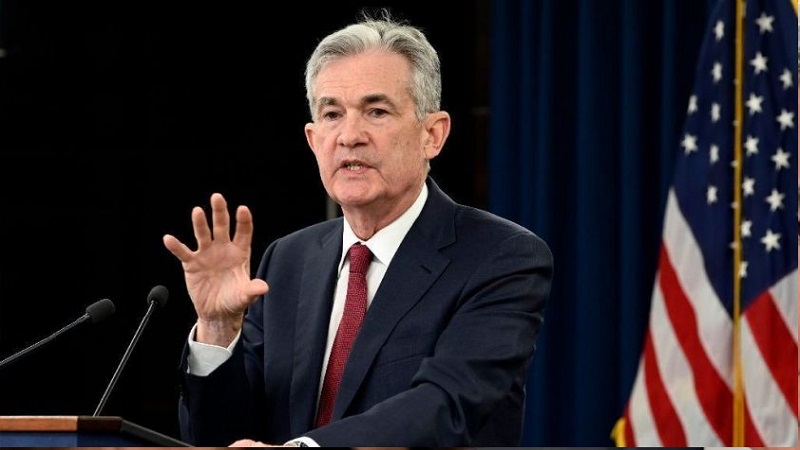
Federal Reserve Chair Jerome Powell struck a cautious but pivotal note at the annual Jackson Hole symposium on Friday, hinting that the U.S. central bank may be preparing to cut interest rates in September.

His remarks marked a turning point in monetary policy discussions, as markets quickly latched onto the possibility of easier borrowing conditions in the months ahead.

“The shifting balance of risks may warrant adjusting our policy stance,” Powell said, carefully avoiding a firm commitment but signaling the Fed’s growing concerns over a cooling job market and uneven inflationary pressures.

The Fed’s benchmark interest rate directly influences borrowing costs across the economy, including mortgages, credit cards, and business loans. Mortgage rates, in particular, tend to move in tandem with the 10-year Treasury yield, which is highly sensitive to both economic outlook and monetary policy changes.

Powell’s comments immediately rippled through financial markets. Gold prices rebounded sharply, buoyed by heightened expectations of a September cut. Spot gold rose 0.7% to $3,362.53 per ounce by 10:26 a.m. EDT (1426 GMT), while U.S. gold futures were 0.8% lower at $3,408.20. The U.S. dollar slid 0.7%, making gold cheaper for buyers using other currencies.

“In his eighth and final Jackson Hole speech, Powell surprised a worried market, opening the express lanes to a September rate cut, which has boosted every single asset, including gold,” said Tai Wong, an independent metals trader. Wong added that the real test would be whether gold can break and hold above the $3,400 threshold in the coming days.

The CME FedWatch tool showed traders now assigning a 90% chance of a 25 basis-point cut in September, up from 75% before Powell’s remarks. Markets are now hanging on to forthcoming jobs and inflation data due before the September 16–17 FOMC meeting.

Gold, which traditionally thrives in low-interest-rate environments because it carries no yield, has gained favor as investors brace for lower returns on fixed-income assets. However, physical demand in Asia remained subdued this week as price volatility discouraged retail buyers, though jewelers in India began stocking up ahead of the upcoming festival season. Spot silver gained 1.3% to $38.67 an ounce, platinum rose 0.5% to $1,359.75, and palladium firmed 1.4% to $1,126.25.

Yet behind the rallying markets, some economists argue that Powell’s pivot is more political than economic, raising concerns about the Federal Reserve’s independence. Some suggest the Fed Chair may have succumbed to intense pressure from President Trump, who has repeatedly called for steep rate cuts to spur growth.

“Powell caved. All FOMC members should be fired for not hiking rates. At least Powell admitted that our economy is weaker and inflation stronger this year under Trump than last year under Biden… Sell U.S. dollars and buy gold & foreign stocks!” said Peter Schiff, chief economist at Euro Pacific Capital.

Schiff, a longtime Fed critic, argued that the economic indices do not yet justify a cut, warning that the decision risks ushering in an era of persistent inflation and stagnant growth. He further emphasized that Powell’s pivot could be bearish for bonds, as a weaker dollar and stronger inflation will sap investor appetite for U.S. Treasuries.

“As a result, demand for Treasuries will fall just as supply rises thanks to soaring budget deficits. To control long-term rates, the Fed will revert to QE,” he added, referring to quantitative easing—a policy of large-scale bond buying that the Fed has previously relied on during financial crises.

Powell’s balancing act—acknowledging labor market risks while conceding inflation remains uncomfortably high—has set the stage for one of the most consequential FOMC meetings in years. Investors are currently betting big on a September cut, but economists remain divided as investors seek an answer to the question: is this a pragmatic response to shifting risks, or the start of a politically driven gamble that could undermine the Fed’s credibility?
Google Signs $10bn Cloud Deal with Meta as AI Infrastructure Race Intensifies

0

The global push for artificial intelligence dominance is no longer just about algorithms or models—it has become a full-scale contest over infrastructure. That reality was underscored on Thursday when Google struck a six-year cloud computing deal with Meta Platforms worth more than $10 billion, according to a source familiar with the matter who spoke to Reuters.

The deal, Google’s second major agreement in recent months after one with OpenAI, will see Meta rely on Google Cloud’s servers, storage, networking, and other services to power its massive AI ambitions. Information first reported the news. Neither Google nor Meta immediately responded to requests for comment.

Meta’s decision comes at a time when its founder and CEO, Mark Zuckerberg, has openly acknowledged the scale of investment required to stay competitive in AI. In July, he said the company would spend “hundreds of billions of dollars” to build multiple massive AI data centers. Reflecting this commitment, Meta last month raised the lower end of its annual capital expenditure forecast by $2 billion, revising it to a range of $66 billion to $72 billion.

To ease the financial pressure of such enormous infrastructure projects, Meta has also begun seeking outside partners. Earlier this month, the company disclosed in a filing that it plans to offload $2 billion in data center assets, a move seen as both a funding strategy and a signal of just how capital-intensive AI development has become.

Meta is not alone in this race. In June, Reuters reported that OpenAI was planning to add Google Cloud services to meet its surging demand for computing power—a striking collaboration given that the two firms are also rivals in AI innovation. OpenAI’s own infrastructure costs are already substantial: Microsoft, its primary partner, disclosed last year that it invested billions into building custom supercomputers specifically tailored for OpenAI’s workloads. Analysts view this as a long-term bet that AI’s exponential growth will justify the upfront cost.

The intensifying focus on infrastructure has transformed data centers, cloud storage, and computing power into the most valuable currency of the AI era. With AI models requiring unprecedented levels of computing capacity, the race is as much about securing reliable access to energy-hungry servers as it is about pushing forward software breakthroughs.

Google itself has been reaping rewards from this surge. In July, Alphabet’s cloud-computing unit reported an almost 32% jump in second-quarter revenue, surpassing expectations—a performance many analysts attribute to the wave of AI partnerships.

The $10 billion pact with Meta further cements Google Cloud’s role at the heart of AI expansion. But more broadly, it highlights a new reality: as companies chase the promise of artificial intelligence, infrastructure investment is emerging as the single biggest—and most expensive—bet on the future.

What is emerging, analysts say, is not simply a race to build the best AI models but a scramble to dominate the unseen scaffolding of the AI economy. Trillion-dollar tech firms are pouring unprecedented sums into the belief that today’s outlays will secure tomorrow’s dominance.

The deal between Google and Meta is just the latest signpost: the AI boom is rewriting the rules of competition, where victory may ultimately be decided not by who writes the smartest code, but by who builds the biggest—and most resilient—foundations.

Goldman Sachs Predicts Stablecoin Boom as Market Heads Toward Trillions

2

Goldman Sachs has projected a massive boom in the stablecoin market, describing the asset as the next major evolution in global finance.

The Wall Street bank, in its new report titled “Stablecoin Summer,” projected that digital assets pegged to the U.S. dollar will expand from about $270 billion today to trillions in the years ahead.

The forecast follows the recent passage of the GENIUS Act, landmark federal legislation establishing the first U.S. regulatory framework for payment stablecoins, and Circle’s high-profile IPO.

U.S. Regulation and Industry Momentum

Recall that the GENIUS Act (Guiding and Establishing National Innovation for U.S. Stablecoins), introduced by a bipartisan group of senators, was signed into law by President Trump on July 18, 2025. The legislation requires stablecoins to be fully backed by safe, permitted reserves such as U.S. dollars and short-term Treasuries.

Its passage marks the first time the U.S. has enacted clear federal rules for stablecoins, creating a foundation for adoption by major corporations now exploring their own digital currencies. At the same time, the House of Representatives has advanced two additional crypto bills: the CLARITY Act, aimed at broader digital asset regulation, and the Anti-CBDC Surveillance State Act, which seeks to limit the Federal Reserve’s ability to issue a central bank digital currency directly to individuals.

Stablecoins in The Global Payment Landscape

Goldman sees stablecoins’ greatest opportunity in enhancing financial infrastructure. With global payment giant Visa processing roughly $240 trillion annually, the bank notes that even limited stablecoin penetration could unlock significant value across remittances, B2B transactions, and real-time settlement.

It forecasts that USDC alone could grow by $77 billion between 2024 and 2027, a 40% annual growth rate driven by regulatory clarity and expanding adoption. In the report, former acting Comptroller of the Currency Brian Brooks, highlighted remittances as a key use case. He noted that with global transfer fees averaging 7%, stablecoins could save consumers billions by providing a cheaper cross-border alternative.

However, not all experts share Goldman’s optimism. Barry Eichengreen, a leading economist at UC Berkeley, cautioned that a proliferation of stablecoins could undermine the “singleness of money”, the idea that every dollar should trade at the same value. If multiple stablecoins trade at varying rates, merchants may face added costs and risks in verifying payments, eroding efficiency, he added.

Market Dynamics and Banking Integration

Today, the stablecoin market is valued at around $268 billion, dominated by Tether (USDT, $166 billion) and Circle’s USDC ($68 billion). Both rely on reserve-backed models, holding safe assets such as Treasuries, cash, and bank deposits.

While Goldman warns that large-scale migration from bank deposits to stablecoins could reshape the financial sector, it notes that such a shift would require stablecoins to provide clear advantages over traditional deposits, something that remains uncertain.

Notably, banks are actively integrating blockchain and stablecoin infrastructure to improve settlement speeds and client services. JPMorgan, for instance, has announced tokenized deposit tokens for institutional clients, which could emerge as a competing alternative to third-party stablecoins.

Looking Ahead

Goldman concludes that the bull case for stablecoins lies in a future where the U.S. economy becomes widely tokenized, with assets such as stocks, bonds, and real estate exchanged directly for tokenized dollars. In such a scenario, stablecoins could rival bank deposits as a core medium of exchange.

For now, stablecoins are moving beyond their speculative origins toward becoming a cornerstone of financial infrastructure. With regulatory clarity, expanding corporate interest, and growing demand for faster payments, the Wall Street bank believes the stage is set for stablecoins to play a transformative role in global finance.

What is GEO? And How Is It Different from SEO?

0

SEO (Search Engine Optimization) optimizes web pages to rank on traditional search engine results pages (SERPs) using keywords and structured data. GEO (Generative Engine Optimization) focuses on optimizing content for generative AI search engines to be included in AI-generated answers and summaries by prioritizing clarity, authoritative sources, structured formatting, and context. While SEO aims for page rankings, GEO aims for content to be extracted, cited, and synthesized by AI, with both strategies working to improve online visibility in different search environments. 

SEO (Search Engine Optimization)

  • Goal: To improve a web page’s ranking in traditional search engine results (e.g., Google, Bing). 
  •  
    Method: Uses keywords, meta tags, technical analysis, and other tactics to make content relevant to specific search queries. 
  • Outcome: A list of links (SERP) for users to click on.
     
  • Focus: Keyword matching to drive traffic and improve page visibility.

GEO (Generative Engine Optimization)

  • Goal: To ensure a brand’s content is visible and cited by AI-powered answer engines and generative AI models.
  • Method: Focuses on content clarity, structured data, authoritative sources, and contextual relevance for AI to interpret and synthesize information. 
  • Outcome: Content being included in AI-generated summaries or direct answers, rather than just ranking pages. 
  • Focus: How AI systems extract, interpret, and generate responses from content, prioritizing citeability and structured formats. 

Key Differences Summarized

  • Target Environment:
    SEO targets traditional search engines; GEO targets generative AI and answer engines. 
  • Primary Mechanism:
    SEO uses keyword matching; GEO uses AI interpretation of intent and context. 
  • Result:
    SEO produces a ranked list of pages; GEO generates direct, summarized answers. 
  • Strategy:
    SEO optimizes for page ranking; GEO optimizes for the AI’s ability to understand, extract, and cite content. 

Google Gemini Veo Brings a New Basis of Competition in AI Race [video]

0

Today, I used Google Gemini Veo which can create videos with simple natural language prompts. At the moment, the length of the video is limited to about 8 seconds, but I expect things to improve in months.

My prompt: “A Tekedia Institute is introducing a new course on AI and is introducing the course to new college students. This is a marketing video designed to get people to understand the importance of AI on careers and impacts in the market. The video also challenges them to take AI courses to advance their careers” with this image attached

Response: this video

Comment: the 8 second limit is a huge limitation but as I said, this will improve. Also, they can clone voices and simulate images. Watch out for career dislocations as AI companies scale the mission. This is not hype…Again, this AI era is real.