DD
MM
YYYY

PAGES

DD
MM
YYYY

spot_img

PAGES

Home Blog Page 6580

The Age of Creative Destruction Is Here

1

Last week, a traditional meatspace advertising agency closed shop in Lagos. His last customer did not renew the contract. The company was a victim of creative destruction where ICT utilities like Facebook and Google are disintermediating agencies by making it easier for brands to reach customers without supply-side gatekeepers. Companies like Google control demand (the customers), and the internet has made supply largely unbounded and unconstrained (there are many ways to get content to the web via Twitter, FB, WordPress, etc) thereby commoditizing supply to a large extent. 

Creative destruction describes the deliberate dismantling of established processes in order to make way for improved methods of production. The term is most often used to describe disruptive technologies such as the railroads or, in our own time, the Internet

So, while they remain important, newspapers are not as dominant as they used to be for brands to reach customers. Understanding that construct, brands now focus on the digital platforms which have the demand (the customers), in the process de-prioritizing the old suppliers of ad space (newspapers) and their syndicated ad agencies. The signs of creative destruction are everywhere:

  • Amazon controls roughly half of US e-commerce and 5% of all US retail sales. It also holds nearly half of global cloud services through AWS, and is carving out a sizable chunk of search.

  • Facebook counts 2.2 billion daily active users across Facebook, Instagram, WhatsApp, and Messenger. That’s 29% of the entire global population

More so, with the ease of use of Facebook and Google ad technologies, most midscale brands do the jobs by themselves with minimal help from external consultants. At the end, it is a double-whammy (lost ads to digital platforms and customers can manage the ads by themselves) and many traditional ad agencies are closing.

This redesign cuts across sectors including banking. For the digital-only-banks in Nigeria, your playbook must consider Silicon Valley Bank. That bank does many things for startups: funding, lending, consulting, networking, and cheerleading. You better check how your industry is changing and ensure you adapt.

How Do You Create Value from “Dead Assets” Like Farmlands in Nigeria?

4

There seems to be challenges on understanding my insights on how we can unlock value from farmlands in our nation. Understand that this has nothing to do with mechanization of farmlands but purely making assets to have “velocity”. I have used that word “velocity” to indicate something that can change hands with ease at the least possible friction. I will explain this in a very simple way thus:

Let us assume that you inherited 1,000 hectares of farmland in remote Abia state. Today, Nigeria will consider you a poor person because the asset is “dead” (un-transferable and no value). Under my proposal, I will get startups to map that farmland and record it in your name. Then, they will register it in the local government/ministry of lands. They would also put the assets in a portal which can enable you to sell say 100 hectares to someone in Lagos, and the part-title moves immediately to the buyer with all powers of the state protecting that buyer. What is happening here is divisibility due to digitization of assets.

Also, you can put another 100 hectares as a collateral to a bank to get money to pay school fees for your kids and also attend to their healthcare needs. The balance of 800 hectares is documented in the ministry as assets in your name which adds to your net worth as a person. 

My thesis is that by doing this, mapping and digitizing and linking that asset to you, your net worth could move from $0 (dead assets) to say $100,000 on that land. Simply, you are now worth $100,000!

By having the ability to “operate” on the $100,000 value, you have built liquidity as a person and have more capacity to borrow and spend, which boosts and drives economic growth. Banks, lenders etc will lend because they know your value is now $100,000, no more the old $0.

Understand that I have not focused on pure selling of any land to anyone. You do not even need to sell the land. You have simply unlocked the assets into your net worth. Also, you may not have planted any crops – this is not farming where we are talking of farm yields.This is purely making a class of asset which is “immobile” with no velocity to become transferable so that values can accrue to the owners. If this explanation does not cut it, contact my team. I will be happy to speak.

Nigeria has about 82 million hectares of arable land. If you put each hectare on average of $1,100, you get about $90 billion as “unlocked value”. Recording the assets easily and making them transferable, people can take loans using the lands as collateral, magically unlocking liquidity in the economy. In short, my $90 billion is pessimistic as the unlocked value could be in multiples.

The Nigeria’s $83 Billion Problem!

2

The Debt Management Office (DMO) says that Nigerian’s total debt profile is N25.7 trillion (about $83 billion using the Central Bank of Nigeria official rate)). The Director-General of the office, Patience Oniha, announced this while addressing House of Representatives Committee on Public Account on Friday in Abuja.

“As at June 2019, our debt profile is at N25.7 trillion; this includes the federal, states governments and the Federal Capital Territory (FCT). We call it the total public debt, out of this total, the federal government is responsible for 80 per cent of the debt,” she said.

Ms Oniha said external borrowing accounted for about 32 per cent of the total debt while the 68 per cent was domestic.

“If you look back several years, over 85 per cent of budget deficits are funded by borrowing which the DMO undertakes as approved by the Federal Executive Council and the National Assembly. We borrow from various sources, the multilaterals, the World Bank, Islamic Development Bank, the African Development Bank, China Exim and we also issue products in the international market. Locally, we are also very active in domestic borrowing, we issue treasury bills, federal government treasure bonds,” she said.

Largely, the amount is relatively huge and for most people, the problem is not necessarily the debts but what the funds were used for, especially at the state capitals. Yet, this debt profile should not be threatening if the government can innovate on policy. If we put velocity on all farmlands in Nigeria (and put those dead assets to work for Nigeria), within three years, we will unlock more liquidity across rural communities, and the accelerated growth will generate tax receipts to pay off this change. Our challenge is looking at the figure, and not inventively pursuing new domains to unlock growth. Yes, a single government policy on the digitization of farmlands can put extra $90 billion in the net worth of Nigerians, boosting spending. That will help us grow faster than sub-2.5%. Nigeria has about 82 million hectares of arable land. If you put each hectare on average of $1,100, you get about $90 billion as “unlocked value”. Recording the assets easily and making them transferable, people can take loans using the lands as collateral, magically unlocking liquidity in the economy. In short, my $90 billion is pessimistic as the unlocked value could be in multiples. 

The National Bureau of Statistics (NBS), says Nigeria’s Gross Domestic Product (GDP) grew by 2.28 per cent (year-on-year) in real terms in the third quarter of 2019.

NBS said this in its “Nigeria GDP Report for Third Quarter 2019’’ released on Friday in Abuja.

It explained that when compared to the third quarter of 2018, which recorded a growth of 1.81 per cent, the real GDP growth rate observed in the third quarter of 2019 indicated an increase of 0.47 per cent points.

The bureau said that relative to the second quarter of 2019, which recorded a growth rate of 2.12 per cent, third quarter 2019 represented an increase of 0.17 per cent points.

Comment on LinkedIn Feed

Deji – let me try again. If you inherited 1,000 hectares of farmland in remote Zamfara, Nigeria will consider you a poor man today because the asset is “dead”. Under my proposal, I will get startups to record/map that farmland in your name, register it in LGA, have it in a portal which can enable you to sell 100 hectares to someone in Umuahia and the part-title moves immediately to him with all powers of the state protecting that buyer.

Also, you can put another 100 hectares as collateral to a bank to get money to pay school fees for your kids. The balance of 800 ha is documented in the LGA as assets in your name which adds to your networth. So, by doing this, mapping and digitizing and linking that asset to you, your networth could move from $0 to say $100k on that land. By having ability to “operate” on the $100k, you have built liquidity as a person and have more capacity to spend, which boosts growth. Banks, lenders etc will lend because they know your value is $100k.

Your comment was not based on my piece and video. You are essentially thinking something else. This is not selling land, this is unlocking dead capital.


Understanding the Power of Positive Illusion

0

I saw a dying cockroach this morning. It was inside a bowl that contained a little water. I felt so uncomfortable removing it, especially as those eyes at the back of its head kept staring at me. I observed this cockroach for some minutes, wondering why it should have those big unblinking “eyes” at the back of its head. That was when it dawned on me – those weren’t eyes, they were just false eyes.

During our biology classes we were taught of false eyes found in many insects. But the examples our teachers and textbooks gave us were butterflies and moths. I never knew cockroaches had one until today. But, why would these animals have spots that look like eyes staring at their observers? And, why do those “eyes” look so threatening and bigger than the actual eyes?

There is just a simple answer to this – illusion.

The effect that cockroach created in me taught me a lot of lessons on the power of illusion. I was uncomfortable, or rather afraid of going near it because I had this unsettling feeling that it was dangerously staring at me. Even if I know it can’t harm me, I still withdrew from killing it or even going near that bowl of water because of the impression created by those eyes. That’s the power of illusion.

If you check the Oxford Advanced Learner’s Dictionary for the meaning of the term, you will see that the meaning of illusion borders around negative attribute. It is looked upon as something that shouldn’t be imbibed. In fact, a lot of people kick against it even when they partake in it unknowingly. But I want to state that illusion can be both positively and negatively utilised. I’ll explain that later.

Now, if you ask me what illusion is I’ll tell you that it is the act of making people see what you want them to see. Illusion isn’t just about the sense of sight, it appeals to all the human senses. For example, we use bouillon cubes (aka magi) that contain the dreadful monosodium glutamate to give out the illusion of great flavour and aroma for our dishes. We use perfumes to give out the illusion of cleanliness (masking our natural smells so people will think we just took our bath). Women make up and fix nails, hairs, lashes and so on just to create the illusion of beauty. You just name it.

So, when we attribute negativity to illusion, we should always remember that we partake in it, knowingly or unknowingly.

Now, over to why illusions are powerful.

When you walk into a hospital, and meet a young man in a sparkling white lab coat, what’s the first thing that comes to your mind? I bet it is the fact that this young man is a medical doctor and that he can help me with your illness. I can tell you that when you want to address this young man, you will do so with much respect. If you had seen him without that lab coat, you may assume him as one of the patients and may even push him out of the way. The truth is that the young man created the illusion of superiority and you bought it immediately without waiting for him to talk to you.

Let me give another instance. You walked into a restaurant. The cool air from the AC hit you as you stepped in (meanwhile the electric door opened for you as you stepped on the threshold). You looked around. There are well-laid tables covered with immaculate white table cloths; there are “gold-plated” lit chandeliers dangling from beautifully decorated ceilings; soft music played at the background; and the floors were tiled with original porcelain tiles that reflected your image like a mirror. A waiter in sparkling white apron approached you, smiled and took you to a table beside a wall made only of glass that gave you beautiful views, and then he took your order. Let me state it here that even this people served you burnt eggs you will believe that it is a special type of dish eaten only by the high class. You know why? It is because these people have succeeded in creating the illusion of speciality and class. And one more thing, you won’t argue with whatever bill they place before you because you are “satisfied” with the burnt eggs.

Creating the right illusion is what a lot of us need. Some people create negative illusions so as to intimidate and extort while others create positive ones that endear them to people. A lot of marketers have learned this strategy and have been using it to the fullest. Other professionals that know how to use this skill (for I see it as skill) are doctors, lecturers, preachers, bankers and motivational speakers. And at home, mothers use it to keep their children on the right track.

Job seekers and students are the next people that need to learn this skill. Making your interviewer believe that you are the right person for the job is more than just answering all the questions correctly. There is a possibility that all the interviewees performed well in the interview, but the only thing that can make you stand out is by letting yourself exude that aura of confidence, which is as good as illusion (because deep down butterflies are fluttering seriously in your guts). This is still the same thing with students. The cases of sexual harassment wouldn’t be in our tertiary institutions if our students have mastered how to create that illusion that warns off predators (just like the cockroach did me today).

No matter how we look at it, we all need to learn the skill of creating the right illusions so that can save grave situations, get people to listen to us, get employment and live better and happy lives.

However, we need to be careful so we don’t create the ones that will send away our helpers.

How KDI is Redesigning Advocacy for Youth Agenda in Osun State, Nigeria

0

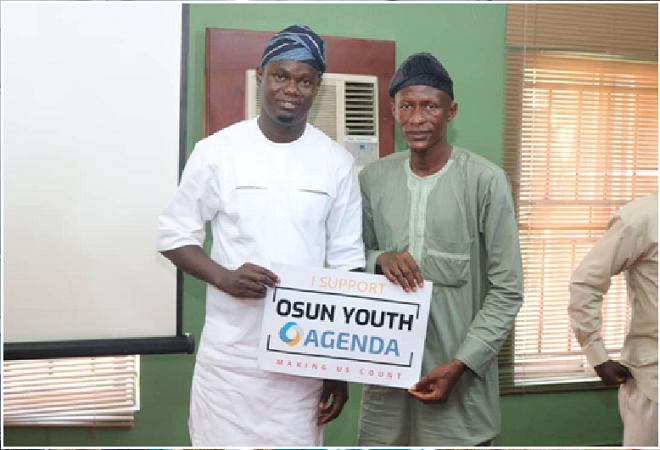
In Osun, just like the rest of Nigeria, they suffer from economic disadvantage and unproductive engagements. The number is in their favour, yet their voices are never heard. It has been said that there is need for youth inclusion in government decision making process. However, the worst they get is being used in supporting partisans when elections knock on the door. They have the energy to campaign. They have the passion to convince. They have the power to struggle and sometimes engage in physical assault. But, whenever the elections are over, their grave situations still stare them in the face. Their potential waits for another four years to be tapped. This was the lot of the youth in Osun before the 2018 gubernatorial election. A non profit, Kimpact Development Initiative, had embarked on a good governance campaign tagged the Vote not Fight, a campaign  was meant to minimize violence during the governorship polls. The organization observed that the major perpetrators of violence are the youth. Still, their fortunes do not get improved either in terms of getting the highly prized dividends of democracy or even in participating in decision making process. And partisans only see them as instruments of mobilization at election time.

After the hugely successful campaign against electoral violence, KDI saw a gap. A wide one in that instance. If these youths were fully persuaded to shun violence at election time, how are they engaged after elections? If truly the idle hand is the workshop of the devil, the youths must be productively engaged. To stop the youths from being used by politicians during  elections, their pre election engagement and welfare matters. It is reasoned that to lure a productively engaged youth to political violence would be a herculean task.

This prompted the organization to roll out a survey – Youth Priority Needs Survey (YPNS)- across the length and breadth of the state. The survey was meant to give the youth a voice in their own affairs and as well identify and validate the areas of their needs.  Employment and Wealth Creation; Improved Agriculture; Improved Health Facilities; Quality Education and Improved Infrastructure were the talking points. The outcome culminated in the tagline for the campaign – Osun Youth Agenda. With funding from donor agencies such as National Democratic Institute, United States Agency for International Development and United Kingdom Agency for International Development, KDI began a journey not only to clearly and smartly articulate the voice of the youths on their priority needs but also to make such needs policy driven. This was an onerous task because the aggregated voices of the youths on their needs must be heard by the stakeholders who must be moved to draw them into policy and budgetary frameworks for implementation. In this time and era of dwindling resources amidst rising government bills, it was imperative for the youth needs to align with existing government programmes.

As a member of the 8-man technical committee of experts on Osun Youth Agenda, I was part of the process of smartening the demands of the youths to make them policy driven and implementable. We had a 5-day brainstorming cum engagement session where the mapped needs were turned into workable and implementable points and policy demands. After serious deliberations, it was agreed that the state needs a youth policy as well as a youth development commission.  The commission would see to the integration and mainstreaming of youth aspirations and development needs into the policies and planning processes of the state at all levels. The commission would help in implementing the youth policy. Other policy points fashioned out include a rejuvenated youth targeted agricultural scheme, conversion of a popular market in Osogbo to a computer village, establishment of a well equipped youth business innovation hub as well as the review and rearrangement of Osun Youth Empowerment Scheme (OYES).

The demand for youth development commission is the umbrella demand of the Osun Youth Agenda. Unlike a ministry, the commission would be established by law, funded through funds and grants drawn from multiple sources such as government, the private sector and development partners. Models of Lagos State Employment Trust Fund, Kogi State Youth Development Commission, Akwa Ibom Youth Development Fund and Oyo State Agency for Youth Development were adopted, adapted and domesticated. It was observed that setting up a ministry is at the discretion of the governor. But, a commission established by law stands. It could not be tampered with except through the instrumentality of the law that establishes it.

There are a number of agricultural or farm settlements in selected zones in the state. Osogbo and Ago Owu are popular settlements. The Osun Youth Agenda advocated that the settlement should be made more youth friendly and conducive for young farmers.  In order to harvest the different young talents in the IT world in Osun, it was suggested that a computer village and an Innovation hub be established to enable young Osun IT-preneurs to flourish. There were equally recommendations concerning reviewing the existing Osun Youth Empowerment Scheme. It was recommended that the scheme be repackaged to encourage the participants to become entrepreneurs. This scheme should train the young participants in business development; give them seed funding and as well attached them to successful entrepreneurs for mentorship for a certain period of time.

KDI employed an intensive advocacy strategies and tactics. The technical committee members and the KDI team were involved in advocacy visits, stakeholder engagements, policy brief generation and policy dialogue. The campaign which started with a clear roadmap to the destination culminated in various visits to critical stakeholders and policy makers. The Policy Dialogue was the last of such interaction. The governor of the state was well represented by the Deputy Governor, Mr. Benedict Olugboyega Alabi. The Speaker of the State House of Assembly, Rt. Hon. Timothy Owoeye and the Chief Whip, Hon. Tunde Olatunji were at the dialogue too. The policy dialogue also had in attendance  high representations from concerned ministries including Ministries of Agriculture, Health and the then Empowerment and Youth Engagement. Commitments were secured from the attendees  and promises were made on the Osun Youth Agenda. Again, I led the team that collated and drafted the outcomes of the dialogue and as well coordinated the communiqué session.

It is seven months down the line when the technical committee first met with KDI for a strategy session on Osun Youth Agenda. The efforts have started to yield results. Few weeks after the policy dialogue in Osogbo, a ministry solely dedicated to youths and sports was created. A 40-year old was put in charge to run the affairs of the ministry. The bill seeking the establishment of the state youth development commission is on its way to the state legislature. The advocacy for the betterment of the affairs of the youth in Osun is yielding result. Special thanks to KDI. We should celebrate soon.