Common mistakes most employers make – they put the company over the employees. A great leader knows that the employees make the company.
Employees are like the engine in a vehicle. Investing in them makes everything works. If you value your workers, they will definitely value your company.
Besides, employees are brand ambassadors. They represent your company. They interact with the customers every day and have total power control over the future of your company. The best way to drive your company forward is by ensuring there is an employee engagement policy being laid down.
Employee engagement is perceived to be one of the essential points for improving business results. The notion of effectively shaping the worker’s expertise is targeted on improving the engagement of employees to cut back turnover, improve productivity, increase accountability and achieve results. Also, it gives the employee a sense of belonging, therefore, enabling them to treat the company like their own.
However, in spite of all the analysis that abounds on improving engagement, it is noteworthy that several organizations still do very little to enhance the leadership’s engagement within the workforce. No wonder many of these companies have folded. They are no longer in operation.
The first problem most companies encounter is from the employees. The moment a company loses the trust of the employees, it becomes difficult to grow because every other department of the company can never function.
Listed below are five ways to destroy worker engagement:
Don’t attempt to offer a vision: You know the task your department must accomplish. There’s no need to offer any reasonable vision or purpose; employees got to do what’s expected of them. Everyone ought to grasp the tasks they have to complete; don’t worry about helping employees understand how what they are doing ties into a bigger image of what you’re attempting to accomplish and why. Too much information just muddies the waters and it is distracting. It doesn’t make sense to hire a smart person and tell him what to do. Rather, let him tell you what to do. It makes him feel trusted, and that will enhance his self-confidence.
Don’t be afraid to let your true feelings show: When things begin to go awry or once employees don’t meet your expectations, you must be at liberty to express your negative emotions with all of the intensity that you simply can muster. Keeping your emotions at bay within yourself sometimes doesn’t work very well. They’re going to come out sooner or later, therefore you may as well let them loose. Feel free to yell, scream, and use profanity. All of those behaviours can serve to get people’s attention and allow them to understand their lack of performance is completely unacceptable.
Don’t express appreciation: People don’t need to be recognized or appreciated. All of this verbal praise becomes pointless if you are doing it all of the time. Individuals are paid for what they are doing, therefore don’t worry concerning expressing any kind of verbal appreciation or recognizing them in any other means. The monetary rewards associated with their work is satisfying enough.
Don’t encourage people to work together: It is better if people simply specialize in doing their work without distraction. All this getting together to collaborate could be a waste of your time. Decisions in groups often take too long and are often not made at all. Keep people targeted on their specific goals while not involving others.
Don’t offer feedback: The whole notion that people need or want feedback is overrated. The most effective feedback is the results that individuals receive from the work that they are doing. Tell individuals to take stock of what they are doing and alter what they have to get higher results. They shouldn’t have to be checking in with you to understand how they’re doing.
Conclusion
If this is the method you lead your team, I can guarantee that turnover is going to be high, productivity is going to be lower, morale is going to be in the tank, and you may not get the results that you simply need.
Simply take every point above and take away the word “don’t,” turning the suggestions into a positive statement of what you must be doing to increase worker engagement.
The growth of the digital marketing has been hinged on the increase in the number of people who use the Internet across the world. In the last few years, the rise has been witnessed more in developing countries because of the yearly surge in the number of people having access to the Internet, especially those in the remote locations.
According to the existing statistics the world is having over 4 billion Internet users as at July, 2019 with an increase of 366 million from the number had in January, 2018. Information has it that this figure represents 56% of the global population, indicating the availability of a significant number of people, businesses, individuals and governments could push various contents to towards brand image enhancement and sales generation.
Using the platform successfully would mainly depend on the companies’ capabilities and abilities to overcome varied challenges associated with it in Nigeria. This piece is not about highlighting and exemplifying the challenges, but to give an account of how the Nigerian facilities management companies are performing on the platform relatively to their counterparts in the world.
From the website presence to the social media including, professional media, the piece offers insights the companies could leverage to increase their online presence to boost sales and improve public and private recognition of the values of the facilities management industry. The insights were generated having analysed the wrongs within the companies’ digital marketing strategies.
In its recent report on the industry, the British Institute of Workplace and Facilities Management documented players in the industry. Thirty companies were grouped into active participant category. These are the companies that were active on various digital platforms (Website, LinkedIn and Facebook) between August and October, 2019.
Further examination of the presence of the presence indicates that some companies’ websites were under construction or not existing at all during the analysis period. It is also important to inform that the Internet-enabled data collection tools used could not turn out enough data for analysis during the period. The brands that had this issue were mainly not pushing sufficient information to the public, most especially their target markets.
The Website
Alexa is our first data source for the examination of the companies’ websites. It ranks websites using a combination of average daily visitors and pageviews over the past month. The site with the highest combination of visitors and pageviews is ranked #1. In this regard, Nigerian FM brands were analysed along with the other brands in the world.
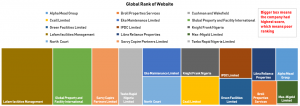
Analysis shows that Cushman and Wakefield, a foreign owned brand, had 87,980 score, representing the lowest score and highly ranked brand in terms of website presence [Exhibit 1. On this exhibit the company does not appear because of the low score. Other companies are displayed because of the highest score garnered which translated to the low ranking of their websites]. Max-Migold, a local brand, closely followed Cushman and Wakefield with 1,849,073 score while Broll Properties Services (2,282,147), Alpha Mead Facilities (2,755,054) and Libra Reliance Properties were in third, fourth and fifth positions respectively.
Exhibit 1: Global Ranks of the 15 Companies with Website Presence
Source: Alexa, 2019; Infoprations Analysis, 2019
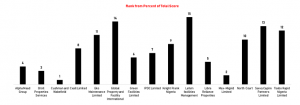
Exhibit 2: Rank Deduced from Percent of Total Score
Source: Alexa, 2019; Infoprations Analysis, 2019
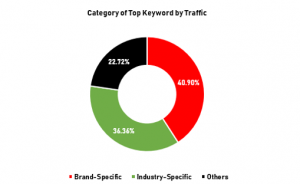
Examining the websites from the keyword perspective, analysis reveals that people searched the companies using brand and industry specific words. Alpha Mead, Avant properties, Cushman and Wakefield, Eko maintenance limited, PFI global, James Cubitt, Lafam, ProFM credential and Willco were brand-specific words used mostly by the public. The industry-specific words include facility management company, real estate development company in Lagos, luxury real estate Lagos, facility management, real estate development prospectus and facility maintenance services. Apart from these keywords, Shoprite Jakande, departed asos, personal loans, walls of Benin, brain dumps notes were also found.
Exhibit 3: Category of Top Keyword by Traffic
Source: Alexa, 2019; Infoprations Analysis, 2019
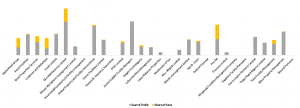
Two things were examined along with these keywords. The Search traffic, which is defined as the percentage of organic search referrals to each website from the keyword. The share of voice is the percentage of all searches of the keyword that sent traffic to each website. For instance, out of the expected 100% search traffic for Alpha Mead, the brand had 23.57%. For the 100% of the share of voice, the company had 26.64%. Avant Facilities attained 61.27% search traffic. Despite this figure, the company recorded 1.53% share of voice.
The performance of Lafam facilities management resonates with Alpha Mead’s performance. The public use of Lafam facilities management as keyword generated 23.57% search traffic, while the share of voice was 0.39%. Eko Maintenance Limited, Global Property and Facility International, Wilco Property Management and Pro FM performed well during the period. The use of Eko Maintenance Limited as the keyword garnered 98.89% search traffic for the brand, while the share of voice was 39.05%. Global Property and Facility International followed it with 86.60% and 3.12% as a percent of search traffic and share of voice respectively. Wilco Property Management had 69.42% as search traffic percent, while Pro FM had 47.48%. In spite of the low search traffic recorded by Pro FM, it edged out Wilco Property Management in share of voice (0.19%) with 43.02% it attained.
Exhibit 4: Comparison of Search Traffic and Share of Voice
Source: Alexa, 2019; Infoprations Analysis, 2019
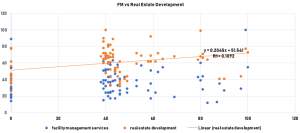
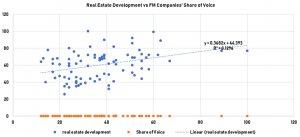
Real estate development and facility management services were part of the dominant keywords used by the potential clients during the period. Our expectation is that the clients wanted to understand the link between the two. This informed the need to do an analysis of the volume of interest in facility management services along with real estate development and real estate development with the share of voice percent recorded by all the brands.
The results indicate that the clients only understood facility management services within the real estate development by 10.9%. This is below 50% expected average of facilitation. However, the brands’ share of voice ensured 12.9% facilitation in the real estate development. This implies that the brand, industry and other related keywords helped the clients to understand the real estate development.
Exhibit 5: The Place of FM Services in Real Estate Development
Source: Alexa, 2019; Google Trends, 2019; Infoprations Analysis, 2019
Exhibit 6: FM Companies’ Voice in Real Estate Development
Source: Alexa, 2019; Google Trends, 2019; Infoprations Analysis, 2019
For example, the emergence of real estate development company in Lagos, luxury real estate Lagos, facility management, real estate development prospectus and facility maintenance services as keywords that appeared along with the brand-specific keywords signifies that the studied FM companies have embedded these keywords on their websites fully or partially.
To successfully capture value from the real estate segment of the built environment, the brands must extrapolate their capabilities and competencies being used for the promotion of FM solutions to the marketing of total real estate solutions. The emphasis should be on the benefits that would accrue to a building when solutions are provided to the faulty parts of the building simultaneously not single-handedly.
Social and Professional Media
In the earlier analysis, Savvy Capire, Alpha Mead Facilities, Eliezer Workplace, Total Facilities Management, and Global Properties and Facilities International are the most socialised brands within the Facebook social networking site. Within the LinkedIn, a professional networking platform, Alpha Mead Facilities, Global Properties and Facilities International, Eliezer Workplace, Green Facilities and Broll are the most socialised brands.
In the current analysis, Max-Migold (10.677), Alpha Mead (8,909), North Court (742), Eliezer Workplace Management (627) and Green Facilities (533) are the brands with the highest number of connections on LinkedIn. Meanwhile, having the highest number of followers seems not to excite the brands because analysis suggests low social proof.
The response of the managers of the brands’ accounts to the followers, when they commented or liked the information posted was low. This aligns with the previous analysis which indicates that employees of the brands did not always share industry-related topics and commented on FM issues raised by professionals on the platform. The failure to improve on social proof would continue to enhance followers’ confirmation bias because they have been denied evidence-based information which could reduce the hypotheses about the companies, particularly the solutions being offered.
Google ispaying $7.35 per share for Fitbit, a wearables company, in an all-cash deal that values Fitbit at $2.1 billion. This is a great move for Google; simply, it will accelerate its capacity to have solid competitive presence in the wearables sub-sector of mobility. For Fitbit, this is a hard landing for a company that previously showed signs of promises, as high as $51.90 per share, before it began to dim.
Relatively speaking, this is a great landing for Fitbit . The company’s price has fluctuated significantly as it worked to adjust to a changing market and fumbled on some of its more recent launches. In summer 2015, it hit an all-time high of $51.90, but this August it went as low as $2.81 after more than two years hovering below $7 — a pattern that changed dramatically after the first reports of Google’s interest began to surface in September.
Yet, the reason why Fitbit did not thrive, on market valuation, was not really due to any market failure in the wearables pioneer, rather, it was because of ICT utilities like Google and Apple. Largely, irrespective of what Fitbit does, investors will remain nervous that one tweet from Apple or Google could annihilate the company.
With that mindset, most have stayed out of the game, looking from outside. That construct is the reason why companies that do things which Apple or Google could do in the near-term will continue to struggle in public markets. Yes, they would remain suspects because of the shadows of the ICT utilities. No matter how you look at it, Fitbit has no chance!
Google is buying Fitbit for $2.1 billion. In this piece, I explain the challenge before companies that do things which are close to what Apple, Amazon or Google (the ICT utilities) may have interests in the near future. Fitbit did not fail as a technology company, Fitbit failed as a “value company” because most investors never felt comfortable buying it, because of the concern that Apple or Google could simply decide to begin doing whatever Fitbit is doing. Under the shadows of these ICT utilities, most promising companies will struggle, and that is a huge challenge in our contemporary technology time. (LinkedIn summary)
The acquisition announcement
Helping more people with wearables: Google to acquire Fitbit
Rick Osterloh
Senior Vice President, Devices & Services
Published Nov 1, 2019
Today, we’re announcing that Google has entered into a definitive agreement to acquire Fitbit, a leading wearables brand.
We believe technology is at its best when it can fade into the background, assisting you throughout your day whenever you need it. Wearable devices, like smartwatches and fitness trackers, do just that—you can easily see where your next meeting is with just a glance of an eye or monitor your daily activity right from your wrist.
Over the years, Google has made progress with partners in this space with Wear OS and Google Fit, but we see an opportunity to invest even more in Wear OS as well as introduce Made by Google wearable devices into the market. Fitbit has been a true pioneer in the industry and has created engaging products, experiences and a vibrant community of users. By working closely with Fitbit’s team of experts, and bringing together the best AI, software and hardware, we can help spur innovation in wearables and build products to benefit even more people around the world.
Google aspires to create tools that help people enhance their knowledge, success, health and happiness. This goal is closely aligned with Fitbit’s long-time focus on wellness and helping people live healthier, more active lives. But to get this right, privacy and security are paramount. When you use our products, you’re trusting Google with your information. We understand this is a big responsibility and we work hard to protect your information, put you in control and give you transparency about your data. Similar to our other products, with wearables, we will be transparent about the data we collect and why. We will never sell personal information to anyone. Fitbit health and wellness data will not be used for Google ads. And we will give Fitbit users the choice to review, move, or delete their data.
Three and a half years ago, I joined Google to create compelling consumer devices and services for people around the world. Our hardware business is still relatively young, but we’ve built a strong foundation of capabilities and products, including Pixel smartphones and Pixelbooks, Nest family of devices for the home, and more. Google also remains committed to Wear OS and our ecosystem partners, and we plan to work closely with Fitbit to combine the best of our respective smartwatch and fitness tracker platforms. Looking ahead, we’re inspired by the opportunity to team with Fitbit to help more people with wearables.
Let me address it here – yes, since the day MTN Nigeria sneezed that it would go “financial” after the Central Bank of Nigeria had postulated its upgraded financial inclusion strategy, most Nigerian banks have been losing market caps. While there are many factors that could have resulted to this precipitation, my conclusion is that markets are pricing a redesign in the financial sector. And most players believe MTN Nigeria MoMo product, on maturity, will trigger dislocations in the sector.
Our largest bank by market cap, GTBank, had fallen from N1.3 trillion to now N741 billion even in a time it has been declaring massive profits and growing revenues. Simply, there is no reason why that should happen. But it is happening due to market perceptions. Look at those numbers; it is only in Nigeria that a bank will deliver such, and yet nothing great happens on its stock (see the figure). Tell me, if massive profits do not deliver the glory of market cap bumps, what will?
The Bank’s balance sheet remained resilient with Total assets and Shareholders’ Funds closing at N3.519trillion and N636.8Billion respectively. Full Impact Capital Adequacy Ratio (CAR) remained very strong, closing at 23.6%. In terms of Assets quality, NPL ratio and Cost of Risk (COR) improved to 5.6% and 0.2% in September 2019 from 7.3% and 0.3% in December 2018 respectively. Complementing the improvement noted in NPLs and COR, we maintained adequate Loan Loss coverage of 95.2% for Lifetime Credit Impaired Loans (NPLs). On the backdrop of this result, Post-Tax Return on Equity (ROAE) closed at 32.3% while Post-Tax Return on Assets (ROAA) stood at 5.8%.
Commenting on the financial results, the Managing Director/CEO of Guaranty Trust Bank plc, Mr. Segun Agbaje, said; “The Bank’s 3rd quarter result reflects the strength of our franchise and the quality of our business strategy to deliver sustainable long-term value for our shareholders. Going into the final quarter of the year, we will continue to differentiate ourselves by maintaining a high standard in service delivery and leveraging our resources, expertise and network to enrich the lives of our customers. That’s why, from November 10 – 11, 2019, we are organizing the GTBank Fashion Weekend, the biggest consumer-focused event in Africa’s fashion industry, to give indigenous small businesses the platform and access to new markets and customers that they need to grow.”
Perception of markets – and you can blame MTN partly for that. Of course, this trajectory is not just on GTBank; other local banks are experiencing the same challenges.