DD
MM
YYYY

PAGES

DD
MM
YYYY

spot_img

PAGES

Home Blog Page 6594

Last Week in Nigeria’s Capital Market – All Shares Index, Tech Giants, Iconic Founders

0

Welcome to This Week in the Capital Market, a summary of events, headlines, comments and lessons from key events in the Market. This week’s roundup covers the performance of Nigerian Stock Exchange All Shares Index (ASI), investment insights, Nigeria’s tech giants – Interswitch and Jumia. We closed the gist with a question: what is missing in the world that Jack Ma and Co. are looking for in Nigeria?

  1. How do you measure the performance of the stock market?

For investment enthusiasts, ASI is a parameter used to measure how well a stock market is performing. You can view it as the daily ‘jamb score’ or ‘CGPA’ measuring the combined daily performance of all stocks in the equities market. As an example, the ASI ‘scored’ 26,339.11 on 13th November, 2019 and recorded a higher score of 26,843.11 on 14th November, 2019 reflecting a growth of 1.91%, when this happens we say the market gained or closed in green vice versa.

The Nigerian Stock Exchange All Shares Index (ASI) has closed mostly in the red (loss) zone this year, leaving most stocks largely underpriced. Currently, our ASI is one of the worst-performing equities indexes globally; for the record, our stock market used to be the toast of Investors globally. Find below a pictorial representation of the daily performance of the ASI in 2019.
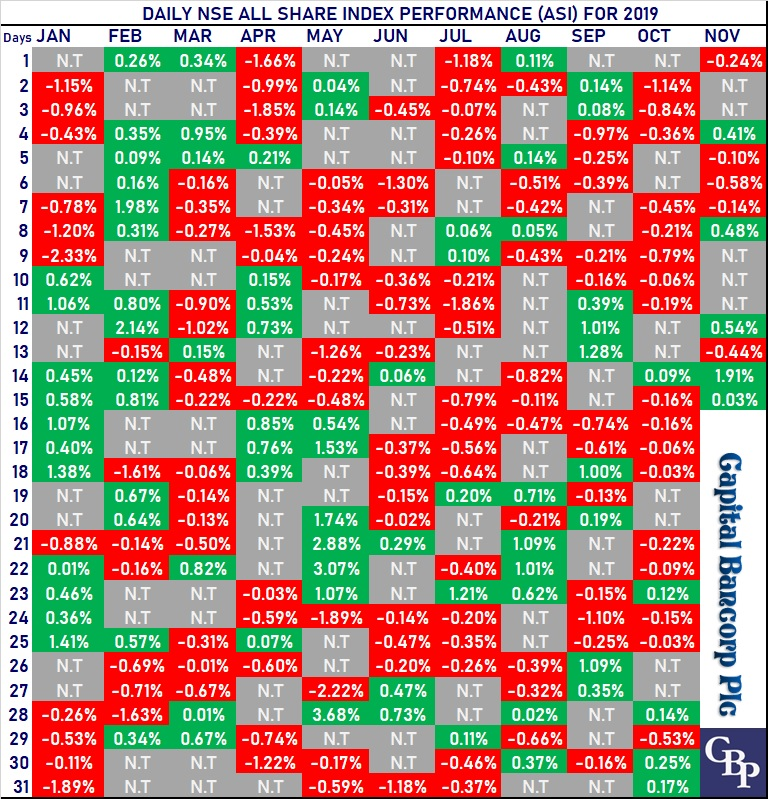
Falling ASI or stock prices cause panic in some investors, but fluctuations in the stock market represent business as usual. Investors who are comfortable with this reality know how to respond to falling prices and how to pick companies that are good buys when stock prices are on the downward trend.

Lesson: what should you do when the stock market is in red?

Find a good stock (company) that is underpriced (cheaper than it should be), buy and be patient. Most importantly, you must know your investment objective, risk appetite and investment horizon (how long you want to hold the investment).

  1. Last week Thursday Stock Market Frenzy: crashing treasury bills rates, bulls to the rescue

On Thursday, 14th November, 2019, the market gained 1.91% to close in green. The highest gain witnessed in a day since May, 2019. This led to a frenzy among investors. In fact, the frenzy is a good reflection of exactly what the market is about, it’s about impressive financial results, directives, regulations, government policies, trends etc.

What caused the frenzy this time?

On 23rd October, 2019, CBN issued a directive excluding individuals and local corporates from investing in ‘high-yielding’ Open Market Operations (OMO) auctions. As a result, the second T-Bills auction after this directive drove rates into the region of single digits (the lowest in 3 years) leaving Investors with zero real returns as follows:

  • 91-day tenor: 7.7998%
  • 182-day tenor: 9.00%
  • 364-day tenor: 10.00%

The current inflation rate is 11.24%, if you invest in any of the treasury bills above, you have not added anything to your wealth. As a result, Investors dashed to the stock market on the 14th of November, 2019 to hunt for stocks with potentials for higher yields and returns.


Typically, when money market rates are down, the equities market becomes attractive for better returns. This explains why the stock market achieved a 6-month high performance on 14th November, 2019 when the treasury bills rate hit a 3-year low on 13th November, 2019. In investment, a lot can change in two days.

Lesson: ensure your investment portfolio is appropriately diversified between the money market and equities market investments.

  1. Visa plans to stake $200 million Nigeria’s pioneering fin-tech company

According to Sky News reports, US-based payments giant, Visa is set to invest $200 million in Interswitch in return for a 20% stake. Do the maths (100/20 times $200m), this will effectively value the company at no less than $1 billion. According to the report, both parties are in advanced talks and could be announcing the deal anytime soon.

If all goes as announced, Visa will become one of the major shareholders in Interswitch; a strategic move that will put Visa in a good position ahead of Interswitch’s planned IPO in London during the first half of next year.

Food for thought: Interswitch was founded in 2002 and it’s already valued at $1 billion, Union Bank was founded in 1917 yet valued at just over $560 million, says everything about possibilities and the power of technology.

  1. Jumia’s losses widen as JumiaPay accelerates the possibility of profit in 2022

Jumia’s growth initiatives are impressive as seen in their financial reports and they have a real potential to take advantage of the emerging African market.

Clearly, the allegations of fraud made about the company may have been overblown and less material than feared, fake orders and orders originating as a result of JForce agent misconduct accounted for 1%-2% of total sales in 2018, and less in 2019.

Key highlights of operational and financial performance:

  1. Added 636,000 new customers during the quarter.
  2. Jumia now has 5.5 million annual active customers, up by 57% from 3.5 million in 2018.
  3. These customers have made 7 million orders as at Q3 2019, up by 95% from 3.6 million recorded in 2018.
  4. On the revenue side, Jumia continues to drive monetization from diversified marketplace revenue streams:
  • Commissions charged to sellers grew by 27%.
  • Delivery fees charged to consumers grew by 82%.
  • Value-added services, which include services to sellers around logistics, packaging, content creation, grew by 33%.
  • Revenue from ad solutions to sellers and advertisers grew by 125%.

Sadly, 3rd quarter operating losses widens by 22% to $55 million year-on-year.
Going forward …

According to the GSM Association, a trade group representing mobile network operators worldwide, in 2018, sub-Saharan Africa witnessed 1.7 billion interpersonal payment transactions totaling $26.8 billion via mobile phones, this presents a huge opportunity for JumiaPay. Currently, JumiaPay primarily handles purchases made on Jumia’s e-commerce marketplace.

“On payments, we’re making great strides with JumiaPay, which is showing very strong growth momentum in both volume and transaction terms. The JumiaPay on-platform total payment volume increased by 95% year-over-year, while the number of JumiaPay transactions accelerated by 262% over the same period. These are excellent results. We’re very pleased with the development and traction of JumiaPay.” Sacha Poignonnec, Co-Founder & Chief Executive Officer

With the bubble recorded by JumiaPay, a lot can happen before the projected 2022 year of profitability for Jumia.

  1. What is missing in the world (of opportunities) that Jack Ma and co. are looking for in Nigeria?

On Thursday, 7th of November 2019, co-founder and CEO of social media service, Twitter, and mobile payments company, Square, Jack Dorsey along with four other executives of Twitter were in Lagos.

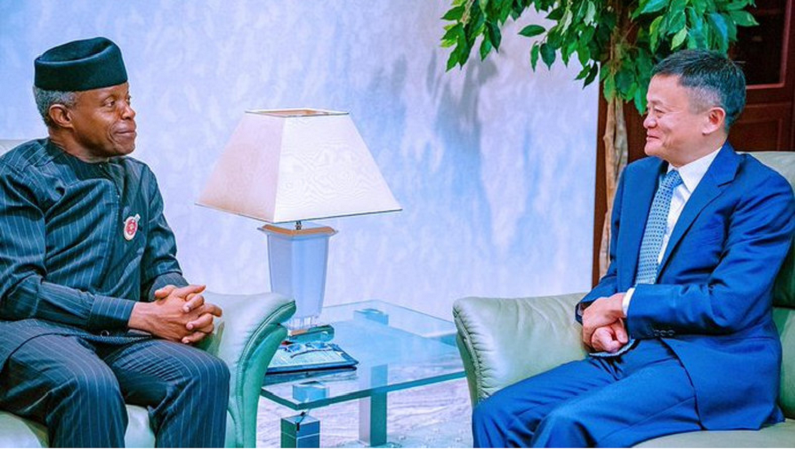
The following week, Jack Ma, former CEO, Alibaba turned up in Abuja for the Digital Economy Summit. According to a report by Channels Television, Jack Ma said he is ready to invest in Nigeria through his “Four Es” programme – E-infrastructure, Entrepreneurship, E-government, and Education.

What is missing in the world that they are looking for in Nigeria?

If you were expecting to find an answer here, sorry, I don’t have your answer. I guess that’s why I’m not a Founder yet. One thing is clear, the tourist potentials of Nigeria have not improved so they did not come here for the fun of tourism…they were here for something.

Whatever it is they are looking for, may unleash a goldmine of solutions and gains. We hope you will find it before they do, cheers to the next Founder.

It’s a wrap for the week!

Reasons Why Forex Traders Fail and Lose Money

0

According to statistics, only 20% of traders earn on Forex, while the rest either accept forex losses or ingloriously leave the foreign exchange market. Each trader has his own reasons for failures and major losses. But at the same time, there are the most popular traps that many participants in the foreign exchange market fall into. Knowing the reasons why traders fail, you can significantly increase your chances of success by circumventing the pitfalls of the market.

Reluctance to Plan Your Trade

Regardless of which financial market and assets a trader chooses, without planning, his chances of success are 0.01%. And this micro-percentage is given to banal luck. The first thing a trader must do before opening a trading position is to draw up a trading plan and clearly follow it. In a documented plan, a trader must consider the estimated return on investment, as well as the rules of money management.

Non-observance of Trade Discipline

This is the most common cause of forex trader losses. Most successful traders built up their capital from a series of several large profitable trades and many unsuccessful operations in which they were able to minimize their losses. But trading in this way is very difficult. Such trading requires to be able to withstand emotions. It is enough to start losing hope, and one failure can entail a whole series of transactions, the result of which will be a loss of money. To effectively cope with the pressure of emotions, a trader needs to create a trading plan and follow the rules of money management. After creating a plan, it is recommended to visit the Alpari forex trading broker to start trading conveniently.

Inability to Adapt to the Conditions Offered by the Market

After creating a plan for each of the transactions, a trader will be able to calculate all possible options for the development of the market situation and reduce the risk of losing a deposit. But even so, some market actions become an unpleasant surprise for traders. Therefore, even the most unlikely scenarios should be considered. Not a single trader has yet been able to predict market behavior with 100% accuracy. The ability to adapt to market requirements allow traders to succeed and find new ways to earn money.

Weak Risk Management

Some traders fundamentally do not use stop orders in their trading. They are afraid that the deal may be closed ahead of schedule. But the problem here is not the stop loss tool itself, but the trader who placed the stop order too close to the price.

A successful trader can immediately say how much of his capital is in danger and always uses stop loss in his work. Professional traders divide their accounts by parameters of profitability and potential risk. They choose the most suitable size of the trading position and also use various trading strategies, which avoids uncontrolled losses.

In most cases, new traders want to invest their funds in high-risk assets. But experienced traders are pickier and allocate only a small part of their funds to such assets, preferring stability and constant income.

Combating the Economic Sabotage of Crude Oil Theft in Nigeria with Technology

0

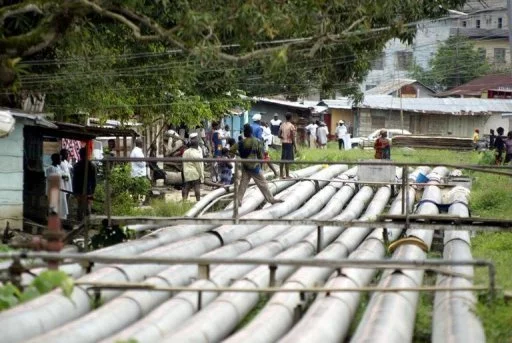
At a period when Nigeria is struggling to meet its revenue target for 2020 national budget, the oil industry which contributes over 70 percent of its revenues lost 22 million barrels in six months or $1.32 billion to crude oil pipeline vandals. That should  be a serious source of concern to not just the stakeholders but the states in the Niger Delta where these criminals operate.

Multinational leading upstream petroleum operator Shell Petroleum Development Company loses about 15,000 barrels per day to oil theft and vandalism.  This amounts to $900,000 or 275 million naira daily to these acts of sabotage.

Aiteo Eastern Exploration and Production, an indigenous player has had to shut down its operations at the Nembe Creek Trunk Line which is responsible for a sizable chunk of crude oil exports due to vandalized pipelines.

For every ruptured pipeline, the affected oil company conducts investigations, deploys boats for inspection, pays for containment and other post spillage activities which cause production downturn as operational targets are not met due to this paralysis. The losses also include environmental pollution, soot which affects the health of human and animal habitants of the communities.

Shell reported 17 oil spills in 2017 and 111 in 2018 replacing 1,160 illegal theft points. In seven years it has had to replace 1,300km out of its 4,000km pipeline network. Most cases of oil spillage are as a result of interference as the oil majors are accused of not carrying their host communities along as partners in development, unlike what happens in other climes which makes their youths vandalize pipelines as a means of protest.

The complicit cycle of corruption has made it possible for the vandals to get crude oil once it is pumped by the oil companies for delivery to the local and foreign markets. Using hacksaws, drillers to make holes and bombs, galvanized pipelines buried underneath are connected to waiting vessels  which will sell the stolen crude to foreign buyers which include refineries.

This criminal activities are also causing Nigeria a negative impression as investors will be wary of committing fresh investments in an environment where their projects are exposed to daily risks.

Poverty is a contributing factor at the heart of vandalism. Due to neglect of the Niger Delta Region whose mineral wealth has been used to develop other parts of the country to the chagrin of its inhabitants, they have taken to crude oil bunkering not minding the negative effects on their immediate environment as well as their existence as a means of survival as refineries, petrochemical plants and other allied industries to create jobs for its youths, state of the art infrastructure are  not in existence.

The Nigerian National Petroleum Development Corporation which operates joint ventures with all the oil companies which operate in the region should do orientation every week on the local TV and radio stations in Ijaw, Urhobo, Itshekiri, Igbo, Ikwerre, Ibibio and other languages spoken by citizens of the Niger Delta states on the dangers of crude oil pipeline vandalization.

Efforts have been made using deep technology to combat this menace. A young Nigerian student Innovator Tayo Sadique from the prestigious Obafemi Awolowo University, Ile-Ife has created a solution Musscomm Spillsat. Spillsat is an oil spill, gas leak and vandalization detection system. It utilizes a balloon satellite to collect aerial data that is processed and used to provide real time analytics to oil and gas companies.

Spillsat should create a mobile and web application for oil and gas operators which will use machine, deep learning and computer vision capabilities in facial recognition for identification and monitoring of  pipeline vandals in real time even under dark cover when carrying out their nefarious activities, reporting the actual amount of barrels per day stolen, environmental impact assessment of the oil spillage or gas leak while integrating the blockchain to track the stolen oil from the point of production to domestic and foreign buyers in order to aid their arrests by officers of the Nigerian Navy and Civil Defense Corps.

The Importance of Early Geotechnical Investigation of a Proposed Site before Development

0

Soil is a living material and the condition, quality, and behavior play a key role in construction projects. All structures, buildings, gas, and chemical plants, harbor, airports,  roads, bridges, dams and even life itself are based on the soil. The soil is the natural foundation that supports all structures and investments. 

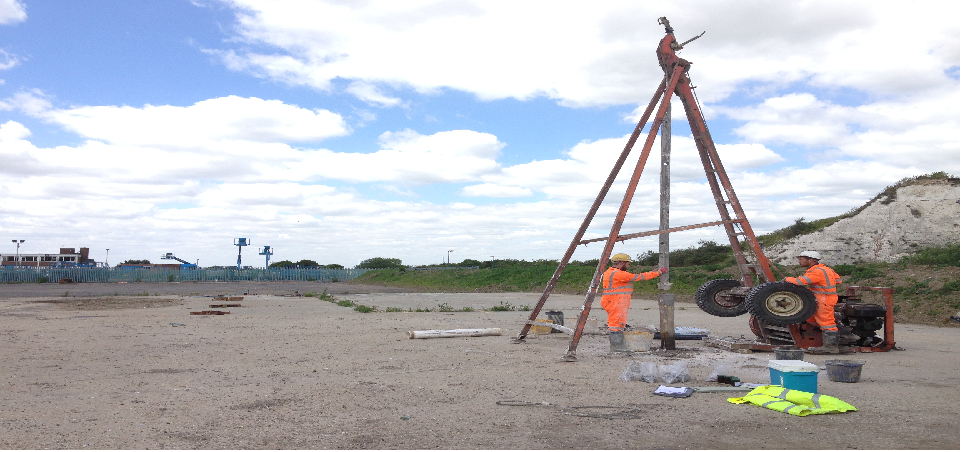
As a result, Geotechnical engineers and Engineering geologists have to perform geotechnical investigations to obtain information on the physical and chemical properties of soil and rock underlying a site to design earthworks and foundations for proposed structures, and for repair of distress to earthworks and structures caused by soil conditions. Geotechnical investigation enables the assessment of the suitability of the soil materials in the site by providing vital data for informed site development decision making and planning.

However, the paradox is that soil is the most important yet most neglected in construction projects in Nigeria. Despite the importance of Geotechnical investigation, for both engineering properties and environmental constituents it is one of the most overlooked parts of the construction planning stages. It is not easy to understand why, but one can speculate that the reason is that asset owners and their consultants want to save money, while the Architects do not want to take liability for the soil conditions of the site.

Again, most clients see soil investigation as a waste of funds despite being the cheapest activity in the construction process, hardly is the cost of soil test up to one percent of the cost of construction. Some contractors too ignore the importance of proper soil investigation and analysis and base their design on assumed bearing capacity and rate of settlement. 

A geotechnical investigation generally includes surface and subsurface appraisal of a site. Occasionally, geophysical methods are used to obtain preliminary qualitative data about sites. Soil Investigation usually involves in-situ testing such as the standard penetration test and cone penetration test. Additionally, site investigation will often include soil sampling and laboratory testing of the retrieved soil samples. Test pits,  trenches, and large diameter borings may also be used to learn about soil conditions at depth for direct visual and manual examination of the soil and rock stratigraphy. The extent of investigation depends on whether the area is built up or not and the size of the structure.

Geotechnical investigation helps geotechnical engineers to correlate varying physical and Engineering properties of soil, which can vary from place to place and from layer to layer even within the limits of the proposed structure. Soil characteristics can change considerably within a small area. Weather, climatic changes, and site management can in the future affect the bearing qualities of the soil if the foundation is not designed properly to the bearing capacity of the soil, then they will fail and so will the structure too. 

An early geotechnical investigation help to determine the bearing capacity of the soil which determine the  soil’s load sustenance capability, helps understand the rate of settlement of the soil which affect the rate at which any structure placed on it settles and stabilise, to select a type and depth of foundation, to select suitable construction technique , to predict and resolve probable foundation problems, to determine if the land can be subjected to subsidence and cause sinking of the building, to determine water table which affects humidity within the foundation and greatly affects the character of a soil which varies considerably with water content, mineral or chemical composition of the soil that might affect the choice of construction materials.

Whatever type of soil one encounters, peat, gravel, clay, silt, sand, or loam soil, understanding the soil properties of a site helps make good construction decisions leading to the success of the project. Therefore,  the structural engineers can efficiently and accurately design the structural elements for the long term viability and soundness of the project. The geotechnical investigation also helps to determine whether there is a need for soil stabilization and the foundation depth to attain the required soil bearing capacity.

In summarising the benefits of geotechnical investigation before any project starts are as follows:

  •  Asset owners and Developers can be informed of potentially problematic soils in the area of their own particular sites. This implies that damage that could be caused by these soils at the inception of the project can be minimized. Thus the associated costs are known from the outset, thus enabling owners and developers to make informed decisions regarding the most appropriate foundation system for the project.
  • In urban development projects there could be the possibility of a group of neighbors owners agreeing to treat a large area of soil on a once-off basis, and sharing the cost of the required treatment process (e.g. the impact rolling of a site located on collapsible soil).
  • In general, early geotechnical investigation reduces maintenance costs, resulting from problematic soils during a project life cycle.

In light of the above, it is clear that asset owners and property developers are taking a huge risk without first performing a rigorous geotechnical investigation of the proposed site.


Allowing Market Forces to Reduce Data Rates In Nigeria using the UK as a Case Study

3

Recently, the Minister for Communications and Digital Economy, Dr Isa Ali Pantami, directed telecommunication companies (otherwise known as telcos) to reduce the price of data plans, improve the quality of service and check illegal deductions of data.

I think the Minister’s action is very commendable but I would have thought it best to allow market forces, through the introduction of new competitive players like MVNOs to assist in achieving the first objective of reducing the price of data plans in Nigeria

Currently, Nigeria has 4 Mobile Network Operators (MNOs) responsible for the provision of communication services. Presently, there is no Mobile Virtual Network Operator (MVNO) existing or operating within the country.

MVNOs differ from MNOs, in the sense that, they do not need a license for spectrum to operate. They either do not need to acquire communication networks or assets. MVNOs purchase communication services (voice or data) from MNOs and then resell to consumers. They could hire customer support, marketing etc. and even operate with their sim. You can think of MNOs as manufacturers, while MVNOs act as wholesalers (middlemen) – simply reselling communication services to consumers.

In most parts of the world, where MVNOs operate, they tend to offer cheaper communication services to consumers, perhaps because their investment in communication networks is light. They also offer consumers the flexibility to choose from different operators.

Using the UK as a case study, Lyca mobile or Lebara, is well known for its cheaper communication services to consumers with lower purchasing power, even though the quality of service may be poor in certain regions. Also, the introduction of Lyca Mobile also means that MNOs like O2 are forced to reduce their services in a bid to attract more customers to their networks and reducing the churn rate.

Additionally, with the advent of 5G, network slicing would allow MNOs to be able to sell slices (dedicated parts of their networks) to enterprises or MVNOs, based on quality of experience, latency, reliability, speed, etc. This means that the Nigeria communication market ought to start preparing for this transition, where MNOs, in the future, could serve simply as manufacturers of communication services while other players market the services directly to consumers. This could equally benefit the MNOs who may be able to reap a quick return on their investments, through a direct focus on manufacturing only.

I therefore would like to conclude that we could achieve lower communication services within the country by incentivising new players (within the industry) to consider acting as MVNOs, which would lead to a fair competition within the market and no doubt, lead to the reduction of communication services offered to consumers.